We are tired of being segregated and humiliated, and are determined to win our freedom.
Martin Luther King Jr., 1955, Montgomery Improvement Association speech
The civil rights movement in the US was a key part of the nation's history. However, it wasn't a single event; it was an ongoing effort. Here are just some of the movement's key events to help you understand how activists changed the fabric of the country's culture and democracy.
The civil rights movement changed the US, not just culturally, but also legally. The movement was shaped by the courts and the landmark rulings that it helped force. The rulings in the 1950s and 1960s helped dismantle segregation, protect voting rights, and expand constitutional freedoms. The decisions helped activists through federal backing when local authorities refused to change.
account_balance
Why These Court Decisions Mattered
Court rulings like Brown v. Board, followed by the Civil Rights Act and Voting Rights Act, attacked segregation and voter suppression at their legal roots. By redefining constitutional protections and empowering federal enforcement, they made it possible to dismantle discriminatory laws that local authorities had defended for decades.
Brown v. Board of Education (1954)
The Brown ruling was a turning point in the fight against segregation. It directly challenged the discriminatory practice of “separate but equal”. The county had to confront the constitutional violations of segregated education since the federal government had sided with the civil rights activists.
The Supreme Court unanimously ruled that school segregation violated the 14th Amendment’s Equal Protection Clause.
The decision overturned Plessy v. Ferguson (1896), the case that had legally justified segregation.
The ruling declared segregated schools “inherently unequal,” providing legal grounds for nationwide desegregation.
Brown energized local and national activists, leading to greater pressure on schools to integrate.
Southern states resisted, prompting further activism, federal involvement, and eventually additional civil rights legislation.
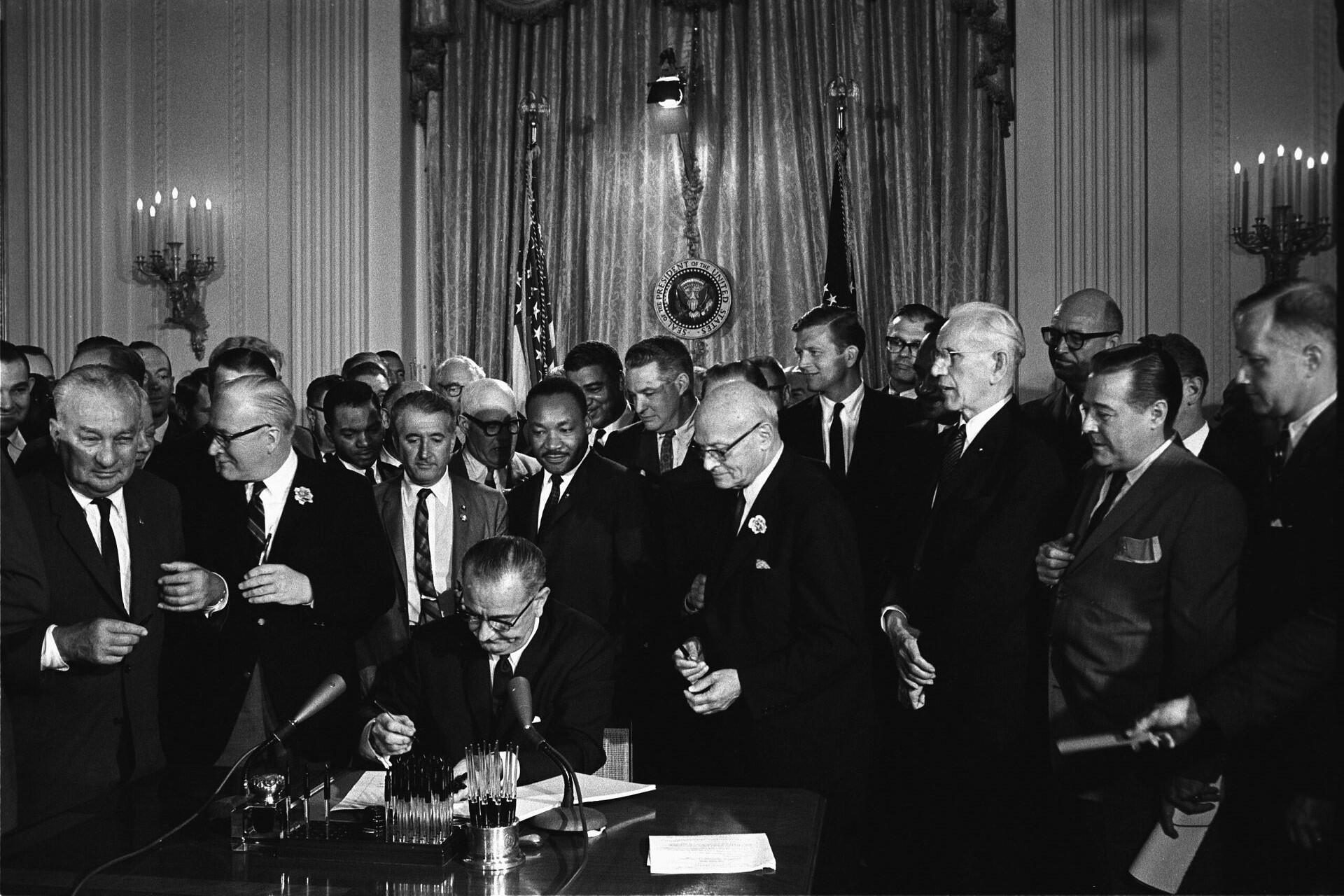
Civil Rights Act of 1964
The Civil Rights Act is, without a doubt, one of the most influential federal laws. It outlawed segregation in public places, banned employment discrimination, and gave the federal government powers to enforce it.
The Act prohibited segregation in public accommodations such as restaurants, hotels, and theaters.
It banned employment discrimination based on race, color, religion, sex, or national origin.
Federal agencies gained the power to enforce desegregation in schools and workplaces.
It strengthened the federal stance on civil rights after years of national protests and violent backlash.
The law dramatically expanded equal access to public spaces, economic opportunity, and political participation.
Voting Rights Act of 1965
The Voting Rights Act targeted the deliberate suppression of Black voting rights in the South. It's one of the most consequential pieces of American civil rights legislation. By shifting the balance of political inequality, it helped create a fairer American democracy.
The Act banned literacy tests, poll taxes, and other tools used to disenfranchise Black voters.
It required federal oversight (preclearance) in jurisdictions with a history of discriminatory voting practices.
Federal examiners could be sent to register voters directly when local officials refused.
Within a few years, voter registration among African Americans rose dramatically in states like Alabama, Mississippi, and Georgia.
The Act empowered the civil rights movement to challenge political inequality and helped reshape American democracy.
Major Protests and Demonstrations
The legal decisions were a key part of the civil rights movement's successes, but they wouldn't have happened without the pressure of public protest. Boycotts, marches, sit-ins, and Freedom Rides forced the nation to look racial inequality square in the eye.
1954
Brown v. Board of Education
Supreme Court rules public school segregation unconstitutional, overturning “separate but equal.”
1955 to 1956
Montgomery Bus Boycott
381-day boycott ends with bus segregation struck down in Browder v. Gayle.
1960
Sit-ins Spread
Student-led sit-ins challenge segregation at lunch counters and energize youth activism.
1961
Freedom Rides
Integrated riders test interstate travel desegregation, facing arrests and violence, prompting federal enforcement.
1963
March on Washington
Roughly 250,000 gather in the capital for jobs and freedom.
1964
Civil Rights Act Signed
Federal law outlaws segregation in public accommodations and employment discrimination.
1965
Selma to Montgomery Marches
National outrage over “Bloody Sunday” helps propel the Voting Rights Act.
1965
Voting Rights Act Signed
Bans literacy tests and brings federal oversight to jurisdictions with a history of discrimination.
insert_link
How Protest and Law Worked Together
Mass protests generated national pressure and visibility, while litigation and federal legislation secured lasting change. Boycotts, marches, sit-ins, and Freedom Rides shifted public opinion and spurred Congress and the courts to act, turning street-level activism into enforceable civil rights.
Montgomery Bus Boycott (1955–1956)
The boycott was one of the earliest and most influential protests during the civil rights movement. It was sparked by Rosa Parks' famed arrest on a bus. It went on to mobilize the Black community in Montgomery. It became a fine example of economic power as a tool for justice while also propelling Martin Luther King Jr. into national leadership for the movement.
Lasted 381 days and relied on carpools, church networks, and mass meetings.
Demonstrated the power of unified economic protest.
Led to the federal ruling Browder v. Gayle, ending bus segregation.
Elevated King and the MIA as key civil rights leaders.
Became a model for later nationwide nonviolent protests.
March on Washington (1963)
I have a dream that one day this nation will rise up and live out the true meaning of its creed, that all men are created equal.
Martin Luther King Jr., 1963
The March on Washington is among the largest and most iconic protests in US history. The march brought together activists, labor organizers, students, and religious leaders. Ultimately, it would probably be best remembered for MLK's "I Have a Dream" speech.
Approximately 250,000 people attended the National Mall.
Martin Luther King Jr.'s speech became a defining moment in US history.
The demonstration increased momentum for the Civil Rights Act of 1964.
Showed unprecedented interracial unity and national support for civil rights.
Established nonviolent mass protest as a legitimate force in policymaking.
Selma to Montgomery Marches (1965)
Marches were integral to the civil rights movement. In the Deep South, marches were often used to influence lawmakers and draw attention to the movement. While these marches were usually peaceful, they would frequently end with peaceful marchers being dealt with aggressively.
“Bloody Sunday” saw state troopers violently attack peaceful marchers on the Edmund Pettus Bridge.
The marches drew national attention via televised footage and press coverage.
A federal court ultimately permitted the final march to proceed safely.
Tens of thousands of supporters joined the movement in Selma.
The events accelerated the passage of the Voting Rights Act of 1965.
Influential Organizations and Leaders
Marches and legal victories helped draw attention to the cause and the injustices present in the US. The civil rights movement was an ongoing operation that needed organizations and leaders. Groups coordinated protests, trained activists, raised funds, and defended people in court. Through collaboration, local struggles became a unified national movement for justice and equality.
Southern Christian Leadership Conference (SCLC)
The SCLC provided the strategic leadership behind many of the movement’s most important campaigns. Rooted in church networks across the South, it brought moral authority, mass mobilization, and nonviolent philosophy to the forefront.
Led by Martin Luther King Jr. and other Black ministers across the South.
Coordinated major protests, including Birmingham (1963) and Selma (1965).
Promoted nonviolent direct action as the primary method of resistance.
Provided crucial training and national visibility for local campaigns.
Worked alongside community leaders to transform local issues into national priorities.
National Association for the Advancement of Colored People (NAACP)
The NAACP was the longest-standing civil rights organization and played a decisive role in the movement's legal strategy. Its attorneys, organizers, and investigators spent decades preparing the groundwork for landmark decisions.
Successfully argued Brown v. Board of Education, ending school segregation.
Maintained chapters nationwide that documented discrimination and provided legal support.
Challenged unjust laws through litigation, appeals, and federal lobbying.
Worked to protect activists from retaliation and violence.
Provided continuity across generations of civil rights advocacy.
Student Nonviolent Coordinating Committee (SNCC)
SNCC brought youth energy, moral clarity, and grassroots organisation to the movement. Its members were among the most courageous activists of the era, often working in the most dangerous regions of the Deep South.
Led sit-ins, Freedom Rides, and voter registration drives.
Emphasized participatory democracy and community empowerment.
Included leaders such as John Lewis, Diane Nash, and Bob Moses.
Played a central role in Freedom Summer (1964) and Selma (1965).
Helped shift national attention to local struggles in Mississippi, Alabama, and Georgia.
Congress of Racial Equality (CORE)
CORE was one of the earliest organizations to embrace nonviolent direct action. It shaped tactics that would later define the entire civil rights movement.
Organized the first Freedom Rides in 1961.
Led early sit-ins challenging segregated public accommodations.
Developed training programs in nonviolent discipline and resistance.
Coordinated with SNCC and SCLC during major campaigns.
Contributed critical strategy, mentorship, and national visibility.
Montgomery Improvement Association (MIA)
Born out of the Montgomery bus incident with Rosa Parks, the MIA transformed a local protest into a powerful model for national activism.
Formed during the Montgomery Bus Boycott to coordinate boycott efforts.
Elected Martin Luther King Jr. as president, launching his national leadership.
Organized carpools, fundraising, and mass meetings to sustain the 381-day boycott.
Pressured the city legally, economically, and socially.
Proved the effectiveness of unified community action.
The “Big Six” Civil Rights Leaders
The movement’s most recognizable national leaders helped connect local struggles to national action and Washington decision-makers. The Big Six included:
Martin Luther King Jr. (SCLC)
John Lewis (SNCC)
A. Philip Randolph (BSCP)
James Farmer (CORE)
Roy Wilkins (NAACP)
Whitney Young (National Urban League)
The civil rights movement, a combination of grassroots activism, legal victories, and moral pressure, reshaped American society. Court decisions, boycotts, and marches all contributed, but the successes were down to the tireless efforts of those involved. The work of activists dismantled discriminatory laws, transformed political participation, expanded constitutional rights, and inspired future justice movements.
Summarize with AI:
Did you like this article?Leave a rating!
5.00 (1 rating(s))
Loading...
Joseph
Joseph is a French and Spanish to English translator, copywriter, and all-round language enthusiast.
The Origins and Significance of Easter: A Comprehensive Exploration Easter is one of the most-celebrated holidays in the world. Every spring, Christians commemorate the holiday with church services, family feasts, and egg hunts. Behind the holiday is a long and storied history, stemming from pagan times before Christianity. Discover how Easter evolved from ancient practices […]
20 Significant Historical Events That Changed the World History is full of pivotal moments, and while there are more moments than we can mention in a simple article, we can still take some time to get familiar with a few of the most important major historical events. Discover what events in US and world history […]
Women's Suffrage Movement in the US: When Was Women’s Suffrage? Challenging long-held rules and demanding fairness required steady determination and clear purpose. The women who fought for voting rights in the United States showed those traits through years of hard work and sacrifice. Their determination helped reshape the country and reminds others that steady effort […]
How to Elect a New Pope: Everything You Need to Know About the Conclave With the death of Pope Francis, spiritual leader of the Catholic Church for more than a decade, a crucial new phase opens for the Catholic world. May 7th, the conclave, the age-old rite through which the Church elects the new Bishop […]
What You’ll Learn in High School History Classes History is one of the most expansive subjects taught in high school. There are many lenses through which to view history; from US history, to European history, to world history, there are always new things to learn. What can a typical American high school student expect to […]
Important Events in American History That Changed Our Society When discussing pivotal moments in American history, the timeline tends to include lots of events from the early years of the country’s birth: the Revolutionary War and the signing of the Declaration of Independence in 1776, the Civil War, and Westward expansion, just to name a […]
What Were the Greatest Empires in History? If you spend ten minutes looking through history, you’ll certainly notice that this word ‘empire’ comes up an awful lot: the Roman Empire, the British Empire, etc. But what exactly do we mean when we say this? And which were the greatest empires in history by size and […]
America Votes: How to Participate in the American System of Voting Get ready for the Presidential election! Voting is a cornerstone of democracy, allowing citizens to have a say in their government’s direction and leadership. In the United States, the process of voting, especially in presidential elections, can seem complex, but understanding it is key […]
Roots of Soul Music in the States Soul music is a genre of African-American popular music that caused the birth of many other genres, from dance music and hip hop to contemporary R&B and funk. Emerged in America in the 1950s, soul music hailed from African-American church music known as "Gospel Music." White American churches […]
June 28 2022 ∙ 6 minutes to read
Summarize with AI:
Frequently asked questions
🌎 What are some of the most influential civil rights events?
The Montgomery Bus Boycott (1955–1956)
The March on Washington for Jobs and Freedom (1963)






 Loading...