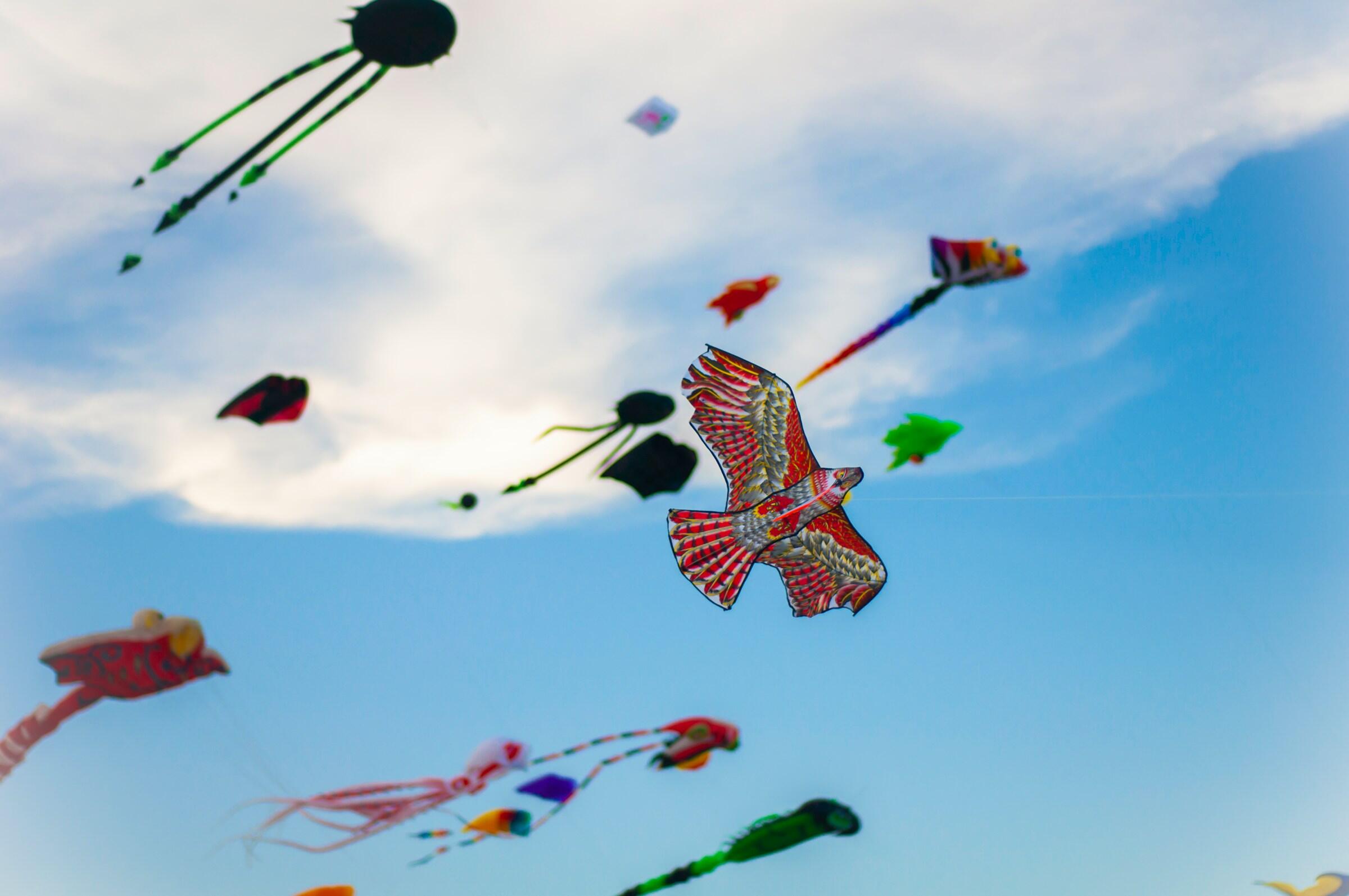

Today, South Korea is a unified country with cutting-edge technology and loads of entertainment options. Still, come time to welcome the new year, they return to traditional Korean games invented hundreds of years ago. These 'pastimes' weren't only about having fun; they were physical and strategic challenges to keep (mostly the men) fighting fit. Through the dynasties and across kingdoms, these are the games people played.
| 🎲Game | 🔊What it sounds like | 🔢How many players | 📖How to play |
|---|---|---|---|
| Yutnori 윷놀이 | At least 2 | Roll the yut stick to determine the order of play. Players take turns moving their pieces around the board. The aim is for players to get all their pieces home. | |
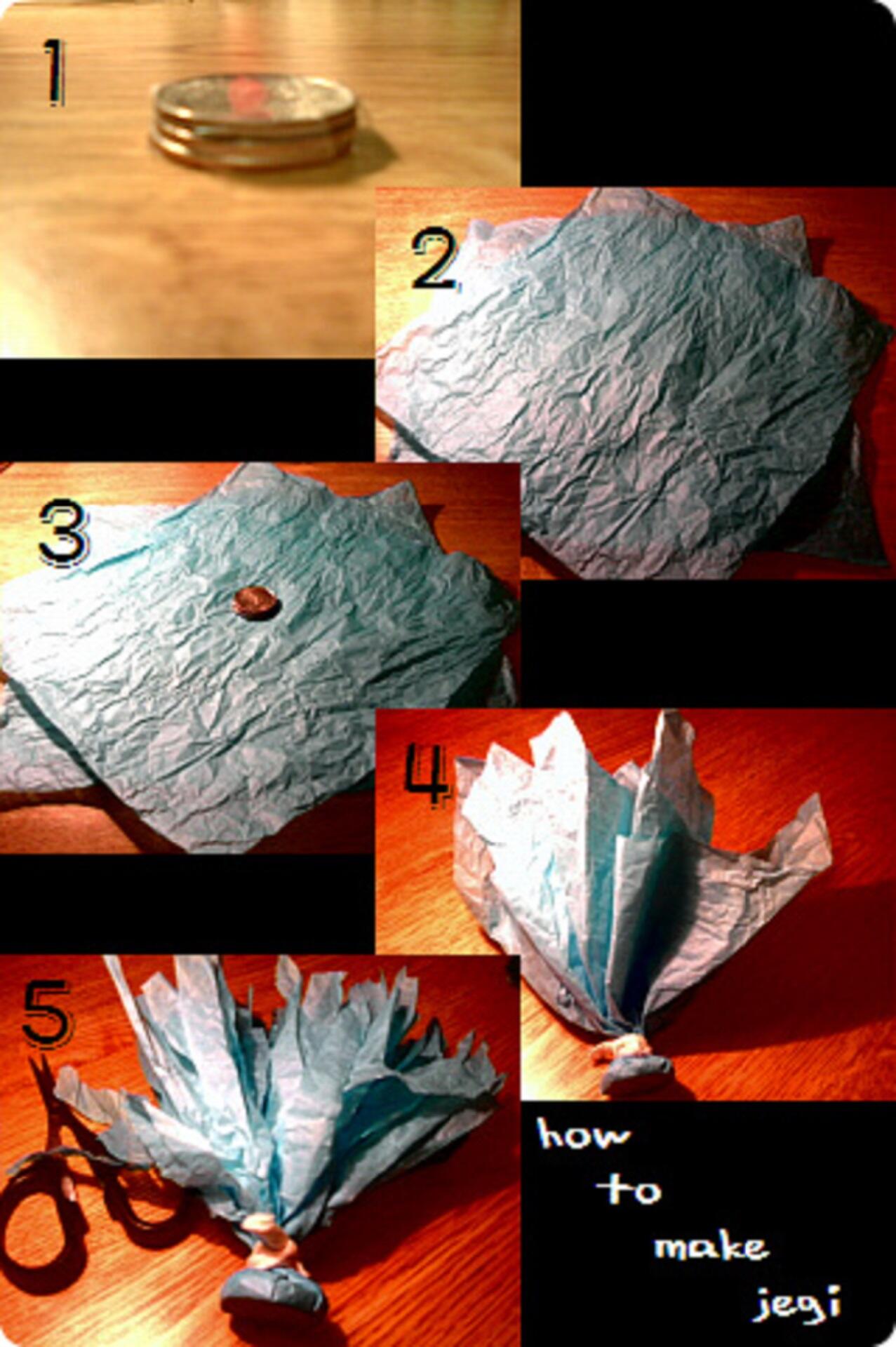
| Jegichagi 제기차기 | You can play by yourself but it's more fun with others! | Drop the jegi onto your foot. Continue kicking it upwards to keep it aloft. | |
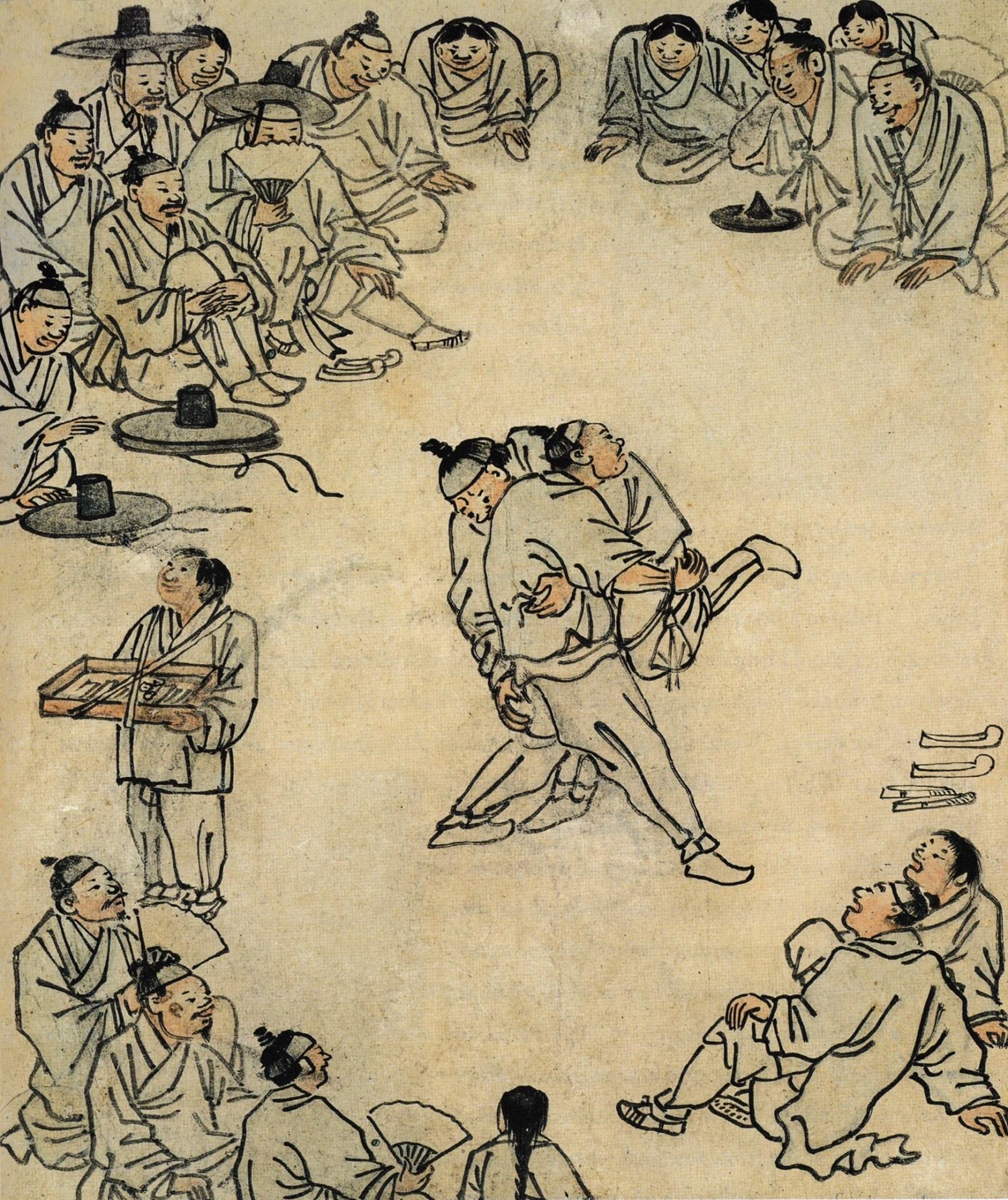
| Ssireum 씨름 | 2 | Each player wraps a belt around their waist and thigh. The players attempt to destabilize each other. Whoever touches the ground first loses. | |
| Neolttwigi 널뛰기 | 2 | Two players stand on either end of the low seesaw. One jumps to launch the other in the air. When they land, the other player is sent upwards. | |
| Tuho 투호 | 2 teams | Both teams stand the same distance from the pot. Each team tries to land the most arrows in the pot. | |
| Yeon nalrigi (kite flying) 연 날리기 | You can do it by yourself but it's more fun with others! | Mark your kite with all the bad sentiments and events you wish to cast aside. Launch it and let it fly as high as possible. Cut the string to cut your losses; start the New Year fresh! |


Yutnori (윷놀이)
This is one of Korea's oldest games, thought to hail from the ancient Kingdom of Buyeo (ca. the 2nd century Before the Current Era [BCE] to 494 of the CE). On today's maps, that region lies north of even North Korea, well into Russian territory.
Historically, China had a major impact on all the surrounding areas' peoples; Koreans were no exception.
Some historians draw parallels between a certain Chinese game and yutnori. However, Korean documents and artwork place this game's creation squarely on the Korean people.
How to Play Yutnori
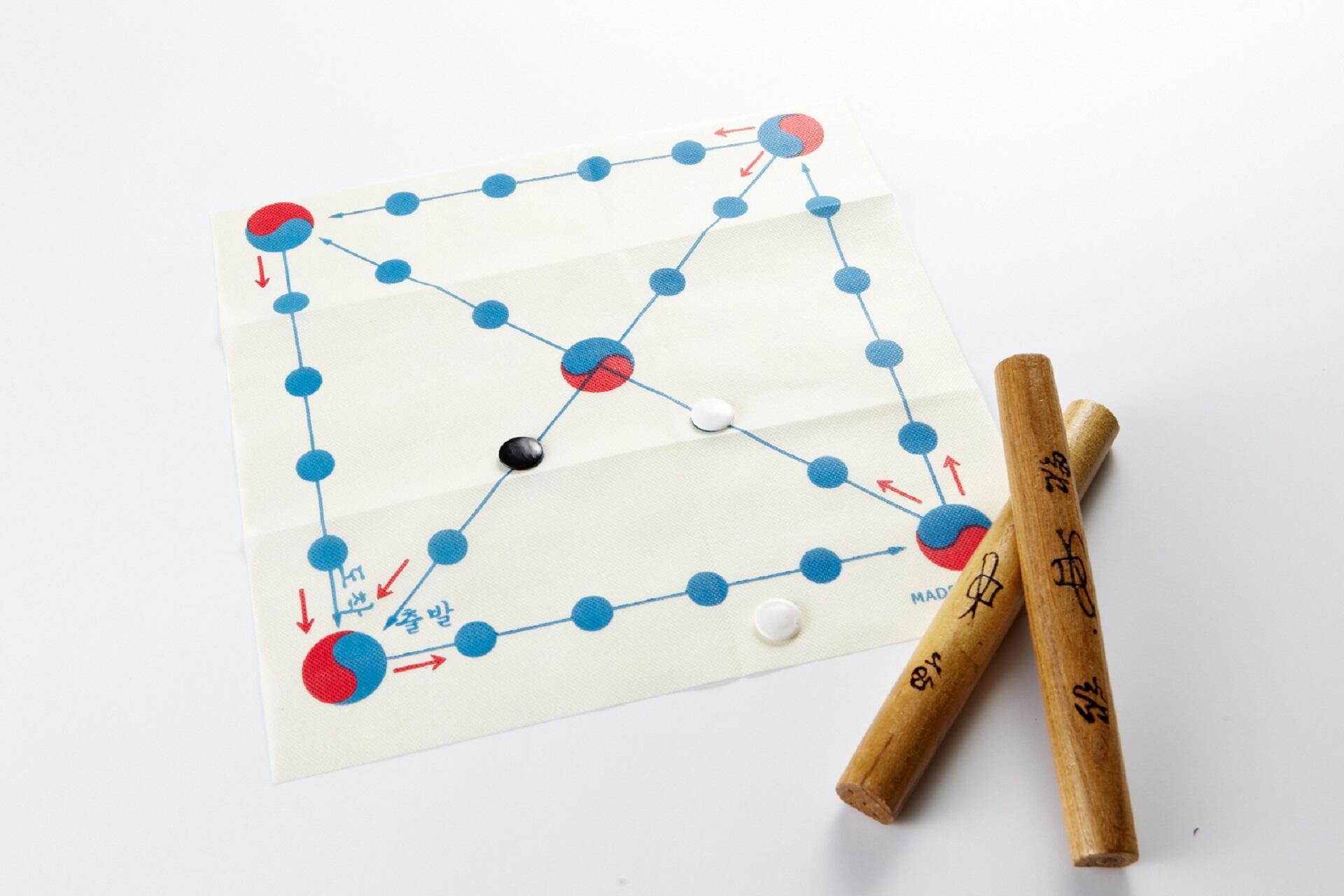
First, you must have a play set. You can buy one but making your own will be far more satisfying1. The board (말판 - malpan) is simple to construct; for a more authentic feel, make it out of cloth. You'll also need tokens (말 - mal) for players to move across the board (coins work a treat!). You might struggle a bit to make yut sticks, though.
They should be around 6in long, and 1in in diameter.
Shape-wise, they should be flat on one side and rounded on the other.
To start your game, you and your opponent cast the yut sticks. Whichever team arrives at the highest number goes first (alternately, you can settle the question with a round of Rock, Paper, Scissors).
The object of the game is for each player to move their mal around the board and back home. Casting the yut sticks determines how many places each piece moves. This chart details their particulars.
| 📛Configuration name | 💢Configuration | 🔢Value |
|---|---|---|
| do - 도 | 3 flat side down, 1 flat side up | move 1 space |
| gae - 개 | 2 down, 2 up | move 2 spaces |
| geol - 걸 | 1 down, 3 up | move 3 spaces |
| yut - 윷 | 4 up | move 4 spaces |
| mo - 모 | 4 down | move 5 spaces |
| backdo - 백도 | one yut with a particular marking is facedown while the others face up (similar to 'do', but for the marking) | move back 1 space |
| nak - 낙 | when a yut lands outside the casting area (yut mat). | player forfeits their turn |
If you happen to cast a yut or mo, you get to cast again, even repeatedly, if yut or mo are all you ever cast. However, you may not split your move between pieces; you must wait for your next turn to advance another piece.
Getting to know the language of Seollal - the greetings, the foods, and the game names, is one of the best ways to embrace all aspects of Korea's New Year celebrations. So, once you make (or buy) your yutnori game, you can master the Korean names for the pieces, moves, and strategies.
Jegichagi (제기차기)
Have you ever played hacky sack? Jegichagi is quite similar, and it ranks among popular Korean New Year activities. But it isn't just for New Years. After all, jegichagi made it into the ever-popular Squid Game.
Still, you'll find a couple of differences between hacky sack and jegichagi.
Jegichagi
- The jegi has a tail
- It has a solid core
- A relatively small striking area
- The jegi is rather light (10gr)
Hacky sack
- The sack is a small beanbag
- It's somewhat bouncy
- It has a rather large diameter
- The hacky sack has heft (between 30-80gr)
Otherwise, the rules are about the same. A group of players stand in a circle and everyone strives to keep the hacky sack/jegi aloft. In a one-on-one contest, the player who keeps the hacky sack/jegi aloft for the greatest number of kicks wins.
In a group game, the player who allows the jegi to fall loses.
He must then toss it to the winner, who may kick it as they wish.
How Jegichagi Began
Like so much else, jegichagi is thought to grow out of a Chinese game called cuju. It is the oldest kicking game in recorded history, the forerunner of our beloved football.
As the legend goes, the Silla general Kim Yu-sin 'accidentally' stepped on (and ripped off) a part of the future king's garment during a game of jegichagi.
He then ordered his sister to sew the ribbons back together, which ultimately led to her marriage to the future king. That king, Muyeol of Silla, gets credit for uniting the Three Kingdoms.
So, it's no surprise that the game he was presumably associated with would feature among the Korean New Year activities. However, on a more practical note, jegichagi is also associated with ancient martial arts training and endurance contests.
Picture the scene: the kids, flush from their jegichagi adventures, rush home in time to enjoy all the yummy traditional Korean foods their families made for Korean New Year. After that, a nice bath, and they're in for the sleep of the righteous!
Ssireum (씨름)
In January 2017, ssireum became Korea's 131st Intangible Cultural Heritage entry, following a remarkable joint petition from North and South Korea.
It's often said that it's the everyday people, not the leadership - aristocracy or royalty, that defend a people's culture2.
Never has that been better proven than with ssireum, tops among traditional Korean games.
Throughout Korean history, people routinely held ssireum competitions, particularly on holidays. Like jegichagi, what started as a military exercise became a national sport. In fact, the first modern ssireum competition took place in 1912, in Seoul's Dansungsa Theatre.
This wrestling activity involves two participants, each of whom winds a long belt (샅바 - satba) around their waist and thigh.
The opponents will then attempt to destabilise one another using the satba. The first player to touch the ground (with any body part from the knees up) loses.
Neolttwigi (널뛰기)
If you've ever watched Korean historical dramas, you might have laughed at women, dressed in graceful hanbok, jumping up and down to look over the walls surrounding their compounds.
That trope has its roots in fact. For such a long time, (typically, aristocratic) women were restricted to their home, forbidden from so much as walking through a market. Craving contact with the world beyond their walls, they devised a way to spring into the air. This allowed them quick glimpes at the rest of the world.
Two more reasons exist for this 'game':
So women could see their imprisoned husbands.
To get some exercise, as women were typically denied vigorous activity.
You might try this more physically demanding seesaw game at your local Korean culture center's Seollal event. As you jump, try counting off the Korean zodiac animals. It will help you remember their order. Give yourself bonus points if you know their Korean names!
Tuho (투호)
Once again, the Korean people put their twist on an ancient Chinese activity.
Records show Chinese soldiers playing touhu, their name for this pastime, as far back as the Warring States period (from around 475 to 221 BCE).
Tuho makes its appearance in the Korean annals during the Goryeo period (918 - 1392). The activity was alternately banned and unbanned, according to successive kings' whims.
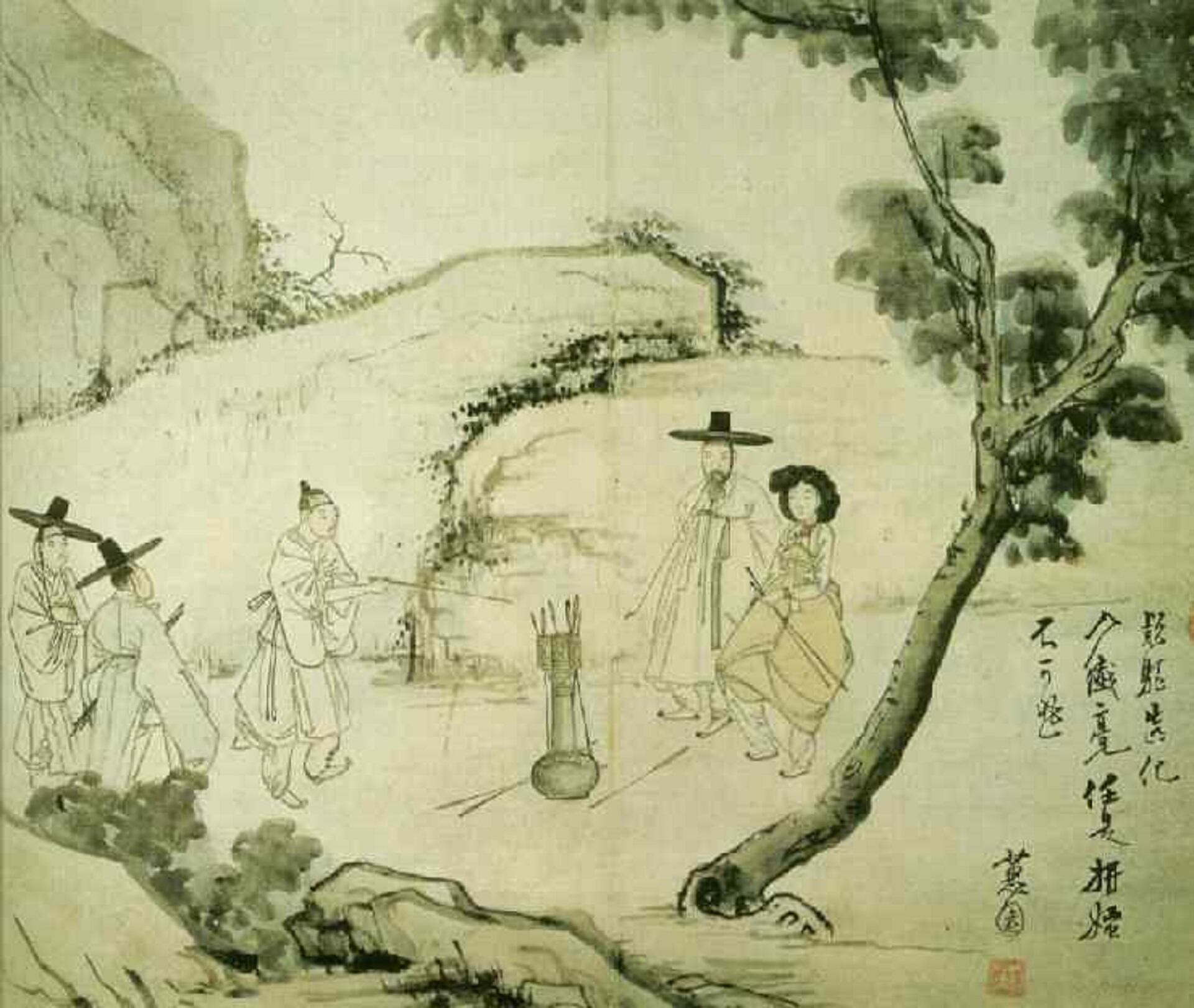
The Joseon Dynasty saw the sport revived as a Confucian activity, which King Junggong affirmed. Soon, tuho went from being a popular court pastime to entertaining the rest of the Korean population.
With the royal seal of approval, academics who formerly dismissed the activity as frivolous embraced it as a way to develop mental focus and physical health.
How to Play Tuho
You need a long-necked pot, some blunt-tipped 'arrows', and an opposing team. With the pot at the center, you and your opponents should take about 10 paces backwards, so you're the same distance away. You then take turns tossing your arrows towards the pot. Whichever team sinks the most arrows wins.
Mark your arrows with different coloured bands for each team to help keep the scoring straight.
Kite Flying (연날리기)
It should come as no surprise that kites are a Chinese invention. After all, China invented the paper-making process and the Chinese were long masters of silk weaving.
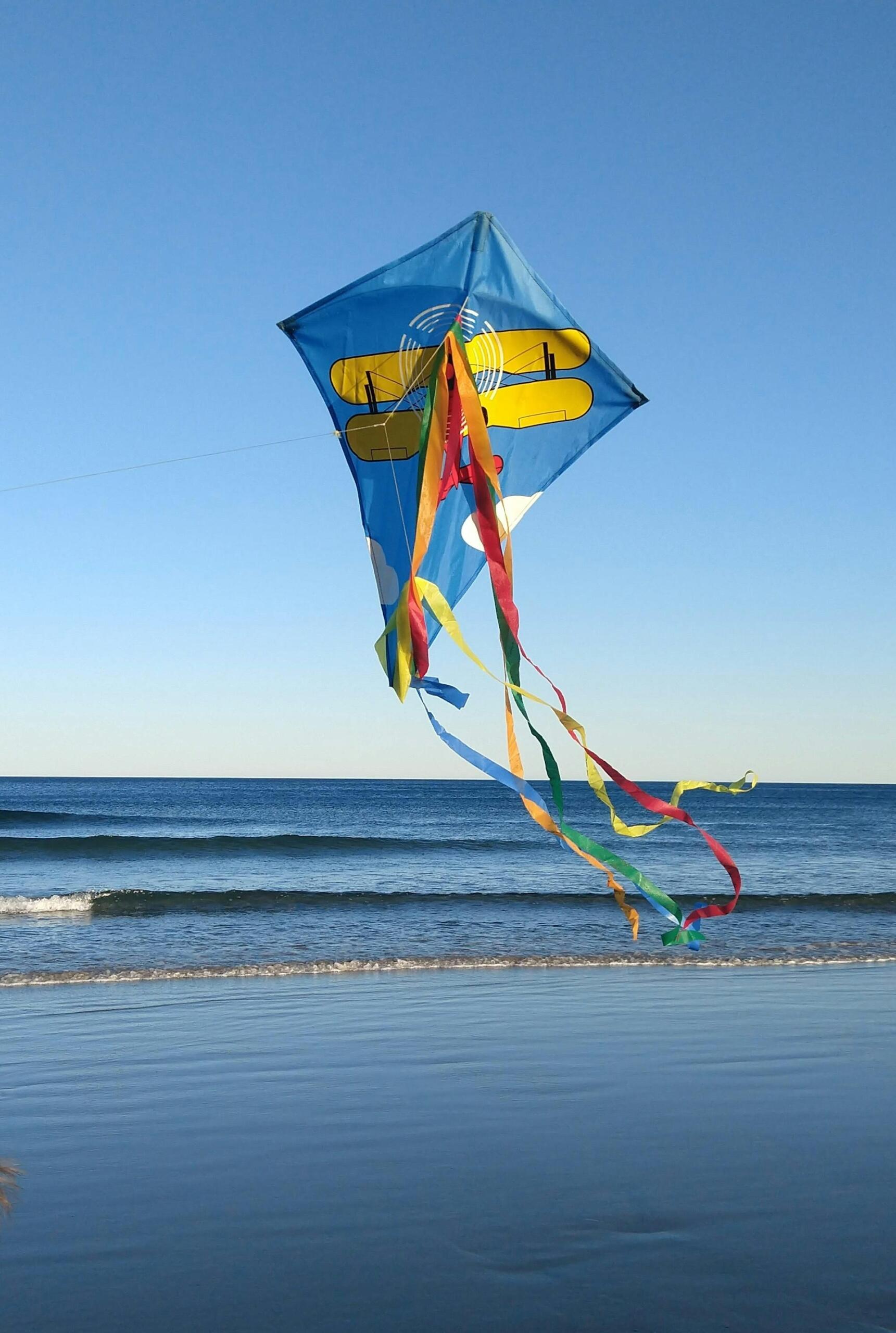
Yet again, Koreans borrowed from their influential neighbor and made what it borrowed their own.
Now, we all know how much fun - how peaceful and relaxing - flying a kite can be. It also takes a measure of skill to keep those delicate flying collages aloft.
Rather like the skill it takes to manage the good and bad life throws at you. Korean culture offers you a way to balance the books, as it were, when the New Year rolls around.
Simply write your bad feelings and experiences on your kite and send them flying.
Once it's at a respectable altitude, cut the cord and let all that negativity go.
The Chinese practice of casting lanterns aloft at New Year is similar to Korean kite flying. However, the Chinese Lantern Festival involves casting wishes into the heavens, not letting go of bad things.
Kite flying is a lovely tradition; an integral part of every Korean New Year celebration. Often, families will make kites together ahead of the big launch. Or they travel together to an ideal kite-flying spot, laughing and playing all the way. Cutting the kite's string may let go of your bad luck, but the activity binds you ever closer to your loved ones.
References
- Instructables. “Yut Nori Game.” Instructables, 2 Dec. 2017, www.instructables.com/Yut-Nori-Game/. Accessed 20 Dec. 2025.
- Korean, Buddies. “Complete Guide to 5 Traditional Korean Games | KoreanBuddies.” Koreanbuddies.com, 2025, www.koreanbuddies.com/shopping-guides/traditional-korean-games. Accessed 20 Dec. 2025.
Summarize with AI:
Enjoyed this article? Leave a rating!

 Loading...