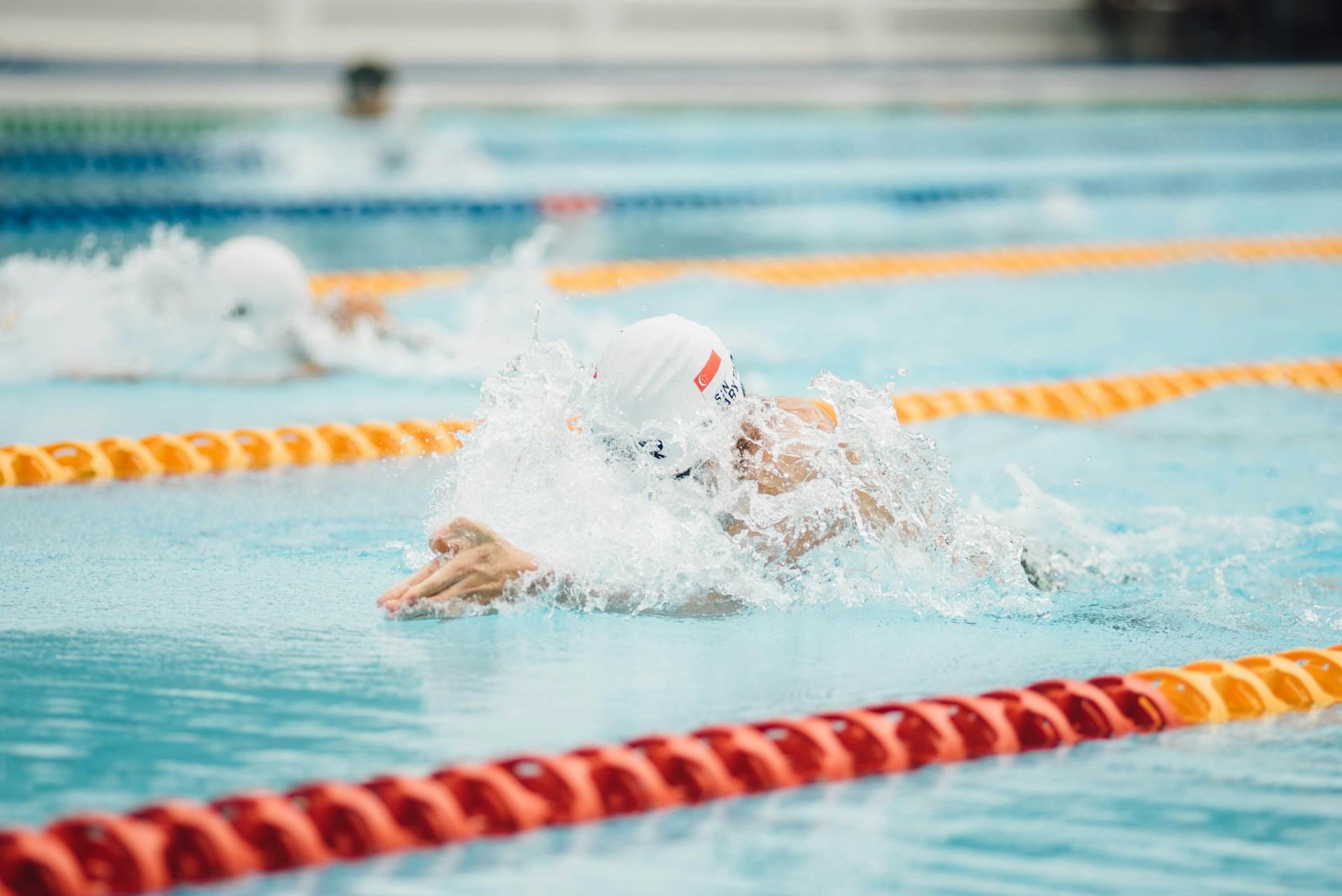

For a lot of people who aren’t strong swimmers, breaststroke is the savior. Knowing how to swim breaststroke is easier and slower than a lot of the other types of swimming strokes, which means that a lot of people learn this stroke first and foremost and are able to get a very basic knowledge of the stroke mastered.
The breaststroke technique is amazing for beginners due to the fact that it does not interfere too much with breathing techniques. When kids start having their lessons, they will probably be swimming breaststroke first of all!
As well as being simple to learn the basics, the breaststroke is also one of the more challenging strokes when you get to the elite level. This is not to be mistaken for some beginner swimming stroke, it is tough and requires excellent rhythm, timing, and endurance if you are going to do this for a long time.


What Is the Breaststroke?
This could well be the oldest formalized swimming stroke, taught for thousands of years. Ancient people in Egypt may have used a stroke that looked like the breaststroke, and we can see pictures of this in old cave drawings. These early swimmers moved their arms and legs in a way that pushed them through the water like frogs, something that has also been reported in literature. If it wasn’t specifically the breaststroke as we know it, it was something similar.
The breaststroke is thus called because the breast stays in the same position and the swimmer pushes from their breast. The laws of swimming dictate that swimming breaststroke involves the body being “on the breast”.
Swimming rules made by the FINA are abbreviated to "SW" for each specific rule.
"From the beginning of the first arm stroke after the start and after each turn, the body shall be on the breast. It is not permitted to roll onto the back at any time. From the start and throughout the race the stroke cycle must be one arm stroke and one leg kick in that order. All movements of the arms shall be simultaneous and on the same horizontal plane without alternating movement."
Breaststroke at the Olympics
The breaststroke has been an Olympic sport for over 100 years, since 1904, but it has been through an evolution in that time. In the 1950s, a modification led to some swimmers trying to swim long distances underwater, which led to disqualification for many of those trying to bend the rules.

Japanese swimmer Masaru Furukawa did manage to bend the rule by not surfacing at all after the start, but swimming a lot of the early stage of the race underwater. He managed to win the gold medal, spending more than half of the time underwater, leading to further rule tweaks.
The 100 m breaststroke and 200 m breaststroke are currently Olympic events for both men and women. In 2016 and 2020, Adam Peaty from the UK won the men’s 100 m. Historically, North American countries as well as Asian and European countries have produced the strongest breaststroke swimmers at the Olympic games.
Peaty also set the world record, currently 56.88 seconds in the 100 m. Compare this to the world record of the front crawl at 46.80 seconds and you will see that this is a slower stroke in general.
In the women's breaststroke, Lilly King has been one of the most successful and record-breaking swimmers of recent times with a time of 1:04.13.
Learn to Swim Using the Breastsroke
A lot of people learn to swim using the breaststroke. This makes perfect sense when you consider the nature of the stroke. Just from watching somebody who is using the breaststroke form you can see the following:
- Ease of breathing: The breaststroke allows for a natural and comfortable breathing pattern, with the head coming out of the water regularly. This makes it easier for beginners to coordinate their breathing with their strokes, similar to the backstroke where the swimmer does not need to worry about breathing patterns too much.
- Visibility: In this stroke, swimmers can keep their heads above water more frequently, they can see where they are going, which is reassuring for beginners.
- Safety and comfort: The slower pace of the breaststroke and the ability to keep the head above water provide a sense of safety and can reduce anxiety for new swimmers.
Initially, when learning to swim, a lot of us are very anxious about things like breathing and just being in the water. This is the ideal swimming technique for people to gain some confidence and see how they feel, before potentially moving on and gaining other swimming strokes in their repertoire.
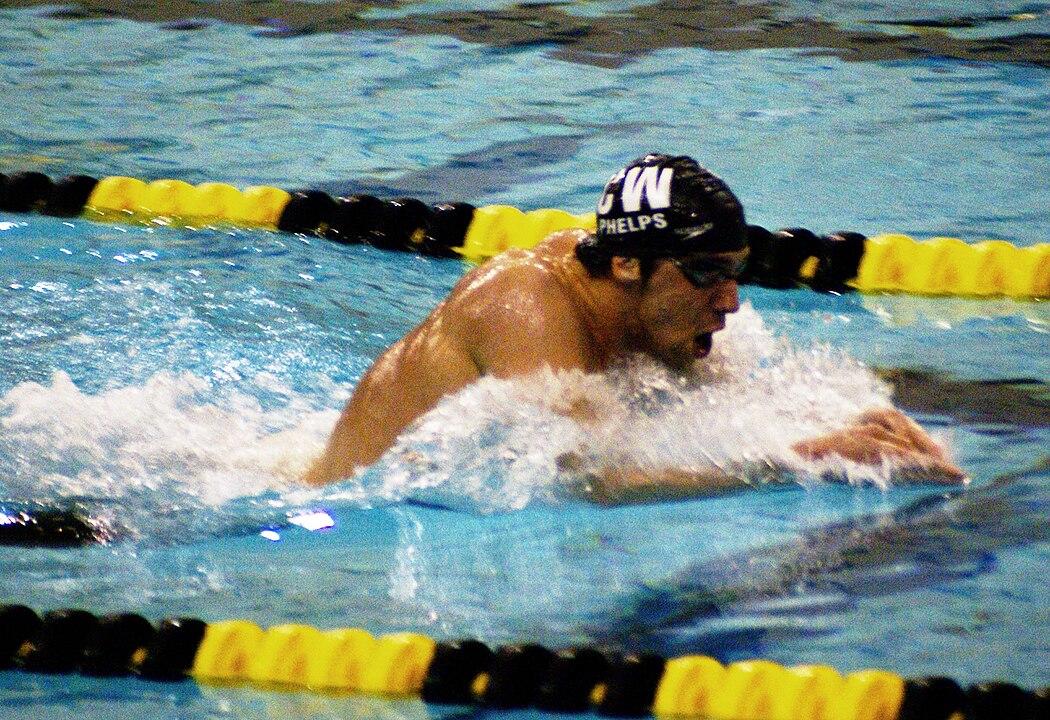
It is seen as one of the more “gentle” swimming strokes. While this is not the case at the competitive level, it is true that this stroke can be used by swimmers who want to take a more gentle approach, such as swimming in the pool while on vacation.
Step-by-Step Breaststroke Technique
So how does the technique actually work, and what is the proper form for breaststroke?
- The swimmer's body is kept as flat as possible in the water, with the face down except when breathing.
- The arms move in a circular motion. Starting with the arms extended forward, they sweep outwards, then downwards and inwards towards the chest, and then return to the starting position.
- The legs perform a frog kick. From a streamlined position, the feet are brought up towards the buttocks, the knees are slightly apart, and the feet then kick outwards and backward in a circular motion, coming back together to push the body forward. This is the main way the swimmer is propelled.
- Breathing is done in timing with the arm stroke. The swimmer lifts their head above water during the in-sweep phase of the arm stroke to inhale and then exhales underwater as the arms extend forward.
These techniques will provide enough simple propulsion. Unlike some of the other techniques, it is the kick that provides most of the power in this technique.
How to Swim Breastroke at a Higher Level – Advanced Tips
Perhaps you are well past a beginner, and you want to get your advanced breast stroke technique nailed and even swim competitively.
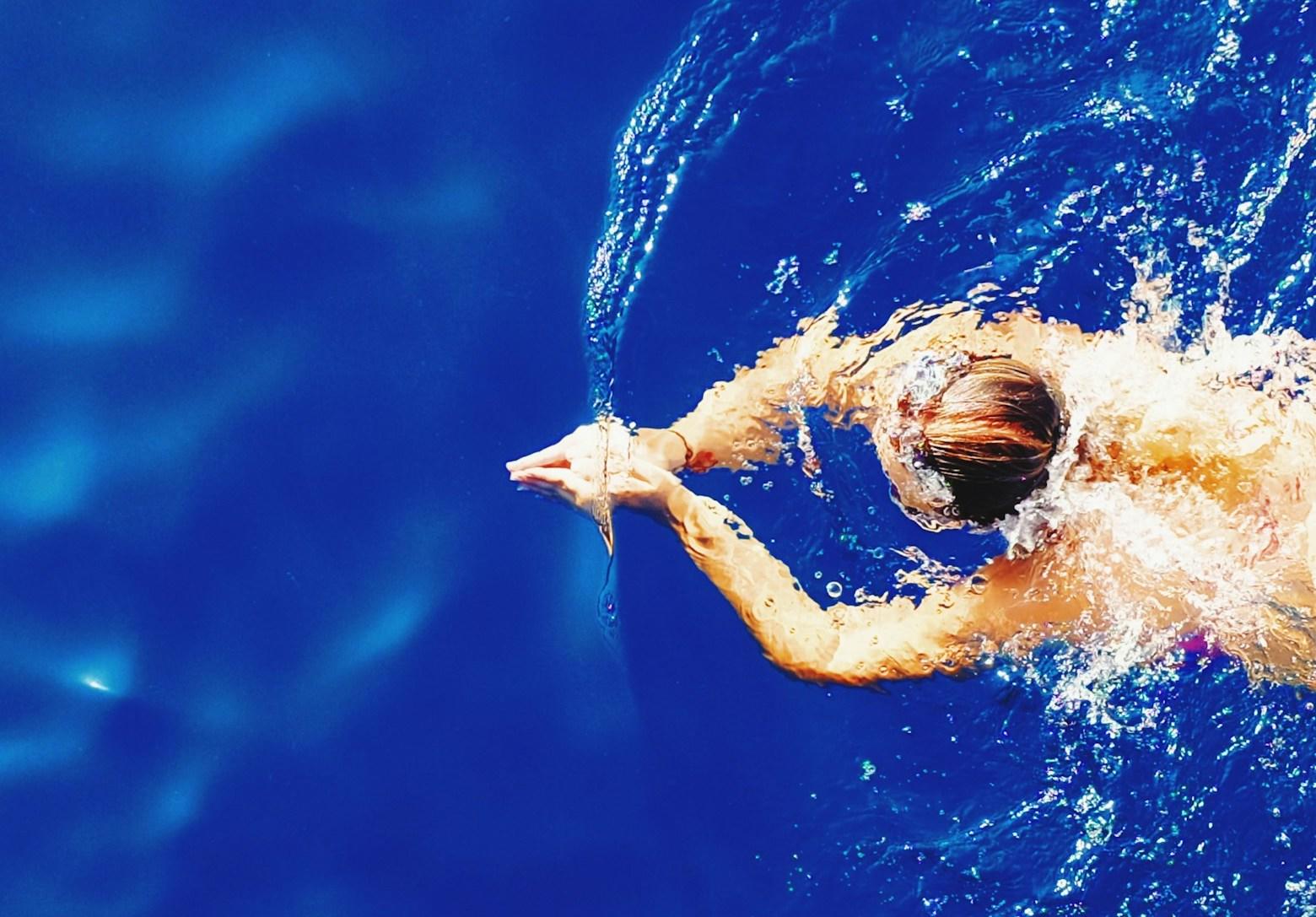
Here are some advanced tips to help you with your breaststroke and become as strong a swimmer as possible:
- Work on your body position: Maintain a streamlined position by keeping your body as flat as possible in the water. Reduce drag by aligning your head, hips, and feet. Try hard to avoid excessive up-and-down movement. You should try to aim for smooth, horizontal motions through the water as you glide forward. Body position is crucial for all strokes including butterfly and front crawl.
- Try to improve your arm pull: Though a lot of the propulsion comes from the kick, try to perfect the pull with your hands slightly wider than shoulder-width apart. Sweep your hands outwards, then downwards and inwards, forming a heart shape. Keep your elbows high in the water and close to the surface during the pull phase, this will provide more power and propulsion.
- Work on the kick: Perform a powerful, whip-like kick by bringing your heels up towards your buttocks, then kicking outwards and backwards in a circular motion. You can work on your general fitness to improve this power, and never skip leg day in the gym!
- Improve your rhythm: Try to get yourself in a groove with a smooth, continuous rhythm by coordinating your arm pull, breath, kick, and glide.
- Get your breathing right: Breathe quickly and efficiently during the in sweep phase of the arm stroke. Lift your head just enough to take a breath without disturbing your body position. Exhale fully underwater before taking your next breath to maintain a relaxed and efficient breathing pattern. This can take some time to get right.
- Build your strength: This can be done outside of the pool as well as inside. Perform core-strengthening exercises outside the pool, such as planks and leg raises, to build a strong foundation for your swimming.
If you want to get as fast as you can possibly be and maybe even take on other swimmers in competitions, it can take many years to get the rhythm of the breaststroke technique and build the proper breaststroke form. The above tips will help you to do exactly that.
Working with a Superprof Tutor to Improve Your Technique
Without the help of a tutor, you can only improve so much. You need to properly explore your technique and work on analyzing your swimming if you are going to get better.
The breaststroke can be a good option for those getting started with swimming, but to do it at an advanced level requires a lot of skill, which is where tuition and coaching can be extremely helpful. Working with a Superprof tutor to improve your skills and gain personalized feedback can be utterly crucial and help you to work on the areas you need to perfect.
Coaches and swimming tutors can be found with Superprof, who will be able to help you to build your confidence and get to the next level. Reach out to a tutor on Superprof today and start your journey to a better breaststroke!
Summarize with AI:
Did you like this article? Leave a rating!

 Loading...