


The world of poetry can be complex and overwhelming, yet it offers great insight, raw emotion, and rich imagery. One way poetry shines is through the use of poetic techniques and devices, which can help a poem stand out, draw the reader into its imagery, and convey its true meaning. Aspiring poets should read plenty, familiarize themselves with various devices, and learn when to use them to their advantage. This article explores the impact of poetic techniques and highlights some common devices poets encounter. Following this, we will consider how, as a student, you may approach analyzing poetry (whether your own or others).


What Techniques Are Used in a Poem?
A poem can feature a wide variety of literary or poetic devices and techniques, as ultimately such techniques build upon each other and work together to help bring a poem to life and make the scene the poem is portraying more vivid to the reader or listener. As such, a variety of factors come into play when utilising poetic techniques, and poets need to think about the overall impact a poem may have.
Whether you decide to use rhyme, personification, or a particular mood or setting for your poem, poetic devices can help make your poem come alive, and can even help inform how you structure your poem. For example, you could decide to structure your poem with stanzas, although there’s no obligation to if you would rather not. A stanza helps to divide a poem by grouping together two or more lines together that usually have a similar metrical form or rhyme, although they don’t have to share this feature. Just as paragraphs are used in literature to group ideas together, stanzas perform a similar function in the world of poetry.
Another question that many poets ask themselves today is whether or not it’s worth incorporating rhyme, iambic pentameter, or rhyming words into a poem. Although older poems may rhyme more frequently than newer, more contemporary poems, ultimately the choice of whether to use rhyme depends on your own preferences towards rhyme as a poet. Don't worry if it doesn't click right away it's all part of learning how to write poetry.
If you do decide to incorporate rhyme into your poem to improve the rhythm of the poem, then you could look to use a poetic technique such as rhyming couplets. A rhyming couplet features two lines of equal length that rhyme. Shakespeare’s sonnets often featured rhyming couplets, if you’re looking for good examples to learn from. Ultimately, the decision of which poetic techniques are best to use is very personal, and will likely change on a poem-by-poem basis. With that in mind, some common poetic devices have been defined and highlighted below to give you some inspiration on which poetic devices and literary terms to include in your next piece of work.
What Are Poetic Devices?
Poetic devices are used throughout various types and styles of poems to increase the poem’s effect on the reader or listener and to help make the poem more memorable overall.
This term refers to anything used by a poet to enhance the literal meaning of their poem. This could mean using rhythm and sound to pull the reader into the world of the poem or adding figurative meaning to their literal words.
As a result, poetic devices can really enhance a poetic work, regardless of the type of poem written, including:
- Sonnets;
- Limericks;
- Narrative poems;
- Haikus; and
- Free verse poems.
Poetic devices can really be the best friend of any poet, including established poets and poets who are just starting out. So, learning them should be among an aspiring poet’s top priorities when they’re just starting to write. Learning about the various techniques is just part of writing poetry as a beginner; being able to use it effectively is the next step!
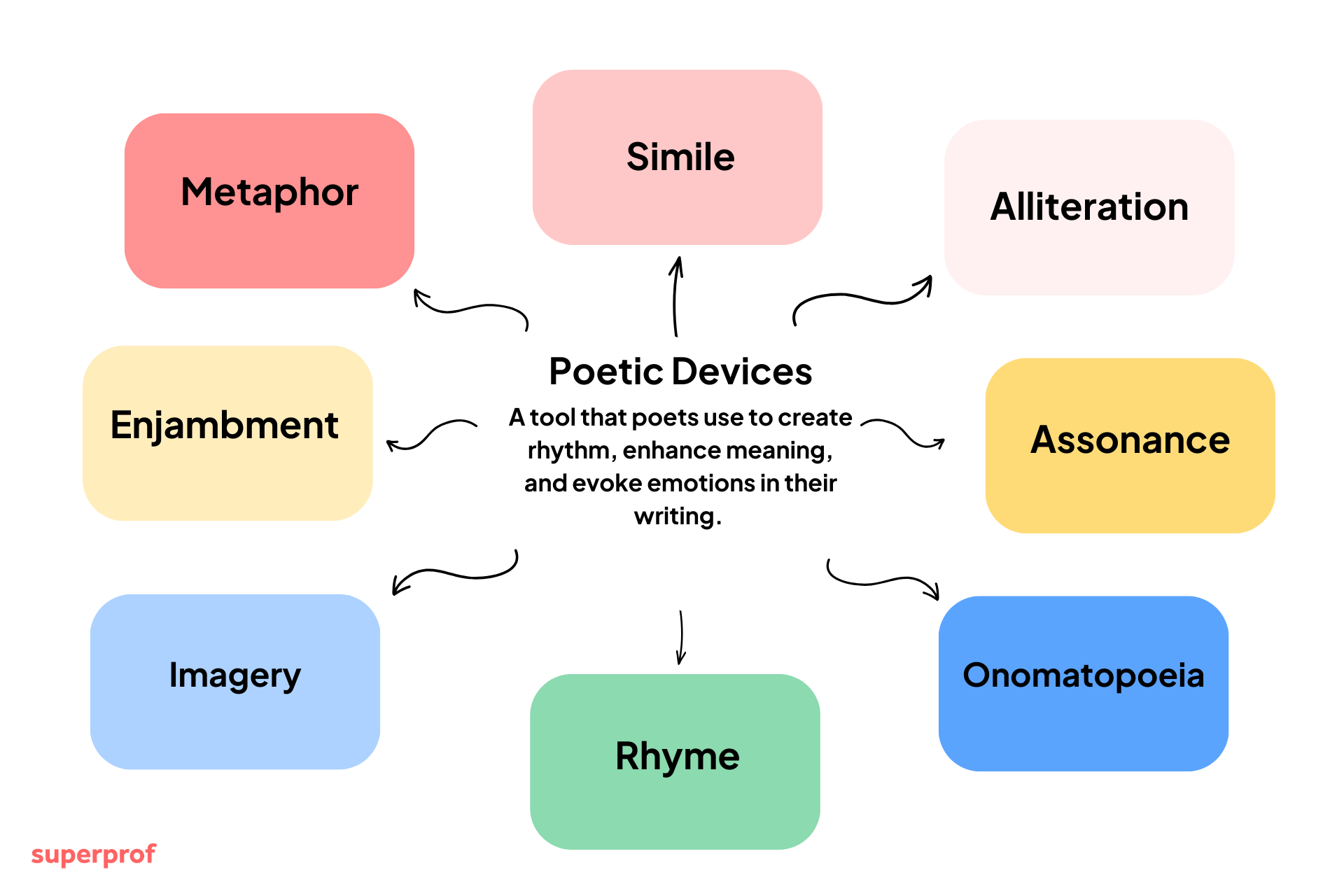
Effects that Enrich the Imagery of a Poem
There are plenty of different ways you can conjure an image in your reader's mind. Let's first take a look at what exactly an image is in the context of poetry and then shift our scope to the various poetic techniques you can employ to add more layers to the words you write in your poems.
Imagery
Imagery is incredibly important in poetry as it enables the reader to get closer to the scene of whatever you decide to write about. Imagery is basically the use of descriptive language to create vivid mental pictures or sensory experiences. It engages the reader's senses and helps them to visualize and connect with the text. The reader can be transported directly to the scene of your poem with a sentence like "The sun-kissed waves lapped gently against the shore, while seagulls cried overhead in the salty breeze." Let's take a look at some poetic techniques that can be used to enrich the imagery in your poems.
Symbolism

The cool thing about using symbolism with imagery is that it can have different meanings for different readers, making your visual descriptions more personal and open to interpretation.
It's like giving your readers something to solve while they're immersed in the sensory details of your poem.
Most poets tend to struggle with this technique, but if you keep practicing, you'll be able to use symbols to add depth and to your visual language!
Simile
Knowing how to differentiate a simile from a metaphor and recognise them in poems is a massive benefit for students studying poetry at school. A simile is a figure of speech that compares two unlike things using the words "like" or "as." It helps to create vivid imagery and make abstract concepts more relatable. So, you could say something like "Her voice was as smooth as silk" to be more descriptive in your next poem.
Metaphor
Once you get the hang of metaphors, you'll be well on your way to becoming a poet. It's a figure of speech that directly compares two, unlike things without using "like" or "as." It can provide a powerful way to describe something by relating it to another concept. A common one that you may have heard throughout your childhood is "Life is a roller coaster, full of ups and downs."
Hyperbole
There are few ways to create an image that sticks with your reader as effective as the art of extreme exaggeration. It's like turning the volume up to eleven on your descriptions. Hyperbole isn't meant to be taken literally; instead, it's used to emphasize a point or create a strong emotional effect.
"I've told you a million times" or "I'm so hungry I could eat a horse" are classic examples, you're most likely familiar with.
In poetry, it can add humor, emphasize feelings, or create vivid imagery.
If we were to leave you with a word of warning it would be that a little goes a long way - you don't want your poem to sound like a tall tale!

Effects that Enrich the Sound of a Poem
If you've studied poetry at school, you've likely heard your teacher say how poetry is intended to be read aloud. Part of its beauty is the fluidity, which is only achieved with a good grasp of the right techniques. Let's take a look at the poetic techniques that will help you get your poems sounding the way you'd like.
Rhyme
Rhyme is what makes a poem flow or sound good when read aloud. It's the repetition of similar sounds at the end of words, typically at the end of lines in poems or songs. It creates a musical quality and can make text more memorable and enjoyable to read or recite. You'll have head a lot of this when you listen to music or even a nursery rhyme you'll have encountered throughout your earliest days at school, like "Twinkle, twinkle, little star, How I wonder what you are."
Alliteration
Close repetition of consonant sounds, especially initial consonant sounds. This technique creates a pleasing sound and can emphasize certain words or phrases, making them more memorable. An example would be "Peter Piper picked a peck of pickled peppers."
Assonance
If you want to add a musical quality to your poems, assonance is your go-to technique. It's all about repeating similar vowel sounds in nearby words, creating a sort of internal rhyme that's super pleasing to the ear. It's like a secret ingredient that makes your poem flow smoothly and sound more melodious. For example, "The light of the fire is a sight to admire" uses assonance with the repeated "i" sound. Cool, right? This technique can really make your poems pop and stick in your readers' minds.
Onomatopoeia
Now, here's a fun one that'll make your poems come alive - onomatopoeia! It's basically using words that sound like what they're describing. Think "buzz," "hiss," or "boom." It's like adding sound effects to your poem, making it more engaging and vivid. For instance, "The bees buzz and zoom, while leaves rustle in the breeze" practically brings the scene to life in your mind. It's a great way to make your poem more interactive and fun to read aloud. So, next time you're writing, try sprinkling in some onomatopoeia for that extra oomph!
Repetition
Repetition is one of the techniques that you know before you even learn poetry. It involves using the same word, phrase, or idea multiple times for emphasis or to create a rhythmic effect. You've definitely seen it in full effect in the famous Martin Luther King Jr speech, "I have a dream that one day... I have a dream that one day...".
Note that some poetic devices are also used as wider literary devices, for example in works of fiction, but these devices can be just as effective when used within a poem. By taking tips for reciting poetry on board, you'll be able to have the listener see exactly what you envision when you craft your poems.
If you’d like to learn more about poetic or literary devices or understand their purpose and effect further, then you may want to reach out to a tutor for some extra direction when it comes to informing your studies. Superprof, for example, has a number of English tutors available who would be happy to give you some further insight into the most effective poetic devices out there, and which ones may complement your writing style.
Poetry Techniques and Effects
Ultimately, when you set out to write a poem, think about the techniques that would best make your poem shine and grab the attention of your intended audience. While literary techniques such as alliteration and onomatopoeia may work well within some poems, in others they may fall flat. Finding the right poetic devices for your poem can really enhance the feelings and emotions of your readers while they are going through your poem, regardless of whether you want to write a ballad, sonnet, or a dramatic poem.
As such, take the time to plan your poem in advance before you start writing, so you can decide which poetry techniques would work best. Advance planning can help to prevent excessive rewrites at a later date, so it can really pay to get on top of your poem early, long before the pen hits the paper.
Thinking about potential techniques in advance can really help you understand how to publish poetry, as you can help figure out whether you'd like to use figurative language, hyperbole, or stressed vowel sounds to help convey the true meaning of your poem to the reader. However, if you didn’t plan out a poem you wrote, or if you prefer to write organically, then do not worry! Even if you’ve finished a poem, it’s still worth spending some time looking through your work to see whether your poem achieves what you’d like it to.
If you think that the poem doesn’t appeal to your intended audience, then it might be worthwhile editing certain lines to make sure the overall poem has its intended effect. For example, modern poems don’t always contain as many rhymes or rhyming words within them compared to older poems. As such, if you’re trying to appeal to a contemporary audience, have a think about whether your poem needs to feature as much if any, rhyme.
A 2023 report by the National Endowment for the Arts found that nearly 28% of readers under 30 read poetry regularly, up from 21% in 2020. Poetry resonates particularly with Gen Z and Millennials, with women representing about 60% of the overall readership.
Of course, if you’re ever struggling to come up with ideas of what literary techniques to use, or would like another person to take a look over your poems to provide their own feedback and suggestions on where to improve, then you could look to hire an English tutor with experience within the area of poetry.
Sites such as Superprof have a range of English tutors, who can be available for one-on-one, group tutoring, remote learning, or workshop sessions. So if you’d like to learn more about poetic techniques and how they could help your poems shine that bit more, then reach out to an experienced tutor today for help and see how it could benefit you.
It's just a case of entering your postcode to find local tutors in your area who are willing to help. With one-to-one lessons and group workshops available, there's sure to be a tuition format that works for you. Even if you'd prefer to have tuition lessons remotely, there are also remote tutors out there!
Using Key Poetry Terms in Comparisons
Whether an English literature student, or someone who is passionate about learning from existing poetry to make their own lyrical writing the best it can be, comparing poems is usually a great way to learn a lot about a poem, its theme, style, and an era.
In an exam, you may be asked to compare two poems on similar themes, even if written a century apart. Analyzing their poetic techniques unlocks deeper meaning.
Identifying where poems are similar or where they differ can help the reader to better appreciate each one individually, understanding how and why the poets have approached the subject in different manners. If you aren't sure where to start (because not all poetry pairings will have obvious similarities and differences), then BBC Bitesize recommends using some of the following questions to trigger discussion points:
- Who is the speaker in each poem?
- How are the speaker's views similar or different?
- Does one poem present a more positive view than the other?
- Do they focus on the same aspect of the overall theme?
- Is there a stronger point of view in one poem compared to the other?
- Do they concentrate on one aspect of a theme or explore different areas?
- What about the tone or mood of each poem - are they similar?
As we conclude our article, hopefully, you find yourself with a better understanding of the various poetic techniques that can be used to enhance the descriptive and auditory capacity of your poems. By reading plenty of poems and implementing a variety of techniques in your work, you will find yourself improving over time. Soon, you'll be crafting poetry that truly resonates with those who read it!
Summarize with AI:
Did you like this article? Leave a rating!

 Loading...
A Poem without a structure is incomplete. Would you throw everything in a Pot when cooking a meal?
POETRY LINES SHOULD ALWAYS SHOW.
An NRK’S 2019 ‘Original’ “IMPACT” Signature Style,
Using ONLY Edgar Allan Poe’s Structure.
Helping Newer Writers improve, Fellow Writers, they will improve,
Sharing your skill is an honor, History will always show.
Being willing to help Writer, Literature becomes better,
Teaching to write will be greater, surely this will bring a Glow.
Knowing Writer became better, having nurtured, you will know –
You are helping someone grow!
Telling a Story in Poem, like writing Prose with a Rhythm,
That is Poem like a Horror, Poetry words should always ‘show’.
You can improve Writing better, by the use of words, be clever,
Show your feelings to your Reader, help them to see what you know.
Allow for some Words, as never being Visual, let it Glow –
Write, let others see you Show.
Learning process becomes slower, by not hearing words used louder,
Edit your work to sound better, read it aloud to hear it slow.
Writing Poem takes time often, ensure you show when writing,
Make sure work does not go dustbin, learn more, so that you will know.
Always think of all your Readers, show them how your work will glow –
Newer Writers, let them know.
Copyright@nrajkumar/16.07.19