Below we present a series of combination exercises, that is, groupings where order does not matter, elements may or may not repeat, and not all elements are considered.
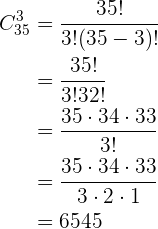
Different committees. In a class of 35 students, a committee of three students is to be chosen. How many different committees can be formed?
First, we should note the following:
Not all elements are included. This is because only 3 of the 35 students are taken.
Order does not matter. This is because it is the same to choose Juan, María and Cynthia as to choose Cynthia, Juan and María. Only who makes up the committee matters, not the order in which they are chosen.
Elements are not repeated. This is because obviously we cannot choose a person more than once. Once someone is chosen, they no longer belong to the group of remaining students.
Having said that, it is clear that we are facing a problem that we can solve with combinations in the following way:
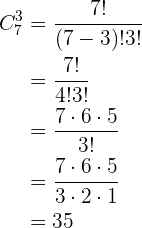
Rainbow colors. Given the colors of the rainbow, how many groups of three colors can we form with them?
To solve this problem we must first note the following:
Not all elements are included. This is because we will only take 3 of the 7 colors in the rainbow.
Order does not matter. This is because we only care about the colors we choose but not the order in which we choose them.
Elements are not repeated. It is clear that we cannot choose a color more than once. When taking a color, it is no longer considered for the next choice; we could say that "we remove it from the set."
Having said that, it is clear that we can solve this problem using the combination formula:
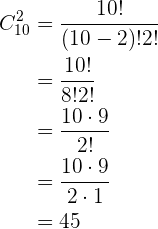
Number of greetings at a meeting. 10 people attend a meeting and exchange greetings among all of them. How many greetings have been exchanged?
Let's note the following:
Not all elements are included. This is because we can analyze a greeting as a group of two people (since it only takes place between two people).
Order does not matter. This is because it is the same for Juan to have greeted María as for María to have greeted Juan.
Elements are not repeated. Note that assuming they are repeated is like thinking that a person could greet themselves, which would not make sense.
Having said that, we have that we can solve this problem by applying the combination formula:
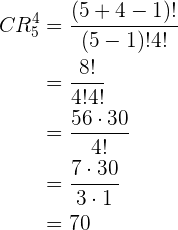
Combinations with bottles. In a store, five different flavors of soda are sold. You want to buy 4, regardless of whether several of the same flavor are chosen. In how many ways can soda flavors be chosen?
First let's note the following data:
Not all elements are included. This is because there are five flavors and we will only take 4.
Order does not matter. It is the same whether two cola-flavored sodas and two apple-flavored sodas are chosen, or first two apple-flavored and then two cola-flavored.
Elements are repeated. This is because we can choose the four different flavors or all four the same, etc.
Having said that, it is clear that we are dealing with combinations with repetition, so applying the formula, we have the result:
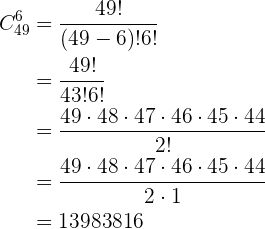
Possible combinations in the national lottery. How many single-column Primitive Lottery bets must be filled in to ensure the correct six results out of 49?
First let's note the following:
Not all elements are included. This is because we only choose 6 out of 49 elements.
Order does not matter. In this case, only the elements we choose matter but not their order.
Elements are not repeated. This is because we cannot choose the same lottery element several times.
Having said that, it is clear that we can solve this problem by applying the combination formula:
Number of triangles in a pentagon. How many diagonals does a pentagon have and how many triangles can be formed with its vertices?
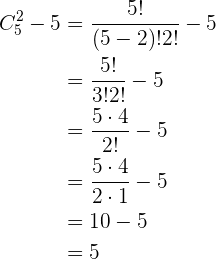
First we need to determine the lines that can be drawn between 2 vertices. Note that we have 5 vertices and each line can be determined as the pair of vertices that define it, therefore, we would have combinations.
Not all elements are included. This is because a line is only defined by 2 of the 5 vertices.
Order does not matter. A line is defined by joining two vertices, but there is no direction, so it doesn't matter which vertex we consider first.
Elements are not repeated. This is because considering the repetition of elements would be considering lines that go from a point to itself, which would not make sense.
Thus, we would have  , from which we have to subtract the sides that determine 5 lines that are not diagonals.
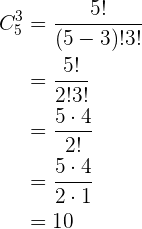
The above number gave us the number of diagonals inside the pentagon. Now, every three diagonals define a triangle inside the pentagon, although the side of the triangle will not always be the entire diagonal, sometimes it will only be part of it. We can see this in the graph of any pentagon with its diagonals; we can see that regardless of which diagonals we take, a triangle will be formed between them, although it is only defined by a part of the diagonals. Having said that, then each triangle is defined by 3 of the 5 diagonals, so we have combinations again since:
Not all elements are included. This is because a triangle is only defined by 3 of the 5 diagonals.
Order does not matter. A triangle is defined by 3 diagonals regardless of the order in which you take them.
Elements are not repeated. This is because the three sides of a triangle are always different line segments.
Thus, we would have  .
.
Combinations with conditions. A group, consisting of five men and seven women, forms a committee of 2 men and 3 women. In how many ways can it be formed, if:
1. Any man or woman can belong to it.
2. A certain woman must belong to the committee.
3. Two certain men cannot be on the committee.
1. Any man or woman can belong to it.
Note that since any man can be chosen, then we can choose any 2 of the 5 men. Also, note that the conditions of exercise 1 are met:
Not all elements are included. This is because only 2 of the 5 men are taken.
Order does not matter. This is because it is the same to choose Juan and Pedro as to choose Pedro and Juan.
Elements are not repeated. This is because obviously we cannot choose a person more than once.
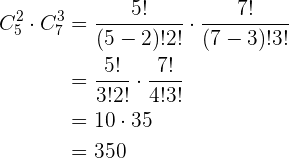
This would give us combinations of to be able to choose the two men. Likewise, we can choose among all the women and, in addition, the same conditions are met, therefore there would be  different ways to take 3 of the 7 women. This gives us as a final result the product of the combinations we obtained. That is:
2. A certain woman must belong to the committee.
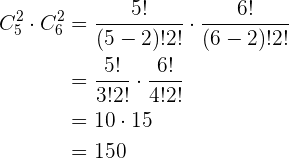
Note that as in the previous section, we can choose among all the men, therefore again we would have combinations for the men. Now, unlike the previous section with the women, here it tells us that one woman is already determined, that is, already chosen, therefore, now we must choose the 2 that are missing among the remaining 6, we calculate this with the combinations  . Thus, again our final result is the product of our obtained combinations:
3. Two certain men cannot be on the committee.
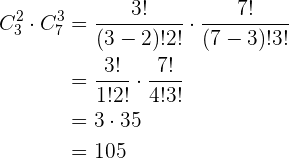
Note that as in section 1, we can choose among all the women, therefore again we would have combinations for the women. Now, unlike the previous sections, here we are told that two men out of the 5 cannot be chosen, therefore, we have to choose the 2 among the remaining 3, we calculate this with the combinations  . Finally, our final result is given by the product of the obtained combinations:
Combinations with coins. A person has five coins of different values. How many different sums of money can they form with the five coins?
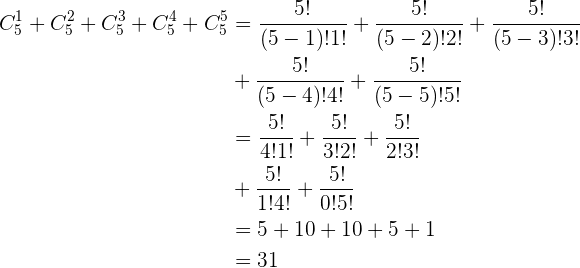
Note that it is a somewhat tricky question. Here we are asked to calculate the different sums, from which one could make the mistake of the different sums when taking all the coins (the five coins), however, what we must consider are the different sums when taking only one coin, when taking two coins, three coins, four coins and five coins, whose different sums are given by  , , ,
, , ,  and
and  , respectively. That is, we must add the different ways to form groups of one coin, groups of two coins, three coins and so on.
Combinatorial equations. Solve the following combinatorial equations:
1 
2 
3 
1
We will solve using simply the definitions of variations and combinations:
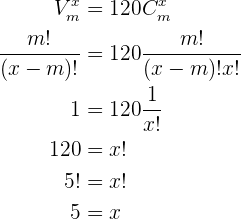
Therefore,  .
.
2
Again we will use the definition of combinations to solve this problem:
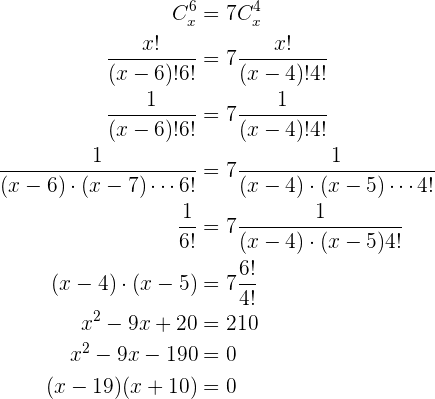
From the above it follows that  or
or  , however, since
  must be obligatorily positive, we have that our only option is .
3
Again we will use the definition of combinations to solve this problem:
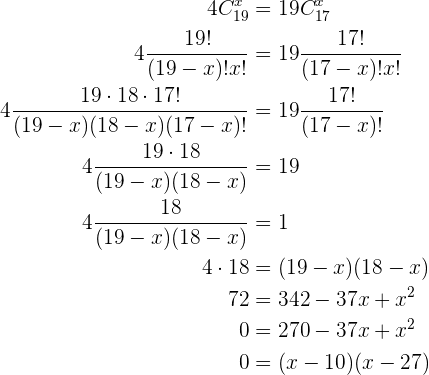
From the above it follows that  or
or  , however, since must be obligatorily less than 19 and 17, since we cannot take more elements than there are in a set, we have that our only option is .
Combinations to form teams. From 6 people, how many different teams can be formed?
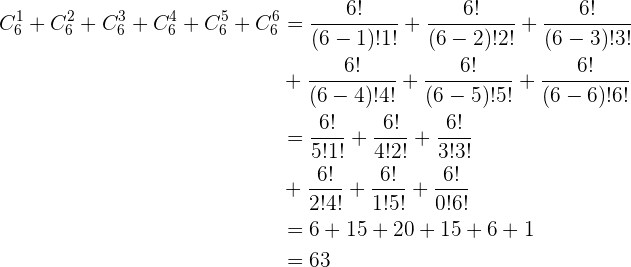
Since this problem does not indicate the number of people on the team, we must consider the different teams made up of only one person, two people, three people, four people, five people and six people, whose different sums are given by  ,
,  ,
,  ,
,  ,
,  and
and  , respectively. That is, we must add the different ways to form groups of one person, groups of two people, three people and so on.
Summarize with AI:
Did you like this article? Rate it!

 Loading...