To be able to add and subtract fractions, they must have the same denominator. When fractions already have the same denominator, the numerators are added or subtracted and the denominator is kept. When they don't have the same denominator, we take the denominators and find the least common multiple (LCM). Then we multiply the fractions by their corresponding numbers to obtain the same denominator without changing the proportion, and we add or subtract the numerators while keeping the denominator as is.


Addition and Subtraction with the Same Denominator
The numerators are added or subtracted and the denominator is kept.
Example:

We add the numerators  and
and  and keep the denominator
  .
.

Addition and Subtraction with Different Denominators
To be able to add or subtract fractions, they must have the same denominator. To find the common denominator, the first step is to decompose the existing denominators into prime factors. We find the LCM and multiply each fraction by its corresponding number. First, the denominators are reduced to a common denominator, and then the numerators of the resulting equivalent fractions are added or subtracted.
Example:

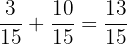
To be able to add these two fractions, the denominator must be the same, but we have on one side and  on the other. Since both denominators are prime numbers, we need to multiply the first fraction by
  , which is actually , and the second fraction by
  , which will help us obtain the same denominator
  .
.

Since we have the same denominator, we add the numerators. The denominator is not added.
Summarize with AI:
Did you like this article? Rate it!

 Loading...