Chapters


Various Operations with Integers
Order, in increasing order, decreasing order, and graphically represent the following integers:
1 -4, -1, 3, 2
2 -4, -1, 0, -7
3 2, 1, -1, 5 -3
4 −4, 6, −2, 1, −5, 0, 9
5 8, −6, −5, 3, − 2, 4, −4, 0, 7
1 -4, -1, 3, 2
Increasing order: − 4 < − 1 < 2 < 3
Decreasing order: 3 > 2 > -1 > -4
Graphical representation:

2 -4, -1, 0, -7
Increasing order: − 7 < − 4 < -1 < 0
Decreasing order: 0 > -1 > -4 > -7
Graphical representation:

3 2, 1, -1, 5, -3
Increasing order: − 3 < − 1 < 1 < 2 < 5
Decreasing order: 5 > 2 > 1 > -1 > -3
Graphical representation:

4 −4, 6, −2, 1, −5, 0, 9
Increasing order: − 5 < − 4 < − 2 < 0 < 1 < 6 < 9
Decreasing order: 9 > 6 > 1 > 0 > -2 > -4 > -5
Graphical representation:

5 8, −6, −5, 3, − 2, 4, −4, 0, 7
Increasing order: − 6 < − 5 < − 4 < − 2 < 0 < 3 < 4 < 7 < 8
Decreasing order: 8 > 7 > 4 > 3 > 0 > -2 > -4 > -5 > -6
Graphical representation:

Absolute Value and Opposite Value
Calculate the opposites and absolute values of the following integers:
1 -4, -1, 3, 2
2 -4, -1, 0, -7
3 2, 1, -1, 5 -3
4 −4, 6, −2, 1, −5, 0, 9
5 8, −6, −5, 3, − 2, 4, −4, 0, 7
1 -4, -1, 3, 2
Calculating the opposites:
-4 → -(-4)=4
-1 → -(-1)=1
3 → -(3)=-3
2 → -(2)=-2
Calculating the absolute values:
|-4|=4
|-1|=1
|3|=3
|2|=2
2 -4, -1, 0, -7
Calculating the opposites:
-4 → -(-4)=4
-1 → -(-1)=1
0 → -(0)=0
-7 → -(-7)=7
Calculating the absolute values:
|-4|=4
|-1|=1
|0|=0
|-7|=7
3 2, 1, -1, 5, -3
Calculating the opposites:
2 → -(2)=-2
1 → -(1)=-1
-1 → -(-1)=1
5 → -(5)=-5
-3 → -(-3)=3
Calculating the absolute values:
|2|=2
|1|=1
|-1|=1
|5|=5
|-3|=3
4 −4, 6, −2, 1, −5, 0, 9
Calculating the opposites:
-4 → -(-4)=4
6 → -(6)=-6
-2 → -(-2)=2
1 → -(1)=-1
-5 → -(-5)=5
0 → -(0)=0
9 → -(9)=-9
Calculating the absolute values:
|-4|=4
|6|=6
|-2|=2
|1|=1
|-5|=5
|0|=0
|9|=9
5 8, −6, −5, 3, − 2, 4, −4, 0, 7
Calculating the opposites:
8 → -(8)=-8
-6 → -(-6)=6
-5 → -(-5)=5
3 → -(3)=-3
-2 → -(-2)=2
4 → -(4)=-4
-4 → -(-4)=4
0 → -(0)=0
7 → -(7)=-7
Calculating the absolute values:
|8|=8
|-6|=6
|-5|=5
|3|=3
|-2|=2
|4|=4
|-4|=4
|0|=0
|7|=7
Factoring
Factor out the common factor in the expressions:
1 3 · 2 + 3 · (−5) =
2 (−2) · 12 + (−2) · (−6) =
3 8 · 5 + 8 =
4 3 · 2 + 2 =
5 (−3) · (−2) + (−3) · (−5) =
For this exercise we will use the distributive property: a(b+c)= a·b + a·c
1. 3 · 2 + 3 · (−5)
Direct solution: 3 · 2 + 3 · (−5) = 6 + (−15)= 6 − 15 = −9
Factorization: We can observe that the common factor is 3, we extract it using the distributive property:
3( 2 + (−5) )
Verification:
3(2+(−5)) = 3(2−5)=3(−3)= −9
2. (−2) · 12 + (−2) · (−6)
Direct solution: (−2) · 12 + (−2) · (−6) = −24 + 12 = −12
Factorization: We can observe that the common factor is −2, we extract it using the distributive property:
−2( 12 + (−6) )
Verification:
−2( 12 + (−6) ) = −2( 12−6)= −2(6)=−12
3. 8 · 5 + 8
Direct solution: 8 · 5 + 8 = 40 + 8 = 48
Factorization: We can observe that the common factor is 8, we extract it using the distributive property:
8( 5+1 )
Verification:
8( 5+1 ) =8(6)=48
4. 3 · 2 + 2
Direct solution: 3 · 2 + 2 = 6+ 2 = 8
Factorization: We can observe that the common factor is 2, we extract it using the distributive property:
2( 3+1 )
Verification:
2( 3+1 ) =2(4)=8
5. (−3) · (−2) + (−3) · (−5)
Direct solution: (−3) · (−2) + (−3) · (−5) = 6 + 15 = 21
Factorization: We can observe that the common factor is −3, we extract it using the distributive property:
−3( (−2)+(−5) )
Verification:
−3( (−2)+(−5) ) = −3(−2−5)= −3(−7)=21
Basic Operations with Integers
Perform the following operations with integers:
1 2 − (-3) -(-1)
2 -4 − 3 -(-5)
3 (3 − 8) + [5 − (−2)]
4 5 − [6 − 2 − (1 − 8) −3 + 6] + 5
5 [12 : 2] : 3
6 9 : [6 : (− 2)]
7 [24 : (-3)]: [16 : (− 4)]
8 [(−2)5 − (−3)³]²
9 (5 + 3 · 2 : 6 − 4 ) · (4 : 2 − 3 + 6) : (7 − 8 : 2 − 2)²
10 [(17 − 15)³ + (7 − 12)²] : [(6 − 7) · (12 − 23)]
1. 2 − (−3) −(−1) =
We write the opposite of (−3) and (−1)
= 2 + 3+1 =
We perform the addition
= 2+3+1 = 6
2. −4 − 3 −(−5) =
We write the opposite of (−5)
= −4 − 3+5 =
We perform the addition and subtraction
= −4−3+5 = −2
3. (3 − 8) + [5 − (−2)] =
We write the opposite of (−2)
= −5 + (5 + 2) =
We operate in the parentheses
= −5 + 7 = 2
4. 5 − [6 − 2 − (1 − 8) − 3 + 6] + 5 =
We operate in parentheses
= 5 − [6 − 2 − (−7) − 3 + 6] + 5 =
We calculate the opposite of (−7)
= 5 − (6 − 2 + 7 − 3 + 6) + 5 =
We operate in the parentheses and take the opposite of the result
= 5 − 14 + 5 = −4
5. [12 : 2] : 3 =
We perform the division in the brackets
= [12 : 2]:3 = 6:3
We perform the remaining division
= 6:3=2
6. 9 : [6 : (−2)] =
We perform the division in the brackets
= 9 : [6 : (−2)]=9 : (−3)
We perform the remaining division
= 9 : (−3)=−3
7. [24 : (−3)]: [16 : (− 4)] =
We perform the division in the brackets
= [24 : (−3)]: [16 : (− 4)]=−8 : (−4)
We perform the remaining division
= −8 : (−4)=2
8. [(−2)⁵ − (−3)³]² =
We perform the powers in the parentheses. For (−2)⁵ we calculate as follows: (−2)(−2) = 4. 4(−2) = −8. −8 (−2) = 16. 16 (−2) = −32. For (−3)³, following the same way of calculating, we have (−3)(−3) = 9. 9 (−3) = −27
= [−32 − (−27)]² =
We remove parentheses
= (−32 + 27)² =
We perform the operation and square
= (−5)² = 25
9. (5 + 3 · 2 : 6 − 4 ) · (4 : 2 − 3 + 6) : (7 − 8 : 2 − 2)² =
We perform 3 · 2 (we will do the multiplication first) and the divisions
= (5 + 6 : 6 − 4 ) · (2 − 3 + 6) : (7 − 4 − 2)² =
We perform the division
= (5 + 1 − 4 ) · (2 − 3 + 6) : (7 − 4 − 2)² =
We operate in each parenthesis
= 2 · 5 : 1² =
We square
= 2 · 5 : 1 =
First we have to multiply and then we will divide
= 10 : 1 =10
10. [(17 − 15)³ + (7 − 12)²] : [(6 − 7) · (12 − 23)]
We operate in the parentheses
= [(2)³ + (−5)²] : [(−1) · (−11)]
We perform the powers
= (8 + 25) : [(−1) · (−11)] =
We operate in the parentheses and in the brackets and divide the results
= 33 : 11 = 3
Order of Operations
Perform the following operations with integers:
1 10:5+2
2 10+6:3
3 6 · 3+6:3
4 18:6- 4· 3
5(7 − 2 + 4) − (2 − 5)
6 1 − (5 − 3 + 2) − [5 − (6 − 3 + 1) − 2]
7 −12 · 3 + 18 : (−12 : 6 + 8)
82 · [( −12 + 36) : 6 + (8 − 5) : (−3)] - 6
9 [(−2)5 · (−3)2] : (−2)2 = (−32 · 9) : 4
10 6 + {4 − [(17 − (4 · 4)] + 3} − 5
1. 10:5+2 =
We perform the division
= 10:5+2 = 2+2
We perform the addition
= 2+2 = 4
2. 10+6:3 =
We perform the division
= 10+6:3 = 10+2
We perform the addition
= 10+2 = 12
3. 6 · 3+6:3 =
We perform the multiplication and division
= 6 · 3+6:3 = 18+2
We perform the addition
= 18+2 = 20
4. 18:6− 4· 3 =
We perform the multiplication and division
= 18:6− 4· 3 = 3−12
We perform the subtraction
= 3−12 = −9
5. (7 − 2 + 4) − (2 − 5) =
We operate in the parentheses
= 9 − (−3) =
We take the opposite of (−3)
= 9 + 3 = 12
6. 1 − (5 − 3 + 2) − [5 − (6 − 3 + 1) − 2] =
We operate in the parentheses
= 1 − (4) − [5 − (4) − 2] =
We take the opposites of the two 4s
= 1 − 4 − (5 − 4 − 2) =
We operate in the parentheses
= 1 − 4 − 5 + 4 + 2 =
We add 4 with its inverse
= 1 − 5 + 2 = −2
7. −12 · 3 + 18 : (−12 : 6 + 8) =
We perform the division in the parentheses
= − 12 · 3 + 18 : (−2 + 8) =
We operate in the parentheses
= −12 · 3 + 18 : 6 =
We perform the multiplication and division
= −36 + 3 = −33
8. 2 · [( −12 + 36) : 6 + (8 − 5) : (−3)] − 6 =
We perform the operations in the first two parentheses
= 2 · [24 : 6 + 3 : (−3)] − 6 =
We perform the divisions
= 2 · [ 4 + (−1)] − 6 =
We operate in the brackets
= 2 · 3 − 6 =
We perform the product
= 6 − 6 = 0
9. [(−2)⁵ · (−3)²] : (−2)² =
We perform the powers
= (−32 · 9) : 4 =
We operate in the parentheses
= −288 : 4 = −72
10. 6 + {4 − [(17 − (4 · 4)] + 3} − 5 =
We perform the product
= 6 + [4 − (17 − 16) + 3] − 5 =
We operate in the parentheses and take its opposite
= 6 + (4 − 1 + 3) − 5 =
We operate in the parentheses
= 6 + 6 − 5 = 7
Solutions Outside and Inside the Set of Real Numbers
Calculate the result of the power and then verify if that result has a square root that exists in the real numbers:
1 (−2)²
2 (−4)²
3 (−9)²
4 (−5)3
5 (−3)5
6 (−1)7
7 (−3)² · (−3)
8 
9 (−2)³
10 
1 (−2)² = 4
The square root of 4 is ± 2
2 (−4)² = 16
The square root of 16 is ± 4
3 (−9)² = 81
The square root of 81 is ± 9
4 (−5)3 = −125
The square root of −125 does not exist in the reals, therefore this root has no solution in the set of real numbers.
In general, the square root of a negative number does not exist because there is no number that when squared has a negative sign.
5 (−3)5 = −243
The square root of −243 does not exist in the reals, therefore this root has no solution in the set of real numbers.
In general, the square root of a negative number does not exist because there is no number that when squared has a negative sign.
6 (−1)7 = −1
The square root of −1 does not exist in the reals, therefore this root has no solution in the set of real numbers.
In general, the square root of a negative number does not exist because there is no number that when squared has a negative sign.
7 (−3)² · (−3) =
We perform the product of the powers and cube
= (−3)³ = −27
The square root of −27 has no solution.
8 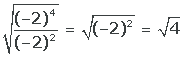
We perform the division of powers, square, and extract the root.
The result is 2, and the square root of 2 does exist in the real numbers.
9 (−2)³ = −8
The square root of −8 has no solution in the reals.
10 
We put 8 in the form of a power, perform the power of a power in the numerator, divide the powers, raise to the fourth power, and extract the root.
The result is 4, and the square root of 4 is ±2.
Operations with Powers
Perform the following operations with powers of integers:
1 (−2)² · (−2)³ · (−2)4
2 (−8) · (−2)² · (−2)0 (−2)
3(−2)−2 · (−2)³ · (−2)4
4 2−2 · 2−3 · 24
5 2² : 2³
6 2-2 : 2³
7 2² : 2-3
8 2-2 : 2-3
9 [(−2)− 2] 3 · (−2)³ · (−2)4
10[(−2)6 : (−2)³]³ · (−2) · (−2)−4
To solve these exercises we will use the laws of exponents:




1 (−2)² · (−2)³ · (−2)4 = (−2)9 = −512
The result will have a negative sign because the base is negative and the exponent is odd.
2 (−8) · (−2)² · (−2)0 (−2) =
First we decompose 8 into factors
(−2)³ · (−2)² · (−2)0 · (−2) = (−2)6 = 64
The result will have a positive sign because the base is negative and the exponent is even.
3 (−2)−2 · (−2)³ · (−2)4 = (−2)5 = −32
4 2−2 · 2−3 · 24 = 2−1 = 1/2
Since the exponent is negative, we have to take the inverse of the base, that is, apply the corresponding sign law.
5 2² : 2³ = 2−1 = 1/2
Since the exponent is negative, we have to take the inverse of the base, that is, apply the corresponding sign law.
6 2−2 : 2³ = 2−5 = 1/25 = 1/32
7 2² : 2−3 = 25 = 32
8 2−2 : 2−3 = 2
9 [(−2)−2]³ · (−2)³ · (−2)4 = (−2)−6 · (−2)7 = −2
10 [(−2)6 : (−2)³] 3 · (−2)· (−2)−4 = [(−2)³]³ · (−2)−3 = (−2)9 · (−2)−3= (−2)6 = 64
Use of Exponents in Operations with Integers
Perform the following operations with powers of integers:
1 (−3)1 · (−3)³ · (−3)4 =
2(−27) · (−3) · (−3)² · (−3)0=
3 (−3)² · (−3)³ · (−3)−4 =
4 3−2 · 3−4 · 34 =
5 5² : 5³ =
6 5-2 : 5³ =
7 5² : 5-3 =
8 5-2 : 5-3 =
9 (−3)1 · [(−3)³]² · (−3)−4 =
10 [(−3)6 : (−3)³]³ · (−3)0 · (−3)−4 =
1 (−3)1 · (−3)³ · (−3)4 = (−3)8 = 6561
2 (−27) · (−3) · (−3)² · (−3)0= (−3)³ · (−3) · (−3)² · (−3)0 = (−3)6 = 729
3 (−3)² · (−3)³ · (−3)−4 = −3
4 3−2 · 3−4 · 34 = 3−2 = 1/3² = 1/9
5 5² : 5³ = 5−1 = 1/5
6 5−2 : 5³ = 5−5 = 1/55 = 1/3125
7 5² : 5−3 = 55 = 3125
8 5−2 : 5−3 = 5
9 (−3)1 · [(−3)³]² · (−3)−4 = (−3)1 · (−3)6· (−3)−4 = (−3)³
First we calculate the power of a power and then we multiply
10 [(−3)6 : (−3)³]³ · (−3)0 · (−3)−4 = [(−3)³]³ · (−3)0· (−3)−4 = (−3)9 · (−3)0 · (−3)−4 = (−3)5 =−243
First we do the division indicated in the bracket, then we perform the power of a power and finally we multiply the powers
Summarize with AI:
Did you like this article? Rate it!

 Loading...