Chapters
A logarithm is the exponent to which a number (called the base) must be raised to obtain a given number. A logarithm finds the exponent  for a base
  that results in a specific value
  .
.
Example:
If the base is  and the result is
  , what exponent must
  be raised to in order to get
  ? As you can see, the exponent used to reach from base is
  .
.
The corresponding logarithmic notation is:

where is the base, is the result, and is the exponent. It's important to note that the base must be positive ( ) and not equal to one.
From this definition, we can conclude the following:
- A logarithm with a negative base does not exist.

- The logarithm of a negative number does not exist.

- The logarithm of zero does not exist.

- The logarithm of 1 is zero.

- The logarithm of a base to itself is 1.

- The logarithm of a power of is equal to the exponent.
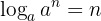


Logarithmic Properties
1 Log of a product is the sum of the logs of the factors:

Example:

2 Log of a quotient is the log of the numerator minus the log of the denominator:
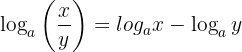
Example:
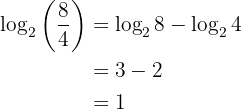
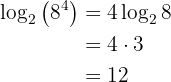
3 Log of a power is the exponent multiplied by the log of the base:

Example:
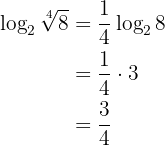
4 Log of a root is the log of the radicand divided by the index:

Example:
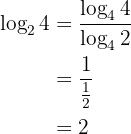
5 Change of base formula:

Example:
Since their invention, logarithms have become a powerful tool for handling very large numbers. Because they work with exponents, they transform complex multiplication into simple addition. Thanks to these properties, logarithms make many mathematical operations easier — making them well worth studying.
Summarize with AI:
Did you like this article? Rate it!

 Loading...