Chapters


Study the Monotonicity, Convergence or Divergence, and Bounds of the Sequences
Study the monotonicity, convergence or divergence, and bounds of the sequences
1 
2 
3 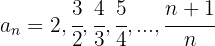
4 
5 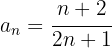
6 
7 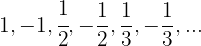
8 
1
Is increasing
Is bounded below
Lower bounds: 
The minimum is 
Is not bounded above
Divergent
2
Is decreasing
Is bounded above
Upper bounds: 
The maximum is 
Is not bounded below
Divergent
3
Is decreasing
Is bounded above
Upper bounds: 
The maximum is 
Is bounded below
Lower bounds:
The infimum is
Convergent, 
4
Is not monotonic
Is not bounded
Is neither convergent nor divergent
5
The first terms of this sequence are:
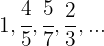
Is strictly monotonically decreasing




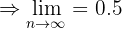
Convergent sequence
Since it is decreasing, is an upper bound, the maximum.
 is a lower bound, the infimum or greatest lower bound.
Therefore the sequence is bounded

6
The first terms of the sequence are:

Is not monotonic
Is neither convergent nor divergent
Is not bounded
7
Is not monotonic
Is convergent because 
Is bounded above, is the maximum
Is bounded below, is the minimum
Is bounded

8
The first terms of the sequence are:
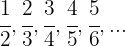
Is strictly monotonically increasing




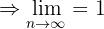
Convergent sequence
Is bounded below,  is the minimum
Is bounded above. is the supremum
Therefore the sequence is bounded

Find the General Term of the Following Sequences
Find the general term of the following sequences
1 
2 
3 
4 
5 
6 
7 
8 
9 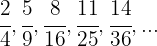
10 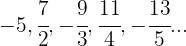
1
We can obtain the difference between consecutive terms:




Since the difference is constant, 
It is an arithmetic progression

2
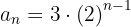
We can divide each term by its predecessor:


Since the quotient is constant, 
It is a geometric progression
3
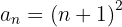
The sequence can be rewritten as:

We observe that the bases are in arithmetic progression, with  , and the exponent is constant, so we can write the following sequence for the base:

Therefore the general term is:
4
Each term of this sequence is one more than the terms of the previous sequence, so we can rewrite it as:

We find the general term as we saw in the previous case and add 1.

5
The sequence can be rewritten as:


6
The sequence can be rewritten as:


7
Each of the terms of this sequence is the opposite of each of the terms of sequence 3, so:

8

9
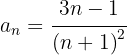
We have two sequences, one for the numerator and another for the denominator:


The first is an arithmetic progression with  , the second is a sequence of perfect squares.
10
If we disregard the sign, the numerator is an arithmetic progression with  .
.
The denominator is an arithmetic progression with .
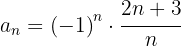
Since the odd terms are negative, we multiply by  .
.
Calculate the General Term of the Following Sequences
Calculate the general term of the following sequences
1 
2 
3 
4 
5 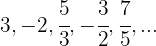
6 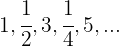
7 
8 
9 
10 
1
The numerator is constant.
The denominator is an arithmetic progression with .

2 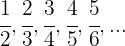
The numerator is an arithmetic progression with
The denominator is an arithmetic progression with
3
If we write each term of the sequence in rational form, we would obtain:

The numerator is an arithmetic progression with
The denominator is an arithmetic progression with
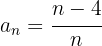
4
If we disregard the sign, it is an arithmetic progression with
Since the odd terms are negative, we multiply by

5
The sequence can be rewritten as:
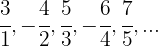
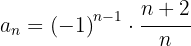
If we disregard the sign, the numerator is an arithmetic progression with
The denominator is an arithmetic progression with
Since the even terms are negative, we multiply by 
6
It is an oscillating sequence
The odd terms form an arithmetic progression with , if we don't take into account the even terms
The denominator of the even terms forms an arithmetic progression with

7
The sequence can be rewritten as:

If we disregard the sign and the exponent, we have an arithmetic progression with
Since the terms are squared, we have to square the general term
Since the odd terms are negative, we multiply by

8
The sequence can be rewritten as:

It is an oscillating sequence
The numerator of the odd terms forms an arithmetic progression with , if we don't take into account the even terms.
Since the terms are squared, we have to square the general term
The first addend of the denominator (disregarding the square) is an arithmetic progression with (not counting the even terms)
The general term must be squared and add 
The even terms form a constant sequence.

9
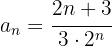
Separating the sequences of the numerator and the denominator we have:
Numerator: 
Denominator: 
The numerator is an arithmetic progression with
The denominator is a geometric progression with
10 
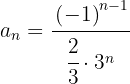
If we disregard the sign, the numerator is an arithmetic progression with
The denominator is a geometric progression with 
Since the even terms are negative, we multiply by
Summarize with AI:
Did you like this article? Rate it!

 Loading...