Chapters


Addition and Subtraction of Fractions
With the Same Denominator
Add or subtract the numerators and keep the denominator.


With Different Denominators
First, reduce the denominators to a common denominator, and add or subtract the numerators of the equivalent fractions obtained.
Determine the common denominator, which will be the least common multiple of the denominators.
This common denominator is divided by each of the denominators, multiplying the quotient obtained by the corresponding numerator.
Add or subtract the numerators of the equivalent fractions obtained.
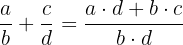

The LCM of  . An easy way to find it is as follows:


Then we can see that to have the same denominator, we have to multiply the first fraction by  , and the second by
  , which gives us
  .
.


Multiplication of Fractions
The multiplication of two fractions is another fraction that has as numerator the product of the numerators and as denominator the product of the denominators.


Division of Fractions
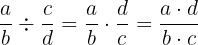
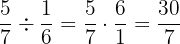
The division of two fractions is another fraction that has as numerator the product of the extremes and as denominator the product of the means.
Combined Operations and Priorities
1. Convert mixed numbers and decimals to fractions.
2. Calculate powers and roots.
3. Perform operations within parentheses, brackets, and braces.
4. Perform products and quotients.
5. Perform additions and subtractions.
Examples of Exercises and Problems with Fractions
1 
First we operate with the products and mixed numbers within the parentheses.

Then, we operate in the first parenthesis, remove the second, simplify in the third, and operate in the last.

We perform the product and simplify it.

Since we have very large numbers in the sum of the first bracket, we operate this part before continuing.
We have:
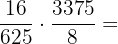
Before doing the addition, we simplify.

We perform the operations in the parenthesis.

We find the LCM of  , looking at each number.


We realize that the LCM is  .
.
We multiply the first fraction by  , the second by
  , the third by
  and we obtain:


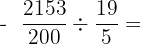
We perform the operations and simplify the result:

2. A box contains 60 chocolates. Eva ate  of the chocolates and Ana
  .
.
a) How many chocolates did Eva and Ana eat?

Eva ate 12 chocolates and Ana 30.
b) What fraction of chocolates did they eat together?

The LCM is 10.
Then we multiply the first fraction by and the second by and we obtain:

3. A father distributes $1,800 among his children. He gives the oldest  of that amount, the middle child
  , and the youngest the rest. How much did each one receive? What fraction of the money did the third one receive?
The oldest received $800:

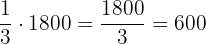
The middle one received $600:
The youngest:
Received  of the $1,800.
 dollars.
4. A family consumed on a summer day:
Two 1.5-quart bottles of water.
4 cans of quart of juice.
5 lemonades of  quart.
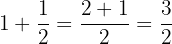
How many quarts of liquid did they drink? Express the result as a mixed number.



Summarize with AI:
Did you like this article? Rate it!

 Loading...