Chapters





How to Simplify Fractions?
Simplifying a fraction means transforming it into a simpler equivalent fraction.
To simplify a fraction, we divide the numerator and denominator by the same number.
We start simplifying by testing the first prime numbers: 2, 3, 5, 7, ... That is, we try to divide the numerator and denominator by 2 as long as possible, then move on to 3, and so on.
We repeat the process until there are no more common divisors.
Example: Simplify
1 First, we divide the numerator and denominator by 
2 The numerator and denominator of the result obtained have again as a common divisor

3 The new numerator and denominator of the result obtained have  as a common divisor
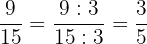
4 Since the new numerator and denominator of the result obtained have no common divisors, we have that the simplification of is  , that is:

If the terms of the fraction end in zeros, we will start by removing the common final zeros from the numerator and denominator.
Example: Simplify 
1 We divide the numerator and denominator by 
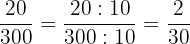
2 The new numerator and denominator of the result obtained have as a common divisor
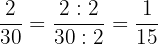
3 Since the new numerator and denominator of the result obtained have no common divisors, we have that the simplification of is  , that is:

If the number by which we divide is the greatest common divisor of the numerator and denominator, we arrive at an irreducible fraction.
Example: Simplify 
1 We divide the numerator and denominator by 
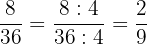
2 Since the new numerator and denominator of the result obtained have no common divisors, we have that the simplification of is  , that is:

Fraction Simplification Exercises
Simplify the following fractions

1 First, we divide the numerator and denominator by 
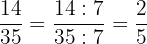

1 First, we divide the numerator and denominator by
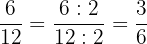
2 The numerator and denominator of the result obtained have as a common divisor
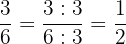
3 Since the new numerator and denominator of the result obtained have no common divisors, we have that the simplification of is  , that is:


1 First, we divide the numerator and denominator by
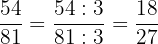
2 The numerator and denominator of the result obtained have as a common divisor
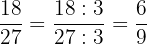
3 The numerator and denominator of the result obtained have as a common divisor again
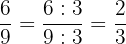
4 Since the new numerator and denominator of the result obtained have no common divisors, we have that the simplification of is  , that is:


1 First, we divide the numerator and denominator by
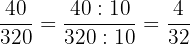
2 The numerator and denominator of the result obtained have as a common divisor
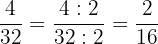
3 The numerator and denominator of the result obtained have as a common divisor again
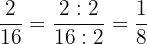
4 Since the new numerator and denominator of the result obtained have no common divisors, we have that the simplification of is  , that is:


1 First, we divide the numerator and denominator by
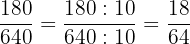
2 The numerator and denominator of the result obtained have as a common divisor

3 Since the new numerator and denominator of the result obtained have no common divisors, we have that the simplification of is  , that is:

Fraction Simplification Exercises with G.C.D.
Simplify the following fractions using the greatest common divisor

1 First, we express the numerator and denominator as a product of prime numbers
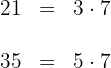
2 To obtain the  of both numbers, we multiply the common factors with the smallest exponent

3 We divide the numerator and denominator by 
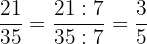

1 First, we express the numerator and denominator as a product of prime numbers

2 To obtain the of both numbers, we multiply the common factors with the smallest exponent

3 We divide the numerator and denominator by 


1 First, we express the numerator and denominator as a product of prime numbers

2 To obtain the of both numbers, we multiply the common factors with the smallest exponent

3 We divide the numerator and denominator by 


1 First, we express the numerator and denominator as a product of prime numbers
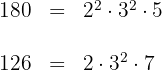
2 To obtain the of both numbers, we multiply the common factors with the smallest exponent

3 We divide the numerator and denominator by 
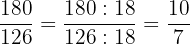

1 First, we express the numerator and denominator as a product of prime numbers

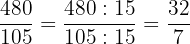
2 To obtain the of both numbers, we multiply the common factors with the smallest exponent

3 We divide the numerator and denominator by 
Summarize with AI:
Did you like this article? Rate it!

 Loading...