In this series of solved exercises, we will explore a variety of work and energy problems in different contexts. From calculating the friction force necessary to perform work, to calculating the kinetic and potential energy of an object.
A 9 lb object rests on a horizontal surface. Find the work done by a horizontal force of 6.7 lb acting over 16.4 ft.
1 We draw the equilibrium diagram
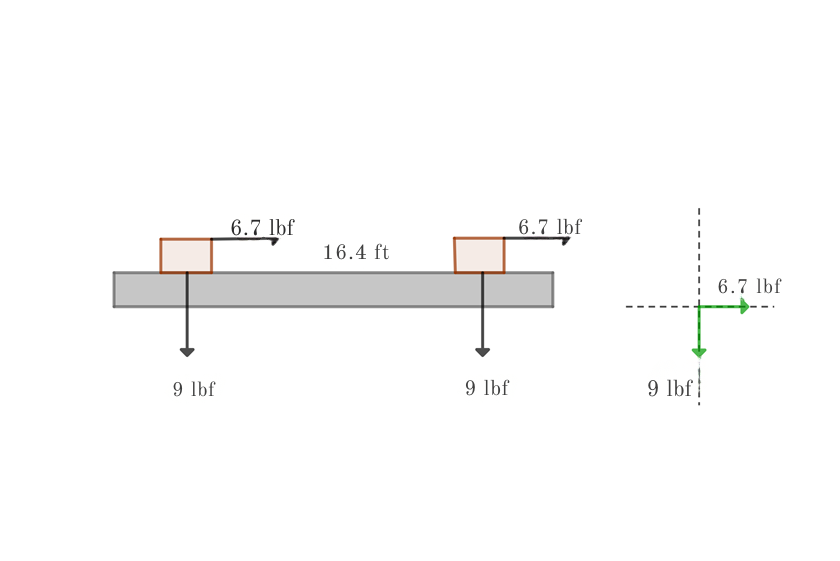
2 We calculate the horizontal and vertical net force for the system:

3 Since the displacement is parallel to the horizontal force, then the work is done by the horizontal net force. There is no work produced by the vertical net force:

4 Substituting the known data:

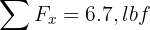
A 6.7 lb object rests on a horizontal surface. Find the work done when pulling the block 19.7 ft with a force of 4.5 lb that forms 32° with the horizontal.
1 We draw the equilibrium diagram
2. We calculate the horizontal and vertical net force for the system:


3. Since the displacement is parallel to the horizontal force, then the work is done by the horizontal net force. There is no work produced by the vertical net force:
4. Substituting the known data:

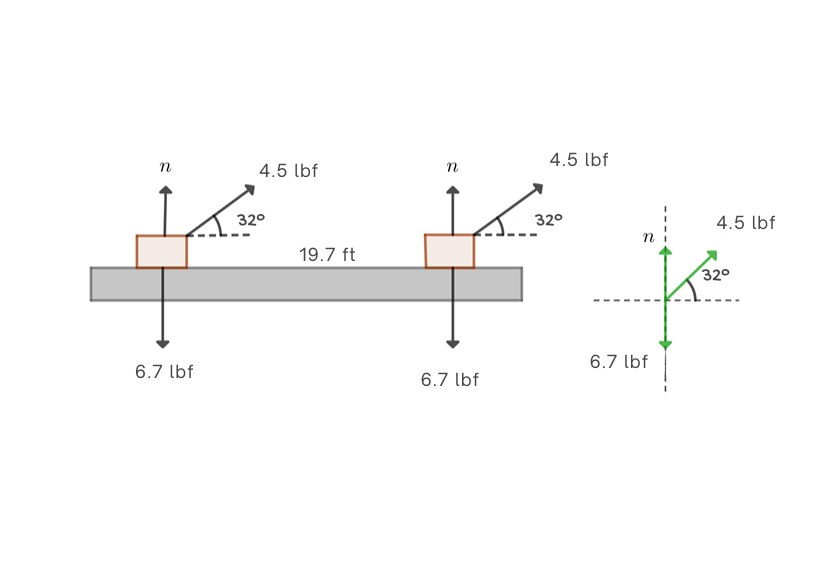
A push of 4.5 lbf is applied along the handle of a 6.7 lbf lawnmower, producing a horizontal displacement of 32.8 ft. The handle forms an angle of 32° with the ground. What is the work done by the 4.5 lbf force?
1 We draw the equilibrium diagram
2. We calculate the horizontal and vertical net force for the system:


3. Since the displacement is parallel to the horizontal force, then the work is done by the horizontal net force. There is no work produced by the vertical net force:
4. Substituting the known data:

An average force of 7.9 lbf compresses a spring to a distance of 2 inches. Find the work done by the spring and the net work.
1 We draw the equilibrium diagram
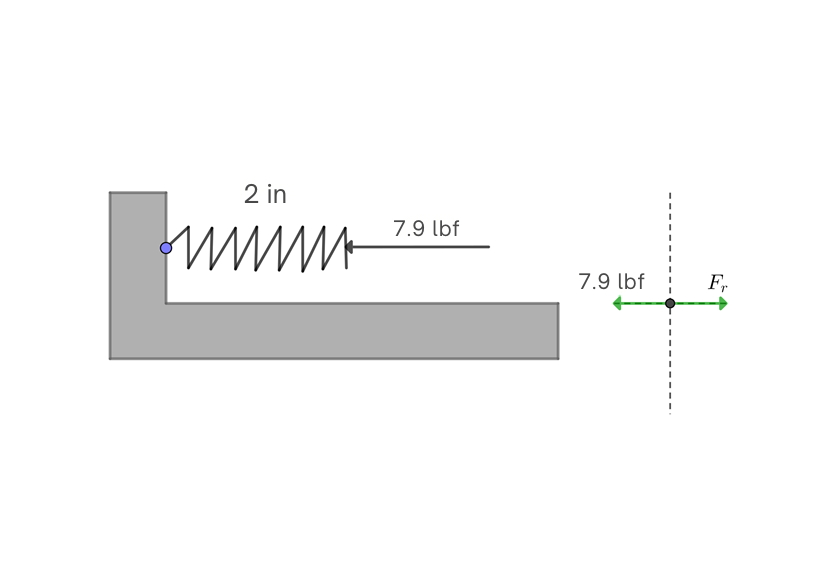
2. Since the displacement is parallel and in the opposite direction to the spring force, then the work for the spring is obtained from:

3. Substituting the known data, considering the distance in feet:

4. Finally, the resulting work is zero, since the net force of the system is zero because the spring exerts a force of the same magnitude and opposite to the 7.9 lbf force.
A 22 lb block is dragged 29.5 ft by a parallel force of 3.4 lbf. If  , find the resulting work and the acceleration it produces.
1 We draw the equilibrium diagram
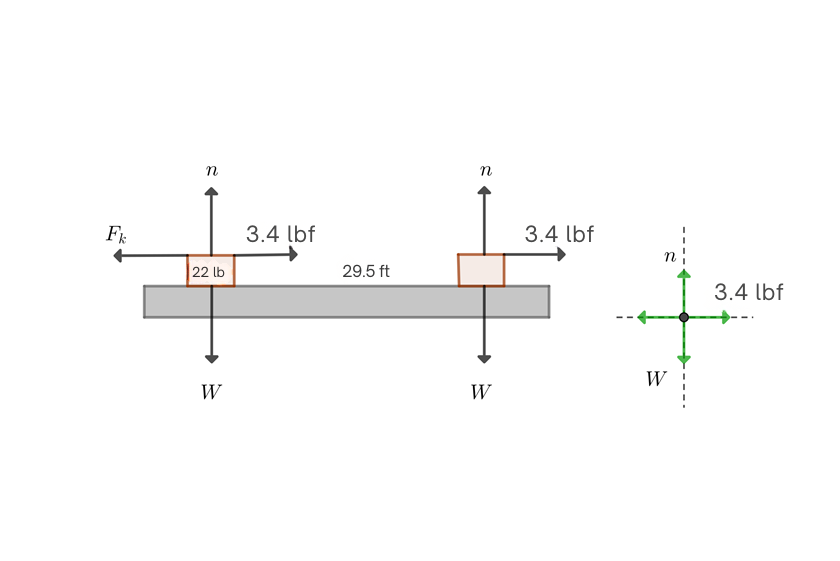
2. We calculate the horizontal and vertical net force for the system:

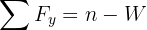
3. By the vertical equilibrium condition, since the motion is horizontal, we have that  . We calculate the weight W and with it, the kinetic friction force:


4. Since the displacement is parallel to the horizontal force, then the work is done by the horizontal net force. There is no work produced by the vertical net force:
5. Substituting the known data:

6. Substituting the known data in the acceleration formula (using mass in slugs: 0.685 slugs):

A 17.6 lb block rests on a plane inclined at 40°. If a push P of 20.2 lbf upward moves the block 6.6 ft, find the net work done for  .
.
1 We draw the equilibrium diagram
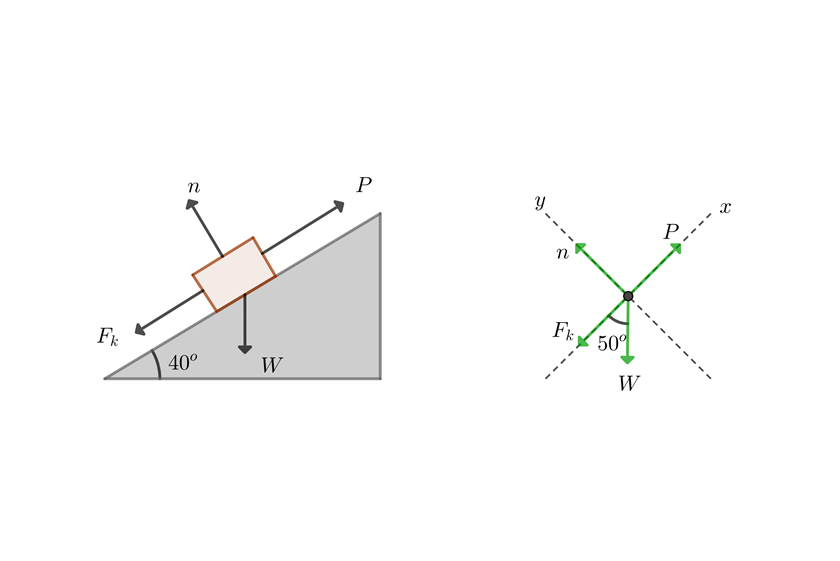
2. We calculate the horizontal and vertical net force for the system:


3. By the vertical equilibrium condition, since the motion is along the incline, we have that  . We calculate the vertical component of weight W and with it, the kinetic friction force:


4. Since the displacement is parallel to the push P, then the work is done by the horizontal net force. There is no work produced by the vertical net force:

5. Substituting the known data:

Find the kinetic energy of a 4.4 lb sledgehammer at the instant its velocity is 65.6 ft/s.
1. We apply the kinetic energy formula (using mass in slugs: 0.137 slugs):

2. Substituting the known data:

A 0.033 lb bullet traveling at 820 ft/s penetrates a piece of wood to a distance of 5.5 inches. Find the average force necessary to stop the bullet.
1. The work necessary to stop the bullet equals the change in kinetic energy.
2. The velocities are:

3. The resulting work that the piece of wood exerts on the bullet equals the change in kinetic energy of the bullet:
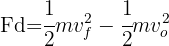
4. Convert distance to feet:

Mass in slugs: 
5. Now we substitute the values in the work-energy formula:

6. Solving for  :
:

The negative sign indicates that the force is opposite to the displacement.
A 4.4 lb brick rests on a table 3.9 ft from the floor. Find the potential energy with respect to the floor.
1. We use the potential energy formula:

2. We substitute the known data:

3. Solving for U:

A 551 lb crate is lifted by a forklift chain until its potential energy is 14,752 ft·lbf relative to the ground. Find the height at which the crate is located.
1. We use the potential energy formula:
2. We substitute the known data:

3. Solving for h:

Summarize with AI:
Did you like this article? Rate it!

 Loading...