

Hello everybody, my name is Kelsey, I’m a professional guitarist and a private tutor in Los Angeles.
The tools a guitarist uses all depends on their needs, guitar type, and whether they play along with singing or not. Many factors, more or less different, are taken into account.
The pick, a slide or even a capo?
Some students hear about them or pass in front of them in music stores, but without ever really knowing how to use them.
Ask the salesperson when buying a guitar? Too late, the guitar has already been bought.





So how to know what all these tools are used for?
My advice can be very useful before learning how to play guitar and buying your first guitar.
Of course, every guitarist has his own toolbox with his needs and habits. But as a guitar teacher addressing more specifically beginner guitar students, I’ll try to clearly explain what these three tools are used for.
What is the guitar pick used for?
What does a pick look like? Its definition is the following: a guitar pick is a tool used to pluck guitar strings.
All right, but this doesn’t really help! What is the guitar pick used for? Are there different shapes? Why use it during guitar lessons online and why buy one when purchasing a guitar? I'll try to tell you more about this essential guitarist tool.
The words of a professional guitarist about the pick:
(The advice given here is global. Each guitarist has their own perception, explanation, style and experience).
1° What is the guitar pick?
More simply put than Wikipedia, I would say that it is a piece of plastic or some other material more or less rigid that is used to strum your guitar strings. It must be held between the index finger and the thumb. It gives you more strength and sound power compared to finger playing.
2° Are there different shapes of picks?
The answer is yes. The photo shape is still the most standard. One can also find the Jazz standard that is slightly thinner and smaller. I’ll soon give you a much more detailed article on the different pick shapes and their uses.
3° Is the pick essential for all music styles?
It’s used for both rhythmic and solo playing. Most rock and metal guitarists find it hard to play without them. It offers great comfort in terms of strength, volume and technique. Many guitarists can only play with it. I’ve seen many friends who needed to use coins or credit cards to play when they had no pick on hand.
However, the pick is quite useless for classical style or pieces with many arpeggios where playing with fingers is undoubtedly better. For me, I’ve always preferred to play with my fingers. It really depends on the sensitivity and preferences of each guitarist.
Check out these stand out guitar lessons.
In addition to the pick:
A pick’s price is really insignificant compared to the guitar. Indeed, be aware that some stores provide them for free at their entrance. All you have to do is choose the one that suits you best (hard, soft).
For example, if we were to give a price, you can find a 12-pack of Fender guitar picks for less than $5.
A little tip: Many guitarists use their credit cards, a coin or any type of accessory that can play the role of a pick.
And you? Pick or no pick?
Discover how to buy a guitar strap…
What is the slide ring used for?
The slide ring is a tool that I love. Here is what it looks like.

The slide ring’s appearance is nothing extraordinary.
It’s a little tube made out of glass, ceramic, steel or copper alloy. Thanks to the slide ring, you can play slide guitar.
When learning how to play with guitar lessons near me, it’s advised not to start off directly using this tool.
Slide guitar with a slide ring is totally different from classical playing (fingers or pick). Listen to Ben Harper play the guitar in this video, or even his memorable track “Ground On Down” from the album Fight for Your Mind and you will understand right away what kind of sound the slide ring is used for.
Most people wear it on the ring finger, but some slide players prefer to wear it on their pinky finger. The pointer and middle fingers complete the play, either by muffling the parasitic sounds of the slide ring or by completing tunes.
However, it’s not so easy to play it! I strongly recommend that you first train in this technique. Do not hesitate to ask your guitar teacher for help in your guitar lessons. In addition to giving you guitar lessons Melbourne, they can help you get familiar with these tools.
In addition to the slide ring:
A regular slide ring is priced around $10. If I were to give you a price range, I would say between $10 and $20.
It’s made out of stainless steel, the standard size allows the slide ring to be used on all fingers. It gives a rich and sharp sound.
A little tip: I’ve seen guitarists substitute slide rings with other pieces of material that have the same look. What I have most commonly seen, and in general there is always one on hand, is a lighter. How to play the guitar with a lighter? (This is another explanation ...)
Get the best online guitar lessons here.
The capo: an essential tool to play with singers
The capo is, for me, one of the most necessary tools when it comes to playing the guitar.
Especially if you are used to or want to play while singing or with singers.
First off, here’s what it looks like:
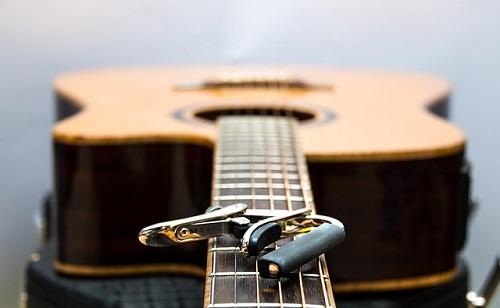
It’s an accessory that can render great service and considerably simplify your life.
The “capos” as they are called, are mostly metallic with a strip of plastic or rubber. They allow the guitar strings to be pushed into the neck as your forefinger would do in the case of a barre chord, and act as a clamp like your thumb at the back of the neck.
Once it’s positioned on your guitar, the capo acts as the new start of the neck. However, the notes before it will no longer be accessible.
But don’t worry, you won’t lose out with this change!
What is the capo used for?
1° Facilitate the chord position of a song
Indeed, it facilitates the positions of your chords in a song and can avoid barre chords, but only in some cases only, and it does not only that!
With that said, when the chords allow it, it's great to be able to sound the strings with a lot of resonance. It can also help you play the guitar faster.
2° Transposing pieces
Transpose means to raise or lower the tone of a song.
The capo will allow you to play sharper notes without changing the position of the chords. Awesome, right?
Since I often sing when I play the guitar and play along with other singers, I must say that this tool is essential to me and is a real asset for singers.
With a capo, the singer can use a sharper register rather than being limited to the low area of their voice.
In addition to the capo:
Price: The cheaper it is, the more likely it is to detune the guitar by exerting too much pressure on the strings. The higher end capos provide a more balanced pressure on the 6 strings and more precise control of the pressure to avoid this problem.
The price of guitar strings ranges from $5 to $40.
A little tip: I have created a makeshift capodaster with a pencil and two rubber bands.
The capo is an essential tool for all guitarists who also wish to sing.
Learn to Use a Capo in 3 Easy Steps
"What's that weird-looking clamp that came with my guitar?" This is a question asked by many a beginner player, and the answer is a fairly straightforward one. That clamp is called a capo, a shortening of the Italian term "capotasto." Understanding how it works will open up a whole new world of possibilities when it comes to your playing.
So, in the interest of helping you improve your skills and learn all things guitar, today's lesson will be filling you in on what a capo is, how it works, the different varieties, and how you can get the most out of yours when you're practicing and performing.
What is a Capo? {definition}
A capo is a small clamp that fits across the neck of a stringed instrument and alters its sound. Slap one across the strings of your guitar, and you'll raise their pitch according to whichever fret you've affixed the capo.
If that sounds confusing, think about the nut of your guitar (that's the piece that divides the headstock and fretboard). Without getting too deep into the weeds here, the nut marks the end of the strings vibrational length, so when you play your strings open (from string six to string one) you get the scale tones E, A, D, G, B, and E.

The capo moves that nut up the fretboard, raising the pitch of your open position notes (and only your open position notes). Place the capo on the first fret, and you'll get F, A#, D#, G#, C, and F. Move that capo to the second fret, and you'll get F#, B, E, A, C#, and F#. It's like having a permanent barre in place along whatever fret you put it on, and you can place it wherever you need for the song that you're playing.
Now, why would this little tool come in handy for a guitarist? We mentioned that the capo raises the pitch of your guitar's open position; with your capo on, you can change the key of a song but use the easy-to-play open position chords you've already memorized instead of having to fool around with a bunch of weird chord shapes further up the guitar neck.
So, if you had your capo on fret two, that standard C Major chord shape becomes a D Major chord, your A Minor chord becomes a B minor chord, your G Major chord becomes an A Major chord, etc. This is a powerful "shortcut" for beginner players, as it enables you to play songs in varied keys, even with a limited chord memory.
How to Use a Capo
Now that you have an idea of what the capo is and how it works, you might be wondering what situations call for its use. First and foremost, you can use your capo to play songs whose original key might be giving you some difficulty. Let's face it -- some of the more advanced chord shapes are difficult to pull off, especially when you're just starting out. With your capo, you can use a greater number of your open position chords to play songs with difficult chords more fluidly (albeit, in a different key).
The ability to change keys with a capo is a gift unto itself, though, if you're playing with a group and need to play a song in a specific key. There will doubtless come a time when one of your bandmates declares, "let's try it in this key," with "that key" inevitably being one with chord shapes you haven't prepared for yet. With your capo in place, you can stay in sync with your group, even when you're messing around with playing your songs in keys you haven't had the chance to study.
There might come a time where you just want a song to sound different. Using your capo will allow you to try out new chord voicings, so if a tune is sounding stale, playing it with a capo will allow for a fresh interpretation that you might find more appealing.
If you like to play and sing, the capo will come in handy, as you can quickly experiment with a song in different keys and see which suits your voice the best -- no complicated transposition necessary. Lastly, you can throw your capo on the guitar to make playing certain melodies an easier task.
Make no mistake -- this is a tool you'll be calling upon a lot in the future. You just need to make sure you get the right one to suit your style of playing and you learn how to use it effectively.
Guitar Capo Chart
If you're still struggling with the capo concept, take a look at a capo chart and everything will start to make a bit more sense. The capo chart shows how your normal, open position chords change when you have your capo affixed to a particular fret. Notice how the A Major shape becomes B Major when you place the capo on the second fret, or D Major when you move the capo up to the fifth fret?
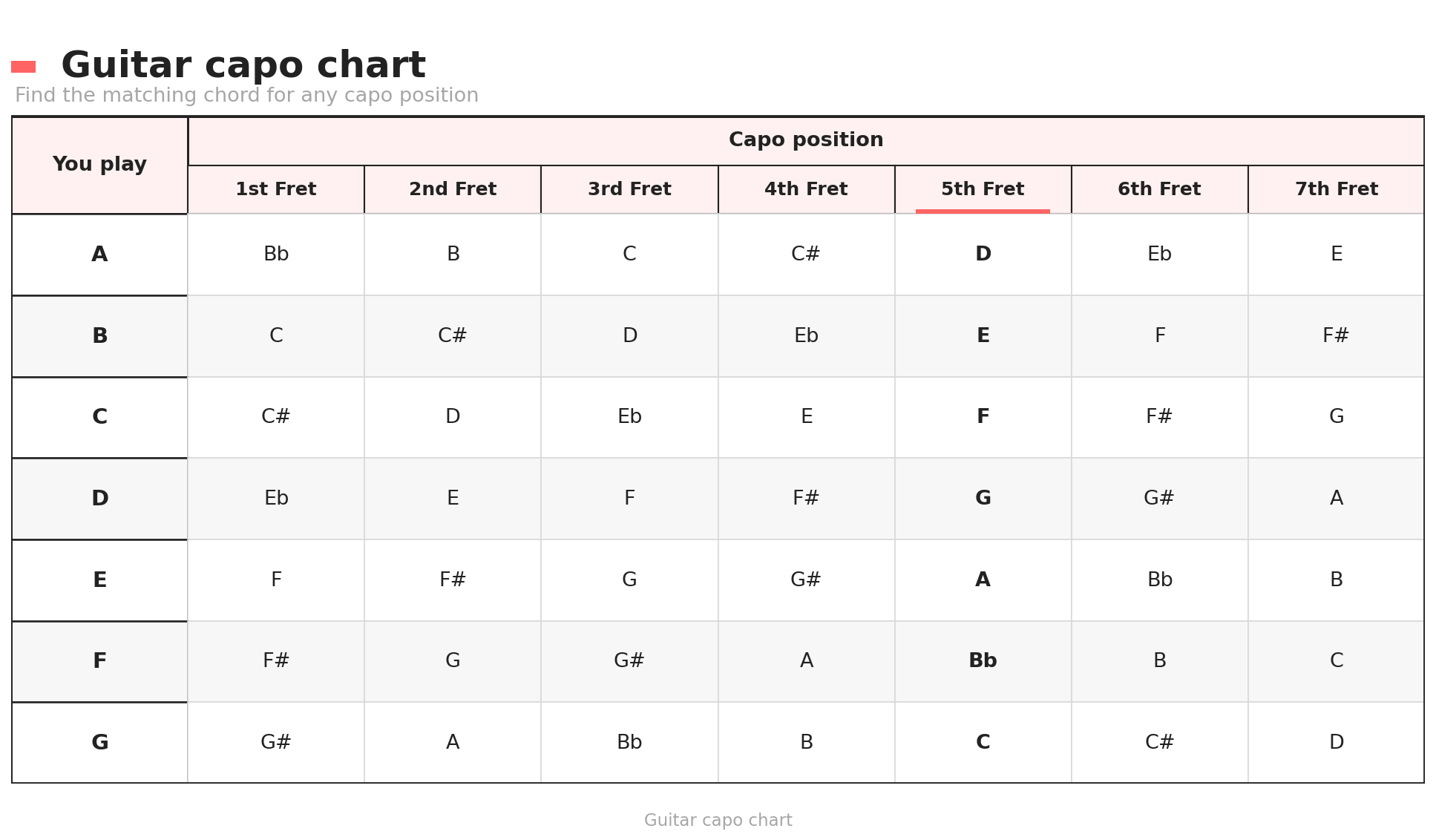
This is the "magic" of the capo, and you can use charts like these to help you determine what fret you should place your capo on in order to move to a different key or get the unique sounds you want out of your guitar.
Capo Styles
There are several types of capos available, but regardless of the style, they'll usually have a rubber-covered bar to avoid damaging your strings. We recommend sticking with capos that incorporate rubber in most cases, but beyond that, you're free to experiment with different capos to determine what you like the best.
Spring-clamp capos (also called quick releases) are easy to put on and take off of your guitar, as you need only squeeze the levers to open them, then release the levers to close them. Unfortunately, though, the pressure they apply is not adjustable, which might throw your tuning off if you don't attach it to the guitar neck properly.

Some lever-style capos have a screw, which you'll need to tighten in order to have the capo clamp the strings snugly. Since it's adjustable, you can apply only the minimal amount of pressure you need for the capo to work its magic. This style will keep from interfering with your guitar's tuning, but also takes a bit longer to put in place since you need to operate it with both of your hands.
Then there are elastic capos that consist of a stretchy cloth and rubber-coated pole piece. You can alter the tension on these capos with minor adjustments, and they can slide up and down the guitar neck without a need for unfastening (a definite benefit if you need to change on the fly). The catch with these, though, is that the elastic band can fatigue over time, providing uneven pressure deeper into the lifespan of the capo.
Finally, you might find a partial capo to be the most useful. These capos let you cover only a few strings at a time, or target specific strings to create new pitch variations without having to retune your instrument. With the right combinations, you'll be able to play some of your most commonly used chords with just a finger, and come up with some unique tunings that will add a bit of flair to the songs you're playing.
Which Capo is Right for Me?
Regardless of which style of capo fits your fancy, there are a few considerations you'll want to bear in mind before purchasing one:
- What size is right for me?
- Will the capo interfere with my playing in any way?
- Is the capo adjustable?
- How easy is the capo to use/adjust?
- Can the capo hold down the guitar strings evenly?
If you're the kind who values aesthetics, you might also want to take into consideration the look of your capo. You might find that certain styles more visually appealing than others, and there are even "vanity capos" with decorative elements that make them look even classier. Just remember, you'll be paying a premium for looking stylish, and those enhanced aesthetics won't have any sway over how well the capo works!
Tips to Using a Capo
As we touched on above, the manner in which you affix your capo to the guitar neck will depend on what type you have. There is, however, one golden rule you should observe, regardless of the particular style of capo: keep it even.
If your capo goes on in an unbalanced manner, it's liable to apply uneven pressure across the strings. The result? You might have some of your strings muted, and won't be able to play them open position (defeating the purpose of using your capo). Alternatively, you might also bend a string or two inadvertently, which will affect their tuning and make your notes sound dissonant while you're playing.
To ensure an even fit, take care when you're putting your capo on your guitar, and practice frequently to ensure you can engage and remove your capo without hassle.
Easy Guitar Songs with a Capo
Do you have your capo nearby? Good. Try some of these songs on for size to get used to playing with your capo in different positions on the fretboard:
- The Doobie Brothers, "What a Fool Believes." Capo on 1st fret
- Everlast, "Stone in My Hand." Capo on 2nd fret
- The Beatles, "Norwegian Wood." Capo on 2nd fret
In time, using a capo will become second nature. Remember to choose the right capo for you, and take the time to place it on properly before you begin. As always, happy practicing!
Summarize with AI:
Did you like this article? Leave a rating!


 Loading...