


An ounce of algebra is worth of a ton of verbal argument.
John B. S Haldane
J.B.S. Haldane's point holds up just as well today. Algebra gives us a precise, compact way to express relationships that would take paragraphs to describe in plain language. That's part of why it sits at the foundation of so much of mathematics, science, and engineering. 📐
Whether you're encountering algebra for the first time, revisiting it after years away, or looking to solidify your understanding of the basic rules of algebra, this guide covers the essential ground. We'll work through the rules of algebra with examples for each concept; from fundamental properties and fractions to exponents, radicals, and the two main types of algebraic equations.


Fundamental Properties of Algebra
The rules to algebra are the ground rules that govern how numbers and variables behave in expressions and equations. They aren't arbitrary conventions; they describe patterns that hold consistently across all real numbers, which is what makes them useful as tools for simplifying and solving problems.
There are five core properties most commonly covered in introductory algebra, plus the identity and inverse properties that round out the full picture. The table below summarizes all of them with their general rules and a concrete example for each.

| Property | General Rule | Example |
|---|---|---|
| Commutative (Addition) | a + b = b + a | 3 + 5 = 5 + 3 |
| Commutative (Multiplication) | a × b = b × a | 4 × 7 = 7 × 4 |
| Associative (Addition) | (a + b) + c = a + (b + c) | (1 + 2) + 3 = 1 + (2 + 3) |
| Associative (Multiplication) | (a × b) × c = a × (b × c) | (2 × 3) × 4 = 2 × (3 × 4) |
| Distributive | a(b + c) = ab + ac | 3(x + 4) = 3x + 12 |
| Identity (Addition) | a + 0 = a | x + 0 = x |
| Identity (Multiplication) | a × 1 = a | 5x × 1 = 5x |
| Inverse (Addition) | a + (−a) = 0 | x + (−x) = 0 |
| Inverse (Multiplication) | a × (1/a) = 1 | 5 × (1/5) = 1 |
Commutative Property
The commutative property tells us that the order of operands doesn't change the result, for both addition and multiplication. In other words, swapping the positions of two terms around an operator leaves the outcome the same.
Addition

Example: 3 + 8 = 8 + 3 = 11
Multiplication

Example: 4 × 6 = 6 × 4 = 24
Note that the commutative property does not apply to subtraction or division. The order matters in those operations: 10 − 3 ≠ 3 − 10, and 12 ÷ 4 ≠ 4 ÷ 12.
Associative Property
The associative property says that when adding or multiplying three or more terms, the way you group them doesn't affect the result. You can rearrange parentheses freely without changing the answer.
Addition

Example: (2 + 3) + 4 = 2 + (3 + 4) = 9
Multiplication

Example: (2 × 3) × 4 = 2 × (3 × 4) = 24
Like the commutative property, associativity applies to addition and multiplication only, not to subtraction or division.
Distributive Property
The distributive property is one of the most frequently used rules of algebra. It describes how multiplication interacts with addition or subtraction: you can distribute the factor outside the parentheses to each term inside.

A practical example makes this concrete. If you have 3(x + 5), distributing the 3 gives:

This also works in reverse: if you see  , you can factor out the
  to get
  . Recognizing both directions is important when simplifying expressions.
Why These Properties Matter 💡
Operations with Fractions in Algebra
The rules for arithmetic with fractions carry over into algebra, but they can feel less familiar when variables are involved. Working through each operation separately helps. Once the patterns are clear, applying them to expressions with variables becomes straightforward.
Addition and Subtraction
The laws of algebra for arithmetic slightly change when dealing with equations that feature fractions.

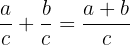
In the rules of adding and subtracting fractions the denominators must be identical; just as it is in arithmetic. The numerators must be attached, and their sums must be placed over the common denominator.
The following is a great example to understand the basics of adding or subtracting fractions in algebra:
Multiplication and Division
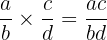
Multiplying fractions is more direct than adding them: multiply the numerators together and the denominators together. A common denominator is not required.
A practical example with variables:
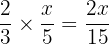
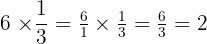
When multiplying a whole number by a fraction, treat the whole number as a fraction with denominator 1:
Dividing by a fraction is equivalent to multiplying by its reciprocal. Flip the second fraction (the divisor) and then multiply as normal.
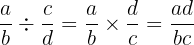
A worked example:

Dividing the denominator of a fraction has the same effect as multiplying the numerator — a useful shortcut to recognize when simplifying.
Rules of Exponents
Exponents are a quantity that represents the power to which a number or expression is to be raised, usually expressed as a raised symbol beside the name or phrase in algebra.
Just as there are rules for everything else in algebra, the following are some of the regulations for exponents:
Zero-Exponent

Anything raised to the power of zero equals 1.
Example: 7⁰ = 1
Product Rule

Same base: add the exponents.
Example: x³ × x⁴ = x⁷
Power Rule

Power to a power: multiply exponents.
Example: (x²)³ = x⁶
Quotient Rule

Same base: subtract the exponents.
Example: x⁵ ÷ x² = x³
The quotient of powers rule is worth examining closely. When dividing two expressions that share the same base, you subtract the exponent in the denominator from the exponent in the numerator:
aᵐ / aⁿ = aᵐ⁻ⁿ (where a ≠ 0)
Example:
x⁸ / x³ = x⁸⁻³ = x⁵
Another example:
2⁶ / 2² = 2⁶⁻² = 2⁴ = 16
If the exponents are equal, the result is 1: which connects back to the zero exponent rule:
aⁿ / aⁿ = aⁿ⁻ⁿ = a⁰ = 1
Zero exponent: a⁰ = 1
Product rule: aᵐ × aⁿ = aᵐ⁺ⁿ
Power rule: (aᵐ)ⁿ = aᵐⁿ
Quotient rule: aᵐ ÷ aⁿ = aᵐ⁻ⁿ
Negative exponent: a⁻ⁿ = 1/aⁿ
The Distinct Rules of Algebra for Radicals
In algebra, radical expressions are the counterpart to exponential expressions. Where exponents raise a base to a power, radicals extract a root. The most common radical is the square root, written as √, but cube roots (∛) and higher roots follow the same general rules.
A radical expression can always be rewritten as a fractional exponent: √a = a^(1/2), and ∛a = a^(1/3). This connection to exponents is what makes the rules below consistent with the exponent rules above.
Find effective algebra tutoring when you search for help on Superprof.
Key Radical Rules
Product Rule
√(a × b) = √a × √b
Example: √12 = √4 × √3 = 2√3
Quotient Rule
√(a/b) = √a / √b
Example: √(9/4) = √9 / √4 = 3/2
Power Rule
(√a)² = a
Example: (√5)² = 5
How to Simplify Radicals
Simplifying a radical means rewriting it in its simplest form, with no perfect square factors remaining under the radical sign. The approach is to find the largest perfect square that divides evenly into the number under the radical, then extract it.
Try this out:
Simplify √72:
Step 1:
Find largest perfect square factor of 72 → 36
Step 2:
√72 = √(36 × 2) = √36 × √2 = 6√2
Now this:
Simplify √50:
Step 1:
Largest perfect square factor → 25
Step 2:
√50 = √(25 × 2) = √25 × √2 = 5√2
When simplifying radicals with variables, apply the same logic: pull out any variable raised to an even power, since √(x²) = x.
√(x⁴y²) = √x⁴ × √y² = x²y
Note that √a + √b does not simplify to √(a+b). The product and quotient rules work for multiplication and division only; addition and subtraction under radicals cannot be separated or combined.

Simple Algebraic Equations
An equation in algebra is a statement that two expressions are equal, connected by an equals sign. Unlike an expression (which has no equals sign), an equation has a solution: a value or set of values for the variable that makes the statement true. Working out what value the variable represents is what it means to solve an equation.
Most equations you encounter at the introductory level fall into two main categories: linear and quadratic. Grasping these algebra concepts, rules, and basics covers the vast majority of problems at the secondary school level and builds the foundation for more advanced mathematics.
Linear Equations
A linear equation is any equation where the highest power of the variable is 1. It produces a straight line when graphed and has exactly one solution in most cases. The standard form is:

Example: 
- Step 1: Subtract 3 from both sides → 2x = 8
- Step 2: Divide both sides by 2 → x = 4
The key principle when solving any equation is to perform the same operation on both sides. This keeps the equation balanced; which is sometimes described as the golden rule of algebra. Whatever you do to one side, you must do to the other.
Quadratic Equations
A quadratic equation contains a variable raised to the second power as its highest term. The standard form is:
ax² + bx + c = 0
Quadratic equations can have two solutions, one solution, or no real solutions, depending on the values of a, b, and c. The most reliable method for solving them is the quadratic formula:
x = (−b ± √(b² − 4ac)) / 2a
Example: x² − 5x + 6 = 0 a = 1, b = −5, c = 6 x = (5 ± √(25 − 24)) / 2 x = (5 ± 1) / 2 x = 3 or x = 2
Simpler quadratics can often be solved by factoring. In the example above, x² − 5x + 6 factors into (x − 3)(x − 2) = 0, giving the same solutions directly.
Linear: highest power is 1 → one solution → graphs as a straight line
Quadratic: highest power is 2 → up to two solutions → graphs as a parabola
The quadratic formula works for any quadratic equation regardless of whether it factors neatly
Summarize with AI:
Did you like this article? Leave a rating!

 Loading...
