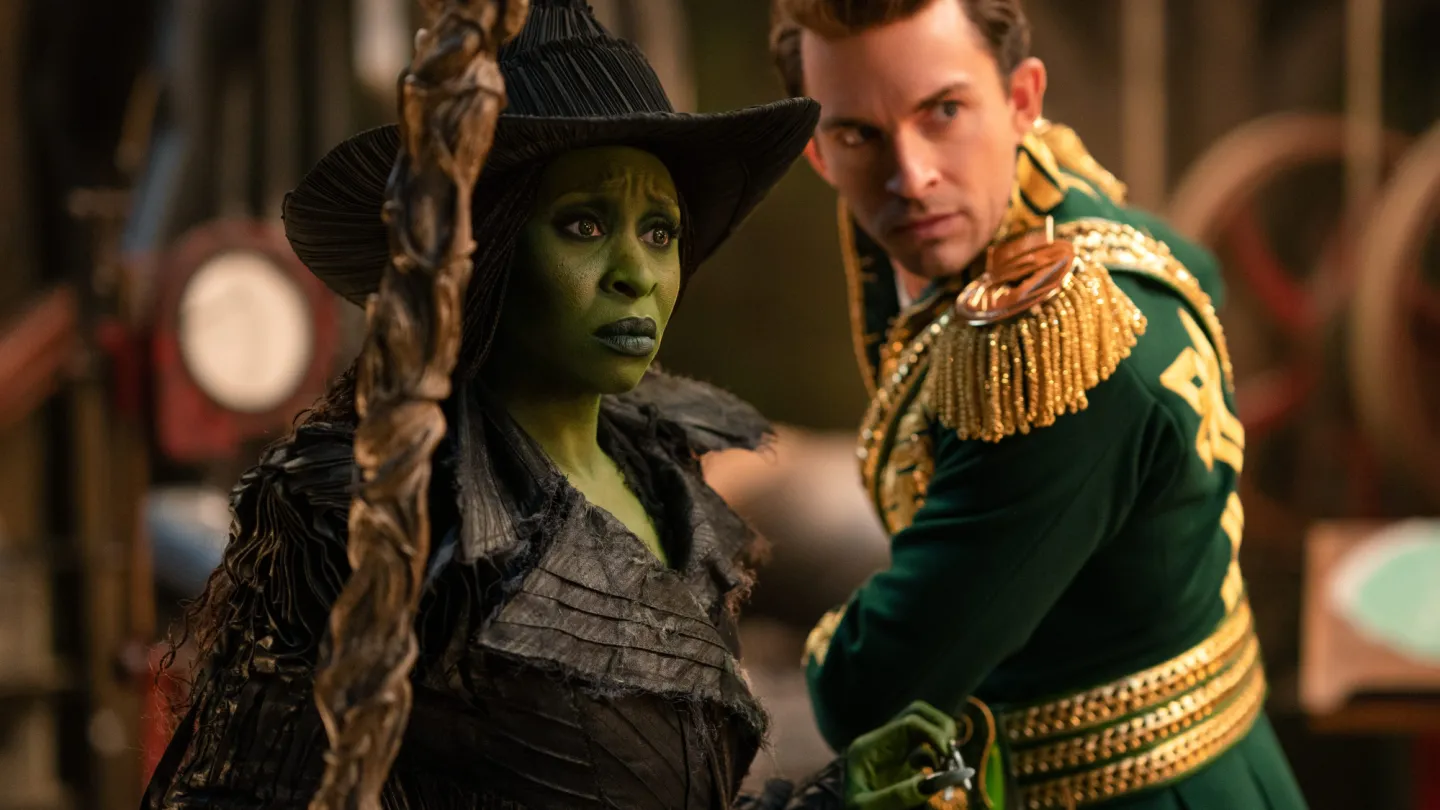

Fiyero Tigelaar is one of the most important characters in Wicked and the novel the musical is derived from. He acts as a catalyst for Elphaba, Glinda, and others to take action in several critical moments. However, he’s not just a supporting role. Fiyero’s arc and development are just as profound and impactful as the main characters’ evolutions. Find out how an aimless, nihilistic, privileged prince becomes one of the secret champions of Oz.



Prince Fiyero’s Background and Role in ‘Wicked’
Fiyero is a creation in Gregory Maguire’s novel, Wicked: The Life and Times of the Wicked Witch of the West; he wasn’t in the original fairytale from 1900. The reason for his creation? Maguire needed to have another role fill in certain gaps in the plot and give the characters motivation for their actions.
In Frank L. Baum’s original story, we see the characters do certain things, but we don’t know what led to their decisions. Maguire’s retelling explores the intrinsic and extrinsic reasons why all the characters make the choices they do. Fiyero acts both as an extrinsic motivator and as another character whose development can be explored.
Origins and Royal Lineage
Fiyero comes from the Vinkus, a region in the western part of Oz. In Maguire’s novel, he is a prince of the Arjikis, a tribal society with its own customs and political structure.
He has royal status, but also royal expectations.
His defeatist, nihilist tendencies come from a fundamental lack of understanding of his role and his purpose in life.
He grows up with wealth and influence, but none of it leads to fulfillment.
He feels disconnected from his role as well as the world around him.

In the stage musical and film, the details of the Arjiki culture are not elaborated for the sake of storytelling, but Fiyero retains his princely title. The musical downplays Fiyero’s political performance, instead portraying him as the careless, restless, hedonistic type grown out of privilege.
This foundation allows Fiyero to undergo a dramatic transformation in his arc. He goes from a privileged, aimless royal to a dedicated soldier with a moral compass and the conviction to act.
Or is it just that the world unwraps itself to you, again and again, as soon as you are ready to see it anew?
Fiyero (novel)
Introduction at Shiz University
We first see Fiyero at the school when he waltzes in, making a scene about how much he doesn’t care. His charming, charismatic nature intrigues everyone, and he makes it clear that he is too “cool” to mind what others think or what the rules say.
In the novel, Fiyero is a visiting student who is curious about the students and activities at Shiz. In the musical, he enters loudly, with flair. The film expands on this idea, but also features the camera lingering on the quieter moments between things that show Fiyero’s discomfort.
On the surface, he tells everyone that he believes in “dancing through life” by making a big show about how much he “doesn’t care.” But someone who really doesn’t care wouldn’t make an entire musical number about it.
Excuse me, there's no pretense here. I happen to be genuinely self-absorbed and deeply shallow.
Fiyero (movie)
Just under the surface, we see Fiyero showing signs of dissatisfaction. We aren’t yet sure what it means, but it becomes clear later on.
While at Shiz, Fiyero meets Elphaba and Glinda. Knowing the two witches proves to be a combination of mutual evolution for all three.
Especially surprising is his connection with Elphaba.

As a “popular” guy, it’s unexpected that he would treat Elphaba with such consideration.
She is prepared for the usual interrogation and cruel comments, but he doesn’t give her any.
This also shows that Fiyero isn’t all that one would expect from someone with his archetype.
Pfannee is another important character at Shiz who symbolizes specific themes.
Fiyero’s Character Development
Glinda and Elphaba are the other main characters who experience an overall positive developmental arc in the Wicked plot. Fiyero’s character fills in a few storytelling gaps. He explores positive development in a male role, as well as themes of loyalty, strength, and embracing one’s inner truth. His initial struggles are relatable to many, and his arc demonstrates a way to overcome them.
Relationship with Elphaba
Fiyero’s connection with Elphaba is remarkable because his “cool guy” persona seems like the type that wouldn’t get along with the social outcast. Elphaba tries to push him away at first, expecting rejection, but if there’s one thing Fiyero is honest about, it’s not caring what others think. He comes to appreciate Elphaba’s personality and the two grow close.
Their relationship begins as a contrast, similar to the start of Elphaba’s relationship with Glinda. Fiyero is popular, privileged, and unaware of his own superficiality. Elphaba is independent, astute, and a deep thinker. They share a deep curiosity about the world, and don’t prioritize fitting in or fulfilling others’ expectations.
In the novel, Fiyero is engaged (and later married) to another woman, Sarima, who lives back in Vinkus in their castle called Kiamo Ko.
They were betrothed at a young age to fulfill the prince’s political duties.
Fiyero and Elphaba remain platonic in their Shiz years, but later, after Fiyero had three children with Sarima, they reunite and become lovers.
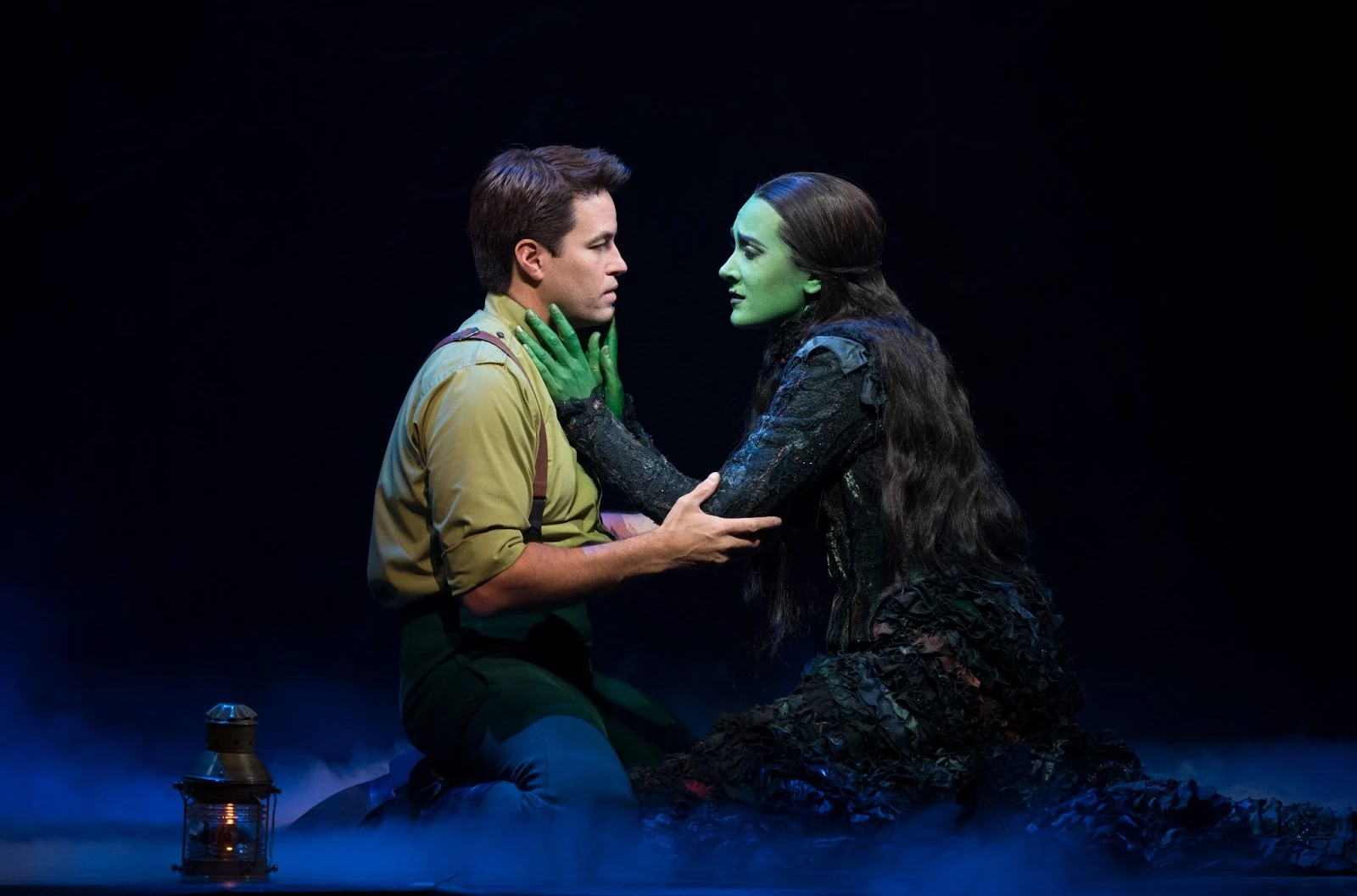
In the musical, Fiyero’s relationship with Sarima is omitted, so his and Elphaba’s relationship is simplified in that way. However, he first has a relationship with Glinda, since they seem like a perfect match when both are going by their surface-level personalities. The Fiyero-Elphaba chemistry ignites when he notices her courage and honesty. They rescue a caged lion cub from class together, cementing their bond. Of course, Elphaba leaves him behind when she denounces the Wizard, leaving him to sensibly stay with Glinda – for the time being.
In the musical and film, it’s very clear that Fiyero’s attraction to Elphaba stems from her integrity and her ability to challenge his stifling self-beliefs. She challenges him to be honest with himself and admit that he really cares deeply about the world, and his “carefree” attitude is just a front to protect his own feelings.
In the film, Elphaba arrives back in the Emerald City to liberate the flying monkey slaves on the same day as Fiyero and Glinda’s wedding, accidentally stopping it. This works out for Fiyero, who didn’t really want to marry Glinda anyway; instead, he joins up with Elphaba. Having been inspired by her dedication to justice and doing what’s right, and used his position as Captain of the Ozian guard to create a distraction and allow Elphaba to escape the Wizard. The two run away and share a brief moment of happiness, until Madame Morrible summons Dorothy’s house and kills Nessarose.
In the musical and film, he is saved by Elphaba’s passion and love as she casts a spell to save his life. In return, he comes back to the castle and helps her escape again after she faked her death. Together, they are able to pursue their higher goals.
Transformation into the Scarecrow
After helping Elphaba escape Oz, Fiyero is captured by the Wizard’s forces and strung up in a cornfield. In the novel, it is unclear whether the witch's spell saves him. She later encounters a scarecrow she believes is Fiyero, but it is revealed to be only straw. The moment raises questions about grief, delusion, and spiritual survival, symbolizing the novel’s theme of myth versus truth.

In the musical and film, the spell succeeds, though Elphaba does not know it.
To protect Fiyero from torture, her magic turns him into a scarecrow who cannot feel pain.
This literal transformation symbolizes the shedding of his royal duties, which he never aligned with anyway.
No longer does he need to rely on maintaining an image.
Instead, he can be entirely dedicated to his purpose and his love for Elphaba.
Fiyero’s Portrayal Across Different Mediums
Fiyero’s personality is adapted by each performer to mesh with the version of the story the entire ensemble aims to tell. Just like how there are several different ways Elphaba is typically portrayed on stage, Fiyero’s character is modified to emphasize certain aspects at the actor’s discretion. The movie also shows Fiyero in a unique light, leveraging the unique storytelling possibilities in film. Who are some of the most famous Fiyero actors?
Norbert Leo Butz - Broadway (2003-2004)
The original Prince Fiyero in the debut Broadway run, Butz’s portrayal emphasized humor, physical ease, and charm. He played Fiyero as restless, making the character’s eventual moral shift feel natural rather than abrupt. This portrayal set the template for the actors who followed.
Derek Klena - Broadway (2013)
Klena is a fan-favorite among Wicked stage musical enthusiasts. His version leaned more into emotional openness and sincerity, bringing a more approachable Fiyero to the stage. Klena highlighted his inner conflict earlier in the story, giving more weight to Fiyero’s growing attachment to Elphaba and sense of loyalty.
Jonathan Bailey - Film Adaptations
Bailey builds his film-adapted Fiyero upon the musical tradition, expertly using the medium’s strengths to deepen the role. The camera’s ability to focus on one actor up close and show subtle facial emotions is not wasted. Bailey uses expressions and emotional hesitation to reveal Fiyero’s inner conflicts, thoughtfulness, and motives beneath his shallow veneer. This version of the character is also able to explore the gradual closeness with Elphaba in a new way, thanks to the extended runtime over both films.
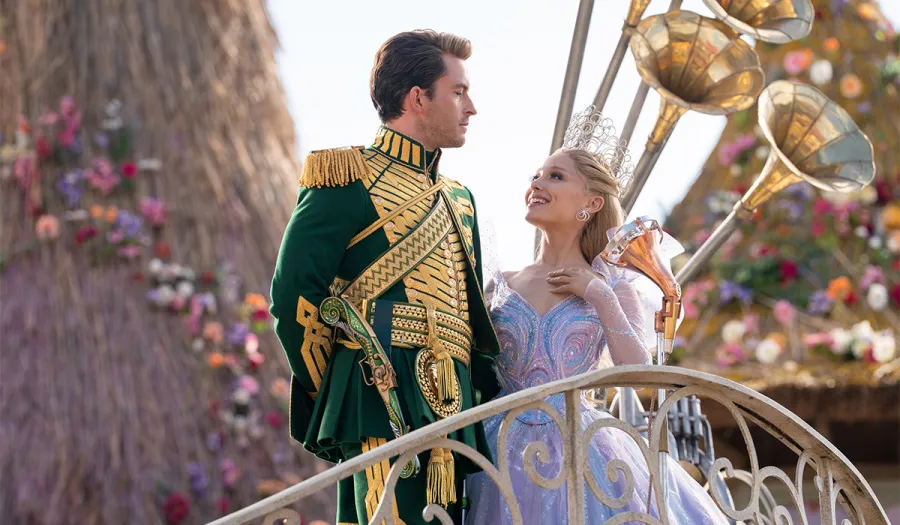
Thematic Significance of Fiyero’s Character
Each role in Wicked is a vehicle for tackling complex themes about humanity and society. Maguire used Prince Fiyero to talk about societal and cultural expectations, vulnerability and inner passions, and loyalty in relation to morality. He is also a symbol of transformation, of course, with a complex view.
Looking Beyond Appearances
Elphaba is the most obvious representation of the message to look beyond the surface to judge a person, but Fiyero is a subtle and relatable depiction. His outward attitude and appearance exude charm, effortlessness, and a cool carelessness that makes him popular. However, when examined further, it’s obvious the personality is a show of inner nihilism, a feeling of “nothing matters, so why bother worrying.” When examined even further, it’s seen that Fiyero feels lost inside. He uses his cool facade as a way to hide his true emotional depths, even from himself. He is afraid to admit how much he cares because it makes him vulnerable to the world around him.
Finding Direction
Fiyero is intrigued by Elphaba and chooses to stay with her because she sparked his awakening. Before, he was detached and afraid of feeling and caring; she inspired him to embrace his inner sense of duty and justice for good. Fiyero hadn’t had a true calling before, since his assigned burdens (being an Arjiki Prince, being charming, etc) weren’t things he really cared about. Elphaba shows Fiyero how he can be a champion of compassion and morality, even if others aren’t expecting it from you. This journey also shows how people are allowed to change over time as their insights and priorities change, especially when they choose honesty over comfort.
Loyalty and Morality
Many characters in Wicked are loyal to something, and use that attachment as a guidepost for their actions. Madame Morrible is loyal to the Wizard and his regime. Glinda is loyal to social norms and her role in them. Boq is loyal to Glinda, even though her affections are unrequited, and Nessarose is likewise loyal to Boq. But all of these characters’ loyalties can be described as misguided at best and immoral at worst.
The Wizard is loyal to himself, as is Elphaba, highlighting the opposite ends of self-loyalty.
Elphaba’s self-loyalty means she is dedicated to her righteous cause, even though it puts her in danger. Fiyero has the opportunity to be loyal to the Wizard, Glinda, societal expectations, or himself alone, especially when he becomes the Captain of the Guard. However, he realizes that’s not what he wants at all, and makes the difficult decision to embrace love and be loyal to Elphaba and her cause.
Dealing with Difficult Transformation
In the musical and movie, Fiyero’s transformation into the scarecrow highlights radical change and acceptance. He loses his body, but not his humanity. He loses everything he once had, but gains anonymity and freedom from physical harm, which perfectly suit the next steps in his journey. His change shows how sometimes dedication leads to irreversible and distressing change; it’s not for the faint of heart. However, if you’re truly dedicated to your cause, you can overcome the challenge in its name and thrive.
In the book, Fiyero was likely not turned into a scarecrow. Elphaba thinks for a moment that he was, but finds that the scarecrow she sees was just full of straw and not animate. His "transformation" into the scarecrow was symbolic, representing how people can live on in memories.
In the musical and movie "Wicked: For Good", he does turn into the scarecrow and accompanies Dorothy, the Tin Man (Boq), and the Cowardly Lion (the rescued cub from class) to the Emerald City so he can reunite with Elphaba.
In all versions, the change to Scarecrow symbolizes living on through history, story, and memory, rather than in a physical body.
Fiyero is one of the most compelling characters in Wicked, evolving from an aimless young prince to a committed partner, and finally, to a self-sacrificial scarecrow. His journey shows how a person’s life can drastically change when they make purpose-driven decisions. His character is a reminder that courage begins with paying attention and daring to care.
Summarize with AI:
Did you like this article? Leave a rating!

 Loading...