

Astronomy compels the soul to look upwards and leads us from this world to another.
Plato
The terms cosmology, astronomy, and astrophysics are often used together, sometimes even interchangeably. All three fields have to do with the study of the universe, but they each focus on different aspects. Each specialty focuses on a different realm of space; together, they can be used as different lenses to paint a fuller picture of the mysteries of the universe.
| Astrophysics | Cosmology | Astronomy | |
|---|---|---|---|
| Main Focus | Interactions between galaxies, etc. | Universe as a whole | Individual celestial objects |
| Primary Goal | Explain physical and chemical processes in space | Understand the universe's structure and history | Understand celestial bodies and their cycles, movement patterns, and qualities |
| Question Asked | How does it work? | Why is the universe the way it is? When did the universe begin? What will happen in the future? | What is out there? |
| Topics | Gravity, fusion, light, matter | Dark matter, expansion, the Big Bang | Planets, stars, galaxies, meteors |
| Methods | Physics-based modeling, observation | Large-scale data, Cosmic Microwave Background (CMB) radiation | Observation |
| Tools | Telescopes, particle detectors, spectometers, satellites, space probes | Mathematical models | Telescopes, spectroscopy, radio telescopes |
| Scale | Stars, planets, galaxies (generally, or specific ones and their relationships with each other) | Entire universe | Local to galactic space |
| Time Focus | Lifetime of a star; Stellar and galactic lifetimes | Billions of years; all time | Present and recent past |



What Is Astronomy?
Astronomy is the study of celestial objects and events outside of Earth’s atmosphere.
The Milky Way galaxy and celestial objects like comets, asteroids, stars, and several planets can all be observed with the naked eye. It’s harder now with all the light pollution and satellites orbiting the earth, but before electricity, everyone all over the world spent a lot of time gazing at the night sky and making observations over time.
Observation is still the primary method astronomers use to gather data. Now, however, there are more sophisticated tools at their disposal.
History of Astronomy
Astronomy is ancient. There is evidence that it has been practiced for as long as humans have been alive because you don’t need a massive space telescope to be an astronomer, nor do you need one to observe the Milky Way, celestial objects like comets and asteroids, and planetary systems and their orbits.
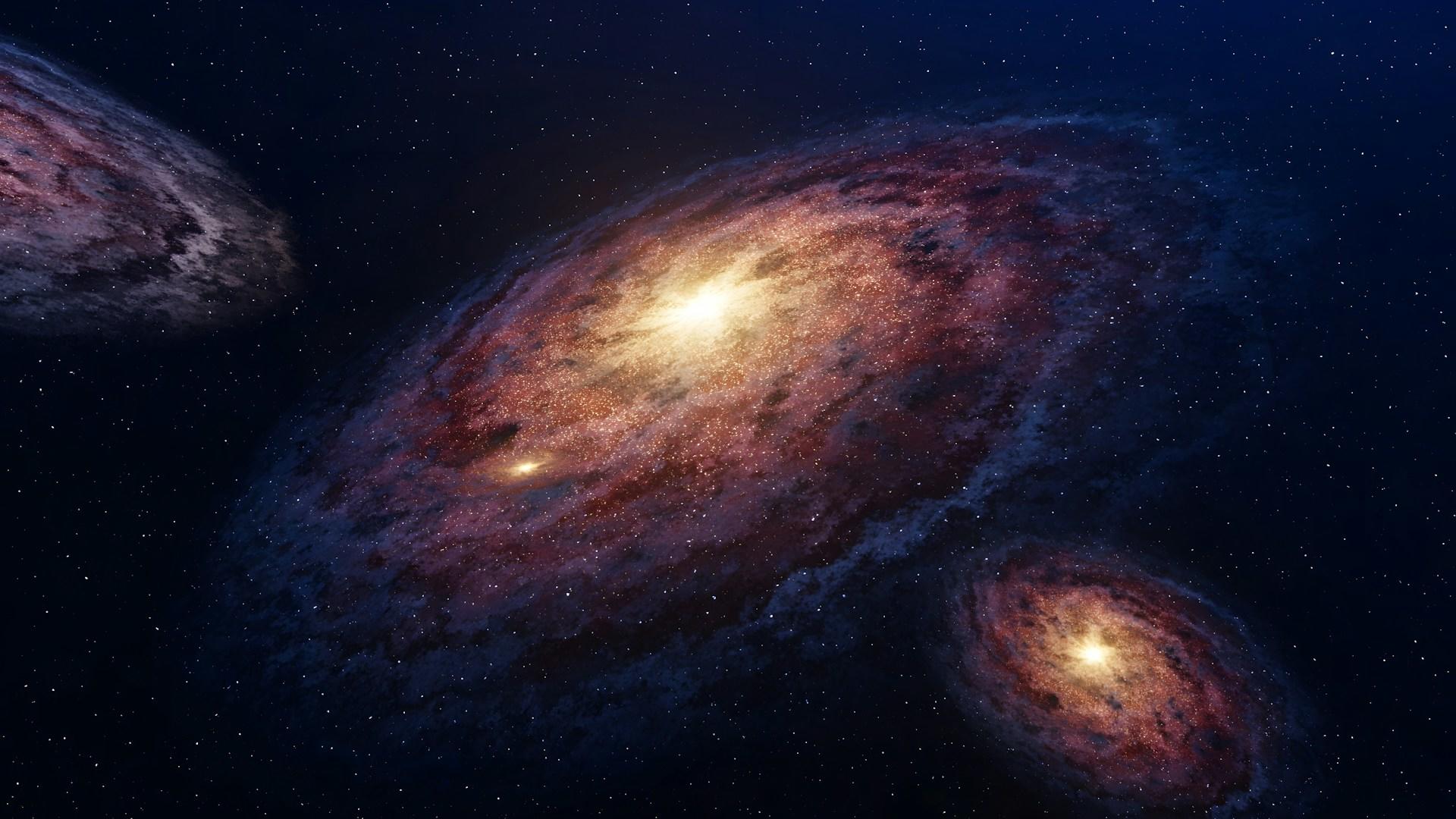
These are the things that are the object of an astronomer’s study. The methodology of observation is still the method that astronomers use – just in a much more sophisticated way.
The Ancient Greeks were excellent at astronomy. Aristarchus of Samos, back in the third century BC, for example, had already worked out that the Earth travels around the Sun – something that scientists didn’t confirm until the seventeenth century. Meanwhile, Eratosthenes used shadows to measure the size of the Earth – something he did with incredible accuracy.
And while we all know about the Greeks, the oldest calendar we know has been found in Aberdeenshire, Scotland. Known as the Warren Field calendar, it is made of twelve pits that correlate to the phases of the moon.
The Warren Field calendar is thought to be ten thousand years old.
Check out good physics tutors online.

Astronomy Today
In this sense, any investigation into the planets and universe – including stargazing and any studies that are ground-based – counts as astronomy.
These days, we just have better instruments with which to conduct such investigations. We are continuing to discover new planets, stars, and even galaxies. For example, the Voyager 1 became, in 2013, the first shuttle to pass Neptune and journey off into the interstellar medium beyond our solar system.
Pluto was the last planet discovered in 1930, but since 2006, it has been classified as a dwarf planet.
Scope and Focus
Astronomy exists to answer the questions “what exists in space?” and “where are the things in space located?”
Astronomers track observable data like movement patterns, brightness, distance, and composition of objects in space.
Astronomers observe:
- Earth’s moon and the moons of other planets
- Planets and exoplanets
- Comets, asteroids, and meteors
- Stars and their life cycles
- Galaxies and nebulae
Even before any advanced equipment was invented, ancient astronomers were using observations and calculations to discover realities about the world. In the 3rd century BCE, Aristarchus of Samos was able to determine that the Earth revolves the sun. Around this time, Eratosthenes was also able to calculate the size of the Earth and the axial tilt by measuring shadows. His conclusions were almost exactly what modern-day measurements conclude.
Ancient astronomy was also used to create calendars!
Many discoveries in astronomy come from analyzing large data sets that have been collected over long periods of time. The data is meticulously measured and recorded so that it can be used years later for further research. It takes a long time for many celestial bodies to move; for example, Pluto completes one revolution around the sun every 248 years, and it was discovered in 1930, so we have only observed about half of Pluto’s year so far.
Methods and Tools
Where ancient astronomy could be done with the naked eye, weak telescopes, and basic tools like sundials, modern astronomy relies on advanced technology. Astronomers focus on collecting data about what celestial bodies exist and where, and how they behave. Movement and physical features are the most relevant pieces of data.
The most common equipment includes:
- Optical telescopes
- Radio telescopes
- Space-based telescopes
These tools help astronomers understand the physical qualities of what they find, like size, shape, and topography.
Notably, astronomers also use spectroscopy, which analyzes light from other stars and galaxies. It helps provide information on the subject, such as the chemical composition, temperature, and speed and direction of movement.
Subfields of Astronomy
There are several subdisciplines in astronomy. Some of the most well-known are:
- Observational Astronomy: Gathering and analysing data from observations.
- Theoretical Astronomy: Developing models to explain astronomical phenomena.
- Radio Astronomy: Using radio waves to study celestial objects.
- Ultraviolet Astronomy: Observation of electromagnetic radiation at ultraviolet wavelengths.
- X-Ray Astronomy: Observation of electromagnetic radiation at X-ray wavelengths.
- Gamma-ray Astronomy: Observation of electromagnetic radiation at gamma-ray wavelengths.
- Galactic Astronomy: Study of the Milky Way galaxy.
- Extragalactic Astronomy: Study of everything outside of the Milky Way galaxy.
- Gravitational-Wave Astronomy: Detection and study of gravitational waves.
- Neutrino Astronomy: Gathers information about astronomical objects by collecting and observing the neutrinos they emit.
Astrology is not a science, but it has to do with observations about the movement patterns of celestial bodies. In ancient times, it went hand-in-hand with astronomy, since both were seen as scientifically viable subjects. However, astrology was found to be unscientific and separated from other studies in the 18th century. Astrology is a belief system that is sometimes tied to religion and spirituality; it has to do with zodiac signs, astrological charts, and divination.
Learn about our Solar System with a physics tutor in Charlotte.
What Is Cosmology?
So, where does that leave cosmology? If astronomy focuses on describing the positions and movements of space, and astrophysics on explaining its nature, what can be properly described as the cosmological?
NASA describes cosmology as the study of the ‘large scale properties of the universe as a whole’ – as opposed to astronomy that looks specifically at the objects in space.
However, this definition does not really give a full sense of everything that cosmology is and has been because cosmology has often overlapped with and been propelled by speculations in philosophy and metaphysics too – about the nature of the universe and its origins.
Search for a physics lesson tutor here.
Cosmology Throughout the Ages
The earliest philosophers, religions, and thinkers all proposed their own image of the universe – their own cosmology.
Take that which is known as the Hindu cosmology, which was proposed in the second millennium BC. It was believed here that the universe was infinite and cyclical, and that each world or cosmos would last eight billion years. Meanwhile, the cosmology of Ptolemy, the Greek thinker, described a universe with the Earth at the middle.

Science and Physical Cosmology
Yet, with the scientific epistemology that developed in the west over the last five hundred years, the metaphysical nature of cosmology has decreased.
Cosmology these days is more concerned with testing hypotheses regarding the origin, development, and future of the universe. Fairly predictably, one of its major concerns is the Big Bang – as well as the expansion of the universe and the nature of the early universe.
Given that, these days, cosmology is a science, it takes its data from astronomy and from astrophysics – as it needs observed material upon which to base its hypotheses.
Scope and Focus
Modern cosmology seeks to find the answers to the biggest questions we have:
- What is the origin of the universe?
- How big is the universe?
- How has the universe changed over time?
- How might the universe change in the future?
- Will the universe last forever, or will it eventually end?
Cosmologists think on a grand scale, in terms of light-years and eons. They piece together the story of the creation of the universe by observing how groups of planets and galaxies behave currently and extrapolate how they came to be in their current state. They study theories like the Big Bang, trying to piece together the mystery of how the universe formed and why stars, planets, and galaxies exist as they do.
Find out what cosmologists and astrophysicists think about extraterrestrial life.
Methods and Tools
Cosmologists use a lot of the same data as astronomers, but they interpret and use the data differently. Instead of focusing on the movement or physical qualities of individual celestial objects, they look for patterns among the web of all things in space to determine context on a larger scale.
In addition to the same methods astronomers use, cosmologists also:
- Analyze cosmic microwave background (CMB) radiation
- Conduct large-scale surveys of galaxies to understand the overall structure and distribution
- Build mathematical models and simulations based on general relativity
They use many computer simulation programs to test hypotheses, understand change over time according to existing data, and theorize about what could happen in the future. The simulations can demonstrate how different models of the universe might behave over time with different factors.
Key Concepts in Cosmology
Cosmologists are the scientists who have posited some of the most influential and game-changing theories about the universe. Since cosmologists are mostly researching the origins of the universe, they have come up with grand theories that can be difficult to comprehend unless you’re well-versed in the science of space and time
The Big Bang Theory
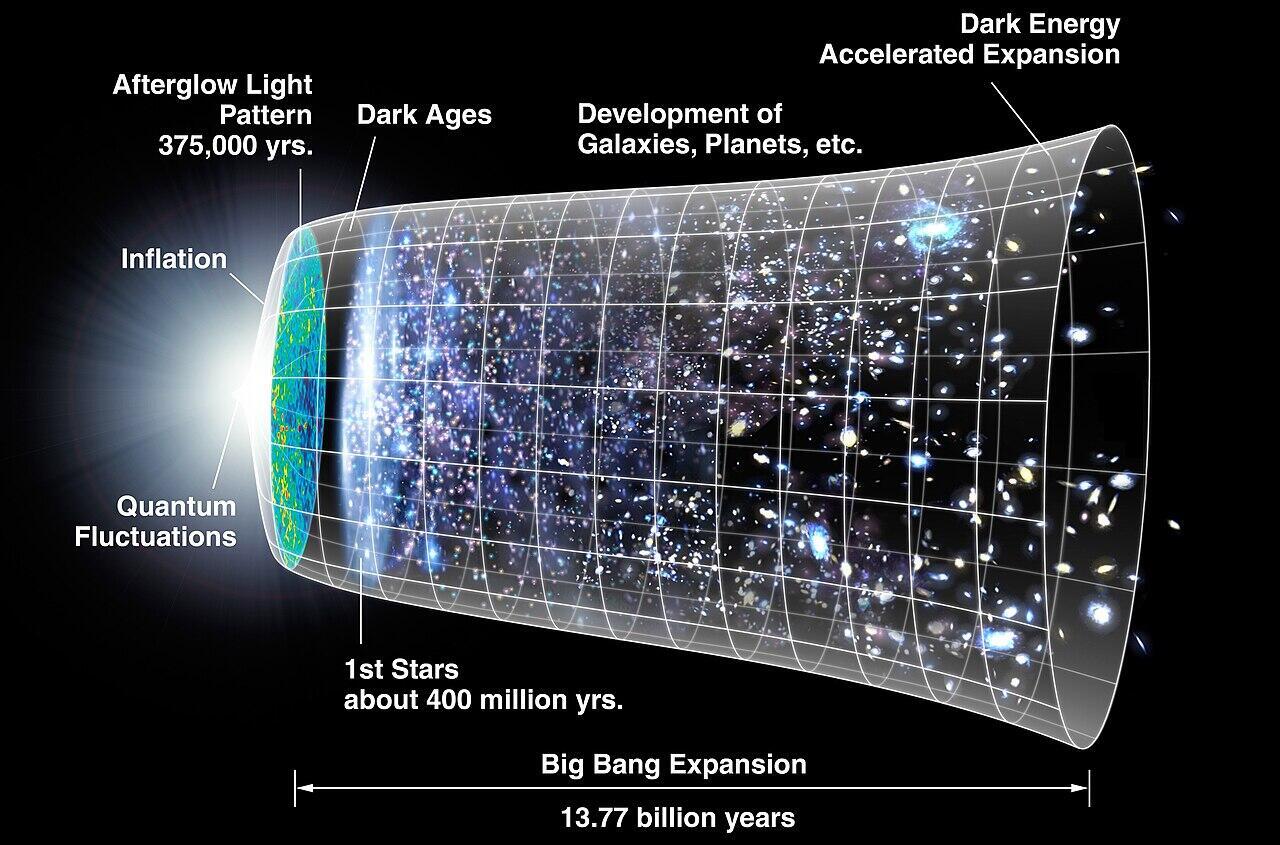
Probably the most well-known cosmological concept, the Big Bang Theory suggests that everything in the universe once began as a tiny, hot, dense point that rapidly expanded. It says that everything in the universe is still expanding outward from one central point where it all began. It’s supported by multiple types of evidence, including CMB radiation and observable galaxy expansion. It combines observational astronomy and particle physics.
Dark Matter and Dark Energy
These theoretical concepts are used as a way to explain how and why galaxies form and move. They are not directly observable, but their existence can be implied from other data. They are critical in the Lambda-CDM model of cosmology. Together, they make up most of the universe’s total mass and energy.
Expansion of the Universe
Dark energy is a key component in the accelerated expansion of the universe. Observations show that the universe is constantly expanding, with galaxies moving away from one another. This discovery has changed the way scientists understand time, distance, and cosmic history.
While physical cosmology focuses solely on the scientific data associated with mapping the universe and determining its factual history, philosophical, religious, and mythical cosmology disciplines focus on the non-scientific parts. There is great value in contemplating the meaning of it all on a spiritual level, especially in an anthropological sense.
What Is Astrophysics?
We’ve seen that astronomy is the broadest discipline when it comes to studies of space. Astrophysics is a subdiscipline of astronomy, essentially, which combines – you’ve guessed it – physics and astronomy.
If astronomy maps the positions and movements of astronomical objects, astrophysics uses the laws of physics to describe and explain their nature.
Using Physics to Understand Space
Physics is concerned with:
- Atomic and Molecular Physics
- Nuclear Behavior
- Quantum Physics
- Relativity
- Thermodynamics
Sure, these are all things that are relevant to the Earth and that were developed through study and knowledge of the nature of the Earth and its physical properties. But space offers a larger arena in which to study them – as well as a whole lot of other things.
By looking at black holes, we push our knowledge of gravity further. By looking at dark matter and dark energy, we need to apply our knowledge of subatomic particles and particle physics.
But there is so much that we don’t understand about space that astrophysics is often highly theoretical. Dark matter in itself, while quite famous as a phenomenon, is entirely speculative: we have not found any evidence that it exists.
For a deeper understanding, you might consider resources like physics tutors near me.
The History of Astrophysics
While astronomy has been around since the beginning of human civilization, this is not quite true of astrophysics.
This discipline was only named as such in the mid-nineteenth century, when Joseph von Fraunhofer began to use spectroscopy – the study of spectra – to draw conclusions about the material nature of stars.
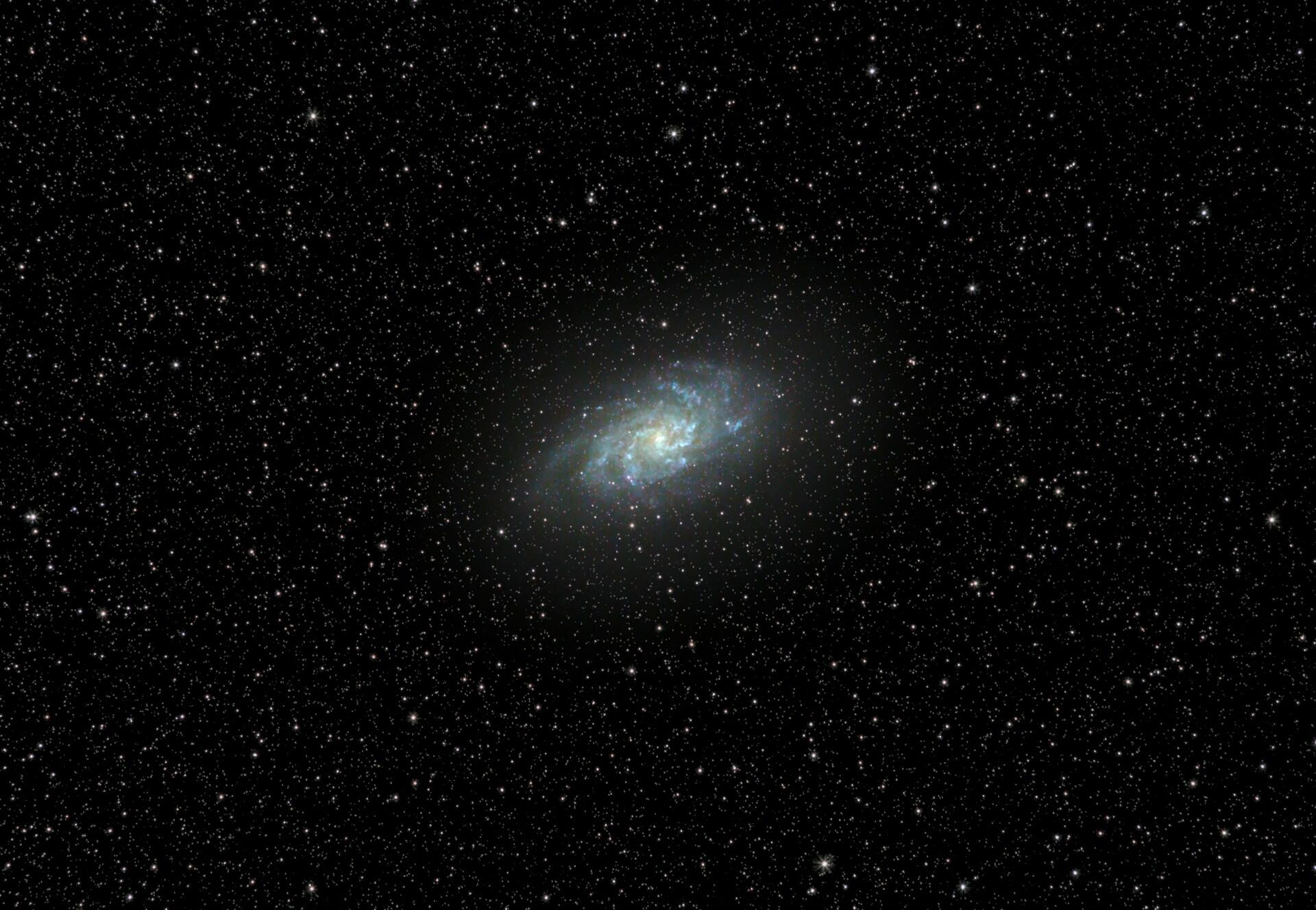
Since then, the study of astrophysics has become increasingly distinct from astronomy, with the majority of new discoveries about space occurring in astrophysics.
Do you know how a star is formed? Find out here!
What Are the Main Differences Between Cosmology, Astronomy, and Astrophysics?
The three major disciplines that involve the study of space are astronomy, astrophysics, and cosmology. And, as we said, while they are profoundly symbiotic – in the sense that a cosmologist couldn’t do her job without the data provided by an astrophysicist – the differences between the three disciplines are important. Here's a closer look at the difference between astrophysics vs cosmology vs astronomy.
- Cosmologists: Study the origins and development of the universe
- Astronomers: Employ observational methods to evaluate and classify celestial objects, but their scope encompasses the broader study of space.
- Astrophysics: Focuses on the physics governing space, blending principles from both physics and astronomy to delve deeper into our understanding of the universe
Someone studying space does not limit themselves to one of these three disciplines. Rather, cosmology, astrophysics, and astronomy are what people do, rather than being something that they are.
Let's take a further look at how these disciplines differ from one another.
Cosmology vs. Astronomy
Astronomy focuses on the study of objects and events beyond Earth, while cosmology is a specialized field within astronomy that examines the universe's origin and development. Topics such as the Big Bang, the formation of chemical elements, and the cosmic microwave background are central to cosmology.
- More theoretical than observational astronomy
- Has elements of physics and philosophy
- All about how it all began and where it's going
- Uses observational techniques, like telescopes and spectroscopy
- Might include planetary science, stellar evolution, and galactic dynamics
- All about what's "out there"
Check out some of the most important discoveries in astronomy.
Astronomy vs Astrophysics
Astronomy primarily delves into the realm of space, with astronomers often specializing in specific cosmic domains like planets, stars, or moons. Their overarching curiosity extends to the vast expanse of the universe itself. On the other hand, astrophysicists concentrate exclusively on the physics governing space and the intricate interplay between its various components.
- Umbrella term that encompasses various fields of study
- Observational and empirical
- Focuses on defining the what and why
- Uses physics and math to understand the celestial
- Theoretical and quantitative
- Focuses on how things work
Learn More About Astronomy, Astrophysics, and Cosmology with Superprof
Did you enjoy reading about the difference between astrophysics and cosmology and astronomy? Perhaps you're weighing the pros and cons of becoming a cosmologist vs astrophysicist. Astronomy, astrophysics, and cosmology offer distinct yet fascinating insights into the universe. With Superprof, you can delve deeper into these subjects, gaining personalized guidance and expanding your understanding of the stars and beyond. Whether you're interested in the mystical aspects of astrology or the scientific principles of astrophysics and cosmology, Superprof provides expert tutors to support your learning journey.
Sign up and start your learning journey with Superprof today!
You can also consider getting physics tutoring nyc to help you gain a comprehensive introduction to everything about space, enhancing your understanding of astronomical concepts and the universe.
Summarize with AI:
Did you like this article? Leave a rating!

 Loading...
Good analysis explaining differences of the three+how they relate.
Not expecting your reply. Best wishes
A very good presentation. Educative, informative. Thank you very much.
Thank you for the comment, Mathew! 😊
Yes being that astronomy and cosmology are two different things the only favorite things that I can think of is cosmology for a fact that it’s bigger and explores more planets and planetary travel in space travel as it has been done by very many astronauts in the past and supposed to be even more extra solar plans to be traveled and discovered later on.