


It’s easier than ever for children to slip into sedentary lifestyles. Gadgets and devices incentivize kids to stay indoors, video games consume large chunks of time (for people of all ages), and unfortunately, sending your kid outside is beginning to feel riskier and riskier.
But, it’s still important for children to get lots of physical exercise for their physical and mental well-being. Gymnastics for kids can be a great way to help your child grow strong muscles and bones, ensure proper physical development in their body systems, gain confidence in their abilities, make friendships, and even take care of their mental health.
Here’s what you need to know about introducing your child into the world of kids' gymnastics!





What Is Gymnastics?
Gymnastics is a sport that combines different physical movements demanding coordination, endurance, flexibility, balance, and strength.
It’s believed that the first iteration of gymnastics was created by the Ancient Greeks as a practice to keep their minds and bodies sharp for war and the Olympics. Since then, it’s become a way for some people to have fun and for others to practice a serious competitive sport.
If your child has big dreams of doing gymnastics at a competitive level, starting them in classes before age 10 is advantageous. The earlier a child begins, the better their chances of being able to master the skills needed to compete.
There are seven official types of Gymnastics:
- Artistic gymnastics: A display of artistic movements where athletes perform short routines on various apparatuses, like the vault, uneven bars, parallel bars, balance beam, pommel horse, still rings, and floor mat.
- Rhythmic gymnastics: The performance of various exercises using skills from ballet, gymnastics, and dance, and using apparatus like ropes, balls, clubs, hoops, and ribbons.
- Trampoline gymnastics: Acrobatic movements performed while jumping on a trampoline. The trampoline can be a circle or a long track. The movements range from jumps in the straddle, tuck, and pike position to complex combinations of somersaults and twists.
- Tumbling and Power tumbling: A series of movements performed down the length of a track consisting of skills like whips, somersaults, back handsprings, and roundoffs.
- Acrobatic gymnastics: A team sport comparable to the athletic parts of cheerleading routines, consisting of lifting each other into the air.
- Aerobics gymnastics: A combination of gymnastic skills with dance in a fun and fast-paced gym sport and can be done solo or in teams.
- Parkour: The newest type of recognized gymnastics, it’s also called freerunning and consists of feats of agility, strength, and quick-thinking.
Gymnastics can be performed for recreational purposes as it is a fun and engaging activity. Moreover, it can also be performed in competitions like the Olympics.
When to Enroll Kids in Gymnastics
When can kids start gymnastics?
When you see what an experienced gymnast can do, you might think there’s no way that gymnastics classes can be suitable for children! But, remember, everyone starts somewhere!
Even Olympic gold medalists like Simone Biles and Paul Hamm started as beginners when they were children (Paul at age 9, Simone at age 6).
So, how do you know what age to start gymnastics?

The Best Age to Start Gymnastics
Kids can start gymnastics at a very early age! Gymnastics classes for kids are specifically designed to be age-appropriate, so you won’t have to worry about your child performing moves that are beyond their skill-levels. Moreover, the kids gymnastics teachers are also trained to work with children and ensure they feel confident and comfortable in casual classes.
The best age to start gymnastics is either when they show interest in the activity or when they’re old enough to decide to give it a try.
Some gymnastics teachers even offer classes for kids as young as 18 months! Of course, a parent is also involved and there are no cartwheels, but the classes can help babies learn better proprioception and build a better bond with their caregiver.
More often, parents will enroll their child in their first kid's gymnastics classes between ages 6 and 10, when they have a better understanding of their physical abilities. Most successful gymnasts begin their training around this time, so if you want your child to have a chance at competing in the sport, this is a good age to begin.
If your child is older, they can still start taking gymnastics at any time! Even you can, if you want!
There is no age limit to beginning to learn gymnastics. You just need to find a teacher or class that suits your needs.
The older the child, the less chance they have of competing in gymnastics professionally later on, but gymnastics is an enjoyable, fulfilling way to stay healthy and have fun at any age.
Most children take their first gymnastics class between ages 6 and 10.
What Gymnastics Classes Are Best for Kids?
There are beginner-friendly and kid-friendly versions of each of the seven types of gymnastics mentioned earlier.
But, tumbling is probably the easiest to approach, since it doesn’t take any special equipment to learn the basics like somersaults, cartwheels, handstands, and rolls.
Many people also find the basics of rhythmic gymnastics easy and fun to learn, followed by artistic gymnastics and aerobic gymnastics.
Trampoline and acrobatic are more difficult for kids since they have a more dangerous element. Parkour can be easy for some and more difficult for others. Even babies can "practice" Parkour, because in essence it's just interacting with your environment in different ways, like crawling and walking on all fours.
Many kids gymnastics instructors will teach a little bit of the basics of several different types so kids can discover which type excites them the most!
Kids typically begin any or all of these types of classes between ages 6 and 10. Which class you enroll your child in depends on their unique interests and abilities. It can be great to have them join a generic "gymnastics class" that introduces aspects from each style of gymnastics to the children, so they can see which type is the most interesting!
It's also common for kids to change disciplines or practice more than one style of gymnastics.
What Are Some Typical Gymnastics Moves for Kids?
In a children’s gymnastics class, the instructor will likely teach a variety of age-appropriate movements and skills. Here are some of the most typical gymnastics moves for kids in a beginner class depending on their age levels.
6 - 8 months
- Arm strength
- Bear crawls
- Being upside down
- Sit ups
- Wheelbarrow walks
18 months - 5 years
- Balance on one foot
- Bridge
- Donkey kicks
- Hanging from a bar
- Jumping jacks
- Log roll
- Somersault
- Straddle sit
5 - 12 years
- Back Bend
- Backward roll
- Bar Pullover
- Candlestick
- Cartwheel
- Handstand
- Headstand
- Roundoff
- Splits
- Split leap
- Turns and pivots
Teachers of gymnastics for kids typically teach these skills and more in a fun way through games and activities. Little gymnasts start learning the basics through play that they can even do at home! You can play some of these games with your child before enrolling in a gymnastics class to see if they enjoy this type of physical challenge.
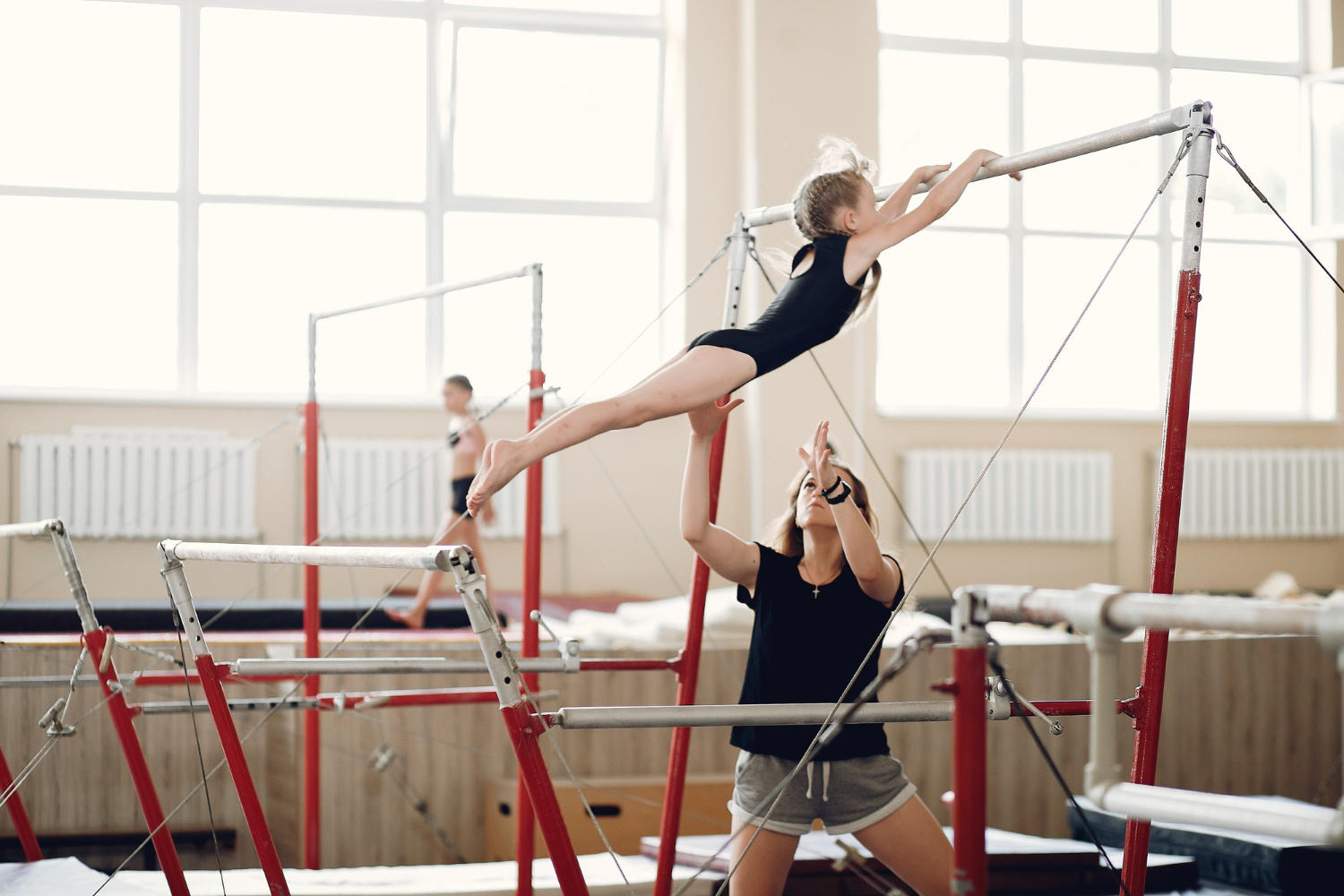
Here are some common games for kids to practice gymnastics.
Obstacle Course
Simple obstacles are set up in a path. In a gym, the instructor might create a course that goes like this:
First, run to the spot on the floor, then hop from spot to spot until you get to the floor-level balance beam. Walk across the balance beam to the wedge. Climb the wedge and roll down the other side. Skip to the ribbon and make 10 circles with it in the air. Then, do a cartwheel before coming back to start and sitting in a straddle.
At home, you can set up something similar using pillows, books, stuffed animals, and other household objects.
Simon Says
This simple and classic kids game can be used as a great gymnastics tool. The leader calls out poses or actions the kids have been learning, such as jumping jacks, pike sit, log roll, balancing on one foot, etc.
Skill Challenge
Stations will be set up for different activities and the kids spend one minute at each station, practicing each skill. Skills can include things like handstands or wall walk-ups, forward rolls, balancing, ribbon twirling, hopping around cones, and other simple exercises.

Benefits of Gymnastics for Kids
Beginning to learn and practice gymnastics at a young age has several benefits. It’s not important that your child achieves a certain level of mastery or competes; simply participating in a fun physical activity is important for their development and well-being.
In fact, it’s not always a good idea to approach an activity expecting it to be something your child wants to do competitively. Sometimes, kids just want to have fun! It’s the same for us adults. Would you want to go to your Zumba class if the expectation was to win the Zumba championship? Sometimes, you just want to enjoy the activity.
Some benefits that your child can experience by learning gymnastics include:
- Developing excellent strength, coordination, endurance, balance, and flexibility
- Cultivating cognitive, social, and emotional development
- Learning concentration, discipline, organizational skills, and time management
- Building self-esteem and confidence through improving skills over time and performing in front of others
- Establishing healthy physical and mental habits for the future
Jump off the beam, flip off the bars, follow your dreams and reach for the stars.
Nadia Comaneci
Gymnastics Safety Concerns for Kids
Of course, safety is everyone’s number one priority when it comes to kids performing physical stunts. Professional kids gymnastics coaches and instructors know how to make sure each child in their care is safe when practicing skills.
Children are naturally a lot more bendy, stretchy, and resilient than adults. In an average class, the risk of injuries in young kids is a lot lower than if a group of students over the age of 35 was doing the same things.
A good coach will teach kids how to protect themselves from sudden injury as well as injuries that occur over time, like failing to protect the back properly or locking the knees.
For beginner’s gymnastics, kids are very unlikely to get hurt. In more advanced classes, they will need individual attention to ensure they learn how to perform new moves safely and confidently before they can try them on their own.
A good gymnastics coach will be a great spotter for your child and ensure they don’t get harmed.
Find Kid's Gymnastic Classes on Superprof
Ready to get your child started in gymnastics at a young age? Find “kids gymnastics near me” and more easily when you search for kids gymnastics teachers on Superprof!
Find online and in-person kids gymnastics coaches who have experience with all different age levels and skill levels.
With several Superprof gymnastics coaches offering group classes, your child can learn this great physical sport while making new friends and strengthening their interpersonal skills, too.
Find gymnastics classes in Los Angeles or wherever you are today on Superprof!
Summarize with AI:
Did you like this article? Leave a rating!


 Loading...
hi I’m sophie and I like well LOVE gymnastics. it is so fun!
Hi Sophie! We’re so happy you liked the article and love gymnastics! If you would like to practice more, feel free to reach out to one of the many expert Superprof gymnastics tutors today! 🤸♀️
Hi im taylor and I’m 10 and as was reading it looms so much fun for me
Hi Taylor! We’re happy you enjoyed the article 😊