

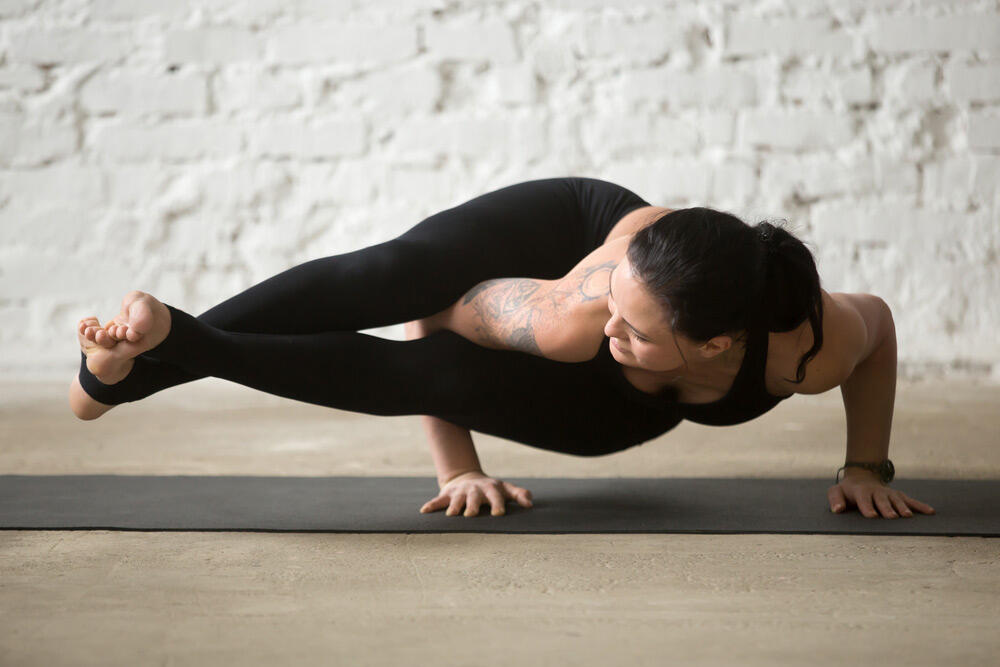
Eight angle pose (Astavakrasana) is an advanced arm balance with a twist. You hook one leg over your upper arm, cross your ankles, and extend both legs to the side. Your elbows bend and your chest leans forward, like a sideways plank on your hands.
It builds strength in the arms, core, and back. That said, it rewards patient preparation more than raw power. Here are the steps, the lead-up poses, prop tricks, and clear safety limits.


What Kind of Pose Is It?
Ray Long, MD, a board-certified orthopedic surgeon and yoga teacher, describes it as a twist and an arm balance in one. Your arms sit in a position close to Four-Limbed Staff Pose (Chaturanga Dandasana). If that pose feels solid, parts of this one will feel familiar.
Quick facts
The Pose at a Glance
| Detail | Information |
|---|---|
| Sanskrit name | Astavakrasana (ahsh-tah-vah-KRAHS-ah-nah) |
| Pose type | Asymmetrical arm balance with a twist |
| Level | Advanced; build core and back strength first |
| Useful props | Yoga blocks, a bolster |
| Strengthens | Arms, wrist extensors, core, back, and thighs |
| Skip it if | You have a wrist, elbow, or shoulder injury |
Sources: Yoga Journal, with anatomy notes from orthopedic surgeon Ray Long, MD. Full references in the Sources section.
Yoga Journal’s advice is clear: build core and upper-back strength before you try it. The stronger you are, the less weight dumps into your shoulders, elbows, and wrists.
What Does the Sanskrit Name Mean?
In Sanskrit, asta means eight, and vakra means bent or curved. The pose honors Ashtavakra, a sage from Hindu tradition whose name means “eight bends.” Mythologist Devdutt Pattanaik retells his story.
While Ashtavakra was still in the womb, he corrected his father Kahoda’s Vedic recitation eight times. The angry father cursed him to be born with eight bends in his body. Later, a scholar named Vandin defeated Kahoda in a debate at King Janaka’s court and enslaved him. Young Ashtavakra challenged Vandin, won, and freed his father.
Bends in the sage’s body
8according to the legend of Ashtavakra, who gives the pose its name
Which Poses Prepare You for It?
Preparatory poses work the shoulders, abs, arms, and legs the same way the full balance does. Yoga Journal recommends these:
- Four-Limbed Staff Pose (Chaturanga Dandasana): Builds the bent-elbow strength the arm balance relies on.
- Extended Side Angle (Utthita Parsvakonasana): Works the legs and side body.
- Lizard Pose (Utthan Pristhasana): Opens the hips for the leg hook.
- Crow Pose (Bakasana): Teaches you to balance with your weight tipped forward.
- Side Crane (Parsva Bakasana): Adds the twist on top of the balance.
Tight hamstrings make the leg hook harder. Standing Forward Bend (Uttanasana) and Downward-Facing Dog (Adho Mukha Svanasana) stretch them. Seated Forward Bend (Paschimottanasana) makes a good counter pose.

How Do You Do Eight Angle Pose?
Start seated in Staff Pose and hook your right knee over your right shoulder. Plant your hands, lift your hips, and cross your ankles. Then bend your elbows, lean forward, and extend your legs right.
Step by step
The Pose in Five Steps
| Step | Action | Key cue |
|---|---|---|
| 1 | Sit in staff pose and hook your right knee over your right shoulder | Grip the arm with your calf and inner thigh |
| 2 | Place your hands beside your hips, shoulder-width apart | Lean slightly forward |
| 3 | Press down and lift your hips and left leg | Lift with your abs, not your arms |
| 4 | Cross your ankles, bend your elbows, and swing your legs right | Squeeze your thighs around your arm |
| 5 | Straighten your legs, breathe, then exit and switch sides | Press out through your heels |
Based on the step-by-step technique published by Yoga Journal.
Step 1: Hook Your Leg
Sit in Staff Pose (Dandasana) with both legs straight. Bend your right knee, draw the thigh out to the right, and bring the knee over your right shoulder. Press the leg firmly into your arm. If it won’t reach your shoulder, hold it with both hands as high as is comfortable.
Step 2: Place Your Hands
Tilt slightly forward and set your hands on the floor beside your hips, about shoulder-width apart. Keep gripping your right shoulder with your right calf and inner thigh.
Step 3: Lift Your Hips
Press your hands into the mat. Engage your abdominal muscles to lift your hips and your left leg off the floor. Draw your navel toward your spine as you lift.
Step 4: Cross and Lean
Hook your left ankle over your right ankle and press the ankles together. Draw your inner thighs toward your upper arm. Then bring your chest forward and bend your elbows while you swing your legs to the right.
Step 5: Extend, Breathe, and Exit
Press through your heels to straighten your legs, and keep breathing. To come out, inhale, lift your chest, and swing your legs back to the center. Exhale, uncross your ankles, and return to Staff Pose. Repeat on the left side.
beenhereBeginner’s tipKeep your torso upright rather than leaning forward while you learn. It makes the balance easier. If balancing still feels hard, rest your bottom hip and leg on a bolster.
Which Alignment Cues Help Most?
Small actions make a big difference. These come from Yoga Journal’s teachers, including Amy Ippoliti and Ray Long:
- Squeeze your thighs: Pressing them together helps you float up. The bottom leg tends to lag, so press it firmly against your upper arm.
- Keep your shoulders back: The weight of your legs may push your shoulders down. Actively draw them back so they don’t get overpowered.
- Hug your elbows in: Hold them close to your torso, as you would in Chaturanga.
- Lock your feet: Turn your feet slightly outward while you try to pull them apart. This locks the ankles and draws the legs deeper into the twist.
I suspect coming into the pose has to do with equal parts smart sequencing, arm and core strength, reaching through your heels, breathwork, humor, and relentlessness.
Renee Schettler, senior editor, in Yoga Journal
How Can Props and Progressions Help?
You don’t need the full shape on day one. Props and simpler versions build strength safely.
Use Yoga Blocks
Place two blocks at their lowest height under your hands. The extra height gives you more space to lift your hips and legs.

Try Side Crane First
If your hamstrings are tight, practice Side Crane (Parsva Bakasana) instead. It builds the same arm strength, with your elbows drawn in as in Chaturanga.
Progress in Stages
Start by lifting your feet with your torso upright. When that feels steady, slowly lean your torso forward while your legs stay lifted. Last, extend your legs out to the side. Stay at each stage as long as you need.
What Are the Benefits?
The pose strengthens your back, arms, and abdominals and stretches the back body and the backs of the legs. Yoga Journal lists these benefits:
- Upper-body strength: It works the chest, arms, and wrist extensors on the backs of the wrists.
- Wrist balance: It stretches the wrist flexors, which helps counteract long hours of typing.
- Core and legs: It strengthens the core and thighs.
- Spinal twist: It adds a twist to the lower spine.
- Posture and focus: It improves posture and body awareness.
These benefits come from teachers, not trials of this single pose. Most yoga research tests full programs.
What Common Mistakes Should You Avoid?
Most problems come from rushing. Watch for these habits:
- Skipping the warm-up: Complex poses need preparation, so move mindfully.
- Lifting with your arms: Use your abdominal muscles to raise your hips.
- Dumping weight into the joints: Without enough strength, your shoulders, elbows, and wrists take the load.
- Placing your hands too close: Set them about a foot in front of your hips so your elbows can bend.
Who Should Avoid This Arm Balance?
Yoga Journal advises avoiding the pose if you have any wrist, elbow, or shoulder injury. Your hands and arms carry your whole body weight here.
The National Center for Complementary and Integrative Health (NCCIH) calls yoga generally safe for healthy people who practice properly with a qualified instructor. Still, people with preexisting injuries, severe high blood pressure, balance issues, or glaucoma may need to modify poses. Pregnant people and older adults should talk with their health care provider first.
beenhereStop if it hurtsCome down right away if you feel pain in your wrists, elbows, or shoulders. Rest, then return to the preparatory poses before you try again.
Sources
- "Eight-Angle Pose: How to Practice Astavakrasana," Yoga Journal, 2025. Available at: https://www.yogajournal.com/poses/eight-angle-pose/. Accessed 28 Sept. 2026.
- Pattanaik, Devdutt. "A Body with Eight Bends." Mid-day, 10 Nov. 2019. Available at: https://devdutt.com/a-body-with-eight-bends/. Accessed 28 Sept. 2026.
- "Yoga: Effectiveness and Safety," National Center for Complementary and Integrative Health, National Institutes of Health. Available at: https://www.nccih.nih.gov/health/yoga-effectiveness-and-safety. Accessed 28 Sept. 2026.
Summarize with AI:
Did you like this article? Leave a rating!

 Loading...

