


Basic geometry equations turn a shape’s measurements into its perimeter, area, or volume. For perimeter, you add the side lengths, so a triangle’s is P = a + b + c. For area, you multiply: A = lw for a rectangle, A = ½bh for a triangle, and A = πr² for a circle. Each formula below comes with a worked example and its units.
More than 2,200 years ago in Syracuse, Sicily, Archimedes trapped π between two polygons. He fitted regular 96-sided figures inside and outside a circle and compared their perimeters. That showed π lies between 3 10/71 and 3 1/7, or roughly 3.1408 and 3.1429. The same habit of building hard shapes from simple ones runs through every formula here.
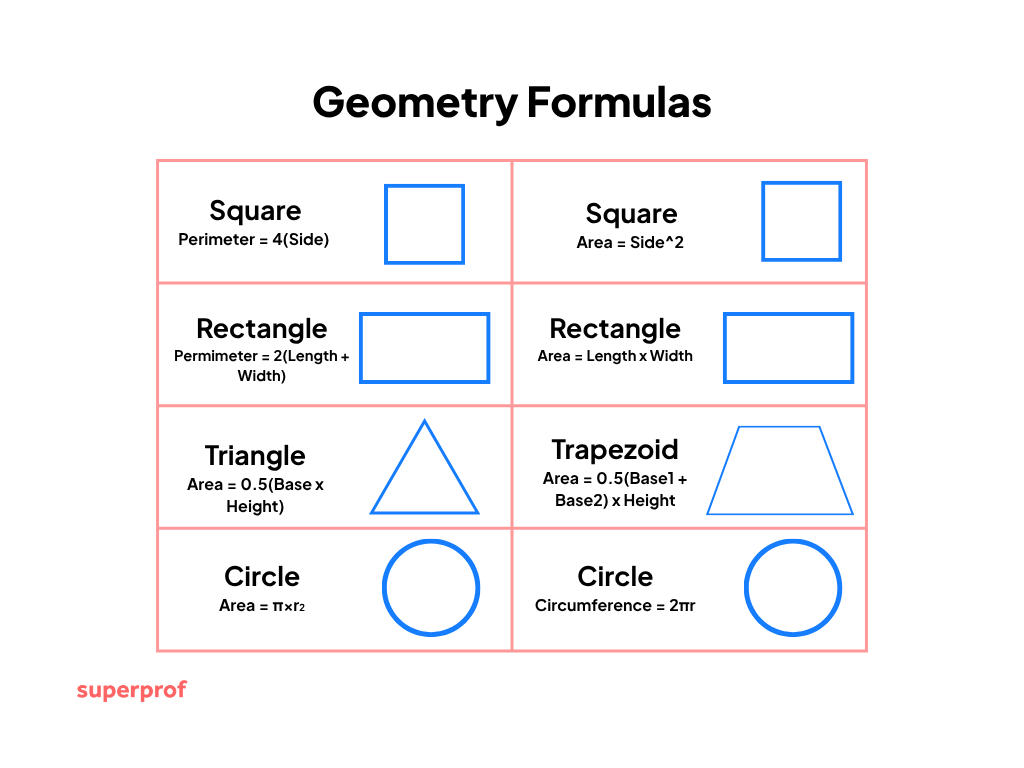


The Basic Shapes and Their Properties
Circles, triangles, and squares are the shapes most people picture first. Every flat figure in this guide belongs to one of four families:
- Triangles have three sides. All three can be equal (equilateral), two can be equal (isosceles), or none can be (scalene).
- Quadrilaterals have four sides. Squares, rectangles, rhombuses, parallelograms, and trapezoids all belong here.
- Polygons are closed shapes with straight sides, such as pentagons, hexagons, and octagons. Triangles and quadrilaterals are polygons, too.
- Circles form a class of their own, because they have no straight sides at all.
Each family has members with special properties. These details decide which formula you can use:
- A square has four equal sides and four right angles.
- A rectangle has four right angles and two pairs of equal, parallel sides.
- A parallelogram has two pairs of parallel sides, and its opposite sides and angles are equal.
- A rhombus is a parallelogram with four equal sides.
- A trapezoid has one pair of parallel sides, called its bases.
- A right triangle has one 90-degree angle, and the side opposite it is the hypotenuse.
Each of these shapes has its own formulas for perimeter, area, and angles. The sections below work through them one family at a time.
How to Find the Perimeter of a Triangle
A triangle’s perimeter is the sum of its three sides: P = a + b + c. For a triangle with sides of 3 inches, 4 inches, and 5 inches, the perimeter is 3 + 4 + 5 = 12 inches. That triangle is scalene, since no two sides match.
It is also a right triangle, because 3² + 4² = 9 + 16 = 25, which equals 5². That same rule is the tool you need when one side is missing.
Using the Pythagorean Theorem to Find a Missing Side
The Pythagorean theorem states that a² + b² = c² in any right triangle. Here, a and b are the two shorter sides, called legs, and c is the hypotenuse. Common Core standards introduce it in 8th grade. Say one leg is 5 in., the hypotenuse is 7 in., and the other leg is unknown:
- Write the theorem with the known values: a² + 5² = 7².
- Square the numbers: a² + 25 = 49.
- Subtract 25 from both sides to isolate the unknown: a² = 24.
- Take the square root: a = √24 ≈ 4.90 in.
For a triangle without a right angle, draw the height from the top vertex down to the base. That splits it into two right triangles. Say the base is 21 in. and the 8 in. height meets it 6 in. from one end. The sides are √(6² + 8²) = 10 cm and √(15² + 8²) = 17 in.. So the perimeter is 10 + 17 + 21 = 48 in..
The same rule finds the distance between two points on a graph. From (1, 2) to (4, 6), the distance is √(3² + 4²) = 5 units. If you would like guided practice, you can also explore online math classes on Superprof.
How to Find the Area of a Triangle
The everyday formula needs only the base and the height: A = ½bh. For the 21 in. by 8 in. triangle above, A = ½ × 21 × 8 = 84 in². The height must be perpendicular to the base, not a slanted side.
When you know all three sides but not the height, use Heron’s formula. Heron of Alexandria proved it in the first century AD. It works in two steps:
- Find the semi-perimeter: s = (a + b + c) ÷ 2. For sides of 10, 17, and 21 in., s = 48 ÷ 2 = 24.
- Apply A = √(s(s − a)(s − b)(s − c)) = √(24 × 14 × 7 × 3) = √7,056 = 84 in².
Both methods give 84 in², which is a handy way to check your work. If you know two sides and the angle between them, use trigonometry instead: A = ½ab sin C. With sides of 8 in and 10 in and a 30° angle, A = ½ × 8 × 10 × 0.5 = 20 in².
Lowercase letters are sides, and uppercase letters are the angles opposite them. With sides a and c, you need angle B, which sits between them. If you study in the Beehive State, you can also search for a math tutor Utah for one-to-one help.
Perimeter is a length, so it uses plain units such as in. Area uses square units (in²), and volume uses cubic units (in³). If your units don’t match the question, a step went wrong.
Perimeter and Area of Quadrilaterals
Squares and rectangles have the simplest formulas in geometry. A square with side s has a perimeter of P = 4s and an area of A = s². A square with 5-inch sides measures 20 inches around and covers 25 square inches.
A rectangle uses P = 2l + 2w and A = lw, where l is the length and w is the width. An 8 ft by 3 ft rectangle has a perimeter of 22 ft and an area of 24 ft².
Parallelograms and trapezoids need two values: the base, b, and the height, h. The height is the perpendicular distance between the parallel sides. Once you have those, pick the matching formula:
- Parallelogram: A = bh. With a 10 cm base and a 4 cm height, A = 40 cm².
- Trapezoid: A = ½h(a + b), where a and b are the two parallel bases. With bases of 6 m and 10 m and a height of 4 m, A = ½ × 4 × 16 = 32 m².
Quadrilaterals are often the easiest shapes to practice with. Our roundup of online geometry study resources points to worksheets and problems to solve.
Perimeter and Area of Polygons
A polygon is a closed, flat shape made of straight sides. In a regular polygon, every side has the same length and every angle is the same size. Its perimeter is P = ns, where n is the number of sides and s is the length of each one.
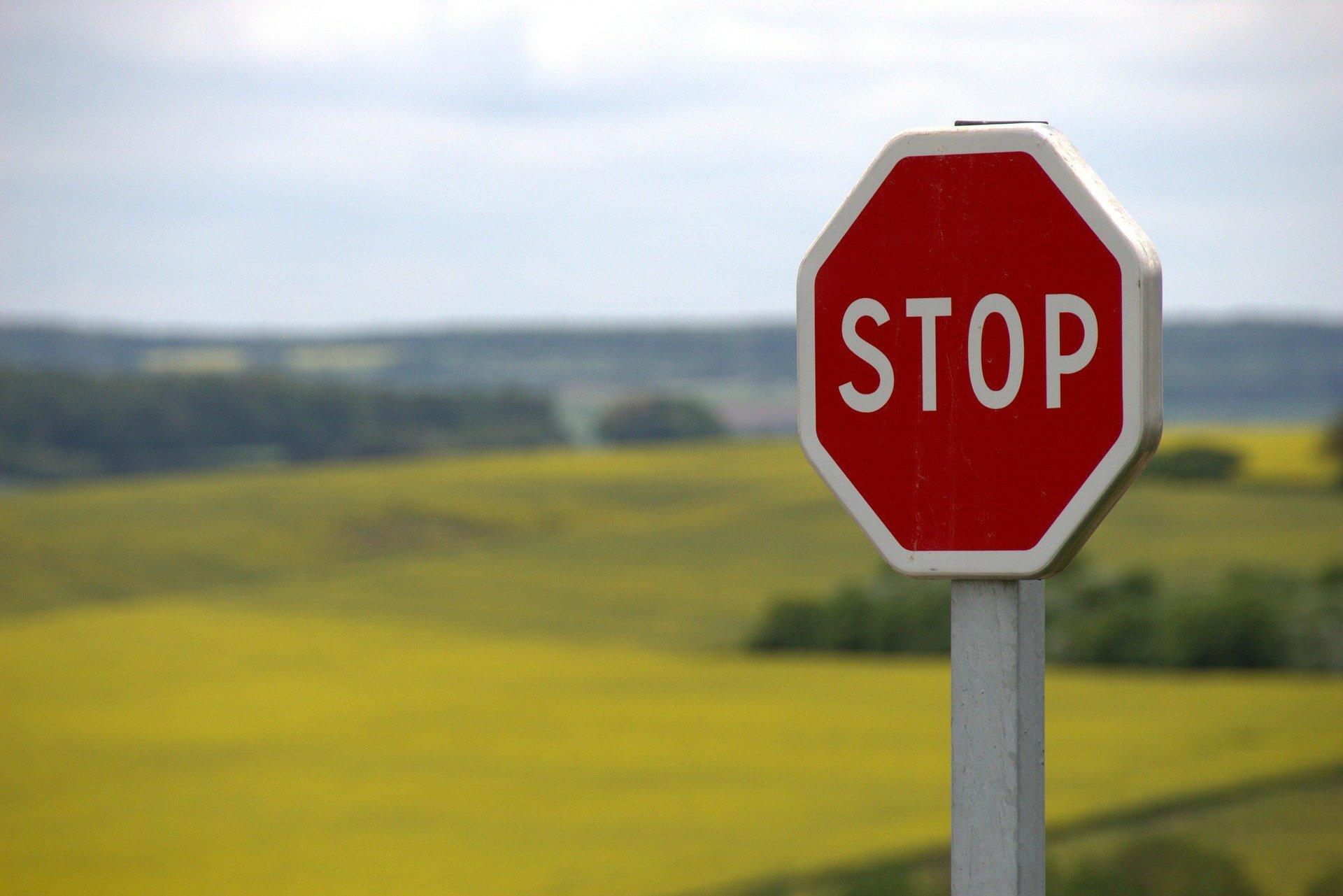
A regular pentagon with 7 in. sides has a perimeter of 5 × 7 = 35 in.. If the sides aren’t all equal, add them up one by one. To total the inside angles of any polygon, use S = (n − 2) × 180°. An octagon, like a stop sign, has angles that add up to 6 × 180° = 1,080°.
Area of a Regular Polygon
The area formula for a regular polygon uses its apothem, a. The apothem runs from the center to the middle of a side, meeting that side at a right angle. It equals the radius of the largest circle that fits inside the polygon, not the distance to a corner.
With the apothem and the perimeter, p, the formula is A = ½ap. OpenStax uses a regular hexagon with 4 in. sides and an apothem of 2√3 ≈ 3.46 in. Its perimeter is 24 in., so A = ½ × 2√3 × 24 = 24√3 ≈ 41.57 in².
The formula works because the apothem splits the polygon into identical triangles, each with height a. For the ideas behind proofs like this, see our guide to geometry foundations and theories. For in-person help, you can search for math tutors near me and compare profiles.
Area and Circumference of a Circle
A circle has no sides, so its perimeter gets its own name: the circumference. The formulas are C = 2πr (or C = πd) and A = πr², where r is the radius and d is the diameter. Common Core standards expect students to know both by grade 7.
For a circle with a 3-inch radius, C = 2 × π × 3 ≈ 18.85 inches. Its area is A = π × 3² = 9π ≈ 28.27 square inches. Square the radius first, then multiply by π.
The ratio of any circle’s circumference to its diameter
Archimedes trusted simple shapes to explain hard ones, and he was candid about his process. Describing how he found many of his results, he wrote:
… certain things first became clear to me by a mechanical method, although they had to be proved by geometry afterwards …
Archimedes, Greek mathematician, as quoted by MacTutor, University of St Andrews
From Flat Shapes to Solids: Volume and Surface Area
Give a flat shape depth, and it becomes a solid with volume and surface area. A cylinder is a circle with height, so its volume is V = πr²h. Its surface area is SA = 2πr² + 2πrh, the two circular ends plus the curved side.
A can with a 3-inch radius and a 10-inch height holds V = π × 9 × 10 ≈ 282.74 cubic inches. Its surface area is 18π + 60π = 78π ≈ 245.04 square inches.
Geometry Formulas at a Glance
The table gathers every 2D formula from this guide with a worked example. Keep it beside your homework as a quick check.
Cheat sheet
Perimeter and Area Formulas With Examples
| Shape | Perimeter | Area | Worked example |
|---|---|---|---|
| Square | P = 4s | A = s² | s = 5 in: P = 20 in, A = 25 in² |
| Rectangle | P = 2l + 2w | A = lw | 8 ft × 3 ft: P = 22 ft, A = 24 ft² |
| Triangle | P = a + b + c | A = ½bh | Sides 10, 17, 21 cm; h = 8 cm: P = 48 cm, A = 84 cm² |
| Parallelogram | Sum of the four sides | A = bh | b = 10 cm, h = 4 cm: A = 40 cm² |
| Trapezoid | Sum of the four sides | A = ½h(a + b) | Bases 6 m and 10 m, h = 4 m: A = 32 m² |
| Regular polygon | P = ns | A = ½ap | Hexagon, s = 4 cm, a = 2√3 cm: P = 24 cm, A ≈ 41.57 cm² |
| Circle | C = 2πr | A = πr² | r = 3 in: C ≈ 18.85 in, A ≈ 28.27 in² |
Formulas checked against OpenStax Contemporary Mathematics on 6 Oct. 2026. Values rounded to two decimal places, using π ≈ 3.14159.
Once these feel natural, angles, similar triangles, and proofs come next. Our beginner’s guide to geometry is a good next step.
Sources
- "Archimedes of Syracuse," MacTutor History of Mathematics, by J. J. O’Connor and E. F. Robertson, University of St Andrews, 1999. Available at: https://mathshistory.st-andrews.ac.uk/Biographies/Archimedes/. Accessed 6 Oct. 2026.
- "Heron of Alexandria," MacTutor History of Mathematics, by J. J. O’Connor and E. F. Robertson, University of St Andrews, 1999. Available at: https://mathshistory.st-andrews.ac.uk/Biographies/Heron/. Accessed 6 Oct. 2026.
- "10.3 Triangles," Contemporary Mathematics, by Donna Kirk, OpenStax, Rice University, 2023. Available at: https://openstax.org/books/contemporary-mathematics/pages/10-3-triangles. Accessed 6 Oct. 2026.
- "10.4 Polygons, Perimeter, and Circumference," Contemporary Mathematics, by Donna Kirk, OpenStax, Rice University, 2023. Available at: https://openstax.org/books/contemporary-mathematics/pages/10-4-polygons-perimeter-and-circumference. Accessed 6 Oct. 2026.
- "10.6 Area," Contemporary Mathematics, by Donna Kirk, OpenStax, Rice University, 2023. Available at: https://openstax.org/books/contemporary-mathematics/pages/10-6-area. Accessed 6 Oct. 2026.
- "10.7 Volume and Surface Area," Contemporary Mathematics, by Donna Kirk, OpenStax, Rice University, 2023. Available at: https://openstax.org/books/contemporary-mathematics/pages/10-7-volume-and-surface-area. Accessed 6 Oct. 2026.
- "10.8 Right Triangle Trigonometry," Contemporary Mathematics, by Donna Kirk, OpenStax, Rice University, 2023. Available at: https://openstax.org/books/contemporary-mathematics/pages/10-8-right-triangle-trigonometry. Accessed 6 Oct. 2026.
- "10.1 Non-Right Triangles: Law of Sines," Algebra and Trigonometry 2e, by Jay Abramson, OpenStax, Rice University, 2021. Available at: https://openstax.org/books/algebra-and-trigonometry-2e/pages/10-1-non-right-triangles-law-of-sines. Accessed 6 Oct. 2026.
- "Grade 7: Geometry," Common Core State Standards Initiative, 2010. Available at: https://www.thecorestandards.org/Math/Content/7/G/. Accessed 6 Oct. 2026.
- "Grade 8: Geometry," Common Core State Standards Initiative, 2010. Available at: https://www.thecorestandards.org/Math/Content/8/G/. Accessed 6 Oct. 2026.
- "§3.12 Mathematical Constants," NIST Digital Library of Mathematical Functions, National Institute of Standards and Technology. Available at: https://dlmf.nist.gov/3.12. Accessed 6 Oct. 2026.
Summarize with AI:
Did you like this article? Leave a rating!

 Loading...
