
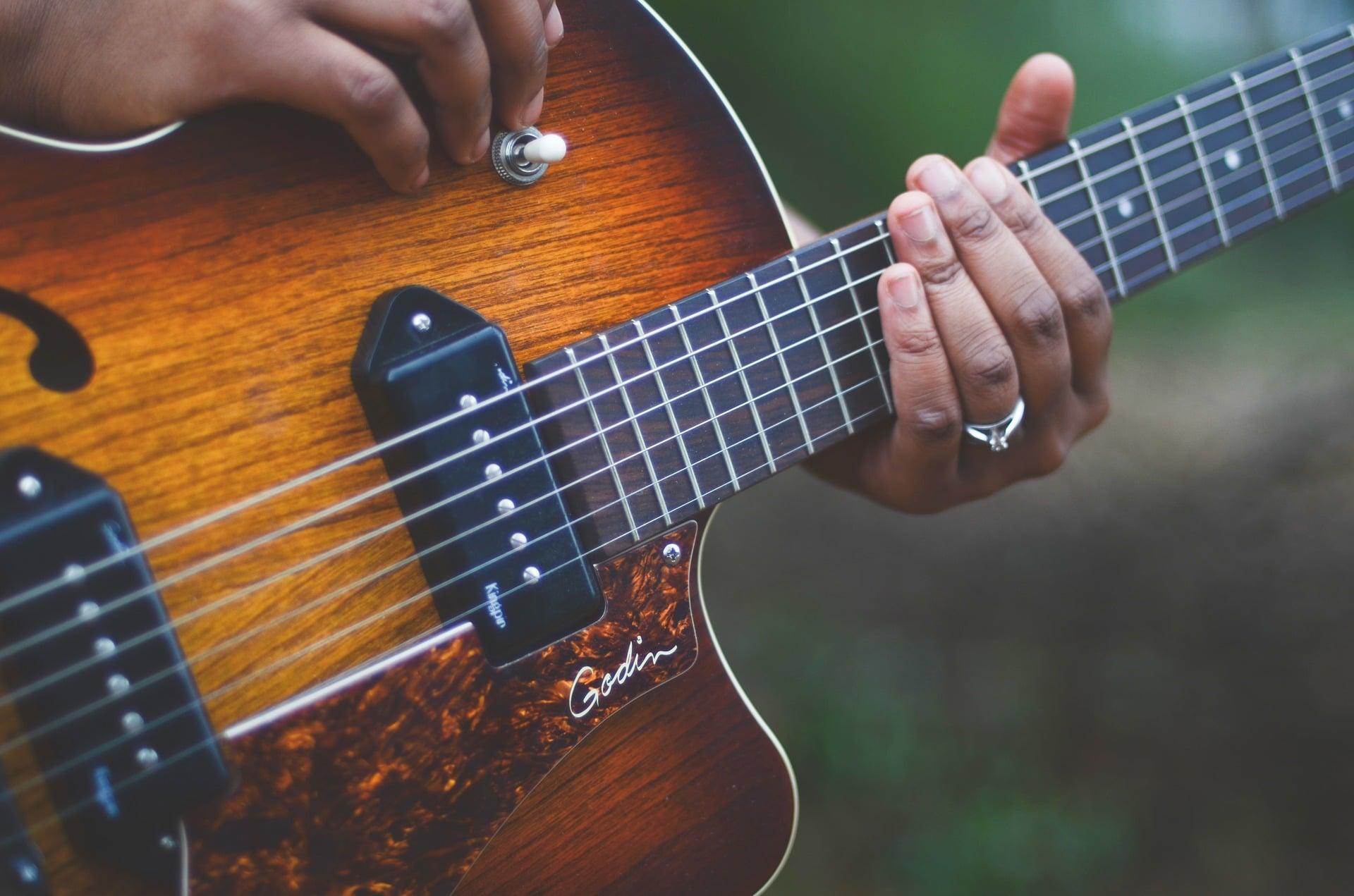

Jazz music is often hailed as an original American art form.
It was born of slavery, played on unconventional instruments such as washboards, earthen jugs and boxes. In its earliest incarnations, it consisted of call-and-response vocals, a pattern of communication common of slaves working in the fields.
Today, we can still hear such homophonic melodies in Gospel music, where the soloist or vocal leader follows one melody and the chorus, a different – maybe slower one.
When jazz music emerged in the late 19th century, no slave would be given or permitted to have a guitar; that instrument was a much later addition to the genre.
Jazz music has gone through several incarnations since American slaves celebrated a good harvest by putting on a show in Congo Square in New Orleans.
Your Superprof wants to take you to the American south, to a time when a new type of music was emerging; a musical style that would come to be associated with class and distinction.
No need for a passport or packing a bag; this journey into the past is intellectual, not physical.





The History of Jazz
Much as the slaveowners tried to stamp it out, they could not dissuade their ‘property’ from upholding and expressing their spiritual beliefs, often in a language unknown.
So it came to be that displaced west Africans, working in the fields of Georgia, Alabama and Louisiana would chant their way through work. And, if there was a cause for celebration – maybe the birth of a child or the end of the harvest, singing and dancing would be permitted.
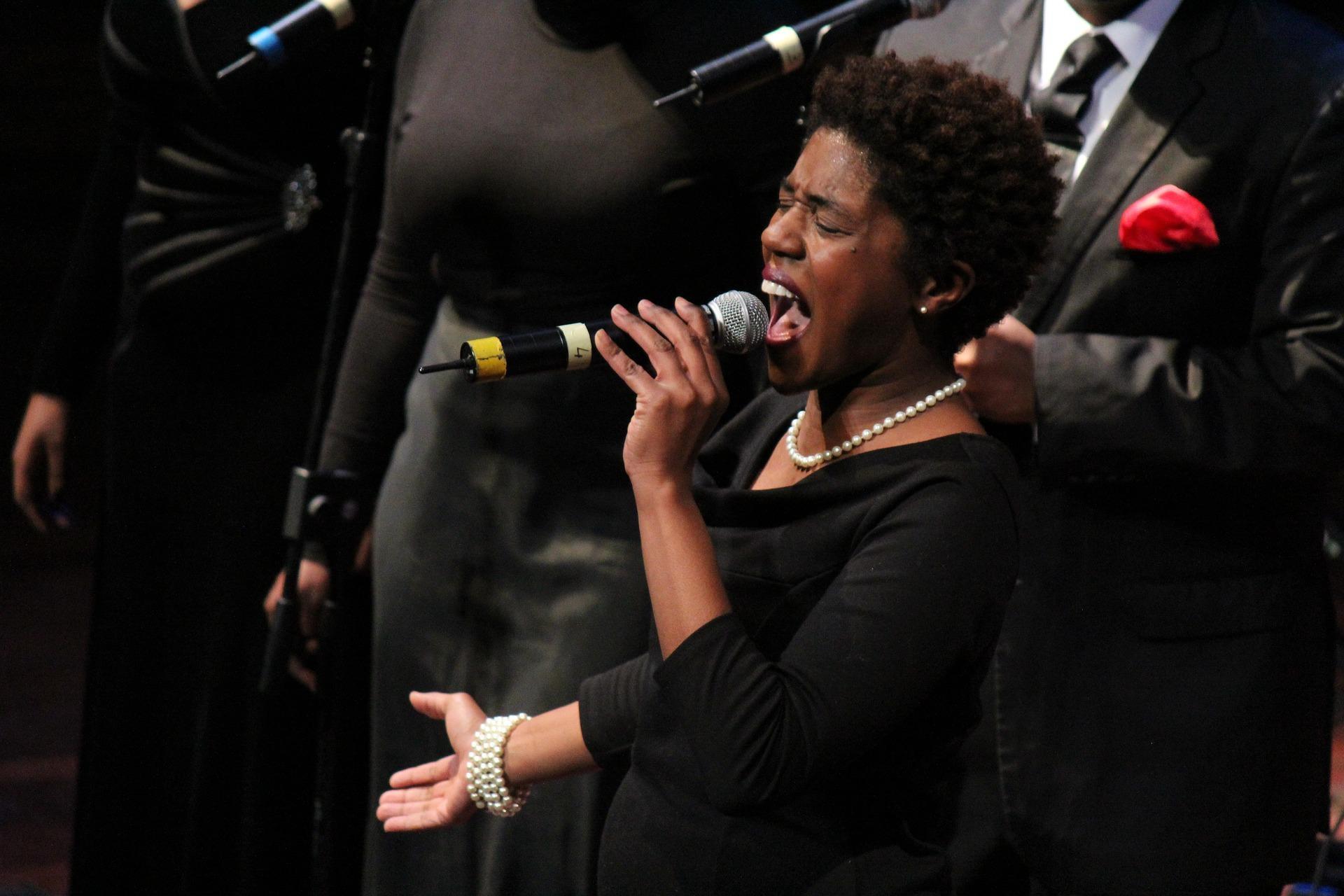
One way that slave owners attempted to dissuade ‘secret’ communication in the slaves’ own language was to force them to speak English and make them attend church – not to worship their own deities but the Christian God.
This mandate gave rise to Gospel music and its secular counterpoint, the Blues, both of which were a pleasing form of entertainment to white ears that permitted further musical exploration by the black population in America.
Out of public squares in New Orleans, specifically Congo Square, those early jazz performers caught strains of French quadrilles being played. That led to to the incorporation of brass instruments into the unique brand of music.
Later, a form of piano-dominant music called Ragtime, played in heavily black population further north made its way down south. Soon, this style of music too was incorporated into what would be a defining musical movement.
It wasn’t until the early 20th century that the guitar would feature into any jazz music; the instrument’s warm tones simply couldn’t compete with the brassiness of the horns and the pounding of the piano.
In 1923, the Gibson L5 acoustic archtop guitar found its home in jazz.
Jazz guitarists like Eddie Lang were thrilled to finally have an instrument to play chords with greater complexity that wouldn’t jar with the warm bass notes, as the banjo did.
The 1920s through the 30s became the Age of Jazz. It blended seamlessly with Swing and Big Band music and the guitar was an integral part of the rhythm section.
The electric guitar had as yet not been invented; acoustically, the guitar still could not compete with the saxes and trumpets. Still, some Big Bands permitted short guitar solos; it was during those times that guitarists such as Django Reinhardt and Charlie Christian got their turn to shine.
After the Second World War, jazz music reinvented itself. Gone were the big bands; say hello to intimate quartets and combos. Coincidentally, early forays into electric guitars meant that jazz guitarists could have their turn in the spotlight.
As electric guitars continued to improve, so did the players of those instruments.
In the hands of Joe Pass, Wes Montgomery and Jim Hall, the jazz guitar explored a wider range of tones and moods; indeed, it is those three guitar players who established what is now known as jazz guitar playing.
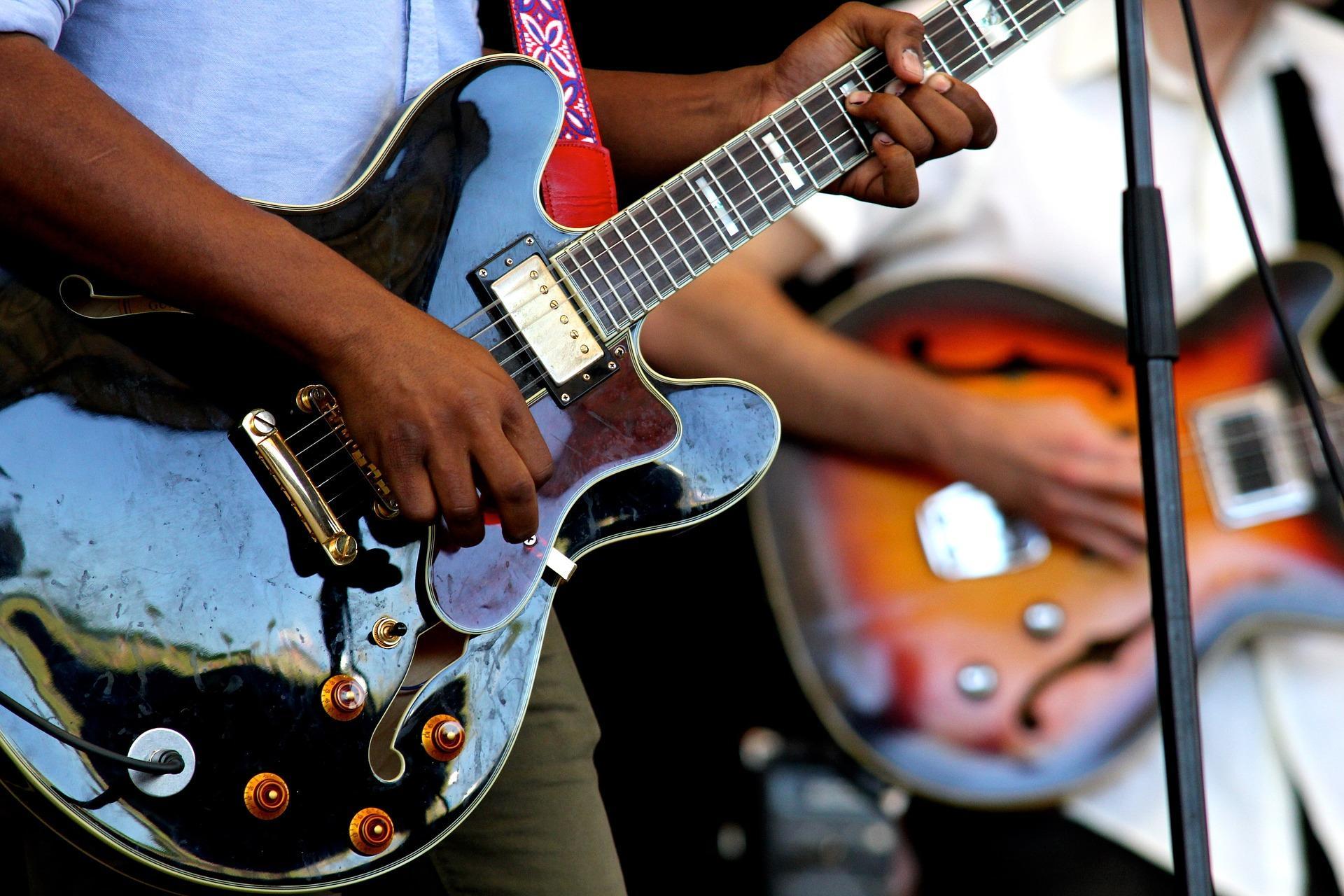
Jazz Guitar Specifics
You might intuit that one can play jazz licks on any guitar.
While that may be true – you could even riff off a few notes on an amped-up Stratocaster, it takes a specific type of guitar to achieve that unique jazz sound.
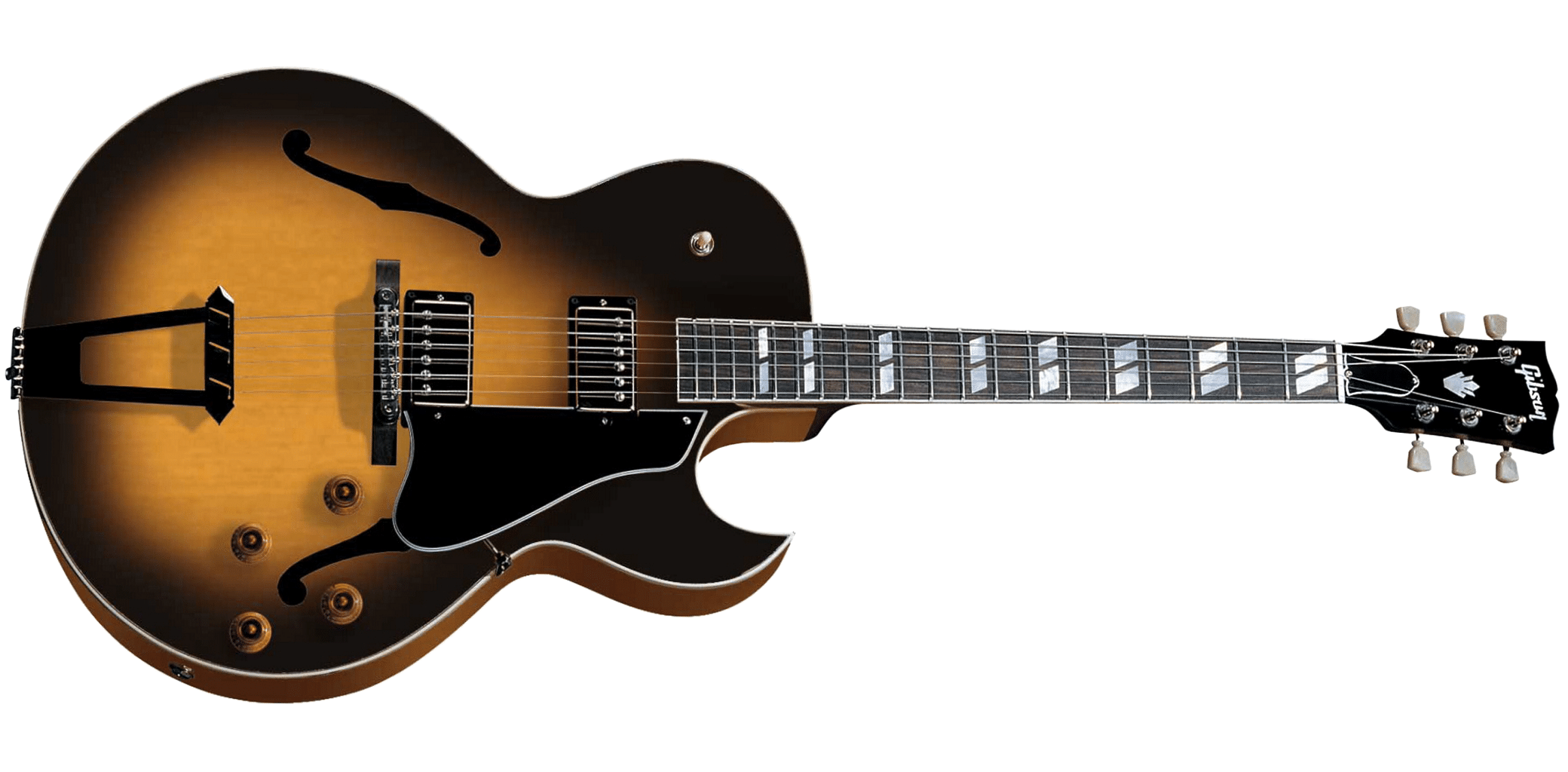
The guitar of choice for jazz guitarists is the full-depth, archtop guitar.
Archtops are acoustic guitars with steel strings and a floating bridge. They boast a large soundbox – thanks in part to their arched tops and f-holes, such as those found on the violin.
Archtops are electric guitars; they may have magnetic or piezoelectric pickups to transmit their sound. Players will often set their guitar’s amplifier to give their instrument a certain tone, depending on the piece being played.
Reverb effects, built-in on guitar amplifiers, often feature in jazz guitar but it wasn’t until the jazz fusion era of the 70s that jazz guitarists started using pedal effects: wahs, chorus and overdrive pedals.
There are other types of guitars that certain jazz players favour or that certain types of jazz call for, for instance, Latin jazz players would favour nylon strings while flat-top steel-stringed guitars have been used in ‘acoustic shredding’ by artists such as Al Di Meola and Larry Coryell.
Did you know that jazz guitarists Lenny Breau and Howard Alden play seven-string guitars? This type of guitar is usually used to play metal music...
The Particulars of Playing a Jazz Guitar
To some extent, playing jazz guitar is like playing any other guitar: you should know chords and chord progressions, you should be able to play either lead guitar or rhythm and improvisation is especially valuable in jazz guitar playing.
Still, even if you play the electric guitar, you have a ways to go before competently playing jazz guitar.
And, before you can play jazz guitar, you have to be able to tune your guitar to be able to play jazz.
You are quite right in thinking that there is such a thing as standard tuning for a guitar; even so, many rock guitarists prefer to use alternate tunings such as Drop-D.
Jazz guitarists are no different in that respect; they usually use ‘regular’ tuning – not the same as standard tuning: regular tuning implies that all of the strings are tuned to an even interval.
Another popular jazz tuning is called All Fourths: each string is set exactly a fourth apart. When playing a guitar thus-tuned, the fretboard feels easier to navigate, especially when improvising.
Jazz music is full of improvised licks and unusual arpeggios. If you are the lead guitarist, you would likely prefer the All Fourths tuning method precisely so your fingers can move more nimbly across the frets.
There are, of course, other tuning methods; some are as popular as All Fourths. You may want to try Major Third regular tuning, for instance, to see how that sounds and feels when you play.
Playing Jazz Guitar
It goes without saying that you have to have a fair measure of proficiency in playing the guitar to begin playing jazz guitar.
And, once you do make the leap from guitarist to jazz guitarist, you should determine your playing style:
- Big Band Rhythm: a rhythm role, usually plays four strums per bar with some improvisation allowed
- this type of playing is mostly gone from the music scene today.
- Small-Group Comping (short for accompanying): uses many inversions rather than standard voicings
- Chord-melody: the guitarist arranges the entire piece and plays melody, harmony and bass.
- Chords may be sparsely played; generally, a pick is used
- Unaccompanied soloing: fingerstyle is emphasised but hybrid picking is also permitted
- ‘Blowing’: also called single-note soloing, it involves maintaining the chord but picking an improvised note
- Chord soloing: involves improvising chords and melody simultaneously, usually on the upper-register strings.
Clearly, these are but brief descriptions of complex styles of playing that call for some guitar instruction.
Learn Jazz Guitar Chords in 5 Easy Steps
To most, jazz music on the guitar is a beautiful art form. Even those who don't appreciate the sounds of swing and bebop can respect the talent of the musicians who perform it, and acknowledge that their playing could benefit from learning some of the principles of the style.
The rub, however, is that jazz can seem intimidating -- even mystifying -- to newer players, to the point where they don't even give it a shot.
If you count yourself among the many who have wanted to dip their toes in the deep end of the jazz pool but felt too befuddled to give it a try, then we encourage you to read this guide.
Today, we're going to be providing and introduction to playing jazz music on the guitar, complete with the information you'll need to start learning jazz chords, playing jazz melodies, and memorizing the scales you'll need to improvise like a seasoned jazz professional.
Getting Started: Intro to Jazz Guitar Chords
Like any form of music, harmonies and rhythms are essential to jazz. The first thing we'll be covering are some basic chords that you'll see frequently throughout your endeavors in the genre. These include the Major 7, Minor 7, and Dominant 7 chords; we'll look at these variations in several keys to serve as examples.
Like any chord, the recommended fingerings we provide aren't the only way you can play them. They are a good starting point for beginners, though, so commit these versions to memory, then start exploring other fingerings to see what works for you.
You may find that you prefer playing some of these as bar chords, for example, and you're more than welcome to do so if you feel it fits the song or will make your playing more fluid. Stay open, and learn as many fingerings for your jazz chords as possible so that you can get to them from anywhere on the fretboard.
Lastly, the chords we'll be covering today are a good base to get started, but are by no means all the jazz-style chords existence. Don't hesitate to look up new chords as you encounter them to find the ones that work for you.
Major 7 Jazz Guitar Chords
This chord includes a scale's root, major third, perfect fifth, and major seventh tones. You'll often see Major 7 chords displayed with one of these symbols: maj7, M7, Δ, 7+. If you were playing a C Major 7 chord, for example, you'd play the notes C, E, G, and B. Here's how you'd tackle it in open position.
C Major 7 Jazz Guitar Chord
- Place your 1st finger on the 4th string/2nd fret
- Place your 2nd finger on the 5th string/3rd fret
- Place your 4th finger on the 1st string/3rd fret
- Play strings 2 and 3 open
- Mute string 6
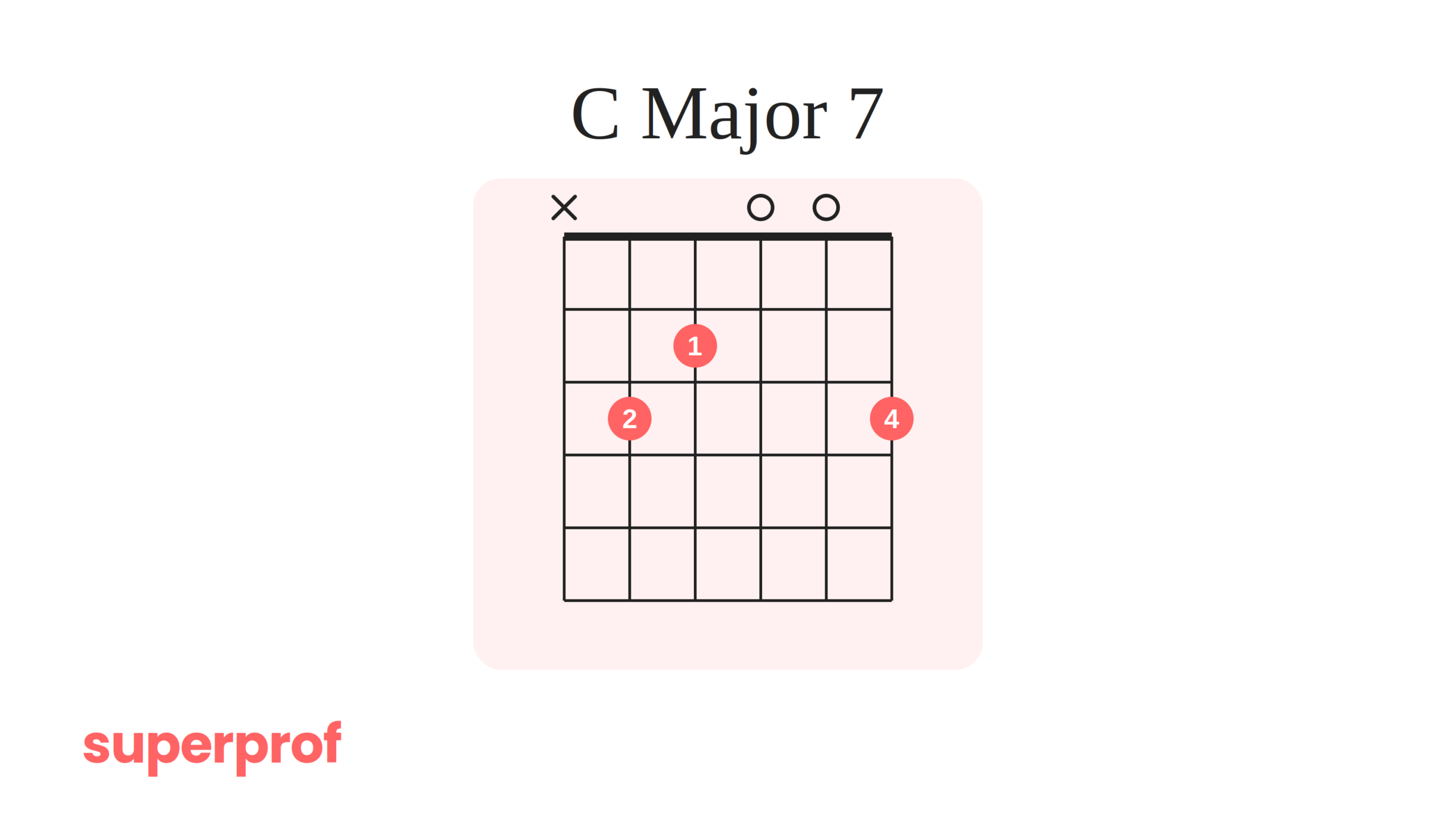
Simple enough. Next, let's move on to G Major 7, which includes the notes G, B, D, and F#. Here's how it goes in open position.
G Major 7 Jazz Guitar Chord
- Place your 1st finger on the 6th string/3rd fret
- Place your 2nd finger on the 4th string/4th fret
- Place your 3rd finger on the 5th string/5th fret
- Play strings 2 and 3 open
- Mute string 1
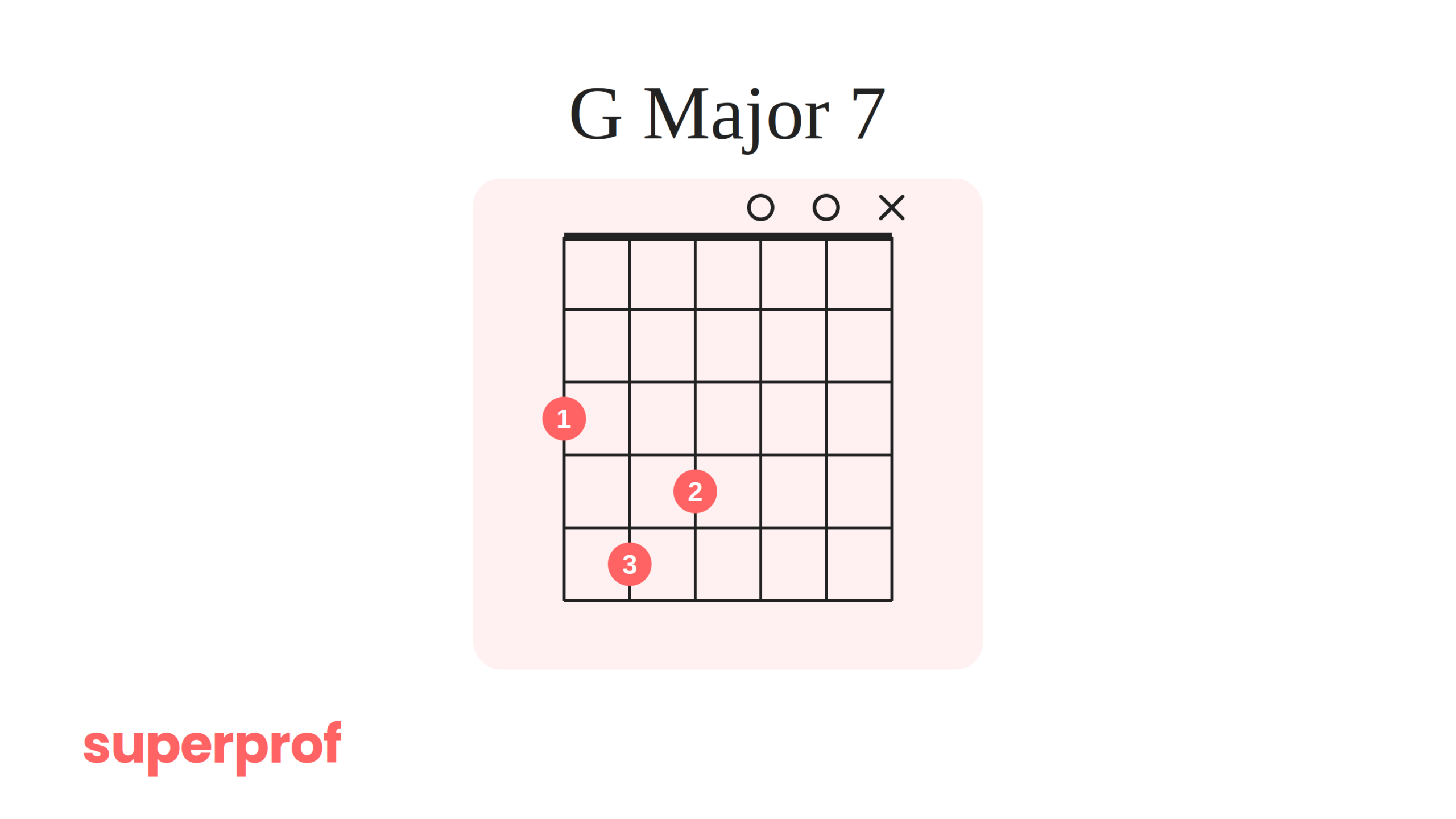
Moving around the horn again, we have D Major 7, comprised of D, F#, A, and C#. Your open position fingering is as follows:
D Major 7 Jazz Guitar Chord
- Use your first finger to bar strings 1, 2, and 3, at the 2nd fret
- Play string 4 open
- Mute strings 5 and 6
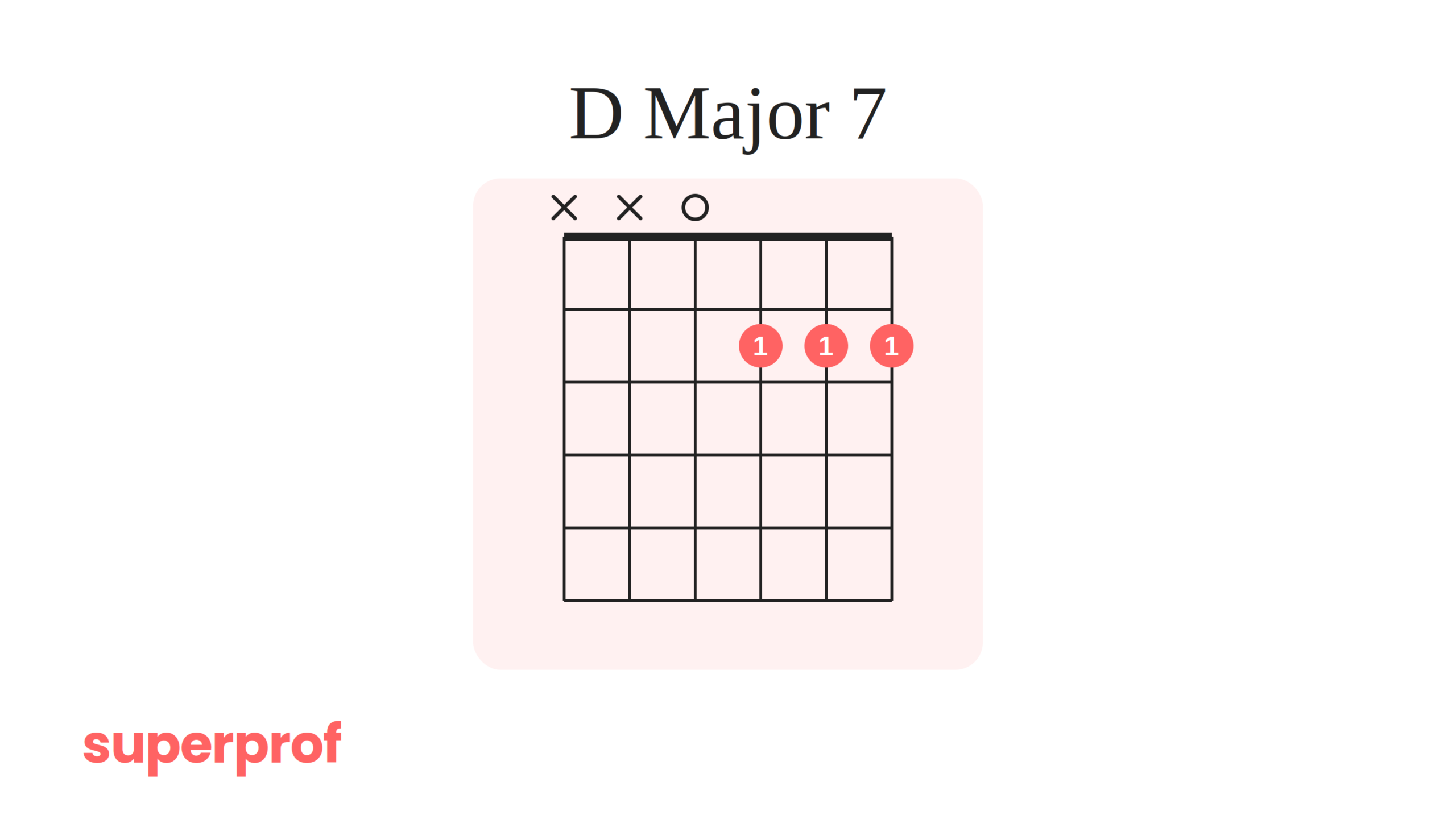
Next up is A Major 7. Your notes for this one are A, C#, E, and G#. Here's an easy open position fingering for the chord:
A Major 7 Jazz Guitar Chord
- Place your 1st finger on the 3rd string/1st fret
- Place your 2nd finger on the 4th string/2nd fret
- Place your 3rd finger on the 2nd string/2nd fret
- Place your 4th finger on the 1st string/4th fret
- Play string 5 open
- Mute string 6
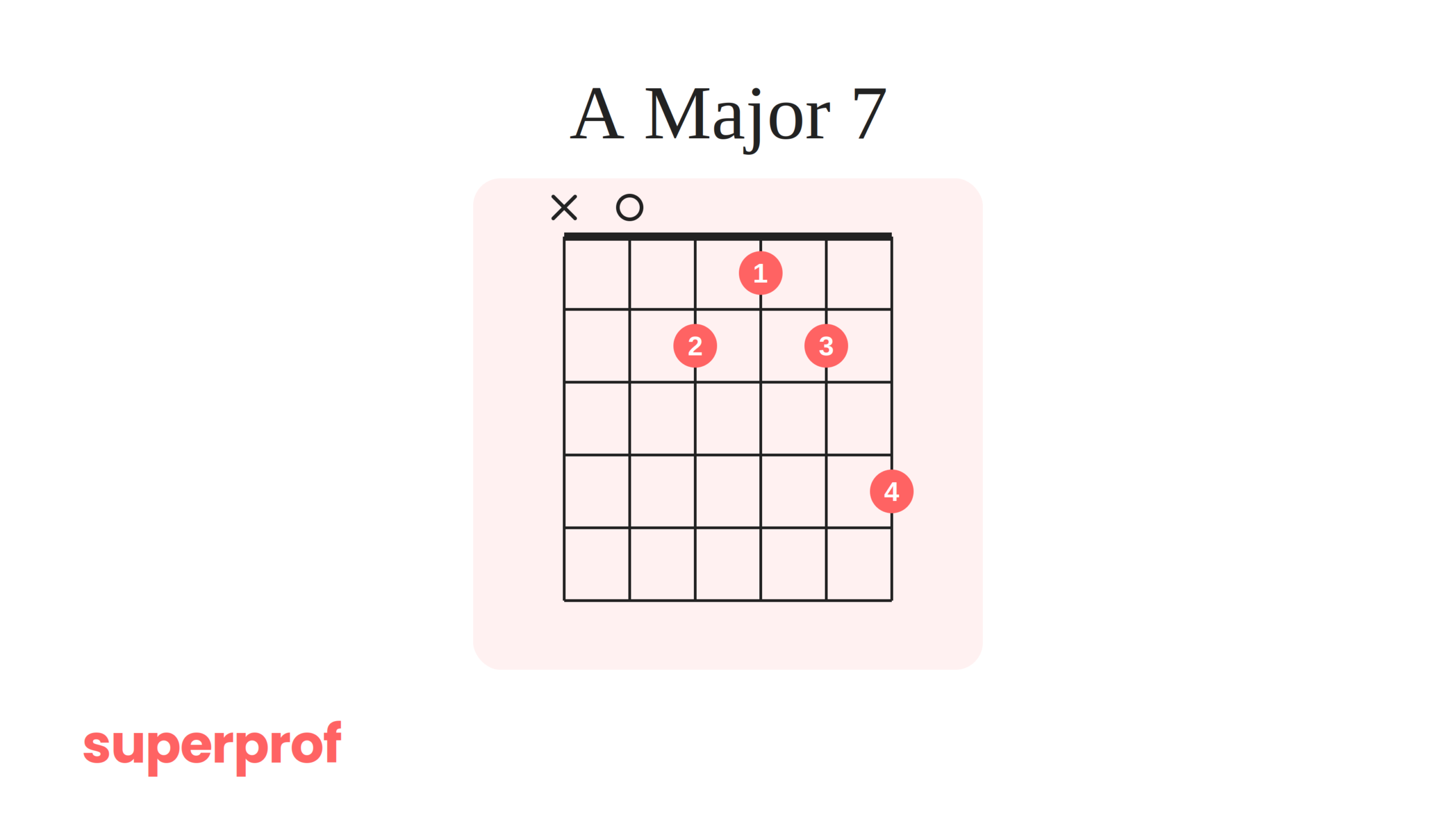
Are you starting to get a feel for the Major 7 chord sound? Excellent. Remember that you can also use a bar chord to get to your Major 7 chords quickly. Your root note for these will always be on the 5th string, so if you were playing C Major 7, for instance:
C Major 7 Barre Jazz Guitar Chord
- Use your 1st finger to bar the strings on the 3rd fret
- Place your 2nd finger on the 3rd string/4th fret
- Place your 3rd finger on the 4th string/5th fret
- Place your 4th finger on the 2nd string/5th fret
- Mute string 6
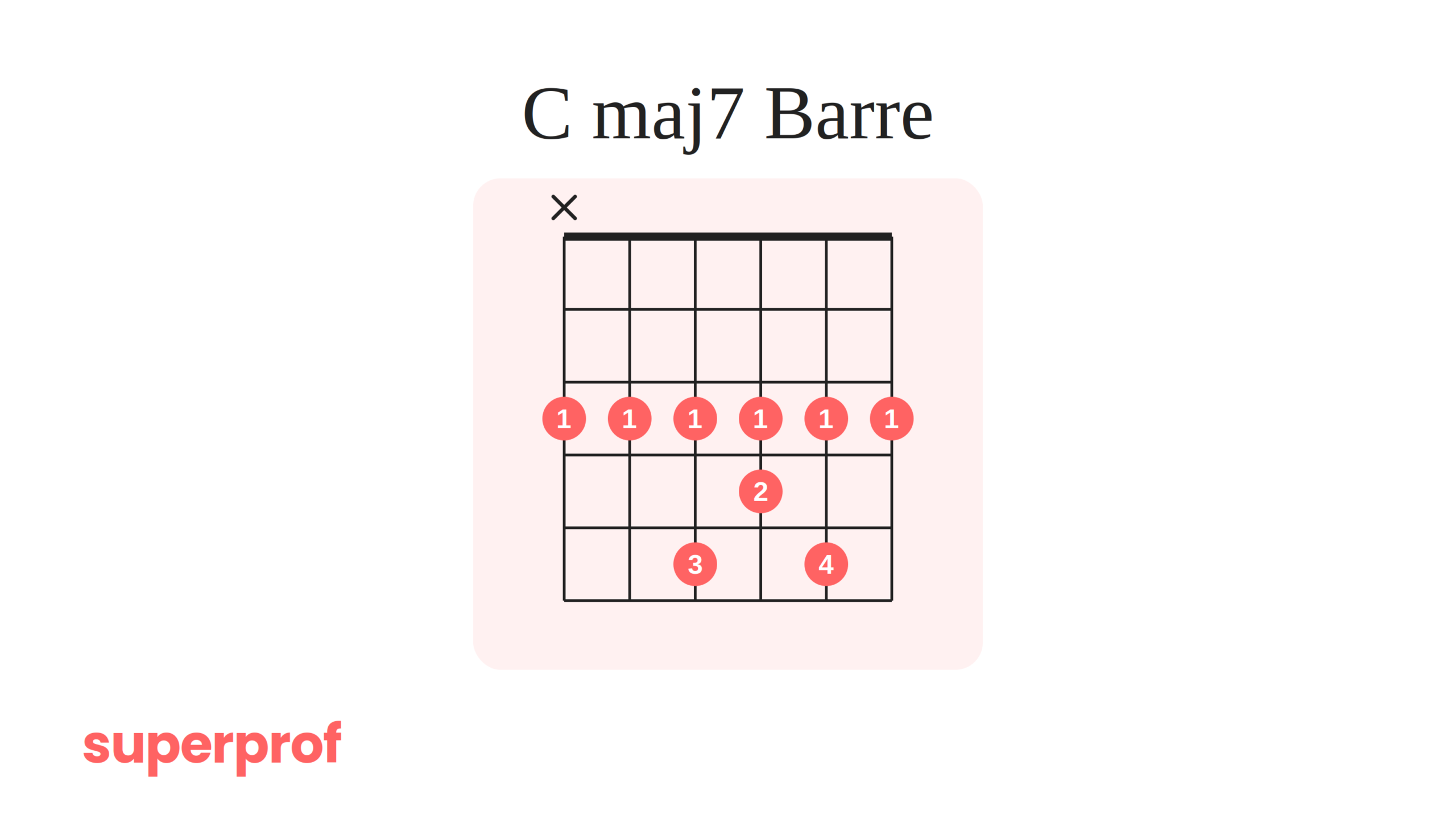
Keep that same shape and move your bar up or down the fretboard, and you'll be playing the Major 7 chord for the note you're covering with your 1st finger on the 5th string. Now, with that out of the way, it's time to take a look at a few Minor 7 chords that will come in handy.
Minor 7 Jazz Guitar Chords
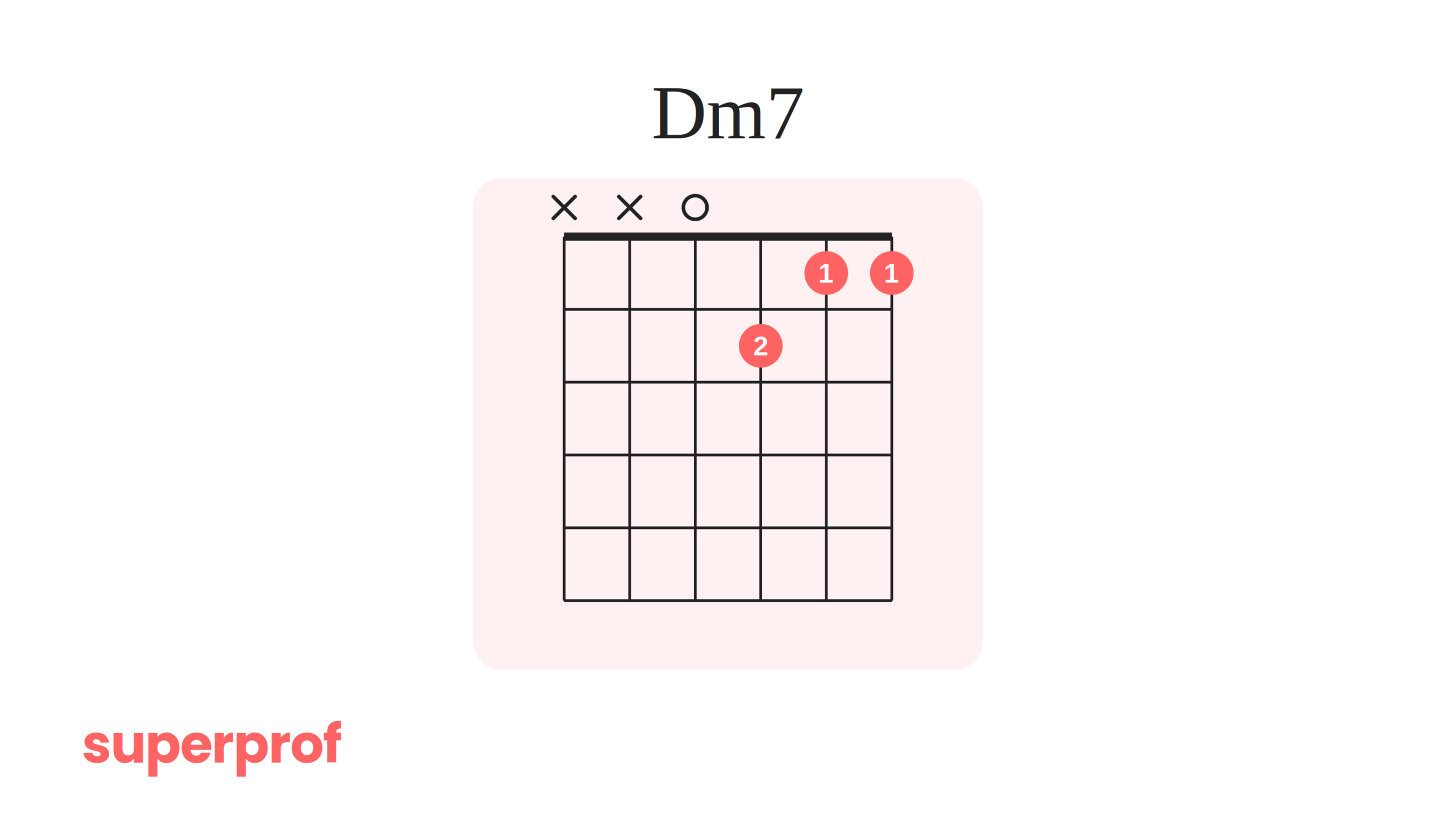
Minor 7 chords contain a scale's root, minor third, perfect fifth, and minor seventh tones. You'll see these represented as an m7 or -7 in your music. We'll start with D Minor 7, with the notes D, F, A, and C:
D Minor 7 Jazz Guitar Chord
- Place your first finger over strings 1 and 2 on the 1st fret
- Place your 2nd finger on the 3rd string/2nd fret
- Play string 4 open
- Mute strings 5 and 6
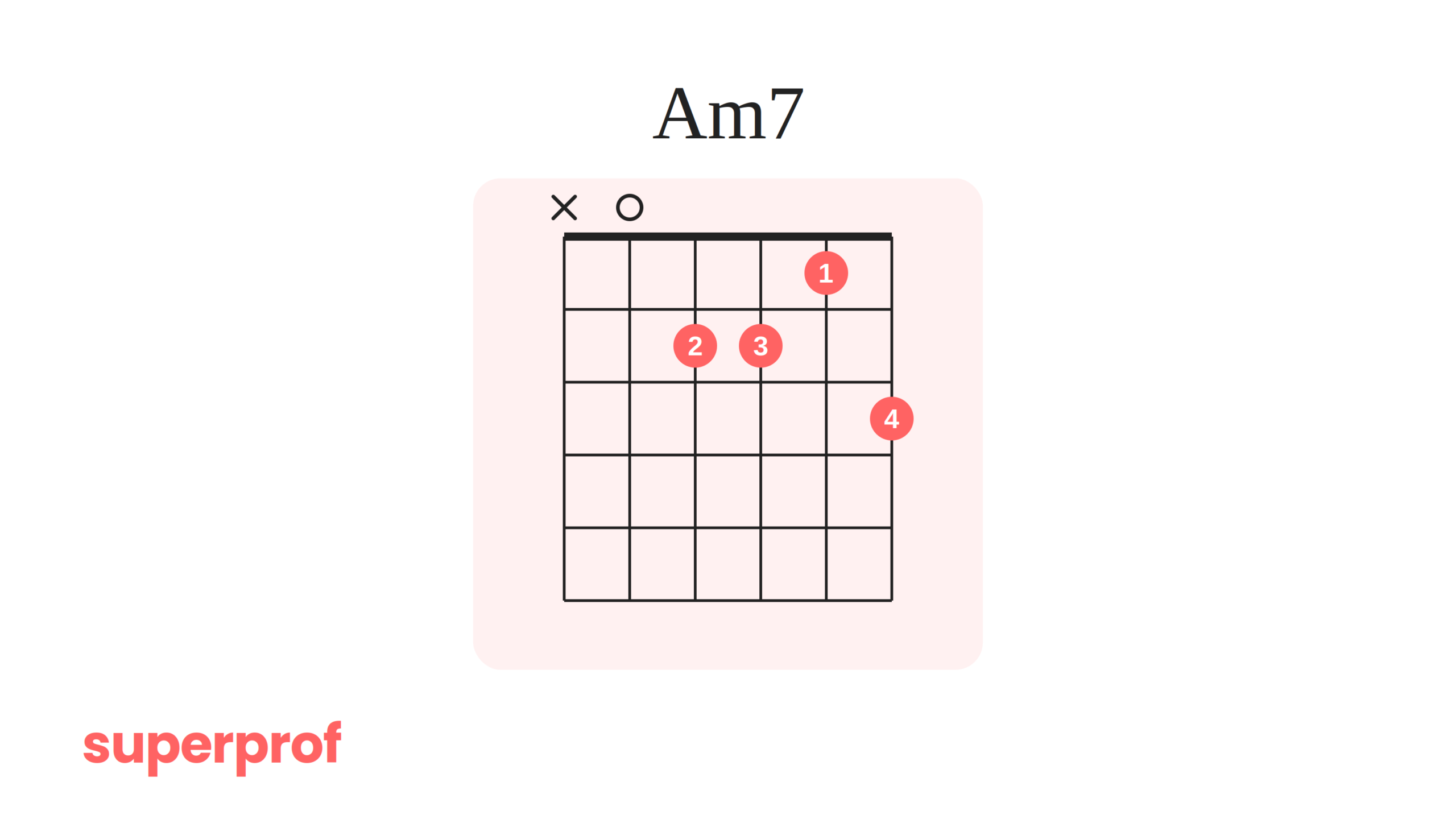
A Minor 7 Jazz Guitar Chord
A Minor 7 is another chord you'll see frequently. It includes the notes A, C, E, and G:
- Place your 1st finger on the 2nd string/1st fret
- Place your 2nd finger on the 4th string/2nd fret
- Place your 3rd finger on the 3rd string/2nd fret
- Place your 4th finger on the 1st string/3rd fret
- Play string 5 open
- Mute string 6
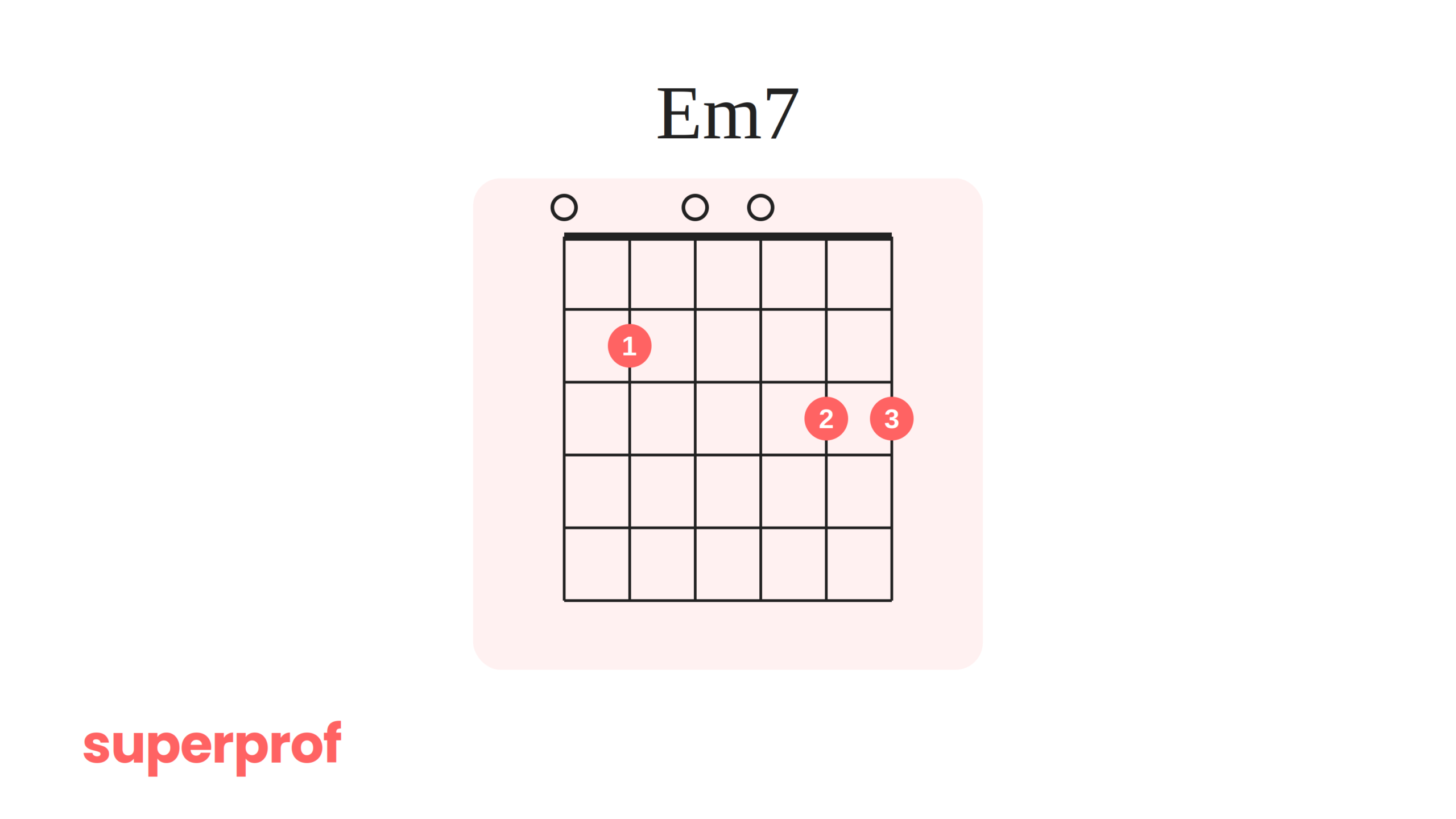
E Minor 7 Jazz Guitar Chord
Last up, we'll tackle E Minor 7, which uses E, G, B, and D:
- Place your 1st finger on the 5th string/2nd fret
- Place your 2nd finger on the 2nd string/3rd fret
- Place your 3rd finger on the 1st string/3rd fret
- Play strings 3, 4, and 6 open
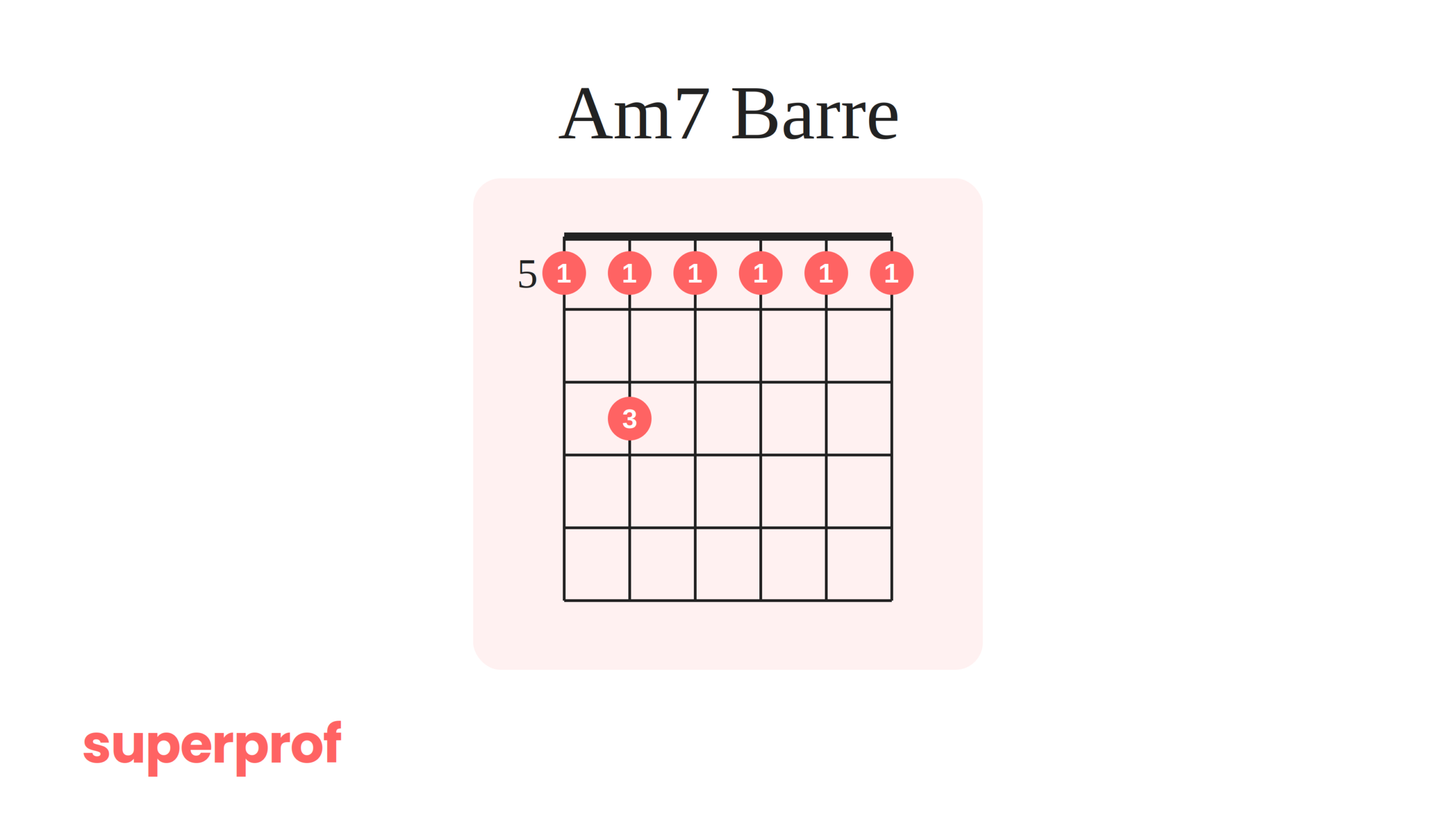
Again, you can use a bar for Minor 7 chords. We'll use A Minor 7 as an example for using string 6 as the root:
A Minor 7 Barre Jazz Guitar Chord (6th as root)
- Use your 1st finger to bar the strings at the 5th fret
- Place your 3rd finger on the 5th string/7th fret
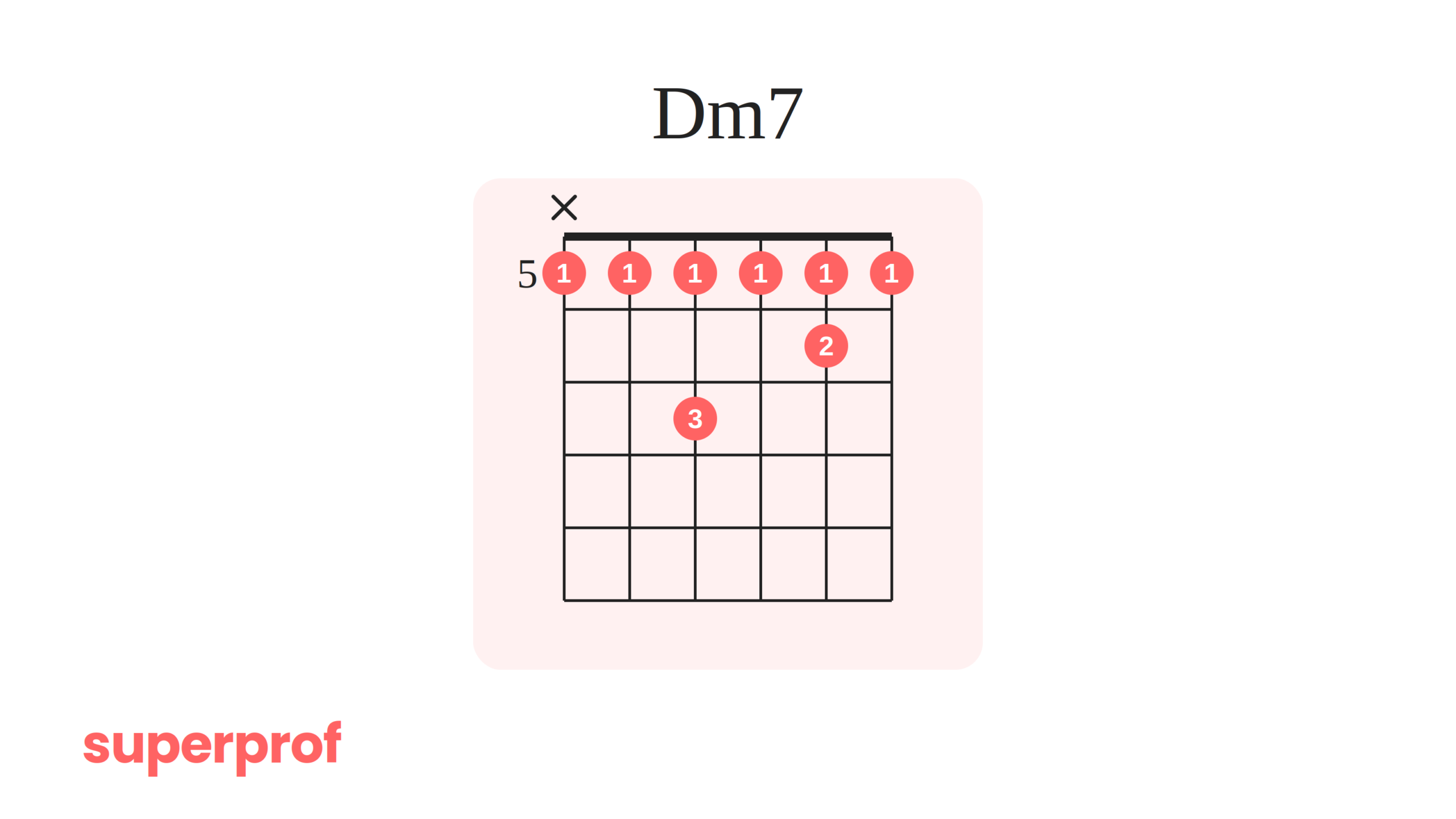
D Minor 7 Barre Jazz Guitar Chord (5th as root)
If you prefer using the 5th string for your root notes, let D Minor 7 here be your guide:
- Use your 1st finger to bar the strings at the 5th fret
- Place your 2nd finger on the 2nd string/6th fret
- Place your 3rd finger on the 4th string/7th fret
- Mute string 6
Now, let's round out our chord introduction with a few Dominant 7 chords.
Dominant 7 Jazz Guitar Chords
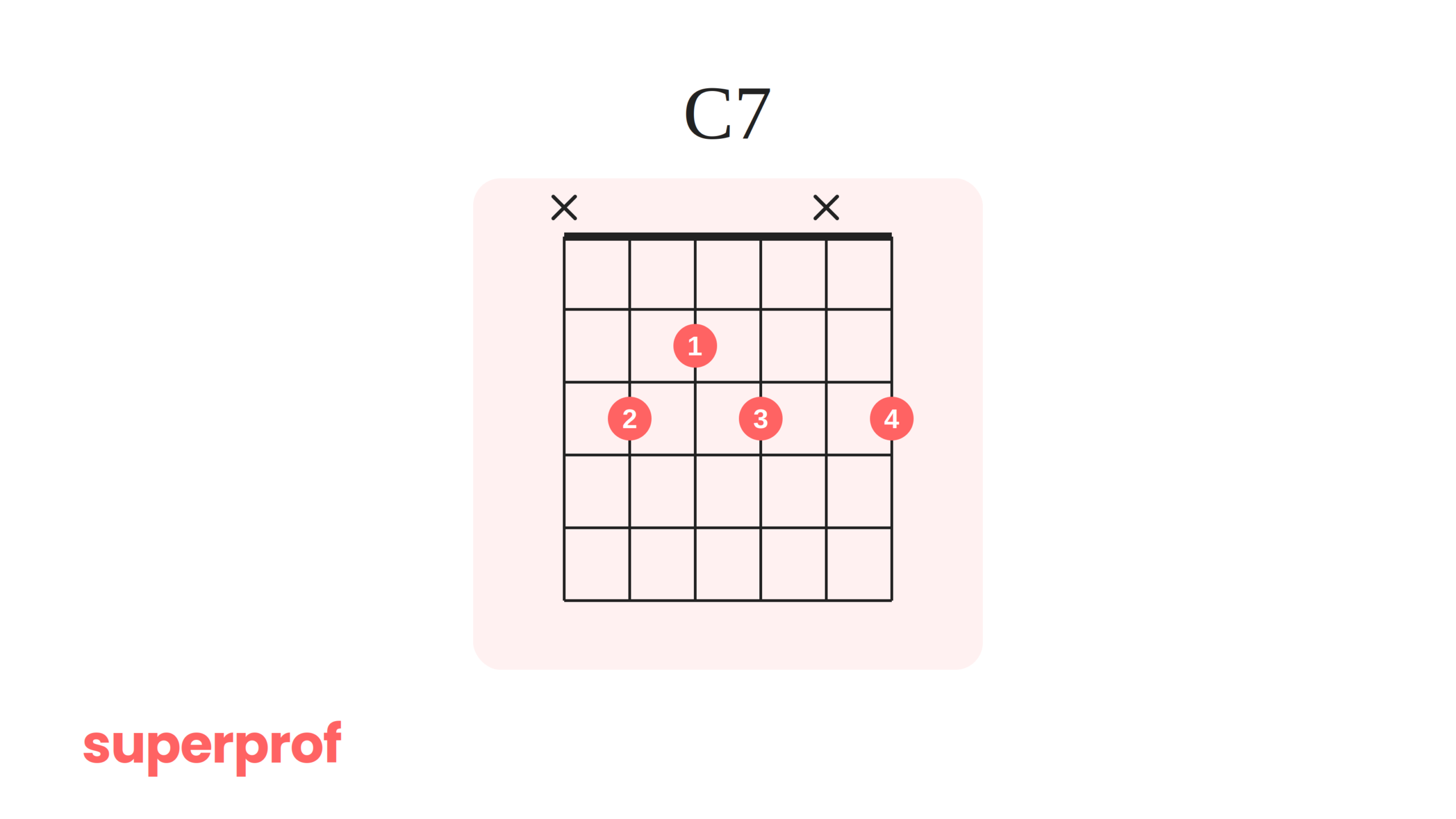
When playing Dominant 7 chords, you'll be using a scale's root, major third, perfect fifth, and minor seventh tones. You'll recognize the symbol as the telltale "7" after the root note. We'll start with the C7 chord, which contains C, E, G, and Bb:
C7 Jazz Guitar Chord
- Place your 1st finger on the 4th string/2nd fret
- Place your 2nd finger on the 5th string/3rd fret
- Place your 3rd finger on the 3rd string/3rd fret
- Place your 4th finger on the 1st string/3rd fret
- Mute strings 2 and 6
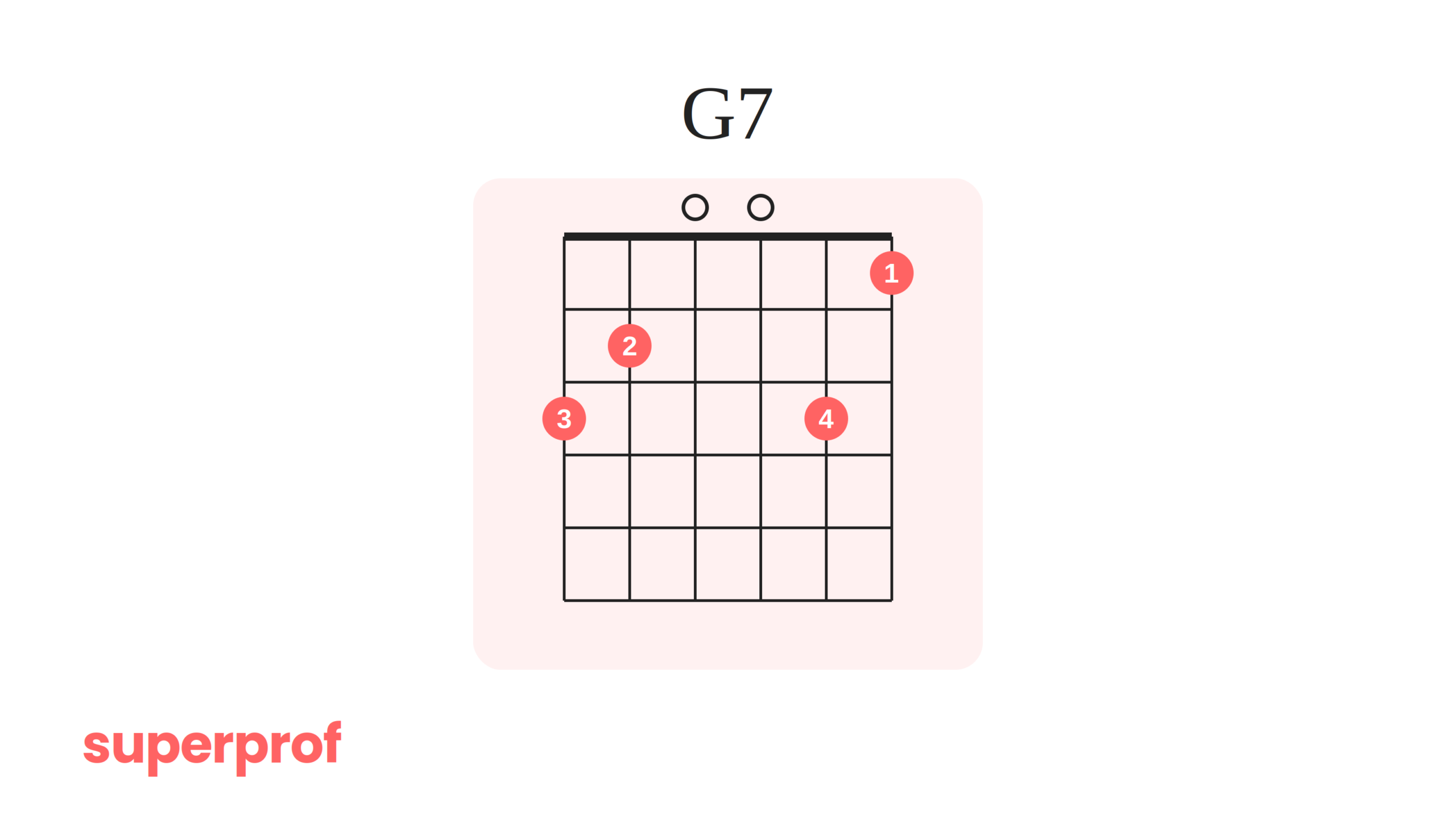
Next is G7, which consists of G, B, D, and F:
G7 Jazz Guitar Chord
- Place your 1st finger on the 1st string/1st fret
- Place your 2nd finger on the 5th string/2nd fret
- Place your 3rd finger on the 6th string/3rd fret
- Place your 4th finger on the 2nd string/3rd fret
- Play strings 3 and 4 open
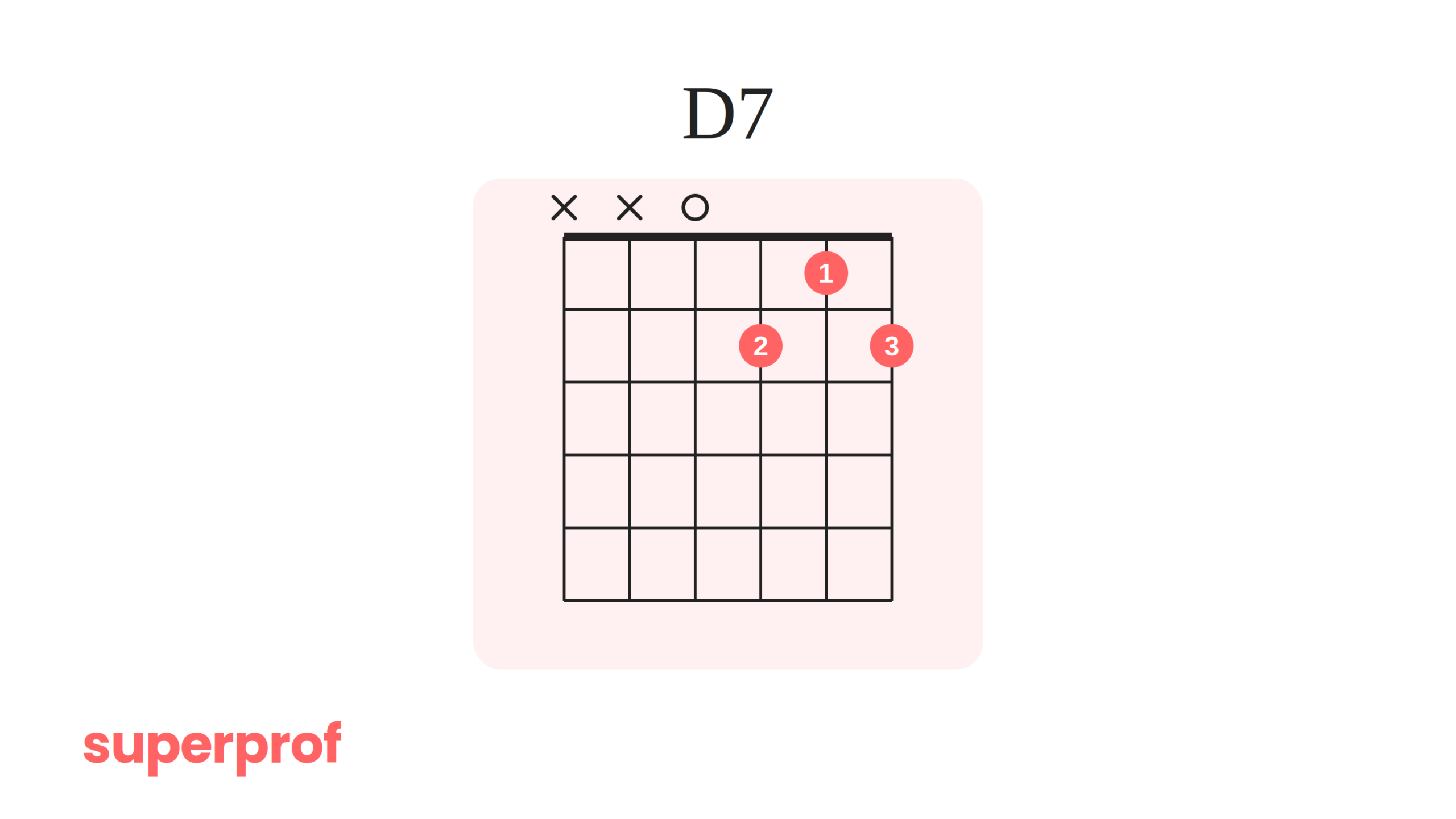
The last Dominant 7 chord we'll learn is D7. You'll need D, F#, A, and C for this one:
D7 Jazz Guitar Chord
- Place your 1st finger on the 2nd string/1st fret
- Place your 2nd finger on the 3rd string/2nd fret
- Place your 3rd finger on the 1st string/2nd fret
- Play string 4 open
- Mute strings 5 and 6
And of course, you can incorporate bar versions of Dominant 7 chords in your playing as well. For the root on string 6, take a look at G7 as an example
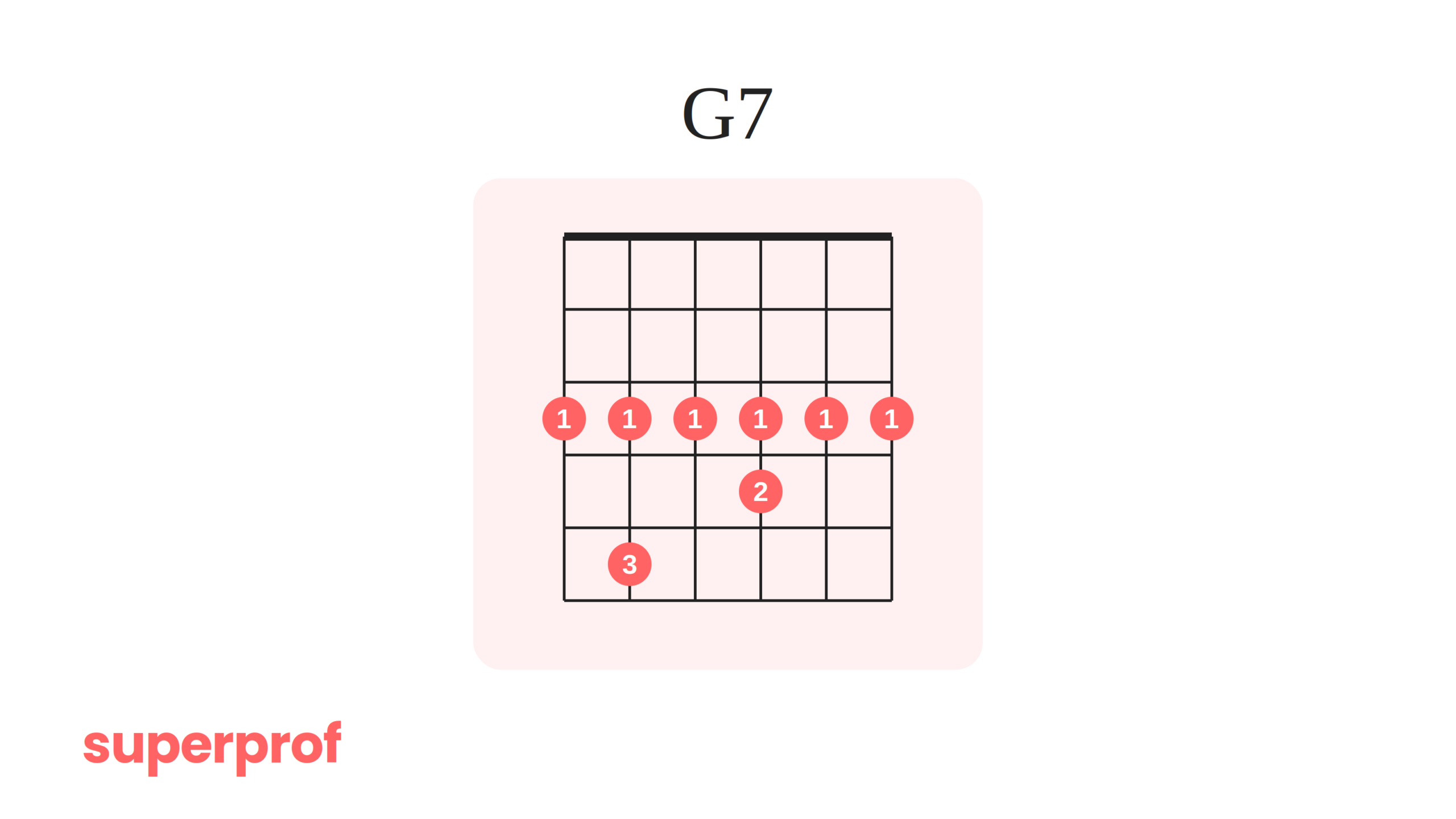
G7 Barre Jazz Guitar Chord (6th string root)
- Use your 1st finger to bar the strings at the 3rd fret
- Place your 2nd finger on the 3rd string/4th fret
- Place your 3rd finger on the 5th string/5th fret
You can move the root to the 5th string as well. Here's how it would look using C7:
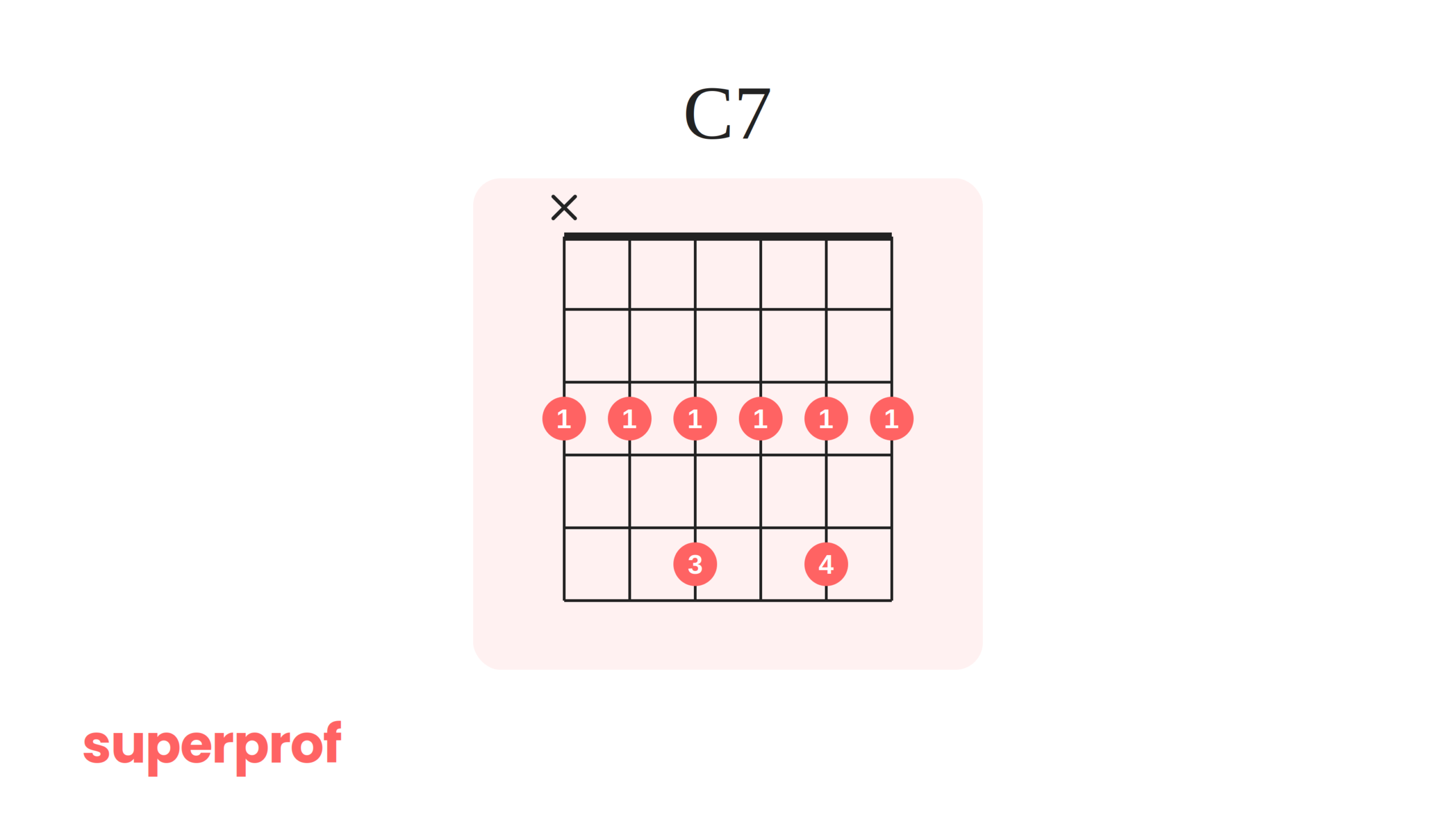
C7 Jazz Barre Guitar Chord (5th string root)
- Use your 1st finger to bar the strings on the 3rd fret
- Place your 3rd finger on the 4th string/5th fret
- Place your 4th finger on the 2nd string/5th fret
- Mute string 6
Don't forget to learn the Dominant 7 fingerings for your other keys as your encounter them. For now, though, let's talk about some the trickier jazz chords you'll come across on your journey.
Diving Deeper: Advanced Jazz Guitar Chords
The chords we touched on above are a great start, but they aren't the only chords you'll be encountering along your jazz journey. You'll be running into plenty of Augmented, Diminished, Sustained, 9, 11, and 13 chords (among others) so keep your chord library nearby and stay prepared to look up any chords you don't immediately recognize when you're learning a new song.
Essential Jazz Guitar Chord Progressions
You might already know that chord progressions are groups of chords commonly used in various song structures. When you're playing jazz, the two most important ones to remember are the ii-V-I and I-vi-ii-V progressions.
Remember that the "I" is your root, and the chord are formed in relation to that root chord (so you can always get to your chords in these progressions if you remember the root). Here's an example of the former, using the key of C as our root:
- ii -- D Minor 7 Chord
- V -- G7 Chord
- I -- C Major 7 Chord
Using C as our root again, this is how you would create the latter progression:
- I -- C Major 7 Chord
- vi -- A Minor 7 Chord
- ii -- D Minor 7 Chord
- V -- G7 Chord
Take these progressions to heart, as they'll form the basis for much of the music you'll be playing.
Jazz Scales and Arpeggios
When it comes to playing melodies and improvising, learning your scales and arpeggios will go long way toward your success. Check the piece you're playing to identify the key (which will either be explicitly stated by the song's key signature or something you can derive from looking at a tune's first and last chords). Today, we'll take a look at two that you'll be crossing paths with frequently.
The Major Scale
Also known as the Ionian scale, your typical major scale will consist of 7 degrees (the eighth note in the scale is the same as the root, just an octave higher). The sequence of intervals between the notes in a major scale is whole-step, whole-step, half-step, whole-step, whole-step, whole-step, half-step. So, if we were playing in C Major, you'd use the following notes: C, D, E, F, G, A, B.
The Minor Scale
There are actually three main variants of minor scales (natural, harmonic, melodic), as opposed to just the one associated with major keys. What we'll be covering today is the Jazz Minor scale, a derivative of the melodic minor scale. We'll use C Jazz Minor as our example; see if you can pick out the relationship between the notes as you play: C, D. Eb, F, G, A, B. Your Jazz Minor scale will always contain that flat-third -- one of it's hallmarks -- and another way of thinking of this scale is as the ascending portion of your melodic minor scale.
Further "Notes" on Scales
Are there other scales you'll be using in jazz music? Naturally, but these two will get you started on playing melodies and improvising. You can start incorporating other scales as they become pertinent to your playing. You'll need to remember the position of your notes on the fretboard to execute any scale properly, so make sure you study your fretboard chart and memorize the positioning of your notes. Coincidentally, that memorization will also come in handy once it's time to start playing arpeggios...
Arpeggios
You can think of arpeggios as chords that you play broken up, note by note. If you to execute a C Major 7 arpeggio, for instance, you'd play C, E, G, and Bb. For a D Minor 7 arpeggio, you'd play D, F, A, and C. Heading to a G Dominant 7 arpeggio, you'd play G, B, D, and F. It's a simple concept, but incorporated into the jazz tunes you'll learn, it can have a profound effect on how your playing sounds.
Remember that the arpeggios you play will work best over their associated chords. If you know your chords, you can learn your arpeggios -- just make sure to practice your fingering so you can get to the notes you need without hassle.
Tackling Some Jazz Tunes
Ready to put it all you've learned today to the test? Try applying your newfound knowledge by playing these five classic jazz tunes:
- A Night in Tunisia
- Moanin'
- Willow Weep For Me
- Blue Bossa
- It's Only a Paper Moon
While you're learning these songs, keep these important points of jazz playing in mind:
- Learn the melody first by reading your sheet music, tab, picking it up by ear.
- Move on to the chords next, learning the progression, individual chords, and trying out different rhythms that fit the music best.
- Try your hand a soloing by using the notes from the scale(s) associated with the song. Remember that your song might be written in a specific key, but jazz is notorious for changes, and you might have to switch the scale you're using mid-song to stay with the music. Watch those chord changes and you should be alright.
Jazz might seem tricky at first, but with time and practice, you'll be able to handle the complexities of this genres, and even apply what you learn to playing songs outside of jazz. The skills you pick up playing jazz make everything else easier, so good luck, and happy practicing!
Taking Jazz Guitar Lessons
If you have never played the guitar before, you would certainly need to learn guitar basics before you contemplate learning how to play jazz guitar.
You have several options for learning how to play the guitar: you might choose adult guitar lessons or, if you are what’s known as an autodidact – someone who can learn on their own, you might find a guitar instruction channel on YouTube to your liking.
In spite of any ability you might have for learning on your own, we would really encourage you to seek out a guitar instructor.
Such a teacher can show you the right way to play; give you pointers on how to take care of your instrument and yourself so that you don’t sustain any injury while playing – something that happens more often than you might think.
Private guitar lessons can be costly… unless you learn the guitar with a Superprof guitar tutor.
Superprof has hundreds of guitar teachers all around the US, capable of teaching all types of guitar playing. Most are happy to give lessons online via webcam while others would prefer to work with you in the same room.
You may certainly find guitar lessons in school, in a conservatory or through your local community centre but, if you were looking for personalised instruction, tailored to the guitarist you aspire to be, you couldn’t do better than Superprof!
Now find out how you too can learn how to play flamenco guitar...
Summarize with AI:
Did you like this article? Leave a rating!

 Loading...
Acoustic rooster jazzy jams s1 ep3 jazz celebration en el mundo de la música y el cine en general y de la música 3