

The noble gases are helium, neon, argon, krypton, xenon, radon and oganesson. This small family of elements has an unusually stable chemical behavior. You'll find them in Group 18 on the far right of the periodic table, and they're far less reactive than most other elements. To understand them, you need to understand their electron structures, their similarities, and the very different roles they play in science, medicine, and industry.
Key Takeaways
- Noble gases are the seven Group 18 elements: helium, neon, argon, krypton, xenon, radon and oganesson.
- Their stable outer electron arrangements explain why they are generally much less reactive than most other elements.
- The noble gases share broad characteristics, but their physical properties and behavior change considerably down the group.
- Helium, neon, argon, krypton and xenon have important uses in cooling, lighting, welding, lasers and other technologies.
- Oganesson is synthetic and extremely difficult to study, so many of its physical properties remain uncertain.


What Are Noble Gases?
In the periodic table, elements are arranged vertically according to related chemical behavior. For the noble gases, their position reflects the arrangement of their outer electrons, which contributes to the group's stability.¹ In ordinary conditions, most of the family is well characterized. Just remember that oganesson is an artificially produced element whose physical behavior is much harder to study directly.⁷
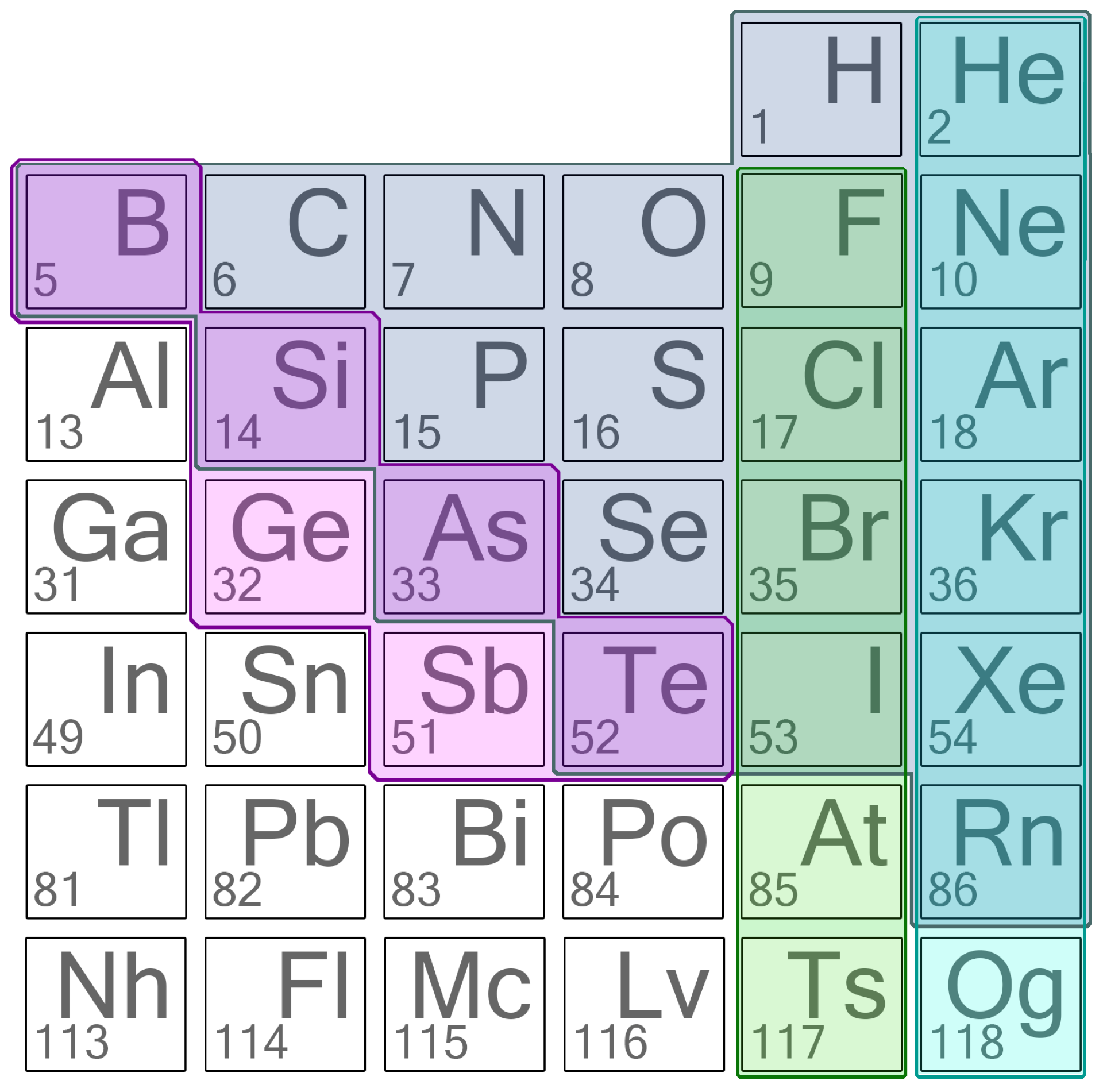
Noble gases occupy Group 18 of the periodic table. The group contains helium, neon, argon, krypton, xenon, radon and oganesson, although oganesson is synthetic and many of its physical properties have not yet been directly measured.
Why They Are Called “Noble”
The term "noble" for the noble gases is from the idea that they tend to remain separate rather than combine with other substances. Chemists also called them inert gases because they initially thought they didn't take part in chemical reactions.² When later discoveries showed that this wasn't exactly the case, the more modern name of "noble" gas was found to be better.
Noble gases are much less reactive than most elements, but they can still react. Heavier members such as krypton and xenon can form compounds under suitable conditions, so "very unreactive" is more accurate than "completely inert".
Noble Gases List
On the noble gases periodic table, Group 18 runs from helium (atomic number 2) to oganesson (atomic number 118). As you move down the group, you can see how atomic number, period, and electron configuration change.¹ Configurations are important because they show the outer-electron pattern associated with noble-gas stability.
From neon onward, the typical noble gas configuration ends with a filled outer s and p subshell, written in the general form ns²np⁶. Helium is the exception since its only occupied shell is complete with two electrons, with the simpler configuration 1s².⁴
| Element | Symbol | Atomic number | Period | Electron configuration | State/status | Example use |
|---|---|---|---|---|---|---|
| Helium | He | 2 | 1 | 1s² | Gas | Cryogenic cooling |
| Neon | Ne | 10 | 2 | [He] 2s²2p⁶ | Gas | Illuminated signs |
| Argon | Ar | 18 | 3 | [Ne] 3s²3p⁶ | Gas | Welding |
| Krypton | Kr | 36 | 4 | [Ar] 3d¹⁰4s²4p⁶ | Gas | Lamps and lasers |
| Xenon | Xe | 54 | 5 | [Kr] 4d¹⁰5s²5p⁶ | Gas | Lighting and ion propulsion |
| Radon | Rn | 86 | 6 | [Xe] 4f¹⁴5d¹⁰6s²6p⁶ | Radioactive gas | Limited specialist use |
| Oganesson | Og | 118 | 7 | [Rn] 5f¹⁴6d¹⁰7s²7p⁶ | Synthetic | Research |
Why Noble Gases Are So Unreactive
Chemical reactions typically involve changes to the electrons in an atom's outermost shell. Because noble gases have especially stable outer-electron arrangements, they tend to gain, lose, or share electrons with other atoms.² Reactions involving the lighter members of the group are particularly uncommon.
High ionization energy, which means considerable energy is needed to remove an electron, also explains why noble gases don't tend to react. As atoms get larger, however, the outer electrons are less tightly held, and heavier members show more varied chemistry. For example, xenon can form several compounds.
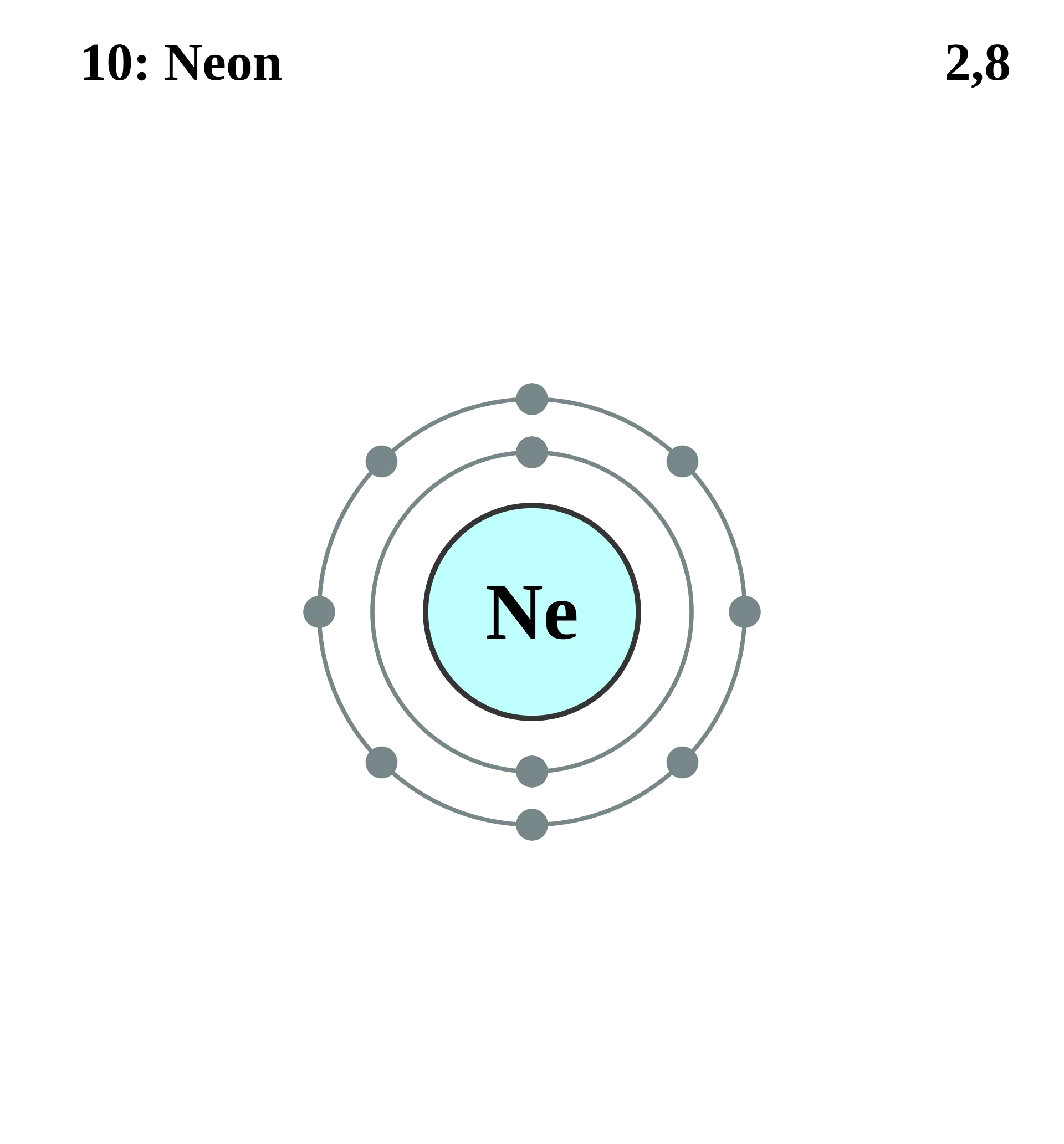
Neon has 10 electrons: two in its first shell and eight in its second. Because that outer shell is already complete, neon has little tendency to gain, lose or share electrons with other atoms. This helps explain why noble gases are generally less reactive than most other elements.
Key Properties of Noble Gases
Although they differ, the elements in Group 18 share enough characteristics to form a clear chemical family. Atomic size and mass increase down the group, and the other physical properties also change in predictable ways.² Given these trends, it's not surprising that helium behaves very differently from the heavier noble gases like xenon and radon.
Shared Properties
These related electron arrangements mean noble gases share recurring chemical and physical characteristics. From helium to radon, there's enough material for direct measurements of these behaviors.² While their values change from one element to the next, the shared behaviors can be compared.
Unique Properties by Element
As you move down Group 18, the increasing atomic size brings differences in mass and behavior. There are physical distinctions, but also differences in radioactivity and the difficulty of producing the element at all. Radon and oganesson are more different from helium and neon than you might first think, given they belong to the same group⁷
Oganesson is officially part of Group 18, but we shouldn't treat it as though all the usual noble-gas properties have been confirmed. Only a very small number of atoms have been produced, so many of its physical properties remain uncertain.
Where Are Noble Gases Found?
Noble gases don't come from a single source. Argon, neon, krypton, and xenon occur naturally in the atmosphere. Commercially useful helium is often recovered from certain natural-gas deposits.² Radon is produced through radioactive decay in rocks and soils, which means it can also enter buildings from the ground.⁸
Oganesson is different because it is produced in specialized nuclear experiments. Scientists have created only tiny numbers of these atoms.⁷ Since it's studied almost entirely through laboratory research and not naturally occurring samples, our understanding of it is much less than that of the other noble gases.

Argon, neon, krypton and xenon can all be obtained from air.
Industrially, air is cooled until it liquefies, then its components can be separated because they have different boiling points.
This process allows scientists, medical professionals, and industry to collect individual gases for scientific, medical, and industrial use.
Uses of Noble Gases in Real Life
The low reactivity of noble gases makes them useful for creating stable environments, especially with materials that often react with air in dangerous ways. They also have other physical properties that give them special uses. This group of elements supports applications such as cryogenic cooling, industrial welding, lighting, and spacecraft propulsion.
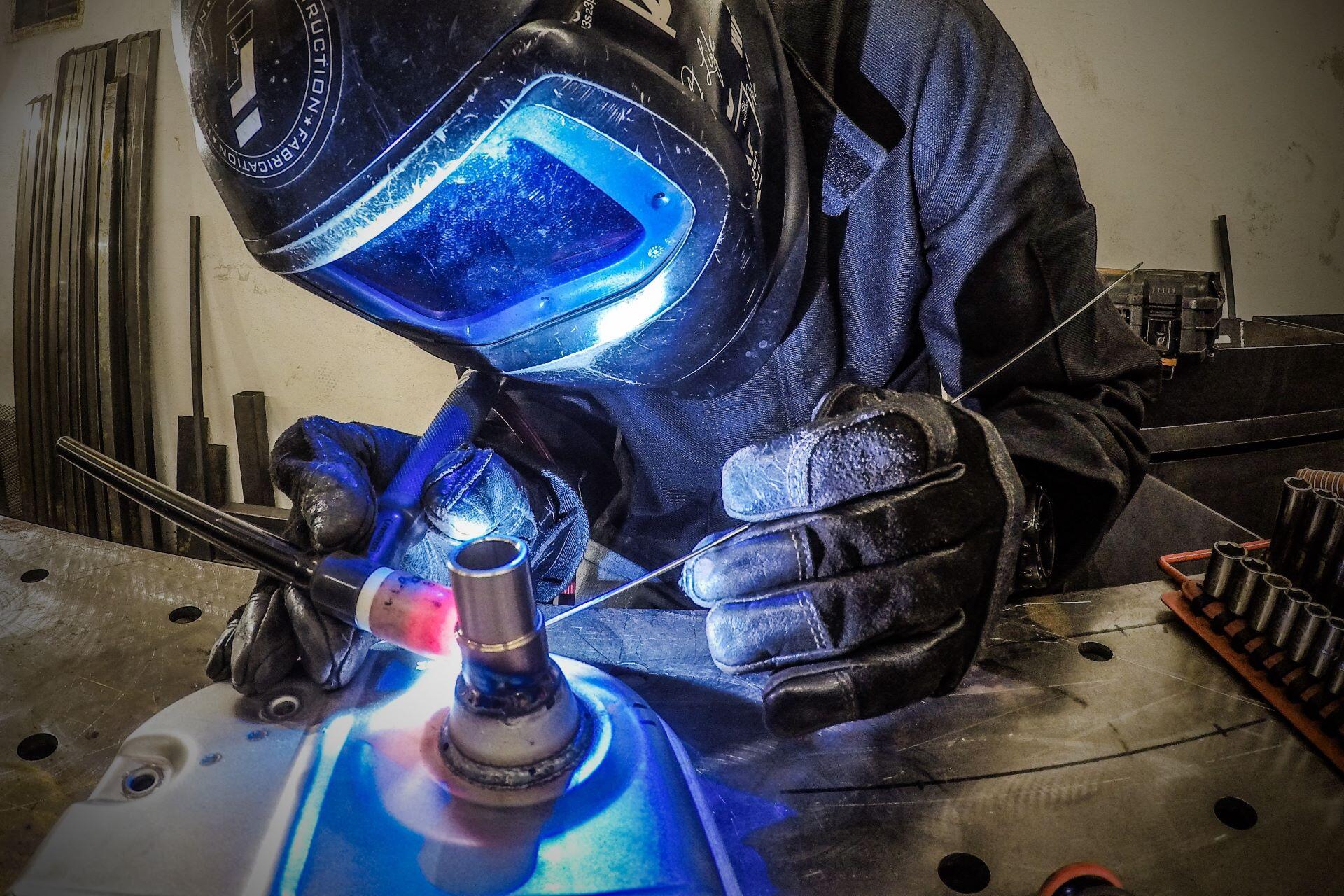
Argon protects hot metals from surrounding gases. Helium is useful for low temperatures. Xenon is useful in ion propulsion because spacecraft engines can ionise and accelerate its atoms efficiently.⁹
Noble gases' low reactivity makes them useful where a stable, protective atmosphere is needed. Their other properties create more specialized uses, from helium in cryogenic cooling to neon in lighting and xenon in spacecraft propulsion.
References
- International Union of Pure and Applied Chemistry. “Periodic Table of Elements.” IUPAC, https://iupac.org/what-we-do/periodic-table-of-elements/. Accessed 7 Oct. 2026.
- OpenStax. “18.12 Occurrence, Preparation, and Properties of the Noble Gases.” Chemistry 2e, OpenStax, 14 Feb. 2019, https://openstax.org/books/chemistry-2e/pages/18-12-occurrence-preparation-and-properties-of-the-noble-gases. Accessed 7 Oct. 2026.
- Royal Society of Chemistry. “Argon - Element Information, Properties and Uses.” Periodic Table, https://periodic-table.rsc.org/element/18/argon. Accessed 7 Oct. 2026.
- Royal Society of Chemistry. “Helium - Element Information, Properties and Uses.” Periodic Table, https://periodic-table.rsc.org/element/2/helium. Accessed 7 Oct. 2026.
- Royal Society of Chemistry. “Krypton - Element Information, Properties and Uses.” Periodic Table, https://periodic-table.rsc.org/element/36/krypton. Accessed 7 Oct. 2026.
- Royal Society of Chemistry. “Neon - Element Information, Properties and Uses.” Periodic Table, https://periodic-table.rsc.org/element/10/neon. Accessed 7 Oct. 2026.
- Royal Society of Chemistry. “Oganesson - Element Information, Properties and Uses.” Periodic Table, https://periodic-table.rsc.org/element/118/oganesson. Accessed 7 Oct. 2026.
- Royal Society of Chemistry. “Radon - Element Information, Properties and Uses.” Periodic Table, https://periodic-table.rsc.org/element/86/radon. Accessed 7 Oct. 2026.
- Royal Society of Chemistry. “Xenon - Element Information, Properties and Uses.” Periodic Table, https://periodic-table.rsc.org/element/54/xenon. Accessed 7 Oct. 2026.
Summarize with AI:
Did you like this article? Leave a rating!

 Loading...