
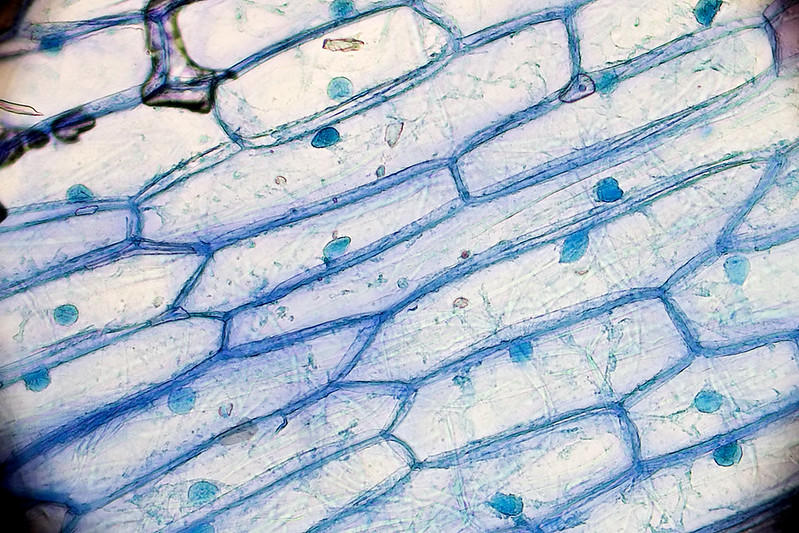

Eukaryotic cells contain a nucleus and organelles bound by plasma membranes. Fungi, plants, and animals are made of eukaryotic cells (eukaryotes). Prokaryotic cells do not have a membrane-bound nucleus or organelles. All bacteria and members of Archaea are made of prokaryotic cells (prokaryotes).


Difference between eukaryotic and prokaryotic cells
The most obvious difference between them is that prokaryotes have no nuclei, but there are four major differences between a eukaryotic and prokaryotic cell:
- No prokaryotic cell has a nucleus; every eukaryotic cell has a nucleus.
- Prokaryotic cells have no mitochondria; nearly every eukaryotic cell has mitochondria.
- Prokaryotic cells have no organelles enclosed in plasma membranes; every eukaryotic cell has a nucleus and organelles, each enclosed in plasma membranes.
- Prokaryotic cells have circular strands of DNA; eukaryotic cells have multiple molecules of double-stranded, linear DNA.
| Eukaryotic Cell | Prokaryotic Cell | |
|---|---|---|
| Cell size | Larger (10-100 μm) | Smaller (0.1-5 μm) |
| DNA | Circular | Linear |
| Nucleus | Yes | No |
| Mitochondria | Yes | No |
| Membrane-bound Organelles | Yes | No |
| Example Organisms | Plants, Fungi, Protists, Animals | Bacteria, Archaea |
Find the best biology tutors near me if you're learning in New York.
Similarities between prokaryotic and eukaryotic cells
For all their differences, prokaryotes and eukaryotes have a few similarities share some common structures (due to physics and evolution), and though their DNA is different, they even share some genetic features.
We only need to look at a sweet puppy or a lovely plant to admire it. However, if we want to be in awe of these organisms, we have to look much deeper into them; how their cells are structured and how their function is optimized.
Both types of cells have five similarities:
- Both types of cells carry on all the necessary functions of life (adaptation through evolution, cellular organization, growth and development, heredity, homeostasis, reproduction, metabolism, and response to stimuli). However, they do these things in different ways.
- Both cells carry DNA and rDNA (ribosomal DNA)
- Both prokaryotic cells and eukaryotic cells have vesicles.
- Both prokaryotes and eukaryotes may be single-celled organisms. Amoebas, paramecia, and yeast are all single-cell eukaryotes.
- Both types of cells have vacuoles, storage units for food and liquid.
Structures found in prokaryotic and eukaryotic cells
All living organisms use cellular organization to create structures to conduct life processes. Cells organize into tissues, which organize into organs, which organize into amazing life forms like plants, fungi, dogs, ducks, and people.
Intracellular structures are common to both types of cells. Both prokaryotic and eukaryotic cells have:
- DNA
- Ribosomes
- Cytoplasm
- Plasma membrane
Prokaryotes
An organism with prokaryotic cells is a prokaryote. Prokaryotic organisms get their names from the Greek roots, pro (before) and karyon (nut or kernel). This roughly means they are cells with structures so simple that they came from a time before a cell's nucleus existed.
The three domains of life, Eukaryota, Bacteria, and Archaea, include two branches that are prokaryotes:
- Bacteria – The first prokaryotes were discovered in 1676. Bacteria have bacterial rRNA (Ribosomal RNA), no nuclear membrane, and cell membranes composed primarily of diacylglycerol diester lipids (ester-linked lipids).
- Archaea – Single-cell organisms. They have no nuclear membrane and share some qualities with bacteria (rDNA, circular chromosomes, asexual reproduction) but are set apart from bacteria by their unique rDNA and ether-linked lipids in their cell membranes.
Only the domain, Eukaryota, has eukaryotic cells.
Examples of archaea include Crenarchaeota (living in extreme acidity or temperatures) and Euryarchaeota (water or producing methane).
Prokaryotic cells
Prokaryotic cells are extremely small, much smaller than eukaryotic cells. A typical prokaryotic cell is of a size ranging from 0.1 microns (mycoplasma bacteria) to 5.0 microns.
1 micron or micrometer, μm, is one-thousandth of a millimeter or one-millionth of a meter.
Anywhere from 200 to 10,000 prokaryotic cells could fit on the head of a pin.
Their small size makes prokaryotic cells just one-half to one-thousandth the size of a eukaryotic cell, which is typically between 10 and 100 microns.
One amazing prokaryotic outlier is Thiomargarita namibiensis, the largest bacterium ever discovered, coming in at a whopping 100 to 300 microns. That is large enough to see in a light microscope.
Prokaryotic Organelles
Prokaryotes have no organelles in their cells! All the equivalent functions of eukaryotic cells are performed by four structures: a plasma membrane, cytoplasm, ribosomes, and genetic material (both rDNA and DNA).
Facts about prokaryotic cells
- Prokaryotes help recycle nutrients by decomposing dead organisms.
- Bacteria in the intestines and mouths of all higher animals help with the digestion of food.
- The DNA of a prokaryotic cell is tightly coiled in a ‘nucleoid,’ which is not a true nucleus since it has no membrane.
- Prokaryotic rDNA is a single ring of DNA and is only about 0.1 percent of the amount of DNA in a eukaryotic cell.
- Prokaryotic cells have many more ways to obtain and use energy than eukaryotic cells, performing photosynthesis, respiration in common with eukaryotes but also using nitrogen fixation, denitrification, sulfate reduction, and methanogenesis.
- Roughly half of all bacteria have flagella, little whip-like external structures that all them to move.
- Prokaryotic cells can use pili and fimbriae; also types of external growths, to stick to other cells or surfaces they make their home.
- Prokaryotic cells can perform binary fission roughly every 24 hours, meaning they can reproduce exponentially fast.
- All adult humans have about 0.2 kg of bacteria in their digestive systems and on their skin; recent studies put the number of bacteria in our bodies as just about equal to the number of eukaryotic cells.
- Prokaryotic cells are the oldest life forms on earth, dating back 3.5 million years.
Eukaryotes
Fungi, plants, protista, and all animals (including humans) are eukaryotes. We are all built with eukaryotic cells. The word eukaryote comes from two Greek roots, eu (good, well), and karyon (nut, kernel), so a eukaryote has a well-defined or “good” nucleus (kernel) in its cells.
Eukaryotes cells
Eukaryotic cells have nuclei and organelles, which sets them apart from prokaryotic cells.
The organelles in eukaryotic cells act as tiny membrane-bound compartments performing all the functions of life in the cell: energy acquisition and transfer, digestion, waste management, reproduction, and cellular respiration.
Some of these eukaryotic cell organelles are:
- Mitochondria (cell powerhouses)
- Chloroplasts (in plants and some algae, for photosynthesis)
- Endoplasmic reticulum (the cell transport system)
- Golgi apparatus (protein packagers)
- Ribosomes (protein synthesis)
- Vacuoles (water and food storage)
- Lysosomes (digestive processes)
- Peroxisomes (metabolic processes)
- Nucleus (the mind and brain of the cell)
Size of eukaryotic cells
In general, eukaryotic cells are much bigger than prokaryotic cells. One eukaryotic cell could be double to 1,000 times the size of a prokaryotic cell. Eukaryotic cells measure between 10 and 100 microns, which means you could barely see them with a standard school light microscope.
Eukaryote Characteristics
- Eukaryotes can be single-celled organisms (like protozoa or paramecia) or multicellular organisms (like you or an elephant)
- The largest organism on earth is a eukaryote nicknamed the Humongous Fungus, a specimen of Armillaria ostoyae that covers almost four square miles under the ground of Malheur National Forest in Oregon.
- Eukaryotes have linear chromosomes, contrasting with the single ring of rDNA in prokaryotes.
- Eukaryotes include animal and plant cells, differentiated in many ways but most obviously by the plasma membrane of animal cells and synthesis cell walls in plants.
- Eukaryotic cells store chromatin (DNA and proteins) in a gel-like fluid called the nucleoplasm inside the nucleus.
- Mitochondria, found only in eukaryotic cells, have their own DNA chromosome, which may indicate they were once freely existing, independent prokaryotic cells “captured” by eukaryotic cells.
- In contrast with the mind-blowing miniature prokaryotic cells, eukaryotic cells are so large, even some of their organelles are visible under the light microscope of a high school science laboratory.
- The oldest eukaryote, Grypania, dates back around 1.874 billion years ago; fossils of this eukaryote were discovered in a Michigan iron mine.
- Eukaryotes mostly reproduce sexually, though some do use cell division.
- Adult humans have around 3⋅1013 human (eukaryotic) cells in their bodies and a roughly equal number of bacteria (prokaryotes).
Find online biology classes and learn from home.
This may be waxing philosophical but people don't often consider the complexity of a living organism. Save perhaps for in Biology class, have you ever thought about the billions of cells your body is made up of and how they all work together as components of a single, large organism?
And can we say that anything is really alive when life depends on cells' continued health and activity?
Ok, so maybe that's a little too deep. How about we explore plant and animal cells now, so we can marvel at how those minuscule units are made.
| Key points of animal and plant cells: |
|---|
| They are both eukaryotic |
| They share many common features, such has having a nucleus and an assortment of organelles that perform similar functions |
| Animal cells form many types of tissues but plant cells only form five |
| Plant cells do not have the same structural support and protection that animal cells enjoy. |
| Only plant cells include chloroplasts; animal cells do not. |
Basic Cell Facts
Cells are the basic unit of life. They contain all of the structure and components, and - most importantly - genetic information to ensure the survival and perpetuation of the organism.
There are two fundamental categories of cells: prokaryotic and eukaryotic. Plants and animals, complex beings that they are, have eukaryotic cells. That means that every plant and animal cell contains a nucleus, cytoplasm - the fluid filling the cells, and a membrane.
You might compare a cell's membrane to our skin; it completely contains everything inside of the cell.
Find biology lessons here on Superprof.
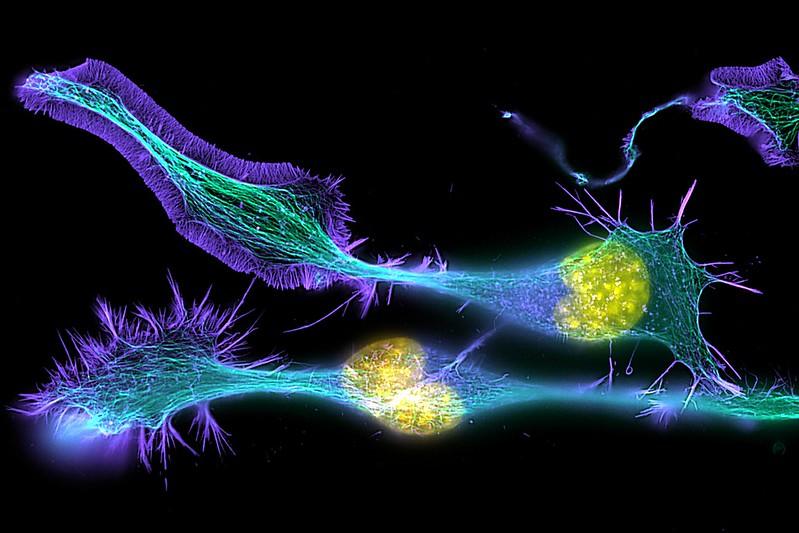
The cell's nucleus contains all of its genetic information and its DNA. A double membrane keeps that information separate from the cytoplasm; that dual protection layer is called the nuclear envelope.
From within the nuclear envelope, instructions for cell growth, division, metabolism, and protein production are issued.
The cytoplasm keeps the nucleus in suspension; it is filled with organelles - the areas where vital chemical reactions take place to maintain homeostasis. Cytoplasm consists of water, salt and other molecules; it is called the intracellular fluid.
The fluid outside of the cell is called extracellular fluid.
Organelles start the divergence between animal and plant cell structures. For instance, while all cells, plant or animal, contain mitochondria and ribosomes - both organelles, only plant cells contain chloroplasts; a different type of organelle.
So now, with basic cell facts in place, let's get specific about cell structures.
Animal Cell Structures
All animals are multicellular; many different types of cells make up the organism. Some animals are simply-constructed while others - humans, for example, are extremely complex.
Complex organisms have blood cells, muscle cells and nerve cells; brain cells, intestinal cells, liver cells and, most important of all, stem cells; these are basically blank templates waiting for instructions on what type of cell to become. And that's just a partial list of the type of cells complex organisms may have.
the variety of cells an animal may have, and the different functions they fulfil mean that not every animal cell is equipped with the same set of organelles. However, many such mini-organs appear across the broad swath of cell types.
Besides a nucleus and cytoplasm, animal cells contain ribosomes; the cells' 'manufacturing department'. They set up the sequence of amino acids in the polypeptide chains according to instructions delivered by the cell's messenger RNA (mRNA). Ribosomes may be anywhere within the cytoplasm but they are often melded to the endoplasmic reticulum (ER).
The ER assemble and transport the long chains of amino acids the ribosomes produced. Each cell has two types of ER: smooth and rough. The rough type has ribosomes attached; the smooth ones don't. The smooth ER's most important function is to remove toxins from the cells.
The Golgi body folds the proteins sent by the ER; it sorts them and packages them into vesicles. As the ribosomes are the production department, the Golgi is responsible for shipping the 'product' out.
Lysosomes contain digestive enzymes; they break down large molecules within the cell so that their component parts may be reused.
Mitochondria organelles produce energy; they are the cells' power station, where cellular respiration takes place. This is where fats and sugars are broken down to release ATP.
All of these components are suspended in cytoplasm and contained within a plasma membrane.
Throughout the cytoplasm is the cytoskeleton, which helps stabilise and anchor the organelles; it also helps the cells keep their shape. The cytoskeleton plays a part in cell signalling - both messaging other cells and sending instructions within the cell. Microfilaments, microtubules and intermediate filaments are the three types of filaments that make up the cytoskeleton.
With the function of animal cell structures explained, let's turn our focus to plant cell structures.
Plant Cell Structure
Three major features distinguish plant cells from animal cells: a cell wall, a vacuole and chloroplasts. Besides them, there are other, more minor differences.
Whereas animal cells rely on glucose and oxygen for their continued survival - molecules they ingest and inhale, plant cells photosynthesise their food. For that, organelles called chloroplasts are vital.
Plants are considered photoautotrophic because they use light energy to make the sugars that sustain them. By contrast, animals are heterotrophic because they eat other animals and plants.
Plant cells do not have the structural protection and security that animals cells have so they have different mechanisms to protect their nuclei and maintain their shapes. The centrally-positioned vacuole and cell wall make the cell structure more rigid and durable.
The vacuole works like a bladder, retaining water so that it balloons towards the cells' sides. This causes turgor pressure - the effect of water-laden cells pressing together. Turgor pressure fulfils the same function as skeletons in animals, providing the plant with the rigidity it needs to grow upwards, towards more sunlight.
To withstand turgor as well as the inner pressure the vacuoles create, plant cells have tough walls. These tough cell walls, in turn, lend the plant strength. Cell walls are made up mostly of cellulose, with a few other molecules thrown in, pectin and lignin among them.
Cellulose presents digestive challenges to organisms that do not naturally produce the enzyme cellulase. Many herbivores produce this enzyme but other animals, including humans, often have a deficiency of it.
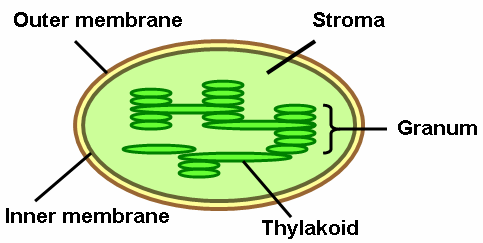
Chloroplasts, the plants' most important organelles, are enclosed in a double membrane. The outer membrane of these disc-shaped organelles forms their outer surface; it is fairly permeable compared to the inner membrane, which doesn't allow as many molecules through.
Chloroplasts are filled with a fluid called stroma - somewhat akin to cytoplasm. Within the stroma are stacks of thylakoids. Each of these coin-shaped compartments contains high levels of carotenoid and chlorophyll, two pigments especially adept at capturing light.
Thylakoid stacks are called grana (singular: granum). They are connected by intergranal thylakoids; essentially a single disc whose sides are embedded in two neighbouring grana.
Like other eukaryotic cells, plant cells contain a nucleus, wherein the cell's genetic material (DNA) is stored. And - again, as in animal cells, proteins are produced in the ribosomes and processed in the endoplasmic reticulum (ER). They are folded and packaged into vesicles in the Golgi apparatus.
Plant cells have mitochondria, too, but they function a bit differently in plants than they do in animals. For instance, while both engage in cellular respiration and ATP production, the mitochondria in animals break down ingested nutrients and extract what it needs while plant mitochondria get their sugars from within, synthesised by the plant itself.
Finally, while animals cells form many different types of tissues, plant cells only form five. Parenchymal, sclerenchymal and collenchymal tissues are considered simple - made up of only one type of cell. By contrast, the phloem and xylem are regarded as complex tissues because they are made up of more than one cell type.
Having taken a close look at these two types of eukaryotic cells, it's easy to see how fascinating cell biology can be but, because the subject can be so complex, many don't like to contemplate it.
Find the best biology tutors near me if you're learning in New York.
Comparing Plant and Animal Cells
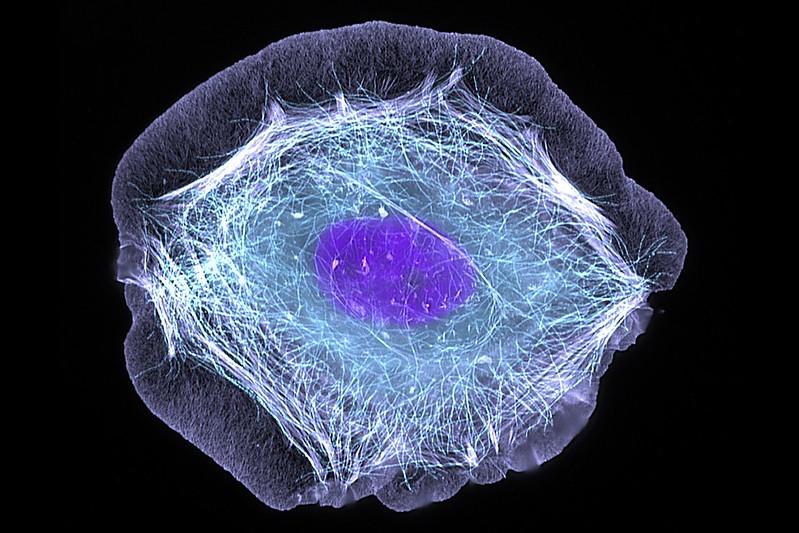
Because they have a defined nucleus and membrane-bound organelles, both plant and animal cells are eukaryotic. Bacteria and archaea, because they have no nucleus - their DNA is housed in a body called the nucleoid, are classified as prokaryotic.
As bacteria are single-celled organisms, and plants and animals are multicellular, we'll exclude bacteria from our analysis to focus on organisms whose multiple cells work together.
Despite their shared classification as eukaryotes and their few similarities, animal and plant cells are fundamentally different.
Plant cells have walls to protect their delicate nuclei; animal cells do not. That's because animals are complex organisms that have many more support instruments for their organs and tissues:
- bones
- ligaments
- tendons
- cartilage
- an assortment of extracellular fluids
- interstitial
- transcellular
- intravascular
- cerebrospinal
With such an extensive support system, it's clear to see why animal cells don't need the extra protection that plant cells have. However, plant cells are rich in chloroplasts, the organelles that make them appear green and enable photosynthesis.
Very few animals - mainly bacteria and amoebas, and only one vertebrate, the spotted salamander, have any chloroplasts. They absorb them from the plants they eat.
Additionally, plant cells have a large, central vacuole; animal cells don't. This central vacuole contains water and maintains the cells' turgor pressure. As plant cells take in water by osmosis and have relatively few defences, it's vital that they have a place to store those molecules.
Note that some animals' cells have small vacuoles that store molecular particles larger than water. Clearly, then, those molecules are helped into the cells by facilitated diffusion.
Summarize with AI:
Did you like this article? Leave a rating!


 Loading...

