

Standing Half Forward Bend (Ardha Uttanasana) is the short, flat-back lift between two forward folds. From a full fold, you press your hands into your shins, blocks, or the floor and lengthen your spine forward. Your back stays flat, your neck stays long, and you hold for one breath or a few.
Yoga Journal notes that many teachers call it Half Lift or Halfway Lift, and it is part of the Sun Salutation sequence. The pose looks simple. Yet it teaches the hip hinge and the long spine that many other poses rely on.
US adults who practiced yoga in 2022
up from 5.0% in 2002, according to the National Center for Complementary and Integrative Health


Standing Half Forward Bend at a Glance
The half lift is a beginner pose, and you need little more than a mat to try it. Here are the basics before you start.
At a glance
Standing Half Forward Bend at a Glance
| Detail | Information |
|---|---|
| Sanskrit name | Ardha Uttanasana (ARE-dah oot-tan-AHS-ah-nah) |
| Other names | Half Lift, Halfway Lift |
| Level | Beginner-friendly |
| Where you meet it | Sun Salutations, right after the full forward fold |
| Primary focus | A long, flat spine with the hinge at the hips |
| Common props | Two yoga blocks, or a chair |
Sources: Yoga Journal, checked Oct 1, 2026.
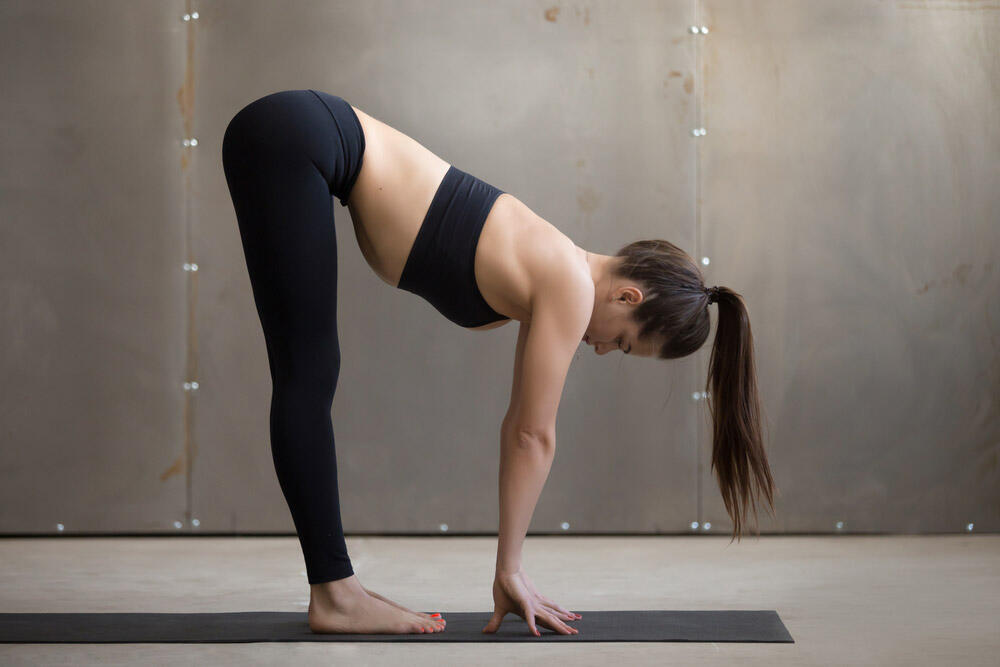
In the full forward fold, your torso hangs toward your legs. In the half version, you lift your torso away from your thighs until your back is long and flat.
What Does the Sanskrit Name Mean?
Yoga Journal gives the pronunciation as “ARE-dah oot-tan-AHS-ah-nah.” Ardha means “half,” and uttana means “intense stretch.” Asana means “posture.”
So the name points to half of Uttanasana, the intense stretch of the full standing forward fold. You fold only partway, and the work moves from releasing the back body to lengthening the spine.
How to Do Standing Half Forward Bend Step by Step
In class, the half lift usually lasts a single inhale. Practicing it slowly on its own first helps you learn the shape. Move with your breath through these four steps.
Quick guide
The Half Lift in Four Steps
| Step | Breath | Key action |
|---|---|---|
| 1. Stand tall | Inhale | Feet hip-width and parallel; reach your arms overhead |
| 2. Fold | Exhale | Hinge from the hips into the full forward fold, knees soft if needed |
| 3. Lift halfway | Inhale | Hands on shins, blocks, or floor; lengthen the spine forward |
| 4. Release | Exhale | Fold back down, then move on to the next pose |
Based on Yoga Journal’s pose and Sun Salutation guides, checked Oct 1, 2026.
Step 1: Stand Tall and Reach Up
Stand with your feet hip-width apart and parallel to each other. Spread your weight evenly between the fronts and backs of your feet. Inhale and sweep your arms overhead.

Firm the muscles of your legs, but keep your knees soft rather than locked. This steady base makes the next move, the hinge, much easier.
Step 2: Fold Forward From Your Hips
Exhale and fold forward, bending from your hips rather than your waist. Keep your ankles, knees, and hips in line as you go down. Bend your knees as much as you need to keep your spine long.
Let your hands come to the floor, to blocks, or to your shins. Stop wherever your back still feels long. Reaching the floor is not the goal.
Step 3: Lift Halfway and Lengthen Your Spine
Inhale and press your palms or fingertips down and back. Straighten your elbows and lift your torso away from your thighs. Make as much length as you can between your pubic bone and your navel.
Lift the top of your breastbone forward and away from the floor. Aim to bring your shoulders level with your hips, or slightly higher. Look down or a little ahead, without squeezing the back of your neck.
Step 4: Hold, Then Release Into the Fold
Hold the flat-back position for a few breaths. Then exhale and release your torso back into the full forward fold. To come up, lift your torso and reach your arms overhead on an inhale.
Can’t touch the floor with your knees straight? Set a yoga block just outside each foot and rest your hands on top. A flat back matters more than how low your hands go.
Where Does the Halfway Lift Fit in Sun Salutations?
The half lift links two of the core moves in a Sun Salutation. In Richard Rosen’s guide for Yoga Journal, you fold into Uttanasana on an exhale. Then you inhale, press your hands to the floor or blocks, and arch your torso forward. On the next exhale, you step back into a lunge.

Rosen describes the sequence as 12 “stations” built from eight postures. The second half retraces the first, so you pass through the forward fold again near the end. From there, you lift your torso and reach your arms overhead on an inhale.
Because it is such a small movement, the lift is easy to rush. Yoga teacher Jason Crandell says students often barely lift the spine before folding again.
When you give this transitional pose short shrift, you prevent yourself from experiencing its primary benefits— strengthening and decompressing the spine—and skimp on your breath.
Jason Crandell, yoga teacher, in Yoga Journal
His fix is simple. Take the whole inhale to lift, and bring your shoulders level with your hips. Most people need their hands on their shins or on blocks to do that.
Common Mistakes and How to Fix Them
Most problems in the half lift come from chasing depth instead of length. These fixes come from Yoga Journal and Yoga International teachers.
- Rushing the lift: give it a full inhale, and let your spine muscles switch on before you fold again.
- Rounding from the waist: hinge at the hips instead, and move your hands higher up your legs if your back curves.
- Cranking the neck: look down or slightly forward, and keep length along all sides of your neck.
- Locking straight legs: bend your knees a little; a long spine matters more than straight legs.
- Knees falling inward: point your knees straight ahead, and ground through your big toes and outer heels.
Check yourself in a mirror from the side. If your upper back looks like a hump, bring your hands higher and lift again.
Modifications and Props
You don’t need flexible hamstrings to do this pose well. Props raise the floor to meet you, so you can keep your back flat.
Modifications
Four Ways to Adapt the Pose
| Option | How to do it | Good for |
|---|---|---|
| Hands on shins or thighs | Keep the back flat and rest your palms on your legs; bend your knees slightly | Tight hamstrings or shorter arms |
| Two blocks | Set blocks just outside each foot, or in front of your feet about shoulder-width apart | Not yet reaching the floor with a flat back |
| Chair | Face a chair, fold forward, and place your hands on the seat; look down at your hands | A gentler angle and more support |
| Bent knees | Bend your knees as much as you need to keep your spine long | Protecting the lower back |
Source: Yoga Journal and Yoga International, checked Oct 1, 2026.
Tight hamstrings are the usual reason to modify. Yoga teacher Nishita Morris explains that the hamstrings are three muscles running from the sit bones to the backs of the knees. Together, they bend the knee and extend the hip.
That is why bending your knees helps. Morris advises bending them as much as you need to keep a long spine as you hinge. Morris adds that the half fold can be an excellent place to stay if you tend to round your upper back.
Who Should Be Careful With This Pose?
Most healthy people can practice the half lift safely. The National Center for Complementary and Integrative Health (NCCIH) calls yoga generally safe for healthy people with a qualified instructor. Still, some conditions call for changes.
- Neck injury: don’t lift your head to look forward. Keep your gaze down and your neck neutral.
- Lower-back injury, hamstring tear, or sciatica: Yoga Journal lists these as cautions for the full forward fold, and they apply here too.
- Glaucoma or a detached retina: Yoga Journal lists both as cautions for the forward fold, so check with your eye doctor.
- Pregnancy: NCCIH advises getting checked by your health care provider first and modifying poses as needed.
- Age 65 and over: NCCIH notes a higher rate of yoga injuries treated in emergency rooms, so move slowly and use props.
NCCIH also lists balance problems, severe high blood pressure, and lumbar spine disease as reasons to modify. If any of these apply, talk with your doctor and your yoga teacher first.
What Are the Benefits of Standing Half Forward Bend?
The half lift mainly builds back strength and spinal length. According to Yoga Journal, it stretches the front torso, strengthens the back, and improves posture. It also teaches the flat back you need in many other postures.
Benefits
What the Half Lift Does for Your Body
| Benefit | What the sources say |
|---|---|
| Front-body stretch | Stretches the front of the torso |
| Back strength | Strengthens the back and improves posture |
| Spinal length | Strengthens and decompresses the spine when you lift fully |
| Belly | Stimulates the belly |
| Skill building | Teaches the flat back that many other yoga postures need |
Sources: Yoga Journal pose guide and Jason Crandell in Yoga Journal, checked Oct 1, 2026.
Those benefits depend on how you practice. A full, slow lift works the muscles along your spine. A rushed one skips most of them, Crandell warns.
Sources
- YJ Editors. "Standing Half Forward Bend (Ardha Uttanasana)." Yoga Journal, 21 Mar. 2025. Available at: https://www.yogajournal.com/poses/standing-half-forward-bend/. Accessed 1 Oct. 2026.
- Lee, Cyndi. "More Than a Toe Touch: Standing Forward Bend." Yoga Journal, 8 Dec. 2010. Available at: https://www.yogajournal.com/poses/standing-forward-bend/. Accessed 1 Oct. 2026.
- Crandell, Jason. "6 Mistakes You Might Be Making in Sun Salutations (And How to Correct Them)." Yoga Journal, 16 Dec. 2022. Available at: https://www.yogajournal.com/practice/yoga-sequences/go-with-the-flow/. Accessed 1 Oct. 2026.
- Rosen, Richard. "Everything You Need to Know About Sun Salutations in Yoga." Yoga Journal, 19 June 2026. Available at: https://www.yogajournal.com/practice/sun-salutation-surya-namaskar/. Accessed 1 Oct. 2026.
- Morris, Nishita. "Yoga for Tight Hamstrings." Yoga International. Available at: https://yogainternational.com/article/view/yoga-for-tight-hamstrings/. Accessed 1 Oct. 2026.
- "Yoga: Effectiveness and Safety," National Center for Complementary and Integrative Health. Available at: https://www.nccih.nih.gov/health/yoga-effectiveness-and-safety. Accessed 1 Oct. 2026.
Summarize with AI:
Did you like this article? Leave a rating!

 Loading...

