

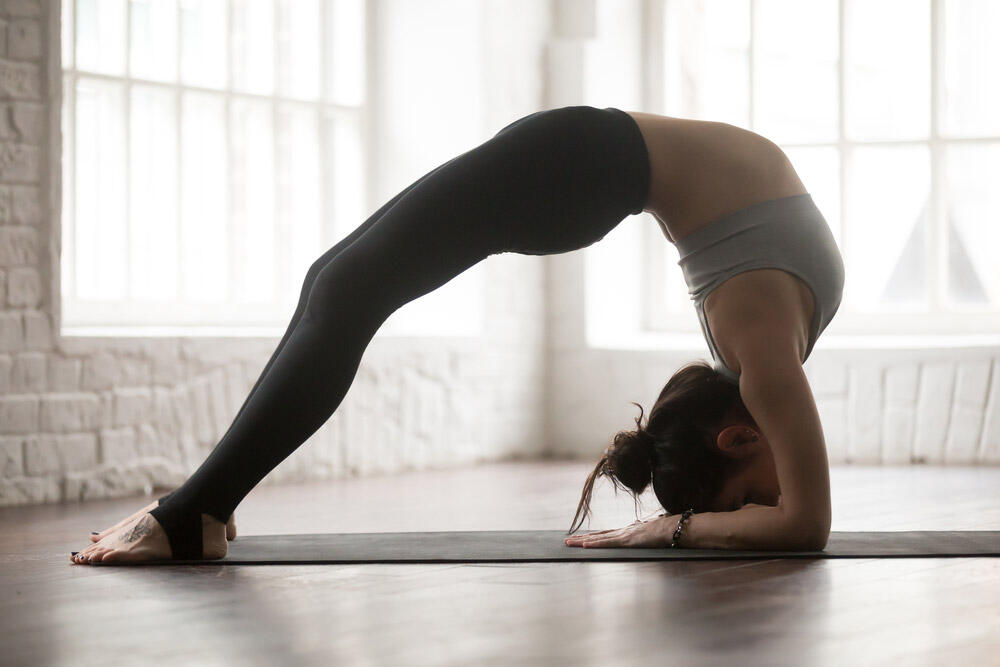
Dwi Pada Viparita Dandasana is an advanced backbend that you enter from Wheel Pose. You rest on your forearms and the crown of your head, with your fingers laced behind it. Then you walk your feet out until your legs are straight and your whole body forms a high arch.
It opens the chest and builds spine and shoulder flexibility. It also asks for patience, so treat it as a long-term project rather than a quick win.
Hold each round for up to
seconds, repeating up to six times, as yoga teacher John Schumacher suggests


Are You Ready for This Pose?
Yoga teacher Barbara Benagh sets two prerequisites in Yoga Journal. You should hold Upward Bow Pose, or Urdhva Dhanurasana, with straight arms, and practice Headstand without strain. If both feel steady, you’re ready to start.
What Does the Sanskrit Name Mean?
The name combines four Sanskrit words, as yoga teacher Pragya Bhatt explains:
- Dwi: two
- Pada: foot or leg
- Viparita: reversed or inverted
- Danda: staff or rod
Bhatt quotes B.K.S. Iyengar’s classic book Light on Yoga, which compares the arch to a yogi’s graceful prostration. In English, most teachers call it Two-Legged Inverted Staff. You’ll also see Upward-Facing Two-Foot Staff, an older name that is less literal.
At a glance
The Pose in Brief
| Detail | What to know |
|---|---|
| Sanskrit name | Dwi Pada Viparita Dandasana |
| English names | Two-Legged Inverted Staff; also called Upward-Facing Two-Foot Staff |
| Level | Advanced |
| Pose type | Backbend with an inverted head position |
| Hold | 30 to 60 seconds, up to six rounds |
| Prerequisites | Wheel Pose with straight arms and Headstand, both without strain |
Sources: Yoga Journal (Barbara Benagh and John Schumacher), checked Oct 2, 2026. Full references in the Sources section.
How to Do the Pose, Step by Step
These steps follow Benagh’s method. Move slowly, keep breathing, and stop at any stage that feels like your limit.
Overview
The Eight Steps in Brief
| Step | Key action |
|---|---|
| 1 | Lie down and set up as for Upward Bow Pose |
| 2 | Press up, then lower the crown of your head to the mat |
| 3 | Interlace your fingers behind your head, as in Headstand |
| 4 | Press your forearms down and lift your chest |
| 5 | Walk your feet away in small steps |
| 6 | Straighten your legs and arch evenly |
| 7 | Hold with a steady breath |
| 8 | Walk back, release your hands, and roll down |
Based on Barbara Benagh’s instructions in Yoga Journal, checked Oct 2, 2026.
Step One: Start From Upward Bow
Lie on your back with your knees bent and your feet flat, heels under your knees. Step your feet a little wider than your hips. Place your palms by your ears, shoulder-width apart, with your fingertips pointing toward your shoulders.
You need to feel confident in Upward Bow Pose first. If you don’t yet, practice the supported version described below instead.

Step Two: Lift and Place Your Head
On an exhalation, press into your hands and feet and lift your hips, shoulders, and head. Then bend your arms and lower the crown of your head to the mat.
Keep your elbows shoulder-width apart and directly over your wrists. Press your hands down and draw your upper shoulder blades toward your tailbone, so your neck doesn’t compress.
Step Three: Interlace Your Fingers
On your next exhalation, slide one hand past your ear and cup the back of your head. Your weight moves onto that forearm. Repeat with the other arm and interlace your fingers, as you would in Headstand.
Lifting onto your tiptoes can make these arm moves easier. If you can’t bring your hands behind your head, hold the position you’ve reached.
Step Four: Lift Your Chest
Exhale and press down through your elbows and forearms to lift your chest. If you can, raise your head off the floor and lower your heels.
Keep your weight even between your elbows and wrists. Don’t let your shoulders push past your elbows, because that strains the joints.
Step Five: Walk Your Feet Out
It’s fine to stay here, with your feet below your knees. To go further, walk your feet away from your hands, one small step at a time.
Schumacher warns that big steps cost you the height of your pelvis. Keep lifting your hips as you go.
Step Six: Straighten Your Legs
When your legs are nearly straight, plant your feet and stretch down through your calves to straighten them. Return the crown of your head to the floor, inside the cup of your hands.
Press your elbows down and keep rolling your top shoulder blades toward your tailbone. Your middle back now bends more deeply.
Step Seven: Hold and Breathe
Keep your breath steady and avoid holding it. Schumacher suggests holds of 30 to 60 seconds, repeated up to six times if you feel clear and pain-free. Over time, you can hold longer.
Step Eight: Come Out Slowly
Walk your feet back under your knees. Then return your palms to the floor beside your ears, with your hands under your elbows.
Push through your hands to lift your head. Tuck your chin and roll your spine down to the floor, with your tailbone touching last. Rest until your breathing slows.
A Supported Version for Beginners
Schumacher teaches a chair version that lets you stay longer and learn the actions. Place a chair about a foot and a half from a wall, with the seat facing away from it.
Sit facing the wall and lean back over the front edge of the seat. Slide your upper back off the seat until your head lightly touches the floor. Press your feet into the wall, straighten your legs, and interlace your hands behind your head.
Benagh starts her practice by lying over a firm blanket roll placed under the middle and lower back. Move the roll or make it smaller if your neck or low back complains.
Who Should Avoid This Backbend?
Benagh lists these contraindications. Skip the full pose, or ask a qualified teacher and your doctor first, if any of them apply:
- Spinal nerve damage or disc problems
- Chronic shoulder dislocations
- Pregnancy
- Unmanaged high blood pressure
- Retina problems
NCCIH, part of the National Institutes of Health, gives wider guidance. People new to yoga should avoid extreme practices such as headstands. Injuries, lumbar spine disease, severe high blood pressure, and glaucoma may also call for changes.
Head-down positions also raise eye pressure quickly, according to a 2015 study in PLOS ONE. During pregnancy, ACOG advises against poses that keep you on your back for long periods. On days you skip the full pose, try a gentler Bridge Pose backbend, one of Benagh’s preparations.
What Are the Benefits?
Benagh says the pose increases spine and shoulder flexibility. She adds that it strengthens and invigorates the whole body and improves breathing. Schumacher stresses the stability and mobility it demands in the chest and shoulders.
Dwi Pada Viparita Dandasana (Two-Legged Inverted Staff Pose) is a deep, heart-opening backbend that depends upon a lot of patience and self-awareness. It is a profound undertaking whether you are flexible or tight.
Desirée Rumbaugh, yoga teacher, in Yoga Journal
Benagh also describes the calm that balanced backbends leave behind. More broadly, NCCIH reports evidence that regular yoga can help with stress and sleep.

Those NCCIH findings come from studies of full yoga programs, not this pose alone. Benagh notes that you probably won’t hold the pose for long at first.
Sources
- Benagh, Barbara. "Dwi Pada Viparita Dandasana (Two-Legged Inverted Staff Pose)." Yoga Journal, 19 Jan. 2025. Available at: https://www.yogajournal.com/practice/yoga-sequences/dwi-pada-viparita-dandasana-two-legged-inverted-staff-pose/. Accessed 2 Oct. 2026.
- Benagh, Barbara. "Dwi Pada Viparita Dandasana: Two-Legged Inverted Staff Pose." The Yoga Studio, 23 Apr. 2019. Available at: https://yogastudio.org/teachings/articles/dwi-pada-viparita-dandasana-two-legged-inverted-staff-pose/. Accessed 2 Oct. 2026.
- Schumacher, John. "Intelligence In Action: 5 Steps to Two-Legged Inverted Staff." Yoga Journal, 20 Jan. 2025. Available at: https://www.yogajournal.com/practice/yoga-sequences/intelligence-action/. Accessed 2 Oct. 2026.
- Rumbaugh, Desirée. "Open Your Heart for Two-Legged Inverted Staff." Yoga Journal, 14 Dec. 2025. Available at: https://www.yogajournal.com/practice/yoga-sequences/bare-your-heart/. Accessed 2 Oct. 2026.
- Bhatt, Pragya. "Dwi-Pada Viparita Dandasana – Two-Legged Inverted Staff Posture." yogawithpragya, 17 Mar. 2020. Available at: https://yogawithpragya.com/2020/03/17/dwi-pada-viparita-dandasana-two-legged-inverted-staff-posture/. Accessed 2 Oct. 2026.
- "Yoga: Effectiveness and Safety," National Center for Complementary and Integrative Health, National Institutes of Health. Available at: https://www.nccih.nih.gov/health/yoga-effectiveness-and-safety. Accessed 2 Oct. 2026.
- "Exercise During Pregnancy," American College of Obstetricians and Gynecologists. Available at: https://www.acog.org/womens-health/faqs/exercise-during-pregnancy. Accessed 2 Oct. 2026.
- Jasien, Jessica V., et al. "Intraocular Pressure Rise in Subjects with and without Glaucoma during Four Common Yoga Positions." PLOS ONE, vol. 10, no. 12, 2015. Available at: https://journals.plos.org/plosone/article?id=10.1371/journal.pone.0144505. Accessed 2 Oct. 2026.
Summarize with AI:
Did you like this article? Leave a rating!

 Loading...

