

Upavistha Konasana, or Wide-Angle Seated Forward Bend, is a seated yoga pose. You open your legs wide and fold forward from the hips. It lengthens the hamstrings and stretches the back, thighs, and calves. Yoga Journal calls it good preparation for most seated forward bends, twists, and wide-leg standing poses.
It can feel hard at first, since few of us sit on the floor in daily life. Props make it accessible at almost any level of flexibility.
U.S. adults who practiced yoga in 2022
Up from 5.0% in 2002, according to NCCIH


The Pose at a Glance
This is a seated forward bend that suits beginners once props are in place. Yoga Journal lists its pose type as a forward bend that targets the lower body. Here are the basics before you roll out your mat.
At a glance
Pose Basics
| Detail | What to know |
|---|---|
| Pronunciation | oo-pah-VEESH-tah cone-AHS-ah-nah |
| Other names | Wide-Angle Seated Forward Bend, seated angle pose |
| Pose type | Seated forward bend |
| Main stretch | Hamstrings, inner thighs, calves, and back |
| Starting point | Staff Pose (Dandasana) |
| Props (optional) | Folded blanket, rolled blankets, bolster, or a chair |
Based on Yoga Journal and Yogapedia, checked Oct 2, 2026. Full references in the Sources section.
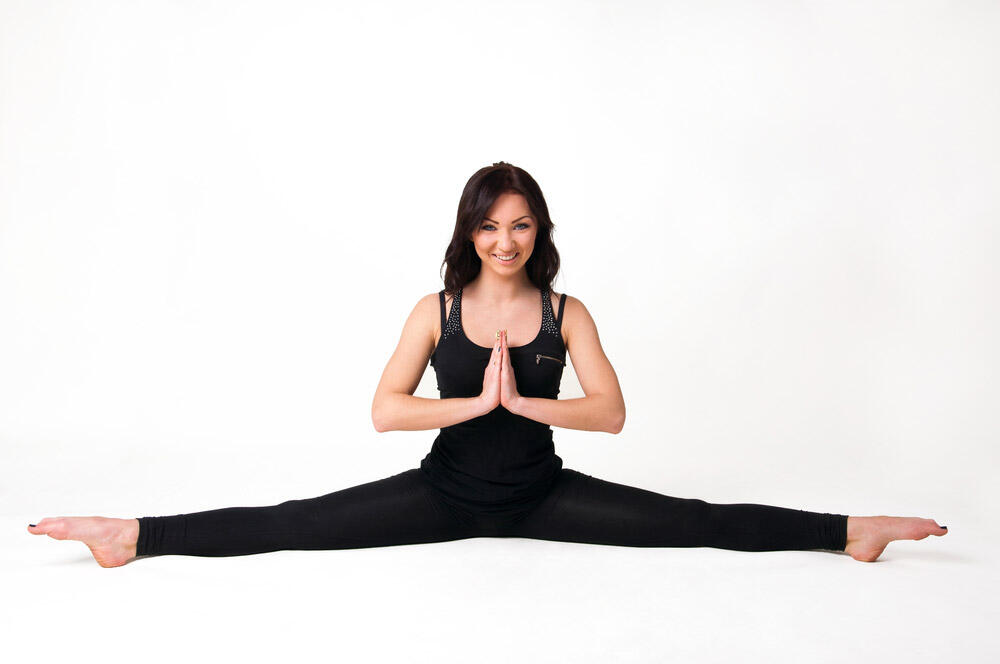
What Does Upavistha Konasana Mean?
The name combines three Sanskrit words. Upavistha means seated or sitting. Kona means angle, and asana means pose. Put together, it describes exactly what you do: sit and open your legs into a wide angle.
Yogapedia notes that the common English name is the wide-angle seated forward bend. Some teachers also call it seated angle pose or a seated straddle. You pronounce the Sanskrit “oo-pah-VEESH-tah cone-AHS-ah-nah.”
How Do You Do a Wide-Angle Seated Forward Bend?
Sit with your legs open wide, flex your feet, and lengthen your spine. Then hinge at your hips and walk your hands forward, keeping your back straight. Stop as soon as your back starts to round, and breathe there.
Step by step
The Pose in Five Steps
| Step | Action | Key focus |
|---|---|---|
| 1 | Sit tall in Staff Pose | Weight on top of both sitting bones |
| 2 | Open your legs wide and flex your feet | Kneecaps and toes point at the ceiling |
| 3 | Inhale to lengthen, exhale to hinge forward | Fold from the hips with a straight back |
| 4 | Walk your hands forward and breathe | Stop when your back starts to round |
| 5 | Walk your hands back and return to Staff Pose | A slow, controlled exit |
Adapted from Yoga Journal’s instructions, checked Oct 2, 2026.
Step One: Sit Tall in Staff Pose
Sit on your mat in Staff Pose (Dandasana), with your legs straight in front of you. Sit directly on top of your sitting bones rather than behind them. If sitting on the floor feels hard, sit on a folded blanket for support.
Step Two: Open Your Legs Wide
Hold your legs near the knees and move them out to the sides, one at a time, as wide as you comfortably can. Flex your feet so your toes point up toward the ceiling. Press through the mounds of your big toes and root your thighs down, so your kneecaps also face the ceiling.
Press your palms into the floor behind you and slide your pelvis forward a few inches. This can help you widen your legs a little more. Keep extending out through your heels.
Step Three: Hinge From Your Hips
Inhale and lengthen your spine. As you exhale, hinge at your hips and walk your hands forward on the floor between your legs. Keep pressing the backs of your thighs into the floor as you go.
Keep your back straight and avoid curving your spine. When your chest starts to collapse and your back begins to dome, stop moving forward. That point is your edge for today, and it will change with practice.
Step Four: Hold and Breathe
Start with 30 seconds to a minute. With each inhale, lengthen your spine slightly, and with each exhale, let your torso settle a little further. Add time gradually over future sessions, as long as your back stays long.
Step Five: Come Out With Care
To exit, walk your hands back toward your hips and sit up. Hold the insides of your knees, bend them slightly, and draw your legs back together. Return to Staff Pose and take a few breaths before your next pose.
Can’t bend forward yet? Focus on sitting tall with your legs as wide as they go and your kneecaps facing up. If your hamstrings are tight, bend your knees slightly and rest them on thinly rolled blankets.
Who Should Modify or Avoid This Pose?
Most people can practice some version of this pose with props. Still, a deep fold asks a lot of the lower back, so a few conditions call for a gentler approach. Talk to your health care provider before you practice if any of these apply.
- Lower-back injury: sit high on one or two folded blankets and keep your torso fairly upright. Yoga Journal warns that rounding the lower back puts pressure on the disks.
- Osteoporosis or osteopenia: a Mayo Clinic study advises avoiding extreme spinal flexion because of the risk of compression fractures.
- Knee or hip injury, or lumbar spine disease: NCCIH lists these among conditions that may call for modified poses.
- Severe high blood pressure or glaucoma: NCCIH lists both as reasons to adapt your practice too.
- Pregnancy: yoga is safe for most pregnant women with precautions, so check with your provider about forward folds.
NCCIH considers yoga generally safe for healthy people when practiced properly under a qualified instructor. The most common injuries are sprains and strains, and serious injuries are rare.
Modifications and Props for Tight Hamstrings
Tight hamstrings are the usual limit in this pose. Yoga teacher Natasha Rizopoulos explains in Yoga Journal that short hamstrings pull the back of the pelvis down. That tucks the pelvis and rounds the lower back.
The simplest fix is height. Sitting on a folded blanket lifts your hips, eases the pull on your hamstrings, and frees your spine to lengthen. These props help too.
- Folded blanket: sit on its edge so your pelvis can tip forward.
- Rolled blankets: slide them under slightly bent knees, with your kneecaps still pointing up.
- Bolster: fold forward as far as you can, then fill the gap between your chest and the floor with a bolster or stacked blankets.
Rest your torso on the support for several slow breaths. Lower it gradually as your flexibility improves.
Deepen the Pose
Once you can fold with a long back, try holding your big toes. Hook each big toe with your first two fingers and thumb, then draw your toes back as your heels extend away. Lift your chest and look forward to lengthen your spine.
On an exhale, fold forward again, leading with your chest rather than your head. If you’re very flexible, you can hold the outer edges of your feet instead. Back off at the first sign of strain.
What Are the Benefits of This Pose?
According to Yoga Journal, it lengthens the hamstrings and stretches the back, thighs, and calves. It can also increase mental calmness and decrease anxiety.
- Stretches the hamstrings, inner thighs, and calves.
- Lengthens the back when you fold with a straight spine.
- Prepares you for seated forward bends, twists, and wide-leg standing poses.
- Calms the mind, like most forward folds.
The pose also gives honest feedback, day by day. Kyle Houseworth, an assistant editor at Yoga Journal, says the breath does much of the work.
In Wide-Angle Seated Forward Bend, the connection between my body and breath is extremely pronounced. With every exhale, my torso noticeably extends farther, taking me deeper into the pose.
Kyle Houseworth, Yoga Journal assistant editor
Variations to Try
You can make the pose gentler, take it to a chair, or add a side fold. Each version keeps the same goal: a long spine and steady breathing.
Variations
Three Ways to Vary the Pose
| Variation | How it works | Best for |
|---|---|---|
| Gentle version | Legs only as wide as is comfortable, hands on the floor in front for support | Tight hips and hamstrings |
| Chair version | Sit on a sturdy chair, hold the front edge, and lift and straighten both legs | Anyone who finds floor sitting hard |
| Side seated (Parsva) | Turn your torso toward one leg and fold over it | Lengthening each side of the body |
Based on Yoga Journal’s pose guide and Marla Apt’s sequence, checked Oct 2, 2026.
Side Seated Wide Angle Pose
Once the basic pose feels steady, try Parsva Upavistha Konasana. Yoga teacher Marla Apt writes in Yoga Journal that it lengthens the hamstrings and inner thighs. It also builds symmetry between the two sides of your torso.
Sit with your legs wide and your thighs pressing down. Turn your torso to face your right leg and hold the outside of your right foot with your left hand. If you can’t reach it, loop a strap around the foot instead.

Place your right hand beside your right hip and lift the right side of your rib cage. Then hold the foot with both hands, bend your elbows out, and lengthen forward over the leg. Breathe for about a minute, come back to center on an inhale, and repeat on the left.
Practicing With a Partner
A partner can help you feel how your inner thighs need to lengthen. Sit in the pose with your legs wide. Your partner sits facing you with legs apart and presses the soles of their feet against the insides of your ankles.
Hold each other’s wrists and keep both pairs of arms straight. Your partner leans back slowly, which draws your torso forward. Tell them to stop the moment the stretch turns into pain.

From there, you can move together in a slow circle, leaning side to side and forward and back. Then switch roles so you lean back and draw your partner forward. Relax your inner thighs throughout, and let your breath, not the pull, set the depth.
Sources
- “Wide-Angled Seated Forward Bend: How to Practice Upavistha Konasana.” Yoga Journal, 22 Mar. 2025. Available at: https://www.yogajournal.com/poses/wide-angle-seated-forward-bend/. Accessed 2 Oct. 2026.
- Apt, Marla. “5 Revolved Seated Forward Bends.” Yoga Journal, 9 Jan. 2013. Available at: https://www.yogajournal.com/practice/positive-spin/. Accessed 2 Oct. 2026.
- “What Is Upavistha Konasana?.” Yogapedia. Available at: https://www.yogapedia.com/definition/6535/upavistha-konasana. Accessed 2 Oct. 2026.
- “Yoga: Effectiveness and Safety.” National Center for Complementary and Integrative Health, Aug. 2023. Available at: https://www.nccih.nih.gov/health/yoga-effectiveness-and-safety. Accessed 2 Oct. 2026.
- Lee, M., et al. “Soft Tissue and Bony Injuries Attributed to the Practice of Yoga: A Biomechanical Analysis and Implications for Management.” Mayo Clinic Proceedings, vol. 94, no. 3, pp. 424–431, 2019. Available at: https://pubmed.ncbi.nlm.nih.gov/30792066/. Accessed 2 Oct. 2026.
Summarize with AI:
Did you like this article? Leave a rating!

 Loading...

