Review Before You Start
Note: Every real number is a complex number, but not every complex number is a real number.
Formulas for operating with complex numbers:
Addition
The real parts are grouped and added on one side and the imaginary parts on the other

Product
It is solved in the same way as the product of 2 binomials, using distributivity
remembering that 

Division



Arithmetic of Complex Numbers
Solve the following quotient of complex numbers

We apply the formula for the quotient of complex numbers

Thus, we obtain

Carry out the following operations:
1
2
3
4
1
We first raise the numerator to the third power

We calculate the quotient

2
We convert the number  into polar form




Finally we calculate the power of 

If we adjust the argument to an angle between  and
 , we obtain

3
We convert the number  into polar form




Finally we calculate the power of

4
We convert the numerator that appears inside the root to polar form


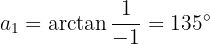

Now we convert the denominator to polar form
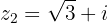

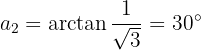

We calculate the quotient
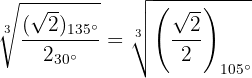
We obtain the modulus and the argument of the roots


The third roots therefore consist of the numbers
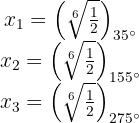
Solve and express in polar form

We convert the number  into polar form


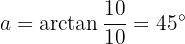
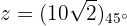
Then

To calculate the roots we obtain the modulus and the arguments

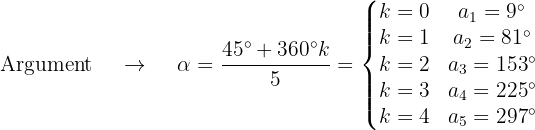
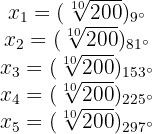
The 5 fifth roots therefore consist of the numbers
Calculate the following operation, giving the result in polar form
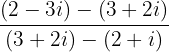
We remove the parentheses in order to carry out the operations in the numerator and denominator

We multiply the numerator and the denominator by the conjugate of the latter


Then

For the polar form, we obtain the modulus and the argument


In this way,

Calculate the value of the quotient. Obtain its cube roots, expressing them in polar, trigonometric and binomial form

1 Calculation of the quotient
We change the negative exponent and expand

Taking into account that  , we are left with

Then

2 Conversion to polar form
To obtain the roots of  , we need to change to its polar form. We do this by obtaining its modulus and argument


So that

3 Calculation of the third roots

We obtain the modulus and the argument of the roots


The 3 cube roots therefore consist of the numbers

4 Roots expressed in trigonometric and binomial form


Roots of an Equation
Calculate the roots of the following equation:


We change the number inside the root to polar form, in this case, -1.

We obtain the modulus and the argument of the roots


The roots of the equation are therefore the numbers with modulus 1 and with the previous arguments, that is,

Calculate the roots of the following equation:


We change the number inside the root to polar form, in this case, -1.

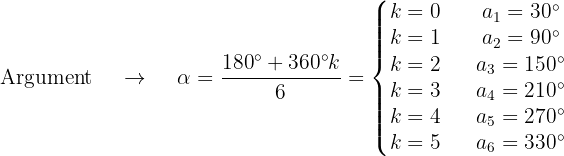
We obtain the modulus and the argument of the roots

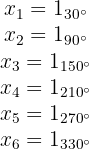
The roots of the equation are therefore the numbers with modulus 1 and with the previous arguments, that is,
Calculate all the roots of the equation:

We isolate


We change the number inside the root to polar form

We obtain the modulus and the argument of the roots

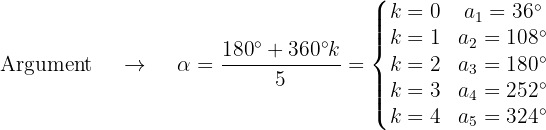
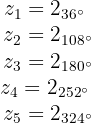
The fifth roots therefore consist of the numbers
Write a second degree equation whose solutions are  and its conjugate.
Given a complex number and its conjugate


We can find a second degree equation whose solutions are those numbers. This equation is expressed in the following way

Where  is the sum of the roots and
 the product. In this case,


Then the equation we are looking for is

Write a second degree equation whose solutions are  and its conjugate.
Given a complex number and its conjugate


We can find a second degree equation whose solutions are those numbers. This equation is expressed in the following way
Where is the sum of the roots and the product. In this case,


Then the equation we are looking for is

Conjugate of a Complex Number, Polar and Trigonometric Form
Determine the result of adding a number to its conjugate
We consider the complex number  and its conjugate

We carry out the addition

Thus, the sum of a complex number and its conjugate is equal to twice the real part of the complex number.
Determine the result of multiplying a complex number by its conjugate
We consider the complex number and its conjugate
We carry out the multiplication

Thus, the product of a complex number and its conjugate is equal to the sum of the squares of the real part and the imaginary part of the complex number.
Determine the result of the difference of a complex number and its conjugate
We consider the complex number and its conjugate
We carry out the subtraction

Thus, the difference of a complex number and its conjugate is equal to twice the imaginary part of the complex number.
Write in polar and trigonometric form, the conjugates and the opposites of:
a
b
a
We obtain the modulus and the argument


Then in polar and trigonometric form is

The conjugate

The opposite

b
We obtain the modulus and the argument


Then in polar and trigonometric form is

The conjugate

The opposite

Write in polar and trigonometric form, the conjugates and the opposites of:
a
b
a
We obtain the modulus and the argument


Then in polar and trigonometric form is

The conjugate

The opposite

b
We obtain the modulus and the argument


Then in polar and trigonometric form is

The conjugate

The opposite

De Moivre's Theorem and the Binomial Theorem
Express in polar and binomial form a complex number whose square is:

We convert to polar form

We want to find a number such that raising it to the square gives the previous number


We obtain the modulus and the argument of the roots

The 2 square roots therefore consist of the numbers


Converting that to trigonometric and binomial form I obtain


Express in polar and binomial form a complex number whose cube is:

We convert to polar form

We want to find a number such that raising it to the cube gives the previous number


We obtain the modulus and the argument of the roots


The 3 cube roots therefore consist of the numbers


Converting that to trigonometric and binomial form I obtain



Express as a function of cos a and sin a:
a 
b 
1 Binomial theorem:
We apply the binomial theorem

We expand

We separate the real part and the imaginary part

2 De Moivre's formula:
On the other hand we know that

Using the result we arrived at with the binomial theorem, we equate the real parts and we obtain that

On equating the imaginary parts we conclude that

Express as a function of cos a and sin a:
a 
b 
1 Binomial theorem:
We apply the binomial theorem

We expand

We separate the real part and the imaginary part

2 De Moivre's formula:
On the other hand we know that

Using the result we arrived at with the binomial theorem, we equate the real parts and we obtain that

On equating the imaginary parts we conclude that

Express as a function of  and
 :
a 
b 
1 Binomial theorem:
We apply the binomial theorem

We expand

We separate the real part and the imaginary part

2 De Moivre's formula:
On the other hand we know that

Using the result we arrived at with the binomial theorem, we equate the real parts and we obtain that

On equating the imaginary parts we conclude that

Summarize with AI:
Did you like this article? Rate it!

 Loading...



 . Always check which quadrant the number falls in — the arctangent alone can't tell the difference between the second and fourth quadrants, so a number like
 has an argument of 135°, not −45°.
