The compound rule of three is used when three or more quantities are related, so that from the relationships established between the known quantities we obtain the unknown one.
A compound rule of three consists of several simple rules of three applied successively.
Since direct or inverse proportional relationships can be established between the quantities, we can distinguish three cases of compound rule of three.


Direct Compound Rule of Three
A direct compound rule of three consists of several direct simple rules of three applied successively.
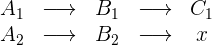
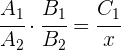
If the quantity in the first column increases, then it also increases in the remaining two; conversely, if the quantity in the first column decreases, then it also decreases in the remaining two columns. The formula to use is:
Example Problem with Direct Compound Rule of Three
Nine faucets turned on for  hours per day have consumed an amount of water valued at
  . Find the cost of water from
  faucets turned on
  hours for the same number of days.
1: We set up by columns

2: We verify that it is direct

3: We apply the direct compound rule of three formula
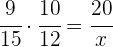
from which we obtain:

Inverse Compound Rule of Three
An inverse compound rule of three consists of several inverse simple rules of three applied successively.
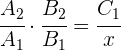
If the quantity in the first column increases (or decreases), then it decreases (or increases) in the third column; if the quantity in the second column increases (or decreases), then it decreases (or increases) in the third column. The formula to use is:
Example Problem with Inverse Compound Rule of Three
 workers working
  hours per day build a wall in
  days. How long will it take
  workers working
  hours per day?
1- We set up by columns

2- We verify that it is inverse

3- We apply the inverse compound rule of three formula

from which we obtain:
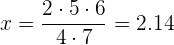 days
days
Mixed Compound Rule of Three
A mixed compound rule of three consists of several direct and inverse simple rules of three applied successively.
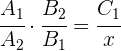
If the first and third columns form a direct simple rule of three, while the second and third columns form an inverse simple rule of three, then we have:
Example Problem with Mixed Compound Rule of Three
If  workers complete
  days working at a rate of hours per day a wall of
  ft. How many days will workers working hours per day need to complete the remaining
  ft of wall?
1- We set up by columns

2- We verify the simple rules of three

3- We apply the mixed compound rule of three

from which we obtain:
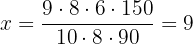 days
days
Summarize with AI:
Did you like this article? Rate it!

 Loading...