Arithmetic progressions are a sequence of numbers in which each term, after the first, is obtained by adding a constant, known as the common difference, to the previous term. This type of sequence is fundamental in mathematics and is applied in various areas, such as economics, statistics, and programming.
In this article, we will present a series of solved exercises that illustrate the key concepts of arithmetic progressions, from the identification of terms to the sum of sequences.
The fourth term of an arithmetic progression is  , and the sixth is
  . Write the progression.
1. The data we know about the progression is:

2. An arithmetic progression satisfies the expression:

3. We substitute the data and obtain the difference " " between the terms of the progression:

4. We obtain the value of the first term of the progression:


5. The arithmetic progression is:

The second term of an arithmetic progression is  , and the seventh is
  . Write the progression.
1. The data we know about the progression is:

2. An arithmetic progression satisfies the expression:
3. We substitute the data and obtain the difference "" between the terms of the progression:

4. We obtain the value of the first term of the progression:


5. The arithmetic progression is:

The fifth term of an arithmetic progression is , and the ninth is  . Write the progression.
1. The data we know about the progression is:

2. An arithmetic progression satisfies the expression:
3. We substitute the data and obtain the difference "" between the terms of the progression:

4. We obtain the value of the first term of the progression:


5. The arithmetic progression is:

The 20th term of an arithmetic progression is  , and the 35th term is
  . Write the progression.
1. The data we know about the progression is:

2. An arithmetic progression satisfies the expression:
3. We substitute the data and obtain the difference "" between the terms of the progression:

4. We obtain the value of the first term of the progression:


5. The arithmetic progression is:

The 40th term of an arithmetic progression is  , and the 85th term is
  . Write the progression.
1. The data we know about the progression is:

2. An arithmetic progression satisfies the expression:
3. We substitute the data and obtain the difference "" between the terms of the progression:

4. We obtain the value of the first term of the progression:


5. The arithmetic progression is:

Write three arithmetic means between and  .
.
1. The data we have is:

2. To find the difference between the terms of the progression, we use the formula:

3. We substitute and solve:

4. The progression is:

Write three arithmetic means between  and .
and .
1. The data we have is:

2. To find the difference between the terms of the progression, we use the formula:
3. We substitute and solve:
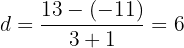
4. The progression is:

Interpolate three arithmetic means between  and
and  .
.
1. The data we have is:

2. To find the difference between the terms of the progression, we use the formula:
3. We substitute and solve:

4. The progression is:

Interpolate 4 arithmetic means between  and
and  .
.
1. The data we have is:

2. To find the difference between the terms of the progression, we use the formula:
3. We substitute and solve:
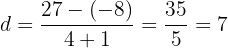
4. The progression is:

Interpolate 4 arithmetic means between  and
and  .
.
1. The data we have is:

2. To find the difference between the terms of the progression, we use the formula:
3. We substitute and solve:
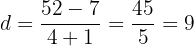
4. The progression is:

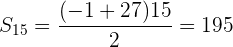
The first term of an arithmetic progression is  , and the fifteenth is . Find the common difference and the sum of the first fifteen terms.
1. The data we have is:

2. In an arithmetic progression, the following is satisfied:

3. We substitute the data:



4. The common difference is .
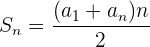
5. To calculate the sum of the first  terms, we use the formula:
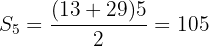
The first term of an arithmetic progression is , and the fifth is . Find the sum of the first five terms.
1. The data we have is:

2. In an arithmetic progression, the following is satisfied:
3. We substitute the data:



4. The common difference is .
5. To calculate the sum of the first  terms, we use the formula:
Find the sum of the first fifteen multiples of .
1. The data we have is:

2. In an arithmetic progression, the following is satisfied:
3. We substitute the data to obtain the fifteenth term:


4. To calculate the sum of the first terms, we use the formula:

Find the sum of the first fifteen numbers ending in .
1. The data we have is:

2. In an arithmetic progression, the following is satisfied:
3. We substitute the data to obtain the fifteenth term:


4. To calculate the sum of the first terms, we use the formula:

Find the sum of the first fifteen even numbers greater than .
1. The data we have is:

2. In an arithmetic progression, the following is satisfied:
3. We substitute the data to obtain the fifteenth term:


4. To calculate the sum of the first terms, we use the formula:
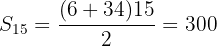
Find the angles of a triangle, knowing they are in arithmetic progression with  .
.
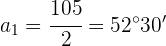
1. We know that the sum of the interior angles of a triangle is  , so substituting into the formula for the sum of the first terms:
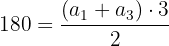
2. Also, we know that between the first and third term the following relationship exists:

3. Substituting the second expression into the first:



Find the angles of a convex quadrilateral, knowing they are in arithmetic progression with  .
.
1. We know that the sum of the interior angles of a quadrilateral is  , so substituting into the formula for the sum of the first terms:
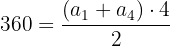
2. Also, we know that between the first and fourth term the following relationship exists:

3. Substituting the second expression into the first:




The shorter leg of a right triangle measures  . Calculate the other two, knowing that the sides of the triangle form an arithmetic progression.
1. We calculate the other two, knowing that the sides of the triangle form an arithmetic progression:


2. We apply the Pythagorean theorem:




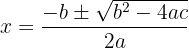
3. We solve using the general formula for second-degree equations:

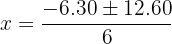


4. Since the result cannot be negative, we obtain:

5. The negative solution is not valid because the length of the sides of a triangle must be positive:

Calculate three numbers in an arithmetic progression that has a sum of  and the sum of their squares is
  .
.
1. Let us consider the middle term to be  .
.
2. The first term would be expressed as: 
3. The third term would be expressed as: 
4. The sum of the three terms is , so:


5. The sum of the squares of the numbers is , so we can write:





6. We have two progressions that satisfy the condition (one for the positive value of and another for the negative value):
 and
and 
Calculate three numbers in an arithmetic progression that has a sum of and the sum of their squares is  .
.
1. Let us consider the middle term to be .
2. The first term would be expressed as:
3. The third term would be expressed as:
4. The sum of the three terms is , so:


5. The sum of the squares of the numbers is , so we can write:


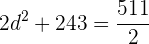
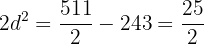


6. We have two progressions that satisfy the condition (one for the positive value of and another for the negative value):
 and
and 
Summarize with AI:
Did you like this article? Rate it!

 Loading...