An exponential equation is an equation in which the unknown appears in the exponent.
To solve an exponential equation, we will take into account:


Properties of Powers
- a > 0






- If
 then
then 
Solving Exponential Equations
Case 1: Both Sides Can Be Expressed in the Same Base
Perform the necessary operations so that both sides have the same base, so that we can equate the exponents.
Examples
1 
We rewrite the right side as  and decompose the number

Since  , then:
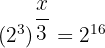

We equate the exponents:

2 
We transform the roots into powers with fractional exponents and equate the exponents:


We solve the resulting equation:

3 
We factor out 

We apply the negative power law and perform the operations and solve for
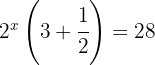
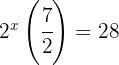

We rewrite the equation with the same base and equate the exponents:


Case 2: The Sum of Terms of a Geometric Sequence
If we have the sum of  terms of a geometric sequence, we apply the formula:

Example

Applying the formula for the sum of the terms of a geometric sequence:

We solve for and express both sides with the same base:


Case 3: Change of Variable
When we have a more complex equation, we can use a change of variable.
Examples
1 
First, we apply the property of the product of powers to remove the sum in the exponent.

We apply the power of a power property:

We perform the change of variable 

Factoring the equation and solving:

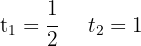
We undo the change of variable:
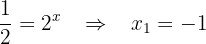

2 
We apply the properties of powers of products or quotients to remove additions or subtractions in the exponents:
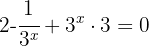
We perform the change of variable 

We multiply both sides by 

We factor and solve the equation:

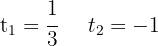
We undo the change of variable:
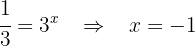

From the second equation, we do not obtain a solution.
3 
We decompose into factors  and
and

We perform the change of variable:


We undo the change of variable only with the positive solution.

Since we cannot equate exponents, we take logarithms on both sides and on the first side we apply the property:

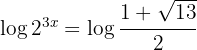
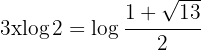
We solve for 
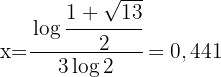
For the other solution with a negative sign, we would not have a solution because when we apply logarithms on the right side, we would find the logarithm of a negative number, which does not exist.
Case 4: Both Sides Cannot Be Expressed with the Same Base
To solve for an unknown that is in the exponent of a power, we take logarithms whose base is the base of the power.


Example
1 
We take logarithms on both sides:

We apply the logarithm of a power property:

Since 

We solve for

Summarize with AI:
Did you like this article? Rate it!

 Loading...