Welcome to the exciting fraction operation exercises guide! In this series of mathematical challenges, we will explore the fascinating world of fractions and learn how to perform various operations with them.
Fractions are an essential part of mathematics and have wide application in everyday life, from cooking and construction to finance and science. During this practice, we will master the fundamental operations with fractions, such as addition, subtraction, multiplication, and division.
Whether you are looking to improve your mathematical skills or simply want to consolidate your knowledge, these exercises will provide you with a solid understanding of how to work with fractions and how to apply them in real-world situations.


Basic Operations with Fractions
Express each of the following fractions of an hour in minutes:

Let us recall that  hour
hour  minutes. Therefore, to convert each fraction into minutes, we can use a simple proportion.
1 Conversion of  hour into minutes:
2 Conversion of  hour into minutes:
3 Conversion of  hour into minutes:
4 Conversion of  hour into minutes:
5 Conversion of  hour into minutes:
6 Conversion of  hour into minutes:
Find the pairs of equivalent fractions and match them:

To solve this exercise, for practicality we will use fraction reduction. Thus, note that the fractions:
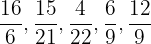 are reducible.
1 We reduce the fraction  :
:
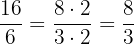
Therefore, the equivalent pair of the fraction is  .
.
2 We reduce the fraction :
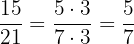
Therefore, the equivalent pair of the fraction  is
is  .
.
3 We reduce the fraction  :
:
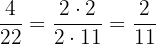
Therefore, the equivalent pair of the fraction is  .
.
4 We reduce the fraction  :
:
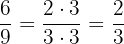
Therefore, the equivalent pair of the fraction is  .
.
5 We reduce the fraction  :
:
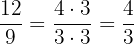
Therefore, the equivalent pair of the fraction is  .
.
Write the inverses of:
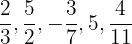
First, let us recall that a number and its inverse satisfy that their product equals 1.
1 The inverse  of
of  must satisfy that
  , therefore
  .
.
2 The inverse of  must satisfy that
  , therefore
  .
.
3 The inverse of  must satisfy that
  , therefore
  .
.
4 The inverse of  must satisfy that
  , therefore
  .
.
5 The inverse of  must satisfy that
  , therefore
  .
.
Compare the given fractions and write the sign ">" or "<" where appropriate.

To solve this exercise, we will use the following two results:
- Of two fractions that have the same numerator, the one with the larger denominator is smaller.
- Of two fractions that have the same denominator, the one with the smaller numerator is smaller.
From the above it follows:
 >
> 
 >
> 
<
 >
>
Compare the following fractions:

To solve this exercise, we need to calculate the common denominator of each of the fractions being compared. Recall that the fraction with the smaller numerator will be smaller. Thus we have the following:
Calculating a common denominator for each case we have the following:

Therefore, the following inequalities are satisfied:

That is:

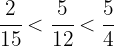
Order from least to greatest:
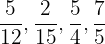
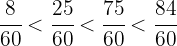
First, we must calculate the least common multiple of the denominators so we can express the fractions with a common denominator. The fraction with the smaller numerator will be smaller.

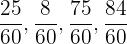
The least common multiple 60 tells us that it is a number that divides each of the denominators. We rewrite each of the fractions so that we obtain a fraction equivalent to the original but with denominator 60:

Develop the following operation in two different ways:
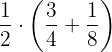
1. Applying the distributive property first:

2. Developing the sum first:

Calculate the result of each sum using common factor factorization:
a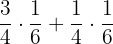
b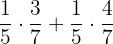
Factoring is the inverse process of the distributive property. We can transform the sum into a product by extracting that factor, that is:

a To calculate 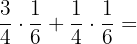 we factor
  and then solve:

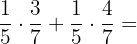 we factor
  and then solve:

Classify the following fractions as proper or improper:
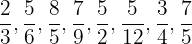
To answer, let us recall two things:
- In proper fractions, the denominator is greater than the numerator.
- In improper fractions, the denominator is less than the numerator.
1. Proper fractions:
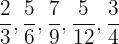

Calculate the sum of the following fractions:

We rewrite and develop the sum:

Conversions from Decimal Expressions to Fractions
Convert the following decimal expressions into fractions:

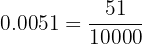
1. Conversion to fraction of  :
:
Since it is an exact decimal number, in the numerator we write the number without the decimal point and in the denominator we write 1 followed by 4 zeros because there are 4 decimal places, as shown below:
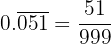
2. Conversion to fraction of  :
:
Since it is a pure periodic number, in the numerator we write the number without the decimal point and in the denominator 3 nines because there are 3 periodic digits:
 .
.
3. Conversion to fraction of  :
:
Since it is a mixed periodic number, in the numerator we write the number without the decimal point and subtract the part that lies outside the period. In the denominator there is one nine and two zeros because we have one digit in the period and there are two decimal places:

Convert the following decimal expressions into fractions:

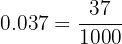
1. Conversion to fraction of  :
:
Since it is an exact decimal number, in the numerator we write the number without the decimal point and in the denominator we write 1 followed by 3 zeros because there are 3 decimal places:
2. Conversion to fraction of  :
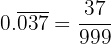
:
Since it is a pure periodic number, in the numerator we write the number without the decimal point and in the denominator 3 nines because there are 3 periodic digits:
3. Conversion to fraction of  :
:
Since it is a mixed periodic number, in the numerator we write the number without the decimal point minus the numbers that lie outside the period. In the denominator there is one nine and two zeros because we have one digit in the period and there are two decimal places:

4. Conversion to fraction of  :
:
Since it is a pure periodic number, in the numerator we write the number without the decimal point minus the part that lies outside the period. In the denominator 4 nines because there are 4 periodic digits:

5. Conversion to fraction of  :
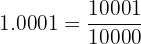
:
Since it is an exact decimal number, in the numerator we write the number without the decimal point and in the denominator we write 1 followed by 4 zeros because there are 4 decimal places:
6. Conversion to fraction of  :
:
Since it is a mixed periodic number, in the numerator we write the number without the decimal point minus the part outside the period. In the denominator there are 3 nines and one zero because we have three digits in the period and there is one decimal place:

Operations with Fractions and Periodic Decimals
Perform the following operations:

a. To calculate the sum of  .
.
First, we will convert both decimal expressions into fractions and then develop the sum:

b. To calculate 
First, we will convert both decimal expressions into fractions and then develop the division:

Solve the following operations with fractions:
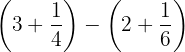
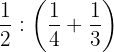
a. We solve 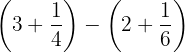 :
:
We remove parentheses. In the 2nd one, since we have a minus sign in front, we take the opposite, that is, we change all signs.

b. We solve 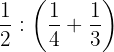
First, we perform the sum inside the parenthesis, subsequently we divide the fractions and finally we simplify.

c. We solve 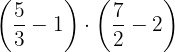
We perform the operations of the parentheses, we multiply the results and simplify:

d. We solve 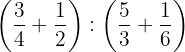 :
:
We perform the operations of the parentheses, we divide the results and simplify:

Perform the following divisions:


To solve each of the divisions, recall that we multiply the extreme values (top and bottom), the product is the numerator, while the product of the internal values is the denominator. In this way, we obtain the following results:
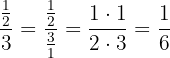


Perform the corresponding operations:
a. To calculate the sum of  , first:
- We perform the operations in the numerator and denominator.
- We put the resulting fraction as a division of two fractions, simplify, perform the division and simplify again.

b. To perform the sum of 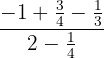 :
:
We operate the same as in the previous exercise:
 .
.
Perform this operation:
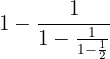
1. First, we perform 
2. We make the inverse of  , such that we obtain what is shown below:

Perform the following operations with powers:
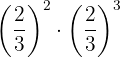
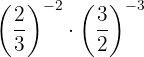
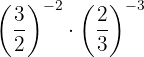

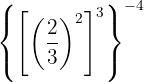
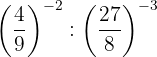
a. We use that we have the same base and add the exponents:

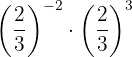
b. We use that we have the same base and subtract the exponents:

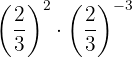
c. We use that we have the same base and subtract the exponents:

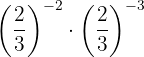
d. We use that we have the same base and subtract the exponents:

e. We perform the following procedure:

f. We need to divide powers with the same base, so we subtract the exponents:

g. We do a procedure similar to the previous one:

h. We do a procedure similar to the previous one:

i. We do a procedure similar to the previous one:

j. We do a procedure similar to the previous one:

k. Recall that to multiply powers with the same base, we multiply the exponents:
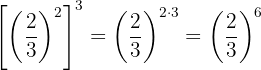
l. We apply a procedure similar to the previous exercise, considering at the end the inverse fraction to change the sign of the exponent of the fraction to positive:

m. We decompose the numbers into factors. Within each parenthesis, we divide powers with the same exponent, therefore we divide the bases and leave the same exponent, as follows:


Perform:
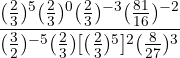
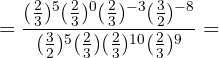
1. We will try to put all fractions with the same numerator and denominator. For this, we decompose numbers that are not prime into factors:
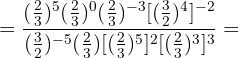
2. To change from a power with negative exponent to positive exponent, we must invert the fraction 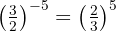 :
:
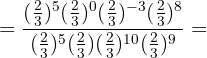
3. We again put the inverse fraction with positive exponent 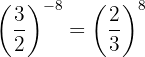 :
:
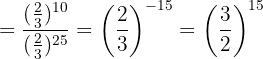
4. Both in the numerator and in the denominator we multiply powers with the same base and divide the results:
Perform the following operation:

1. We perform the indicated operations in the parentheses. In the parenthesis of the 2nd denominator we must multiply first and in the next step we divide.  is a mixed number, so we keep the same denominator (7) and the numerator is the sum of the multiplication of the whole number (5) by the denominator (7) plus the numerator of the mixed number (1).

2. We perform the indicated operations and simplify  :
:
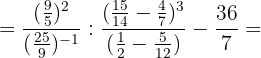
3. We perform the indicated operations and reduce to common denominator in the 2nd fraction:
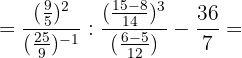
4. We perform the operations in the second fraction and simplify:
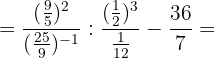
5. We perform the powers and note that in a fraction raised to a negative number we must change the numerator with the denominator and then raise to the exponent:

6. We simplify and operate:

Solve:

1. We perform the operations in the two parentheses:

2. Since we have removed the parentheses, the bracket becomes parentheses:
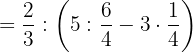
3. We perform the division and multiplication in the parenthesis and simplify the results:
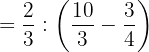
4. We divide 2/3 by the result of the parenthesis and simplify:

Operate:
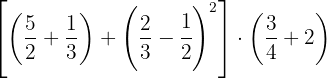
1. We perform the operations in the parentheses:
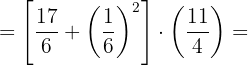
2. We perform the power and replace the bracket with a parenthesis:
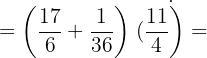
3. We solve the first parenthesis:
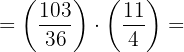
4. We perform the multiplication and simplify:

Perform:

1. We operate in the parentheses:
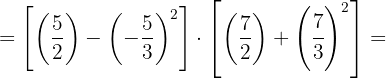
2. We perform the powers:
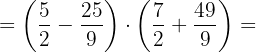
3. We perform the operations in the parentheses:
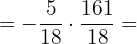
4. We perform the multiplication and simplify the result:

Operate:

1. We convert the mixed number  to a fraction. We keep the same denominator (2) and the numerator is the sum of the multiplication of the whole number (2) by the denominator (2) plus the numerator of the mixed number (1). We reduce the fractions in each parenthesis to their common denominator.

2. We perform the operations in the numerators. Since inside the 2nd bracket we have removed the parentheses, the bracket becomes parentheses:
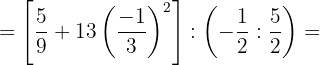
3. We perform the power and since there are no parentheses left in the first bracket, we replace it with parentheses:

4. We multiply in the first parenthesis and divide in the 2nd:
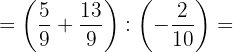
5. We perform the sum of the first parenthesis, simplify in the 2nd and divide:

Perform:

1. First, we operate with the products and mixed numbers in the parentheses:
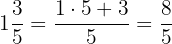
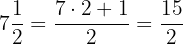
2. We substitute the results:

3. We operate in the first parenthesis, remove the second, simplify in the third and operate in the last:

4. We perform the product and simplify it. We change the bracket for parentheses:

5. We perform the operations in the parenthesis:

6. We perform the operations in the numerator, divide and simplify the result:

Summarize with AI:
Did you like this article? Rate it!

 Loading...