Definition of the Gauss Method
The Gauss method consists of transforming a system of equations into an equivalent one such that it becomes an echelon system.
To facilitate the calculation, we will transform the system into a matrix, in which we will place the coefficients of the variables and the independent terms (separated by a line).

Equivalent Systems of Equations
We obtain equivalent systems by eliminating dependent equations if any of the following conditions are met:
1 All coefficients are zeros.
2 Two rows are identical.
3 One row is proportional to another.
4 One row is a linear combination of others.
Criteria for Equivalence of Systems of Equations
1 If we add or subtract the same expression to both sides of an equation in a system, the resulting system is equivalent.
2 If we multiply or divide both sides of the equations in a system by a nonzero number, the resulting system is equivalent.
3 If we add or subtract one equation of a system to another equation in the same system, the resulting system is equivalent to the original.
4 If in a system we replace an equation with another that results from adding two equations of the system previously multiplied or divided by nonzero numbers, the result is another system equivalent to the first.
5 If in a system we change the order of the equations or the order of the unknowns, the result is another equivalent system.
Example: 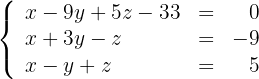
We add  to both sides of the first equation and obtain:

By the first equivalence criterion, the original system is equivalent to the system:
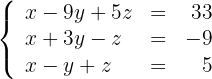
Example:
We multiply both sides of the equations by  , and by the second equivalence criterion, the original system is equivalent to the new system obtained:

Example:
We add the second equation to the third equation. We obtain a system of equations that by criterion 3 is equivalent to the original system:
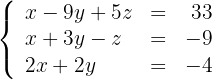
Example:
We replace the second equation with the sum of the first equation and the second equation multiplied by three. We obtain a system of equations that by criterion 4 is equivalent to the original system:

Example:
We interchange the second and third equations. We obtain a system of equations that by criterion 5 is equivalent to the original system:

To solve a system of equations, we use the above criteria as we will see in the following exercises.
Exercises on Systems of Equations
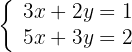
1 We write in matrix form:
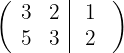
2 We replace row  with
with  and obtain by criterion 4 the equivalent matrix:

3 We replace row  with
with  and obtain by criterion 4 the equivalent matrix:

4 We replace rows  with
with  respectively and obtain by criterion 4 the equivalent matrix:

5 We have that the original system has a unique solution and its solutions are 
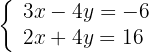
1 We write in matrix form:
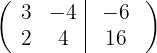
2 We replace row with  and obtain by criterion 4 the equivalent matrix:

3 We replace row with  and obtain by criterion 4 the equivalent matrix:

4 We replace rows with 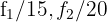 respectively and obtain by criterion 4 the equivalent matrix:

5 We have that the original system has a unique solution and its solutions are 
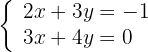
1 We write in matrix form:
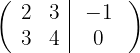
2 We replace row with  and obtain by criterion 4 the equivalent matrix:

3 We replace row with  and obtain by criterion 4 the equivalent matrix:

4 We replace rows with  respectively and obtain by criterion 4 the equivalent matrix:

5 We have that the original system has a unique solution and its solutions are 
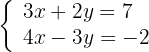
1 We write in matrix form:
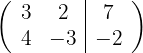
2 We replace row with  and obtain by criterion 4 the equivalent matrix:

3 We replace row with  and obtain by criterion 4 the equivalent matrix:

4 We replace rows with  respectively and obtain by criterion 4 the equivalent matrix:

5 We have that the original system has a unique solution and its solutions are 
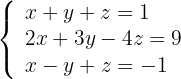
1 We write in matrix form:
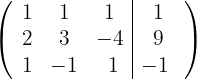
2 We replace rows  with
with  respectively and obtain by criterion 4 the equivalent matrix:

3 We interchange rows  and
and  and obtain by criterion 5 the equivalent matrix:

4 We replace rows  with
with  respectively and obtain by criterion 4 the equivalent matrix:

5 We replace row with  respectively and obtain by criterion 4 the equivalent matrix:

6 We replace rows  with
with  respectively and obtain by criterion 2 the equivalent matrix:

7 We have that the original system has a unique solution and its solutions are 
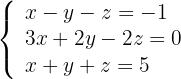
1 We write in matrix form:
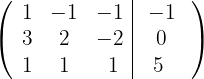
2 We replace rows with  respectively and obtain by criterion 4 the equivalent matrix:

3 We replace rows with  respectively and obtain by criterion 4 the equivalent matrix:

4 We replace rows with  respectively and obtain by criterion 4 the equivalent matrix:

5 We replace rows with  respectively and obtain by criterion 2 the equivalent matrix:
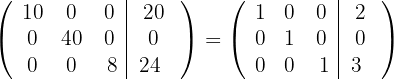
6 We have that the original system has a unique solution and its solutions are 
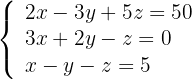
1 We write in matrix form:
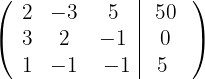
2 We interchange rows  and and obtain by criterion 5 the equivalent matrix:

3 We replace rows with  respectively and obtain by criterion 4 the equivalent matrix:

4 We replace rows with  respectively and obtain by criterion 4 the equivalent matrix:

5 We replace rows with  respectively and obtain by criterion 4 the equivalent matrix:

6 We replace rows with  respectively and obtain by criterion 2 the equivalent matrix:
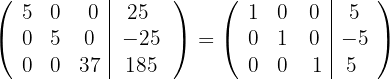
7 We have that the original system has a unique solution and its solutions are 
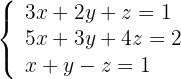
1 We write in matrix form:
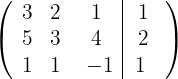
2 We interchange rows and and obtain by criterion 5 the equivalent matrix:
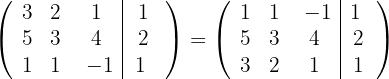
3 We replace rows with  respectively and obtain by criterion 4 the equivalent matrix:
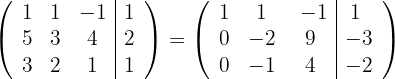
4 We replace rows with  respectively and obtain by criterion 4 the equivalent matrix:

5 We replace rows with  respectively and obtain by criterion 4 the equivalent matrix:

6 We replace rows with 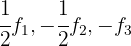 respectively and obtain by criterion 2 the equivalent matrix:

7 We have that the original system has a unique solution and its solutions are 

1 We write in matrix form:
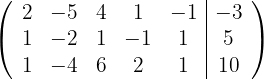
2 We interchange rows and and obtain by criterion 5 the equivalent matrix:

3 We replace rows with respectively and obtain by criterion 4 the equivalent matrix:

4 We replace rows with  respectively and obtain by criterion 4 the equivalent matrix:

5 We replace rows with  respectively and obtain by criterion 4 the equivalent matrix:

6 We obtain the system with infinitely many solutions that is equivalent to the original system:
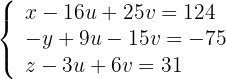
7 We multiply the second equation by  and by criterion 2 we obtain the equivalent system:
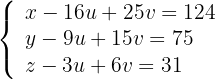
8 Setting  and
and  we obtain:


1 We write in matrix form:
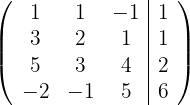
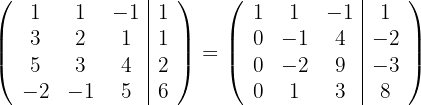
2 We replace rows  with
with  respectively and obtain by criterion 4 the equivalent matrix:
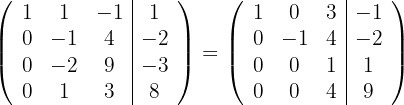
3 We replace rows  with
with  respectively and obtain by criterion 4 the equivalent matrix:
4 We replace rows  with
with  respectively and obtain by criterion 4 the equivalent matrix:
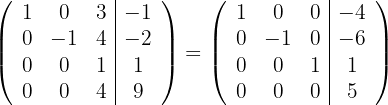
5 Since in the last row the coefficients are zero and the constant term is nonzero, the system is inconsistent (has no solution).
Summarize with AI:
Did you like this article? Rate it!

 Loading...