Concept of the Incomplete Second-Degree Equation
A second-degree equation is incomplete when one of the coefficients: b or c, or both, are equal to zero. Therefore, we can encounter three types of incomplete second-degree equations.
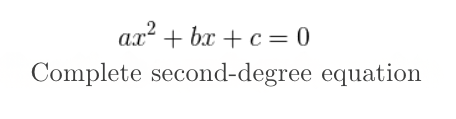
First Case
When both coefficients are equal to zero, the incomplete second-degree equation is the following:
If b=0 and c=0 then ax² = 0 (incomplete second-degree equation).
For this type of equation, the solution is always x = 0.
Examples of Incomplete Second-Degree Equations - Case One
1 
2 
Second Case
When the coefficient c is equal to zero, the incomplete second-degree equation is the following:
If c=0 then ax² + bx = 0 (incomplete second-degree equation).
Let us see how the solutions are obtained:
1. We extract the common factor x.

2. Since we have a product equal to zero, either one factor is zero, or the other factor is zero, or both are zero.

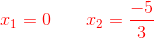
3. Therefore, the solutions are:

Examples of Incomplete Second-Degree Equations - Case Two
1 
We extract the common factor x:

Since we have a product equal to zero, we set the factors equal to zero:

The solutions are:

2 
We extract the common factor 3x:

Since we have a product equal to zero, we set the factors equal to zero:

The solutions are:
Third Case
When the coefficient b is equal to zero, the incomplete second-degree equation is the following:
If b=0 then ax² + c = 0 (incomplete second-degree equation).
Let us see how the solutions are obtained:
1. We move the term c to the second member, changing its sign.

2. We move the coefficient a to the second member, dividing.

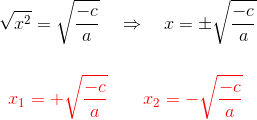
3. We perform the square root on both sides of the equality, and we obtain two solutions, one positive and one negative, that is:
Examples of Incomplete Second-Degree Equations - Case Three
1 
We move the term c to the second member, changing its sign:

We move the coefficient a to the second member, dividing:
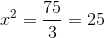
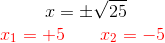
We perform the square root on both sides of the equality, and we obtain two solutions, one positive and one negative:
2 
We move the term c to the second member, changing its sign:

We move the coefficient a to the second member, dividing (but since it is 1, the result is the same as the previous step):
When we perform the square root on both sides of the equality, we obtain a negative radicand, which has no solution in the real numbers.

Summarize with AI:
Did you like this article? Rate it!

 Loading...