An inequality is an algebraic comparison in which its two members are linked by one of these signs:

The solution of an inequality is the set of values of the variable that satisfy the inequality.
We can express the solution of the inequality through a graphical representation or an interval.
Examples
1. Solve the inequality 2x - 1 <7
Graphical representation: 
Interval: 
2. Solve the inequality 


Graphical representation: 
Interval: 
3. Solve the inequality 2x - 1 > 7
Graphical representation: 
Interval: 
4. Solve the inequality 


Graphical representation: 
Interval: 
Equivalence Criteria for Inequalities
Property 1: If the same number is added to or subtracted from both sides of an inequality, the resulting inequality is equivalent to the original.
Property 2: If both sides of an inequality are multiplied or divided by the same positive number, the resulting inequality is equivalent to the original.
Property 3: If both sides of an inequality are multiplied or divided by the same negative number, the resulting inequality reverses direction and is equivalent to the original.


Linear Inequalities
Resolution of Linear Inequalities
Consider the inequality:

We will solve it by applying the following steps, when possible:
Step 1: Remove grouping signs


Step 2: Remove denominators


Step 3: Group the terms with  on one side of the inequality and the independent terms on the other

Step 4: Perform the operations

Step 5: Since the coefficient of is negative, we multiply by −1, so the inequality sign reverses

Step 6: Solve for the unknown

We obtain the solution as an inequality, but we can also express it:
Graphically: 
As an interval:
Linear Inequality Exercises
1. 2(x+1)-3(x-2)


2. 
Multiply both members by the LCM of the denominators.









3. 



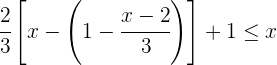
4. 




Summarize with AI:
Did you like this article? Rate it!

 Loading...