In this section we will learn the definition of a monomial, its characteristics, properties, and some operations among them.


What Is a Monomial?
A monomial is an algebraic expression of a single term that is composed of the product of unknowns or variables (literals) whose exponents are non-negative integers, and a number called the coefficient. A polynomial is the sum of several monomials, therefore we can see a monomial as a type of polynomial that has only one term.
The degree of a monomial is the largest power among the variables.
Examples of monomials are:
 , whose literal is
  , its coefficient is
  , and its degree is
  .
. , whose literal is
  , its coefficient is
  , and its degree is
  .
. where the literals are and
  , the coefficient is
  , and its degree is
  .
.
On the other hand,  is not a monomial because its exponent is a fraction. Similarly,
  is not a monomial because its exponent is negative.
Monomial Exercises
Identify which of the following algebraic expressions are monomials, and indicate their degree and coefficient:
1
2
3
4
5
6
7
8
9
10
We will analyze whether the expressions meet the definition. If they do, we will proceed to identify their degree and coefficient.
1.
We can see that it meets the definition of a monomial. Moreover, since there is only one literal and its power is  , the degree of the monomial is , and its coefficient is also .
2.
We can see that the power of the variable is  . Therefore it does not meet the definition of a monomial because monomials cannot have negative powers.
3.
It does not meet the definition of a monomial because a monomial must consist of only one term. Here we have two terms:  and . In fact, this is a binomial.
4.
It meets the definition of a monomial. Moreover, the degree is since the exponent of is . The coefficient is  .
.
5.
It does not meet the definition of a monomial because this expression is equivalent to  , whose exponent is negative.
6. 
It does not meet the definition of a monomial because this expression is equivalent to  , whose exponent is not an integer. Remember that the exponent must be a non-negative integer.
7. 
It does not meet the definition of a monomial because a monomial must consist of only one term. Here we have two terms:  and . In fact, this is a binomial.
8.
It meets the definition of a monomial. Moreover, the degree is since the exponent of is . The coefficient is  .
.
9.
It does not meet the definition of a monomial because this expression is equivalent to  , whose exponent is negative.
10. 
It does not meet the definition of a monomial because this expression is equivalent to  , whose exponent is not an integer. Remember that the exponent must be a non-negative integer.
Basic Operations with Monomials
Addition and Subtraction of Monomials
To add or subtract two monomials and combine the terms (simplify), the variables in them must be the same and must have the same powers. The result of the addition or subtraction will be a monomial whose coefficient will be the sum or difference of the coefficients being added or subtracted, multiplied by the variables with their respective powers. For example, the sum 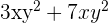 can be simplified because the variables or literals are the same, and , and they have the same powers. has power and has power in both monomials. Therefore, the sum would be equal to:

On the other hand, the sum  cannot be simplified because the powers of the literal are not equal. Therefore, we can only express this sum as . Although it is true that we could factor out an from both monomials, that is not a topic we will cover in this article.
Multiplication and Division of Monomials
We know that when multiplying two terms with the same base, the result is the base raised to the sum of the powers. In other words, given expressions with the same base  and
and  , their product is:

For example, the product of  and
and  is:
is:

With monomials, it is very similar. Given two monomials, when we multiply them, the resulting coefficient will be the product of the respective coefficients. For the variables, we simply group those with the same base and perform their respective products. If there are variables that appear in only one monomial and not the other, we pass them directly. For example, taking the monomials  and
and  , their product is:

Similarly, we know that when dividing two terms with the same base, the result is the base raised to the difference of the powers (the power of the numerator minus the power of the denominator). In other words, given expressions with the same base and , their division is:

For example, the division of and is:
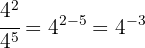
With monomials, it is very similar. Given two monomials, when we divide them, the resulting coefficient will be the division of the respective coefficients. For the variables, we simply group those with the same base and perform their respective divisions. If there are variables in the numerator that are not in the denominator, we pass them directly. However, if there are variables in the denominator that are not in the numerator, we pass them but change the sign of the power. For example, taking the monomials  and
and  , their division is:

Powers of Monomials
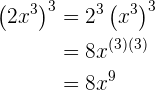
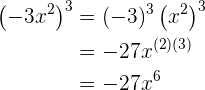
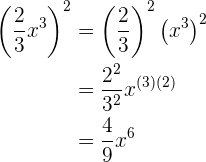
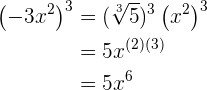
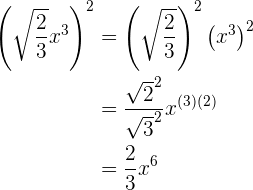
Powers of monomials are straightforward. Simply raise both the coefficient and each literal to the power to which we raise the entire monomial. Of course, always applying the properties of exponents. So, if we want to raise, for example, the monomial to the power , we have:

Exercises on Monomial Operations
Addition and Subtraction of Monomials
Perform the following additions and subtractions of monomials:
1
2
3
4
5
1.
Since both monomials have the same literals and these have the same powers, we can simplify directly:

2.
Since both monomials have the same literals and these have the same powers, we can simplify directly:

3.
Since both monomials have the same literals and these have the same powers, we can simplify directly:

4.
We can see that all monomials have the same literals, but only two monomials have the literals with the same powers. Therefore, only these two can be simplified:

5.
We can see that all monomials have the same literals, but not all have these raised to the same powers. We will group those monomials that have the same literals with the same powers and simplify:

Multiplication of Monomials
Perform the following multiplications of monomials:
1
2
3
4
5
To solve these exercises, we will use the explanation of monomial multiplication we saw previously. Remember to group equal variables and coefficients.
1
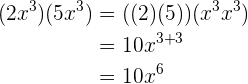
2
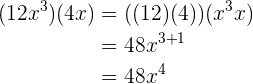
3
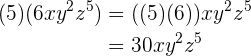
4
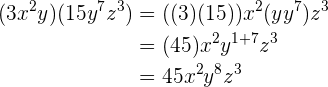
5

Division of Monomials
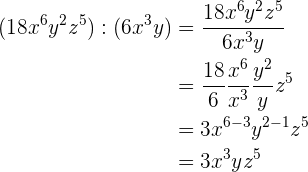
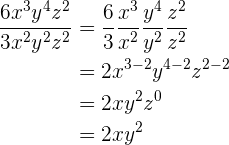
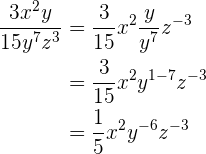
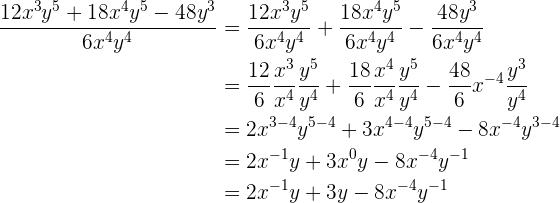
Perform the following divisions of monomials:
1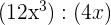
2
3
4
5
To solve these exercises, we will use the explanation of monomial division we saw previously. Remember to group equal variables and coefficients.
1
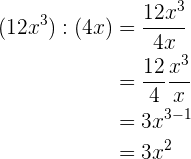
2
3
4
5
Powers of Monomials
Solve the following powers of monomials:
1
2
3
4
5
To solve these exercises, we will use the explanation of monomial powers we saw previously. Remember to raise both variables and coefficients to that power.
1
2
3
4
5
Summarize with AI:
Did you like this article? Rate it!

 Loading...