A cylinder is a geometric solid generated by a rectangle rotating around one of its sides.
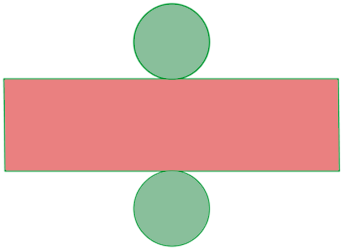


Elements of the Cylinder
A right cylinder consists of different parts that we enumerate below:
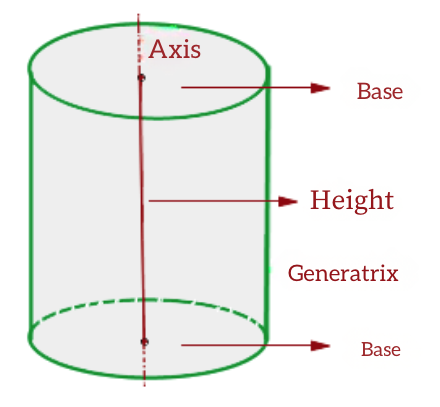
Bases of the Cylinder
The circles that form the lower and upper edges of the cylinder. These circles are equal and parallel.
Axis of the Cylinder
It is the line that passes through the centers of the bases of the cylinder; this is perpendicular to those bases. Note that the axis contains the side of the rectangle that rotates on itself.
Height
It is the length of the segment whose endpoints are the centers of the two bases. It is equal to the side of the rectangle that rotates on itself.
Generatrix
It is the side opposite the height and is the side that generates the cylinder. Note that  .
.
Lateral Area of the Cylinder
It equals the area of the cylinder's surface without considering the area of its bases:

Area of the Cylinder
It equals the total area of the cylinder's surface considering its bases:

Volume of the Cylinder

Exercises on Right Cylinders
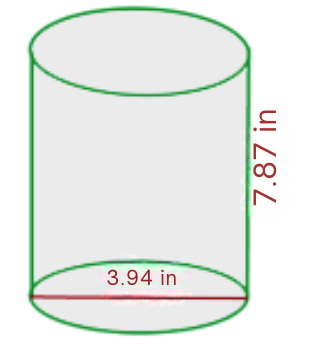
Calculate the amount of tin needed to make  cylindrical cans with a diameter of
  and a height of
  .
.
1. The amount of tin required is the total area of the cylinder:

2. The total amount of tin required to manufacture cans is:

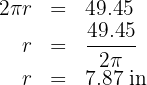
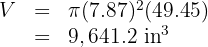
A cylinder has a height equal to the length of the circumference of the base. If the height is  , calculate the total area and volume.
1. First, we use the fact that the height equals the length of the circumference of the base to find the radius:
2. We calculate the total area:

3. We calculate the volume:
A cylinder has a height equal to the radius of its base. If the height is  , calculate the lateral area.
1. First, we use the fact that the height equals the radius:
2. We calculate the lateral area:

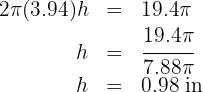
The lateral area of a cylinder equals half the area of its base. If the radius of the base is , calculate the height of the cylinder.
1. First, we calculate the area of the base of the cylinder:

2. We equate the lateral area with half the area of the base:
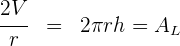
Express the lateral area of a cylinder in terms of its volume and radius.
1. Starting from the volume formula, we construct the lateral area formula:

2. We multiply both sides by 2 and express the radius squared as a product of radii:

3. We solve for the lateral area:
Find the lateral area of a cylinder with a radius of  and a volume of
  .
.
1. Using the formula for lateral area in terms of volume and radius:
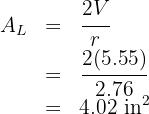
Thus, the lateral area is  .
.
Find the volume of a cylinder with a radius of  and lateral area of
  .
.
1. Using the formula for lateral area in terms of volume and radius:
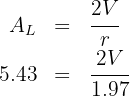
2. Solving for volume:
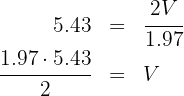
Thus, the volume of the cylinder is  .
.
Find the total area of a cylinder with a radius of  and lateral area of
  .
.
1. The total area of a cylinder equals the sum of its lateral area and twice the area of its base. Since we know the lateral area, we only need the area of the base.
2. We calculate the area of the base:

Thus, the total area is:
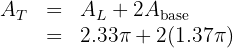
Therefore, the total area of the cylinder is  .
.
In a graduated cylinder with a radius of  , four ice cubes with edges of
  are placed. What height will the water reach when they melt?
1. We calculate the volume  of one ice cube:
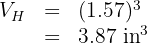
The volume occupied by the four ice cubes is  .
.
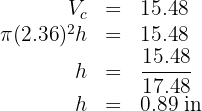
2. To find the height of the graduated cylinder, we equate the volume of the cylinder  with the volume of water from the four ice cubes:
A cylindrical container with a radius of and a height of is filled with water. If the mass of the full container is  , what is the mass of the empty container?
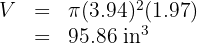
1. We calculate the volume of the container:
2. Since 1 pound equals approximately 16.39 cubic inches of water, we convert the volume:
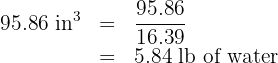
3. Thus, the mass of the empty container is  .
.
Note: This result is negative, which indicates the container's mass cannot be determined with these values as the water mass exceeds the total mass.
If the radius of the base of a cylinder is reduced to half, is its volume equal to half the original volume?
1. We calculate the volume of the cylinder with radius  and height
  :
:

2. We calculate the volume for the cylinder with the radius reduced to half:
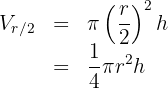
3. The volume of the cylinder with the radius reduced to half equals one-quarter of the original cylinder's volume, not half.
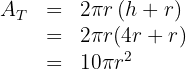
We want to construct a cylindrical can whose radius is one-fourth of its height. Express the volume and total area of the can in terms of its radius.
1. We calculate the volume of the cylinder with radius and height :
2. We use the fact that the radius equals one-fourth of the height to express height in terms of radius:

3. We substitute the value into the volume formula to express it in terms of :
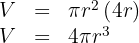
4. We substitute the value into the total area formula to express it in terms of :
If the height of a cylinder is increased by  units, what is the increase in its volume?
1. We calculate the volume  of a cylinder with radius and height :
2. We calculate the volume  of the cylinder with an increase of units in height:
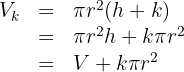
The volume increases by times the area of its base.
What is the volume of a cylinder with a height of  inscribed in a sphere with a radius of ?
1. We calculate the radius of the cylinder inscribed in the sphere with radius , using the Pythagorean theorem:
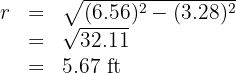
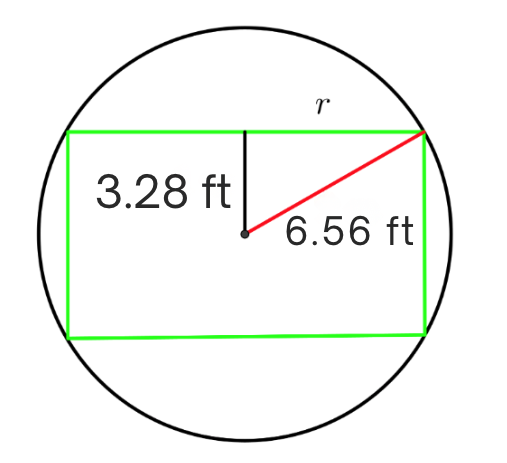
2. We calculate the volume of the cylinder:
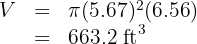
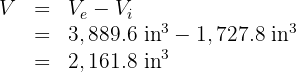
A concrete cylinder is constructed with a diameter of  , thickness of , and height of
  . What is the volume of concrete used to construct the cylinder?
1. We calculate the volume  of the outer cylinder with diameter and height :
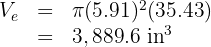
2. We calculate the volume  of the inner cylinder with diameter and height :
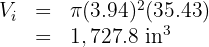
3. The amount of concrete used is:
Summarize with AI:
Did you like this article? Rate it!

 Loading...