The inverse matrix is a fundamental concept in linear algebra that plays a crucial role in a variety of applications, from systems of linear equations to linear transformations in geometry and linear programming.
In this series of exercises, we will explore the notion of the inverse matrix and how to calculate it and use it to solve systems of linear equations.
Get ready to immerse yourself in the fascinating world of inverse matrices and strengthen your skills in linear algebra!
Calculate by the Gauss method the inverse matrix of:
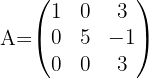
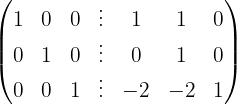
1. Construct a matrix of the type 
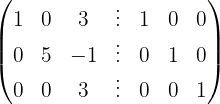
2. Use the Gauss method to transform the left half, A, into the identity matrix, and the resulting matrix on the right side will be the inverse matrix: A⁻¹.



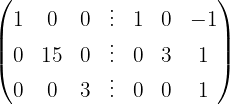


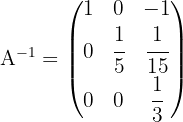
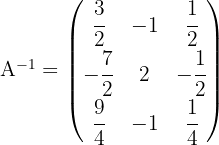
The inverse matrix is:
Calculate by the Gauss method the inverse matrix of:
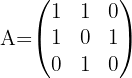
1. Construct a matrix of the type
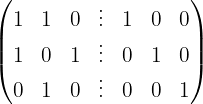
2. Use the Gauss method to transform the left half, A, into the identity matrix, and the resulting matrix on the right side will be the inverse matrix: A⁻¹.



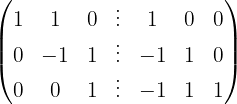




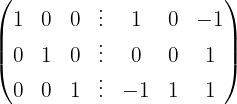
The inverse matrix is:
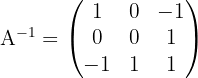
Calculate by the Gauss method the inverse matrix of:

1. Construct a matrix of the type
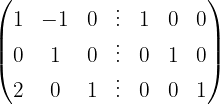
2. Use the Gauss method to transform the left half, A, into the identity matrix, and the resulting matrix on the right side will be the inverse matrix: A⁻¹.

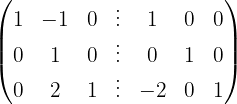

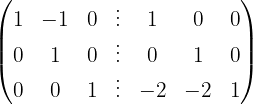

Find by determinants the inverse matrix of:
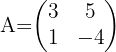
1. We obtain the determinant

2. We obtain the adjugate matrix

3. We obtain the transpose of 

4. We divide the transpose of the adjugate by the determinant:


Find by determinants the inverse matrix of:
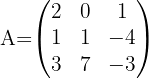
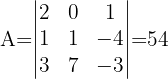
1. We obtain the determinant
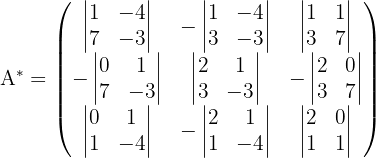
2. We obtain the adjugate matrix
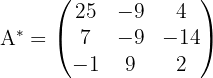
3. We obtain the transpose of

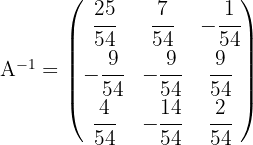
4. We divide the transpose of the adjugate by the determinant:
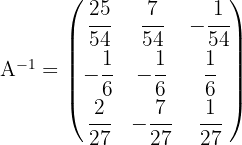
Find by determinants the inverse matrix of:
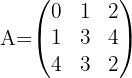
1. We obtain the determinant
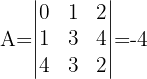
2. We obtain the adjugate matrix
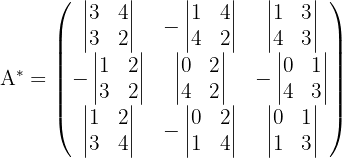

3. We obtain the transpose of
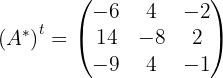
4. We divide the transpose of the adjugate by the determinant:

For what values of  does the matrix
  not admit an inverse matrix?
1. We calculate the determinant of the triangular matrix, which equals the product of the elements of its diagonal
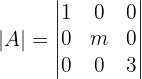

2. We set the determinant equal to zero and solve the equation


Therefore the matrix  has an inverse for any real value of
For what values of does the matrix  not admit an inverse matrix?
1. We calculate the determinant of the upper triangular matrix, which equals the product of the elements of its diagonal
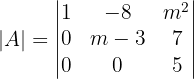

2. We set the determinant equal to zero and solve the equation


Therefore the matrix has an inverse for any real value of 
For what values of does the matrix  not admit an inverse matrix?
1. We calculate the determinant of the matrix


2. We set the determinant equal to zero and solve the equation


Therefore the matrix has an inverse for any real value of
For what values of  does the matrix
  not admit an inverse matrix?
1. We calculate the determinant of the matrix
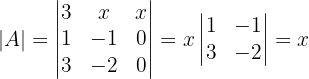
For  the matrix does not have an inverse.
Summarize with AI:
Did you like this article? Rate it!

 Loading...