What Are Implicit Functions?
Implicit functions are those that are expressed in terms of both 'x' and 'y', and neither variable is solved in terms of the other. To find the derivative in implicit form, it is not necessary to solve for 'y'. In fact, in some implicit functions it is impossible to solve for 'y'. It is enough to derive member by member, using the rules of differentiation and keeping in mind that:
A. 
B. In general 
C. For this reason we omit x' and leave y'
D. When the functions are more complex, we use a rule to facilitate the calculation:

Implicit Function Exercises
Derive the following functions:

1. We derive each term separately. The one containing 'y' with respect to 'y' and the one containing 'x' with respect to 'x'.

2. We solve for y'


1. We derive each term separately. The one containing 'y' with respect to 'y' and the one containing 'x' with respect to 'x'. Terms containing both variables are derived twice, once with respect to 'x' and once with respect to 'y'.

2. We must solve for y'. We can keep on one side the terms containing y' and move the others to the other side.

3. We factor out the common factor and solve

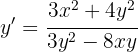

1. We derive each term separately. In this case we must derive both members, once with respect to 'x' and once with respect to 'y'.

2. We must solve for y'. We can keep on one side the terms containing y' and move the others to the other side.

3. We solve the operations with fractions, factor out the common factor, and solve for y'

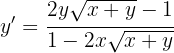
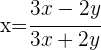
1. We derive each term separately. Those containing both 'x' and 'y' are derived twice, once for each variable. In the second member of the equality we must use the quotient rule for derivatives.



2. We must solve for y'. We can keep on one side the terms containing y' and move the others to the other side, then solve the operations with fractions.


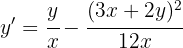

1. We derive each term separately. The one containing 'y' with respect to 'y' and the one containing 'x' with respect to 'x'. Terms containing both variables are derived twice, once with respect to 'x' and once with respect to 'y'.
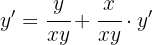
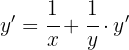
2. We must solve for y'. We can keep on one side the terms containing y' and move the others to the other side.
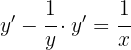
3. We factor out the common factor and solve for y'
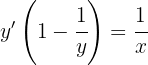
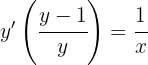
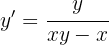

1. Having several transcendental functions, we move all terms to one side of the equality and apply: 

2. We calculate  and
and 


3. We substitute into
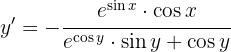

1. Having several transcendental functions, we move all terms to one side of the equality and apply:

2. We calculate and


3. We substitute into
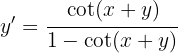

1. We calculate and


2. We substitute into
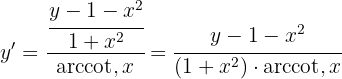

1. We multiply both members by  to eliminate the fraction and move all terms to one side of the equality
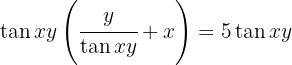


2. We calculate and


3. We substitute into


1. Having several transcendental functions, we move all terms to one side of the equality and apply:

2. We calculate and
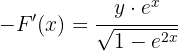

3. We substitute into

Summarize with AI:
Did you like this article? Rate it!

 Loading...