Trigonometric Ratios in a Right Triangle
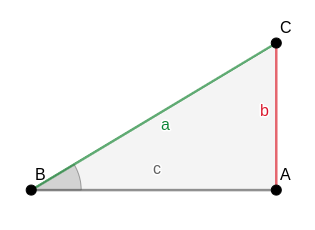
Sine
The sine of angle B is the ratio between the side opposite the angle and the hypotenuse. It is denoted by sin B.
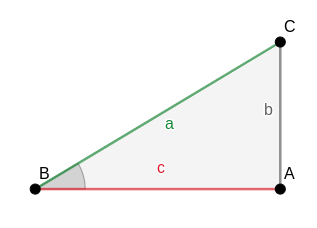
Cosine
The cosine of angle B is the ratio between the side adjacent or contiguous to the angle and the hypotenuse. It is denoted by cos B.
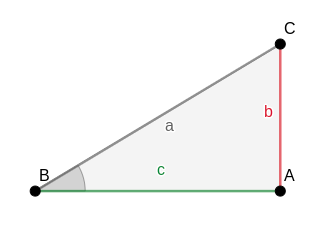
Tangent
The tangent of angle B is the ratio between the side opposite the angle and the side adjacent to the angle. It is denoted by tan B.
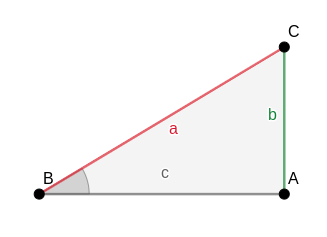
Cosecant
The cosecant of angle B is the reciprocal ratio of the sine of B.
It is denoted by csc B or cosec B.
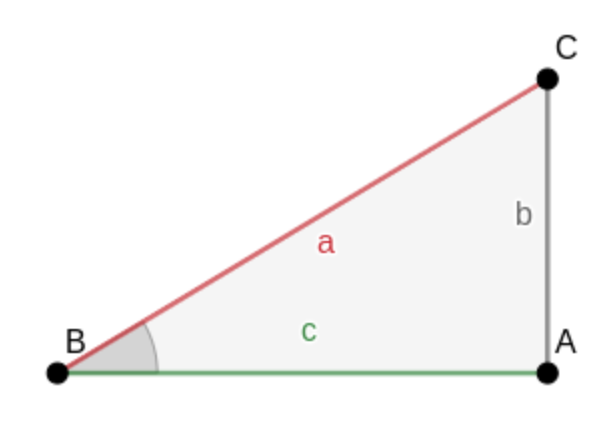
Secant
The secant of angle B is the reciprocal ratio of the cosine of B.
It is denoted by sec B.
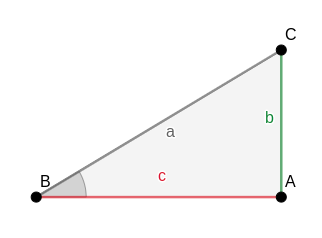
Cotangent
The cotangent of angle B is the reciprocal ratio of the tangent of B.
It is denoted by cot B.
SOH-CAH-TOA: An Easy Way to Remember
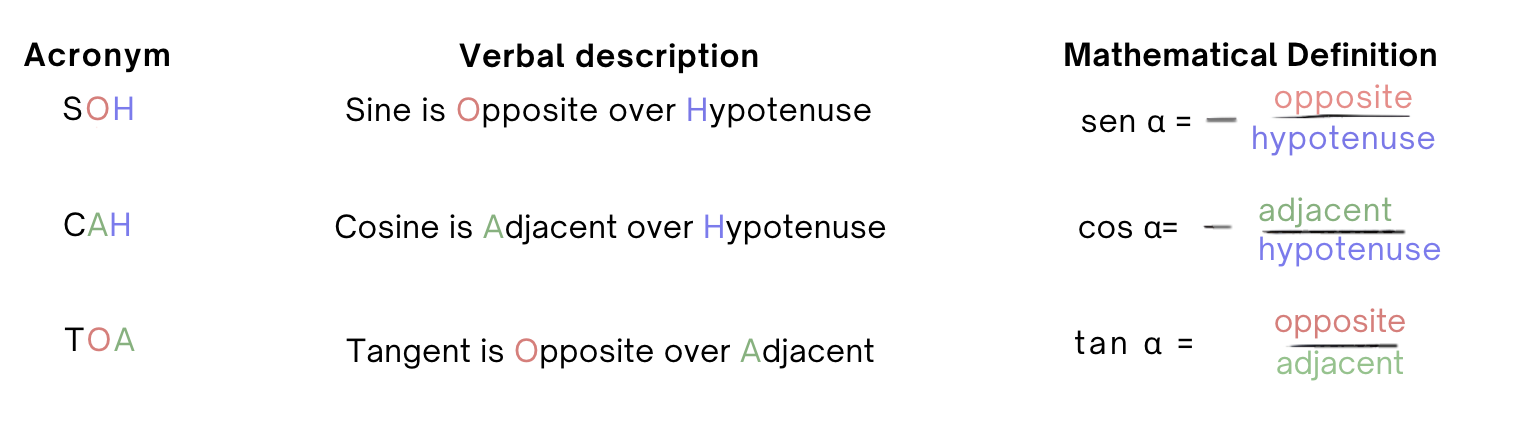
SOH-CAH-TOA is an acronym used to memorize the definitions of the most important trigonometric ratios: sine, cosine, and tangent. The following table explains its meaning.
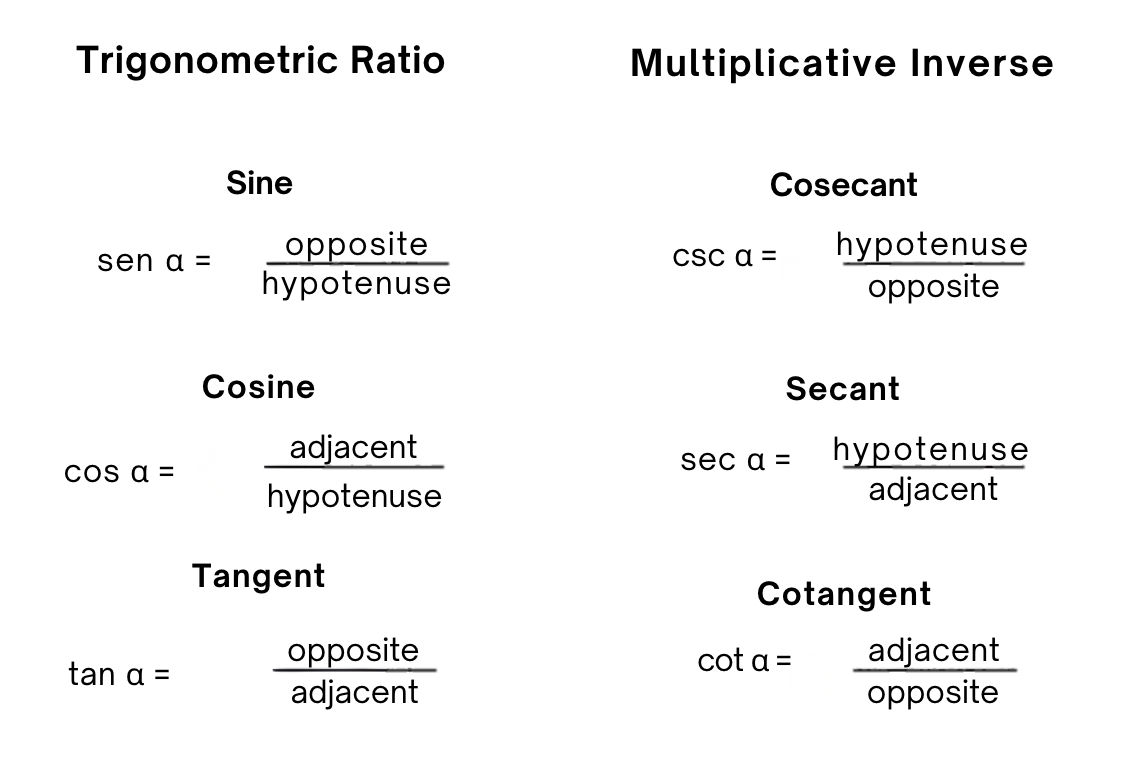
For the other trigonometric ratios, instead of creating another acronym, it is easier to learn the fact that cosecant, secant, and cotangent are multiplicative inverses of sine, cosine, and tangent, respectively. The following table details this.
Trigonometric Ratios in a Circle
A goniometric circle or unit circle is one that has its center at the origin of coordinates and its radius is one unit.
If we consider a right triangle inside the circle where the radius forms the hypotenuse and one of the legs lies on the X-axis, we obtain a figure like the following.
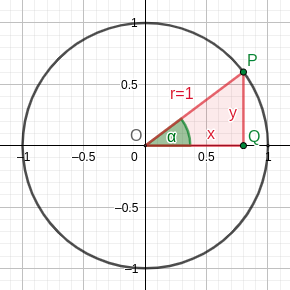
We calculate the sine and cosine of angle 


We conclude that:
The sine is the y-coordinate of P, that is, of the point on the circle.
The cosine is the x-coordinate of P, that is, of the point on the circle.
Another fact we can deduce is that the values of sine and cosine are between 1 and -1.
-1 ≤ sen α ≤ 1
-1 ≤ cos α ≤ 1
It should be noted that the reason trigonometric functions are considered on the circle is to be able to handle larger angles. For example, for a right triangle we couldn't determine what  is, because we cannot construct a right triangle with a 150° angle.
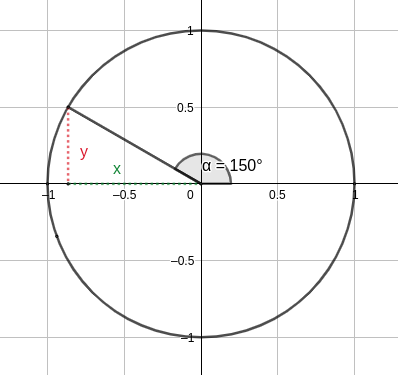
The unit circle allows me to make that calculation. What we do is:
1 Locate the 150° angle formed from the X-axis in a counterclockwise direction.
2 Consider the point on the circle formed by the angle.
- The y-coordinate of that point is the sine.
- The x-coordinate is the cosine.
For the other trigonometric ratios, we consider the following figure:
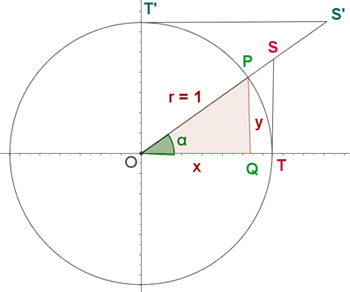
QOP and TOS are similar triangles. Then,

QOP and T'OS′ are similar triangles. Then,
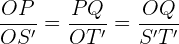
Using the definitions of trigonometric ratios and the relationships between similar triangles we obtain:




Signs of Trigonometric Ratios
In the unit circle, the coordinate axes delimit four quadrants that are numbered counterclockwise. Recall that if we consider an angle and take the right triangle inside the circle generated by that angle, the sign of the sine or cosine of this angle will depend on which quadrant the triangle is located in.
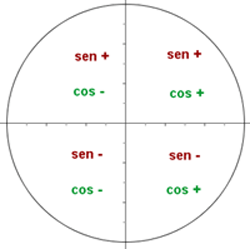
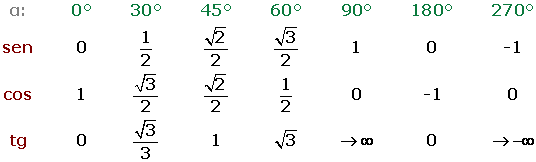
Table of Trigonometric Ratios
Pythagorean Relationships Between Trigonometric Ratios



Explanation:
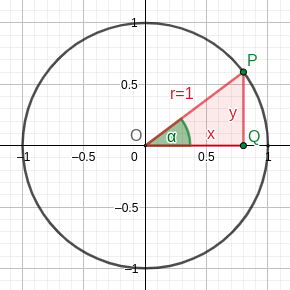
Since the triangle considered inside the circle is a right triangle, it follows that:

In the image, the legs (a and b) correspond to the values x and y, and the hypotenuse to the radius, that is, 1.
Thus 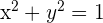
Since x is the x-coordinate and y is the y-coordinate, we know that these values correspond to cosine and sine respectively. Therefore:

By dividing the previous equation by  we obtain
If instead we had divided by  we would have obtained
Relationships Between Trigonometric Ratios of Certain Angles
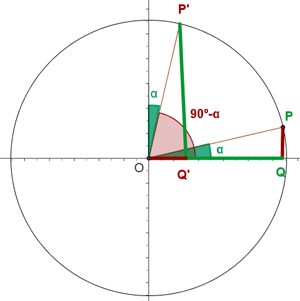
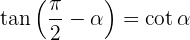
Complementary Angles
Two angles are said to be complementary if their sum is 90°, that is, a right angle.


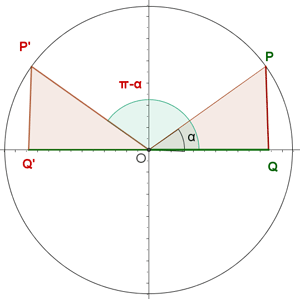
Supplementary Angles
Two angles are said to be supplementary if their sum is 180°.



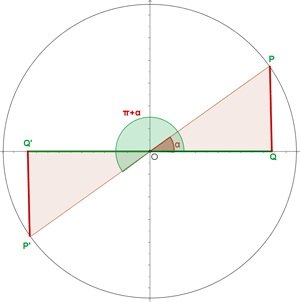
Angles That Differ by 180°



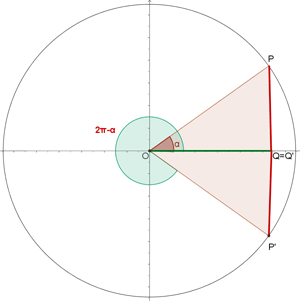
Opposite Angles



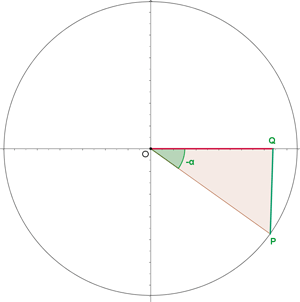
Negative Angles



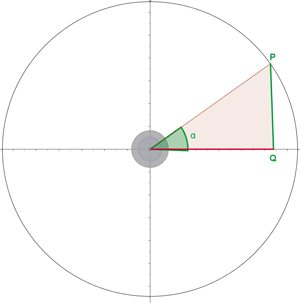
Greater Than 360º



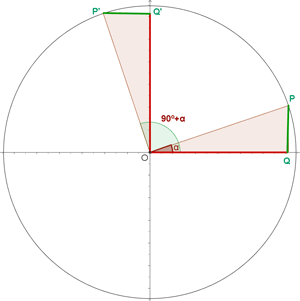
Angles That Differ by 90º
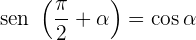


Angles That Sum to 270º
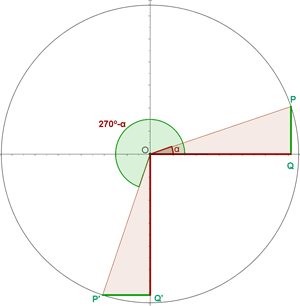
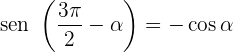
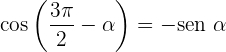
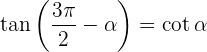
Angles That Differ by 270º
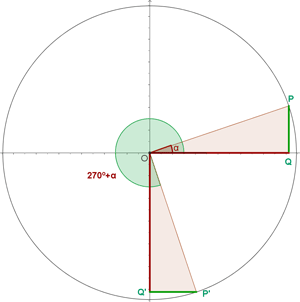
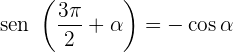

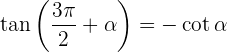
Trigonometric Ratios of Sum and Difference of Angles






Trigonometric Ratios of Double Angles


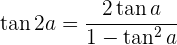
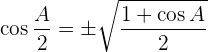
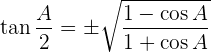
Trigonometric Ratios of Half Angles

Transformations of Sums into Products




Transformations of Products into Sums



Exercises for Calculating Sine, Cosine, and Tangent
Calculate the sine, cosine and tangent of  :
:
1 Sine

2 Cosine

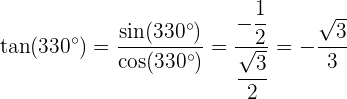
3 Tangent

Calculate the sine, cosine and tangent of  :
:
1 Sine

2 Cosine

3 Tangent
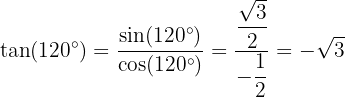
Calculate the sine, cosine and tangent of  :
:
1 Sine

2 Cosine

3 Tangent

Calculate the sine, cosine and tangent of  :
:
1 Sine

2 Cosine

3 Tangent

Calculate the sine, cosine and tangent of  :
:
1 Sine

2 Cosine

3 Tangent
Are you looking for an elementary math lesson? Discover lessons with an expert Superprof tutor! You can contact our teachers, whether you're looking for an online math teacher or an in-person one.
Summarize with AI:
Did you like this article? Rate it!

 Loading...