
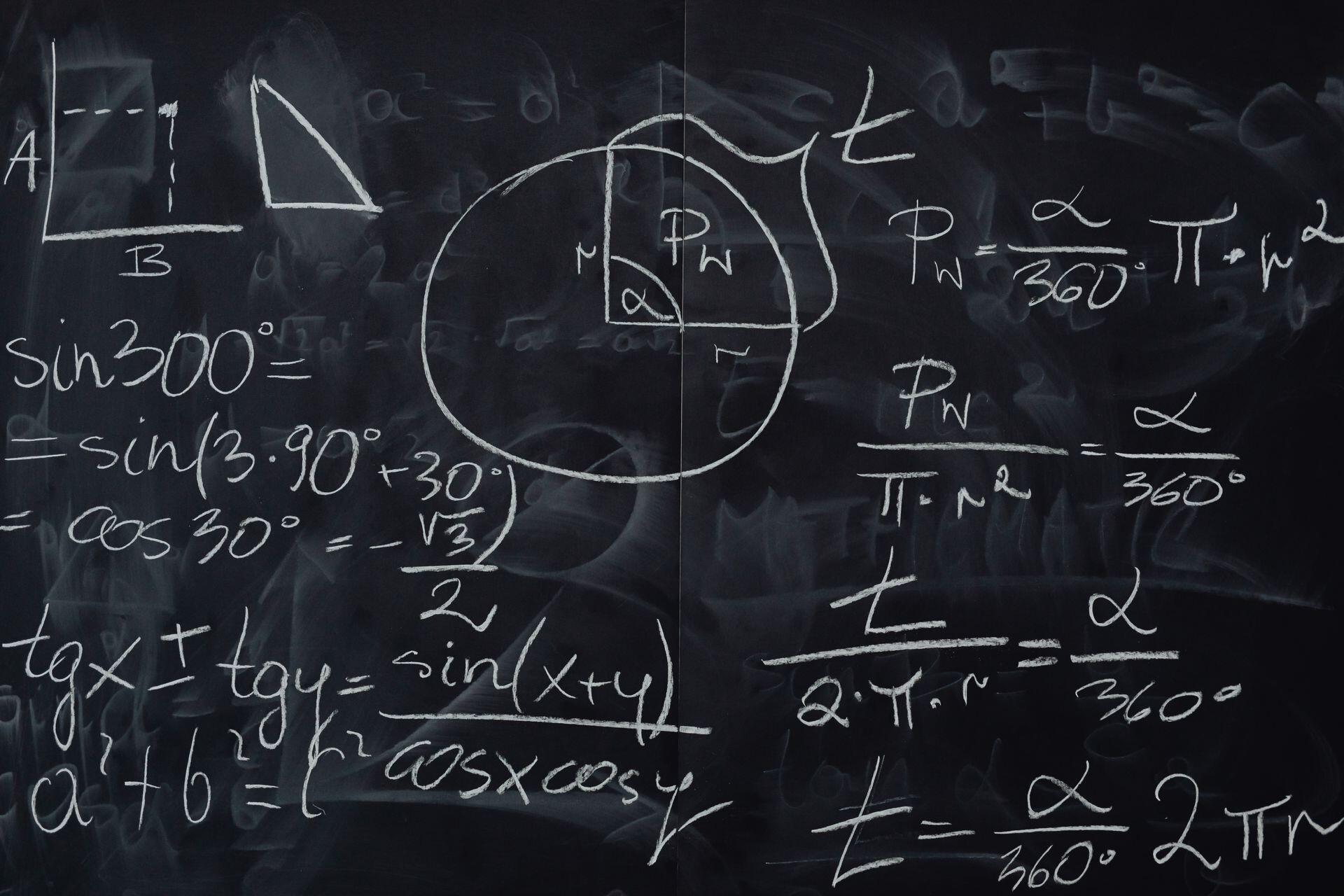

The ACT math section challenges your knowledge of high school math. One of those challenges is knowing certain formulas and when to use them. Unlike some tests, the ACT does not provide a formula sheet; you must remember key formulas and how to apply them on your own. You don’t need to know every formula in algebra, geometry, trigonometry, and statistics, but having the basics memorized will help you succeed.
| Formula Name | Formula |
|---|---|
| Standard Form | Ax + By = C |
| Slope-Intercept Form | y = mx + b |
| Point-Slope Form | y - y1 = m(x - x1) |
| Slope | m = (y2 - y1) / (m2 - m1) |
| Quadratic Formula | x = (-b ± √(b^2 - 4ac)) / 2a |
| General Form | ax^2 + bx + c = 0 |
| Geometry Distance | √((x2 - x1)^2) + ((y2 - y1)^2) |
| Triangle Area | A = 1/2bh |
| Parallelogram Area | A = bh |
| Trapezoid Area | A = 1/2(b1 + b2)h |
| Regular Polygon Area | A = 1/2ap |
| Prism Volume | V = Bh |
| Right Prism Surface Area | SA = 2B + Ph |
| Circular Cylinder Volume | V = πr^2h |
| Right Circular Cylinder Surface Area | SA = 2πr^2 + 2πrh |
| Pyramid Volume | V = 1/3Bh |
| Right Pyramid Surface Area | SA = B + 1/2Ps |
| Circular Cone Volume | V = 1/3πr^2h |
| Right Circular Cone Surface Area | SA = πr^2 + πrs |
| Sphere Volume | V = 4/3πr^3 |
| Sphere Surface Area | SA = 4πr^2 |
| Circle Area | A = πr^2 |
| Circle Sector Area | A = ((θ) / 360)πr^2 |
| Circumference | C = πd = 2πr |
| Center-Radius Form | (x - h)^2 + (y - k)^2 = r^2 |
| Degree Measure in Regular Polygon | (180(n - 2)) / n |
| Sum of Degree Measures in a Polygon | 180(n - 2) |
| Pythagorean Theorem | a^2 + b^2 = c^2 |
| Arithmetic Sequence | a_n = a1 + (n - 1)d |
| Arithmetic Series | s_n = (n/2)(a1 + a_n) |
| Simple Interest | I = prt |
| Compond Interest | A = p(1 + (r/n))^nt |
| Distance | D = rt |
| Direct Variation | y = kx |
| Indirect Variation | y = k/x |


Algebraic Formulas
Algebra makes up a large portion of the ACT math section. Memorizing essential formulas will save you valuable seconds on the timed ACT test. Like the SAT, questions involve equations, functions, and number relationships. There are a few essential formulas you should know before arriving at the testing center.
It's not enough to memorize formulas; you have to know how to apply them, too.
You must be familiar with algebra vocabulary such as: variable, constant, expression, term, exponents, and coefficient.
You must also know techniques and concepts like simplifying expressions, solving with substitution, multiplying binomials, function notation, linear inequalities, logarithms, and how to handle a negative number.
Slope Formula
The slope of a line tells you how steep it is. This formula appears often in coordinate geometry questions. For example, you may need to find the slope between two points or determine if lines are parallel. Keep in mind this concept is also applicable in geometry.
Slope-Intercept Formula
This is the most common way to write a linear equation. It’s often combined with the slope formula above to find missing information. Here, m is the slope and b is the y-intercept.
Quadratic Formula
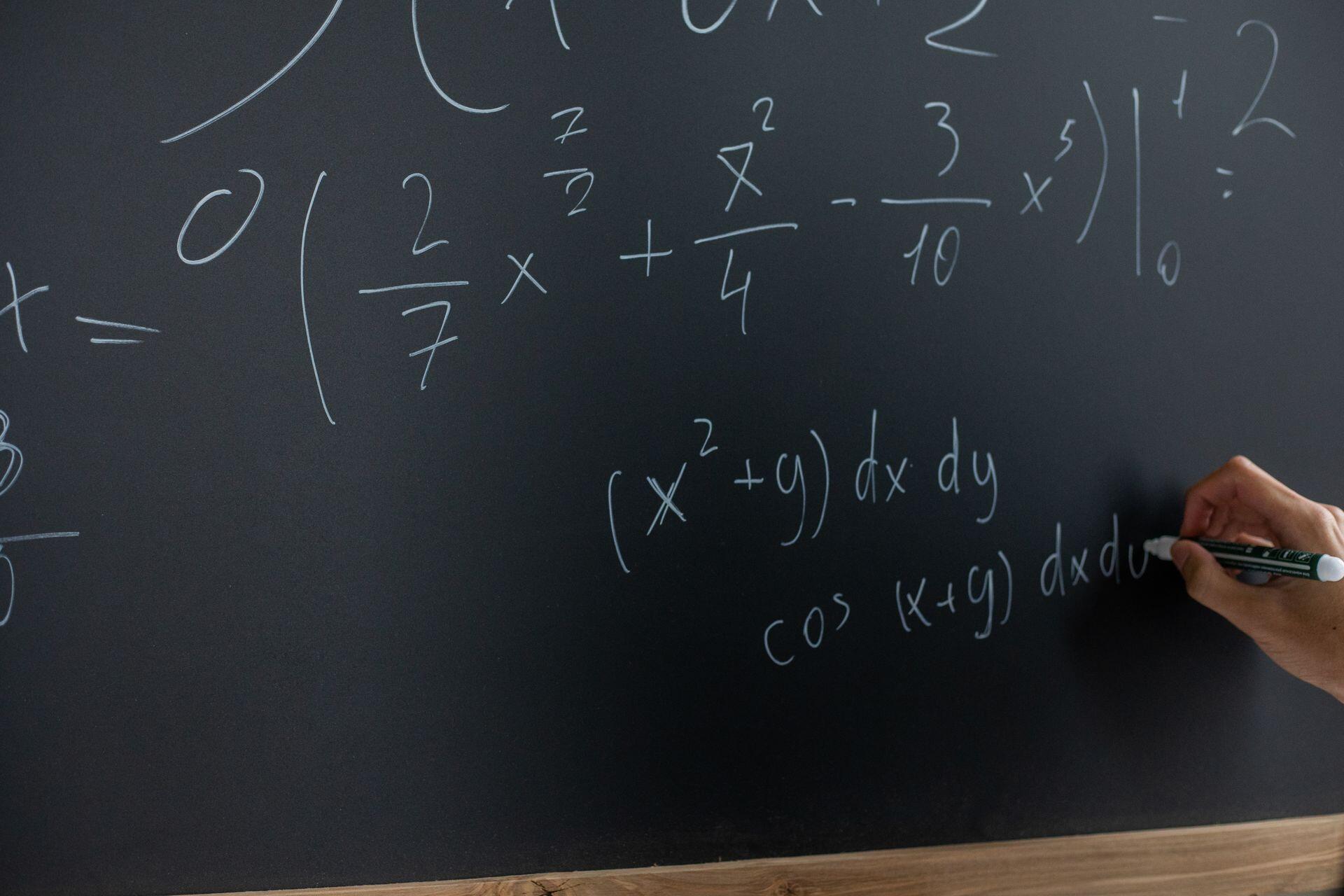
Among the most important math formulas to know for the ACT, you use this formula when solving quadratic equations. When factoring doesn’t work, this formula will yield the information you need.
FOIL Method
This is used to multiply two binomials. Many ACT questions involve expanding expressions. Memorizing this technique will help you avoid making simple mistakes. In any algebraic situation, be sure to fill in all the known number values if you're trying to find a solution with a specific value.
Geometry Formulas
Geometry questions on the ACT primarily focus on shapes, area, and volume. Focus on identifying shapes (both 2D and 3D) and understanding the formulas for calculating area, surface area, and volume. Coordinate geometry is also frequently featured in the ACT, but with the right knowledge, you can sometimes convert them into regular geometry questions for simpler solving.
In geometry, you must know fundamental concepts like determining angles (interior, exterior, vertical) in relation to different line configurations, different types of triangles and polygons, coordinates, graphs of sine, cosine, and tangent, two-dimensional quadrants, transformations, radians, and periods and amplitudes.
Area of a Triangle
Finding the area of a triangle can be helpful in many different types of math questions. The formula is very common. Occasionally, the height may not be obvious and must be calculated first.
Area of a Circle
Circles are another common occurrence in many math questions. Remember the critical facts about circles, such as that the diameter of a circle is twice the radius. The number of geometry questions on the ACT is usually quite high, so it's important to have a strong grasp on the subject.
Circumference of a Circle
The circumference of a circle is a fundamental math concept. It is used for many types of mathematical situations. Like all perimeter formulas, you should have it well memorized.
Area of a Rectangle
Many math problems build upon this basic concept. It’s simple, but important. Thankfully, it’s easy to remember.
Pythagorean Theorem
Another critical concept to memorize, this formula applies to right triangles. It’s one of the most tested formulas on the ACT. It can be used in many situations outside of typical geometry.
Volume of a Rectangular Prism
For three-dimensional geometry questions, be prepared to know this common formula. It’s not only important on tests like the ACT and SAT, but in many real-life situations as well.
Volume of a Cylinder
This formula is often combined with other concepts, such as surface area. Remember that it differs from other volume calculations because of its circular shape.

Trigonometry Formulas
Trigonometry questions are usually limited to basic ratios. You should know the core definitions and standard relationships between specific data points. You do not need advanced trigonometric knowledge for the ACT. Having a strong grasp of these concepts will help you achieve a high ACT score.
Sine, Cosine, Tangent
These three ratios are used in problems about right triangles. A common strategy is to label the sides before applying the formula. This helps you remain consistent and remember which figures you’re calculating for. The memory aid for these concepts is quite helpful! You should also know the reciprocals.
Sine, cosine, tangent
- SOH → sin(θ) = opposite / hypotenuse
- CAH → cos(θ) = adjacent / hypotenuse
- TOA → tan(θ) = opposite / adjacent
Reciprocal equations
- csc(θ) = hypotenuse / opposite
- sec(θ) = hypotenuse / adjacent
- cot(θ) = adjacent / opposite
Special Right Triangles
Memorizing the formulas for specific types of triangles can save a lot of time. Two special ones are 45-45-90 and 30-60-90 triangles. These shapes also have set side ratios that can help you calculate values quickly.
- 45-45-90 triangle: sides are x, x, x√2
- 30-60-90 triangle: sides are x, x√3, 2x
Statistics and Probability
This section of the math ACT tests your data interpretation knowledge. You’ll be tasked with calculating things like averages and probabilities. Many of the questions are simple, even if they are worded in a more complex way.
In this mathematical area, you must know mean, median, mode, and range, unweighted and weighted average, standard deviation, outliers, independent and dependent events, compound events, and how to read charts and graphs.
Mean (Average)
This is one of the most frequently used math concepts of all time. You’ll need to know it for many instances outside the classroom. On the test, you may need to find missing values or compare averages.
Probability
Another common problem type on the ACT includes statistics and probability. Simple probability is easy to calculate with this equation.
Permutations and Combinations
Many students find the concept of permutations and combinations challenging to remember. They often get confused with one another. To avoid such confusion, be sure to study the formulae and complete many practice problems of each type.
Permutations:
Combinations:
Standard Form of Linear Equation
This form is useful for systems of equations. Students should remember that this form can be rearranged into slope-intercept form (y = mx + b). Understanding the relationships between these forms can help you visualize and comprehend what’s being asked.
Strategies for Memorizing the Different Formulas
Unlike the SAT, the ACT does not provide a formula sheet for even the simplest math formulae. Therefore, it’s important to memorize (or better yet, fully comprehend) as many math formulas as you can before the test. Some formulas are all but guaranteed to make an appearance, while more advanced ones may or may not be on the test. Here’s how you can approach studying ACT math formulas.
Formulas like geometric areas, diameter and circumference, volume, degrees in different polygons, the Pythagorean Theorem, slope-intercept, the quadratic formula, and concepts like mean, median, and mode are likely to appear on the test.
Examine the ACT math reference sheet and see which formulas are easy for you to manipulate, and which are difficult. Spend more time doing practice problems for the ones you don’t already remember well.
Writing by hand helps reinforce memory more than just reading or typing. Create your own handwritten formula sheet and review it daily.
You can write the formula on one side and an example question on the other. Test yourself both ways. You can also rewrite the formula each time it comes up to further solidify it in your mind.
Access practice math questions on the ACT website and use them as part of your weekly study routine. Take timed practice tests at least a few times before the official test date so you can get used to the pacing and recalling formulas under pressure. It will also help you realize which formulas you still have trouble remembering.
With your ACT-approved calculator, practice writing the calculation in the correct notation so you know exactly what keystrokes are needed on test day.
On test day, you can help yourself by writing down a few critical formulas that you typically have trouble recalling at the beginning of the math session. You can use official scratch paper, the writable sections of the test booklet, or the ‘scratch paper’ area in the online test. Don’t spend too much time on this task, however, since it will eat into your reading and problem-solving time.
Remember that all questions contribute to your score equally, so don't spend too long on hard questions. Instead, flag it and skip to the next one. If you can make an educated guess, great! Wrong answers do not contribute to negative points on your score. Do not leave any answers blank. With your ACT-approved calculator and memorization practice, you’ll be prepped to take the ACT with confidence on test day!
References
- “ACT Calculator Policy: What’s Allowed and Prohibited.” ACT, www.act.org/content/act/en/products-and-services/the-act/test-day/calculator-policy.html. Accessed 17 July 2026.
- “ACT Online Testing | a New Option for Taking the ACT Test.” ACT, www.act.org/content/act/en/products-and-services/the-act/test-day/online-testing.html. Accessed 17 July 2026.
- “Mathematics 1 Reference Sheet.” ACT.org, 2019, www.act.org/content/dam/act/unsecured/documents/2022/30134-Mathematics-I-Reference-Sheet.pdf. Accessed 20 July 2026.
- The Princeton Review. “The Princeton Review | Test Prep, Tutoring, and Admissions.” The Princeton Review, www.princetonreview.com/college-advice/act-math-formulas. Accessed 20 July 2026.
Summarize with AI:
Did you like this article? Leave a rating!

 Loading...
Essential Formulas to Know for ACT Test Day
Preparing key formulas before ACT Test Day can make math questions faster and easier to solve. Focus on essential formulas for algebra, geometry, percentages, averages, slopes, areas, volumes, and probability. Reviewing these formulas regularly can help you recognize common problem types, manage time effectively, and approach the test with greater confidence.