
To learn Spanish conjugation, you have to be rigorous and meticulous: for starters, you have to learn the endings of all verbs in each tense and learn all of the irregular verbs, which don't follow the normal rules. Mastering verb conjugation is essential for effective communication in Spanish, as it allows you to express actions, time, intentions and emotions clearly and naturally. Here are our tips on how to conjugate verbs in Spanish.
The conjugation of a verb involves changing its endings and, sometimes, its stem to indicate who performs the action, when it takes place, how it is performed, whether it is singular or plural, and whether the action has been completed or is in progress.
For example:
- Yo hablo español — I speak Spanish
- Nosotros hablamos español — We speak Spanish
- Ella habló español — She spoke Spanish
As you can see, in this case, the verb hablar (speak) changes depending on the subject and the tense.
The Three Verb Endings
In Spanish, most verbs belong to one of these three categories based on the ending of their infinitive form:
| Verb Type | Ending | Example | Meaning |
|---|---|---|---|
| First group | -ar | hablar | to speak |
| Second group | -er | comer | to eat |
| Third group | -ir | vivir | to live |
Understanding these three groups will certainly make it easier to conjugate regular verbs, since they all follow the same conjugation pattern.


Regular Verb Conjugation Patterns
Regular verbs in Spanish follow predictable conjugation rules, which is a great tip for any beginner learning the language. Once you understand how verb endings change depending on the tense and the subject pronoun, you'll be able to conjugate regular verbs in Spanish more easily.
Present Tense Conjugation
The present tense in Spanish is used to express actions that are happening right now or in general, for example, to talk about routine situations or geneeral truths.
| Subject Pronoun | -AR Verbs (hablar) | -ER Verbs (comer) | -IR Verbs (vivir) |
|---|---|---|---|
| Yo | -o → hablo | -o → como | -o → vivo |
| Tú | -as → hablas | -es → comes | -es → vives |
| Él : Ella / Usted | -a → habla | -e → come | -e → vive |
| Nosotros/as | -amos → hablamos | -emos → comemos | -imos → vivimos |
| Vosotros/as | -áis → habláis | -éis → coméis | -ís → vivís |
| Ellos / Ellas / Ustedes | -an → hablan | -en → comen | -en → viven |
Examples:
- Tú hablas con tu madre todas las tardes. — You talk to your mother every afternoon.
- Él come sushi todos los viernes. — He eats sushi every night.
- Ellos viven cerca de la playa. — They live near the beach.
Past Tense Conjugation
The past tense is a verb tense that allows us to refer to actions, events, or situations that have occurred in the past, adding a historical and narrative perspective to our communication.
| Subject Pronoun | -AR Verbs (hablar) | -ER Verbs (comer) | -IR Verbs (vivir) |
|---|---|---|---|
| Yo | -é → hablé | -í → comí | -í → viví |
| Tú | -aste → hablaste | -iste → comiste | -iste → viviste |
| Él / Ella / Usted | -ó → habló | -ió → comió | -ió → vivió |
| Nosotros/as | -amos → hablamos | -imos → comimos | -imos → vivimos |
| Vosotros/as | -asteis → hablasteis | -isteis → comisteis | -isteis → vivisteis |
| Ellos / Ellas / Ustedes | -aron → hablaron | -ieron → comieron | -ieron → vivieron |
Examples:
- Tú hablaste con tu madre todas las tardes. — You talked to your mother every afternoon.
- Él comió sushi todos los viernes durante el verano pasado. — He ate sushi every Friday last summer.
- Ellos vivieron cerca de la playa durante su infancia. — They lived near the beach during their childhood.
In the past tense, you don't keep the full infinitive. Instead, you drop the ending (-ar, -er, -ir) and add different past tense endings.
Future Tense Conjugation
The future tense in Spanish is a verb tense used to refer to actions or situations that will take place in the future.
| Subject Pronoun | -AR Verbs (hablar) | -ER Verbs (comer) | -IR Verbs (vivir) |
|---|---|---|---|
| Yo | -é → hablaré | -é → comeré | -é → viviré |
| Tú | -ás → hablarás | -ás → comerás | -ás → vivirás |
| Él / Ella / Usted | -á → hablará | -á → comerá | -á → vivirá |
| Nosotros/as | -emos → hablaremos | -emos → comeremos | -emos → viviremos |
| Vosotros/as | -éis → hablaréis | -éis → comeréis | -éis → viviréis |
| Ellos / Ellas / Ustedes | -án → hablarán | -án → comerán | -án → vivirán |
Examples:
- Tú hablarás con tu madre todas las tardes durante tu viaje. — You will talk to your mother every afternoon during your trip.
- Él comerá sushi todos los viernes durante el verano. — He will eat sushi every Friday during the summer.
- Ellos vivirán cerca de la playa tras mudarse. — They will live near the beach after they move.
For the future tense, you just need to keep the infinitive of the verb (hablar, comer, vivir, etc.) and add the future ending (é, ás, á, emos, éis, án).
To learn conjugation in Spanish, always try to focus on the most commonly used Spanish verbs, discover the top action words, easy examples, and tips to use them every day.
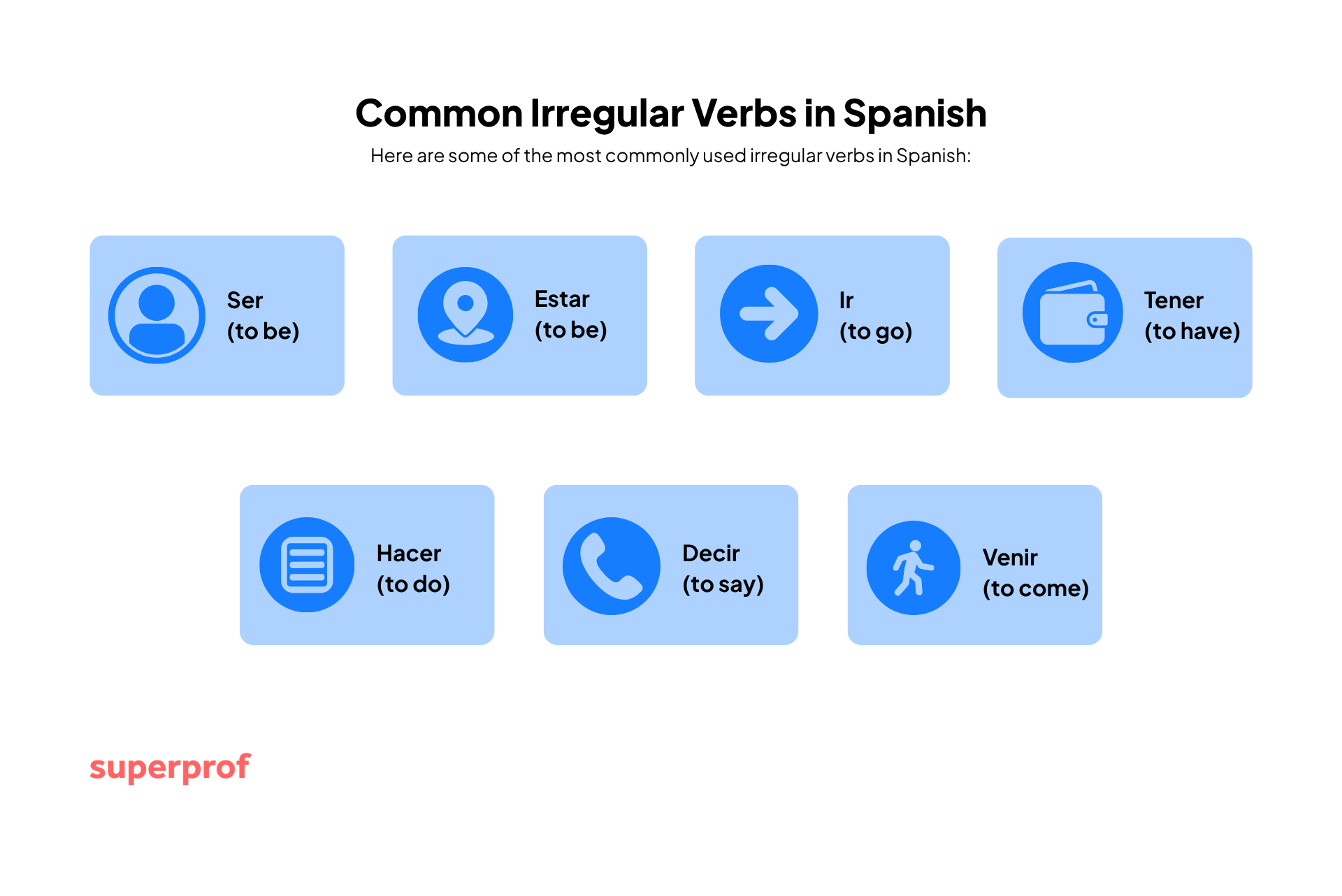
The following table shows the present tense conjugations of some of the most common irregular verbs in Spanish: ser, ir, and tener.
| Subject Pronoun | Ser (to be) | Ir (to go) | Tener (to have) |
|---|---|---|---|
| Yo | soy | voy | tengo |
| Tú | eres | vas | tienes |
| Él / Ella / Usted | es | va | tiene |
| Nosotros/as | somos | vamos | tenemos |
| Vosotros/as | sois | vais | tenéis |
| Ellos / Ellas / Ustedes | son | van | tienen |
These verbs are very common in everyday conversation, so practicing and understanding their conjugations from the moment you start learning Spanish can significantly improve your fluency.
Stem-Changing Verbs
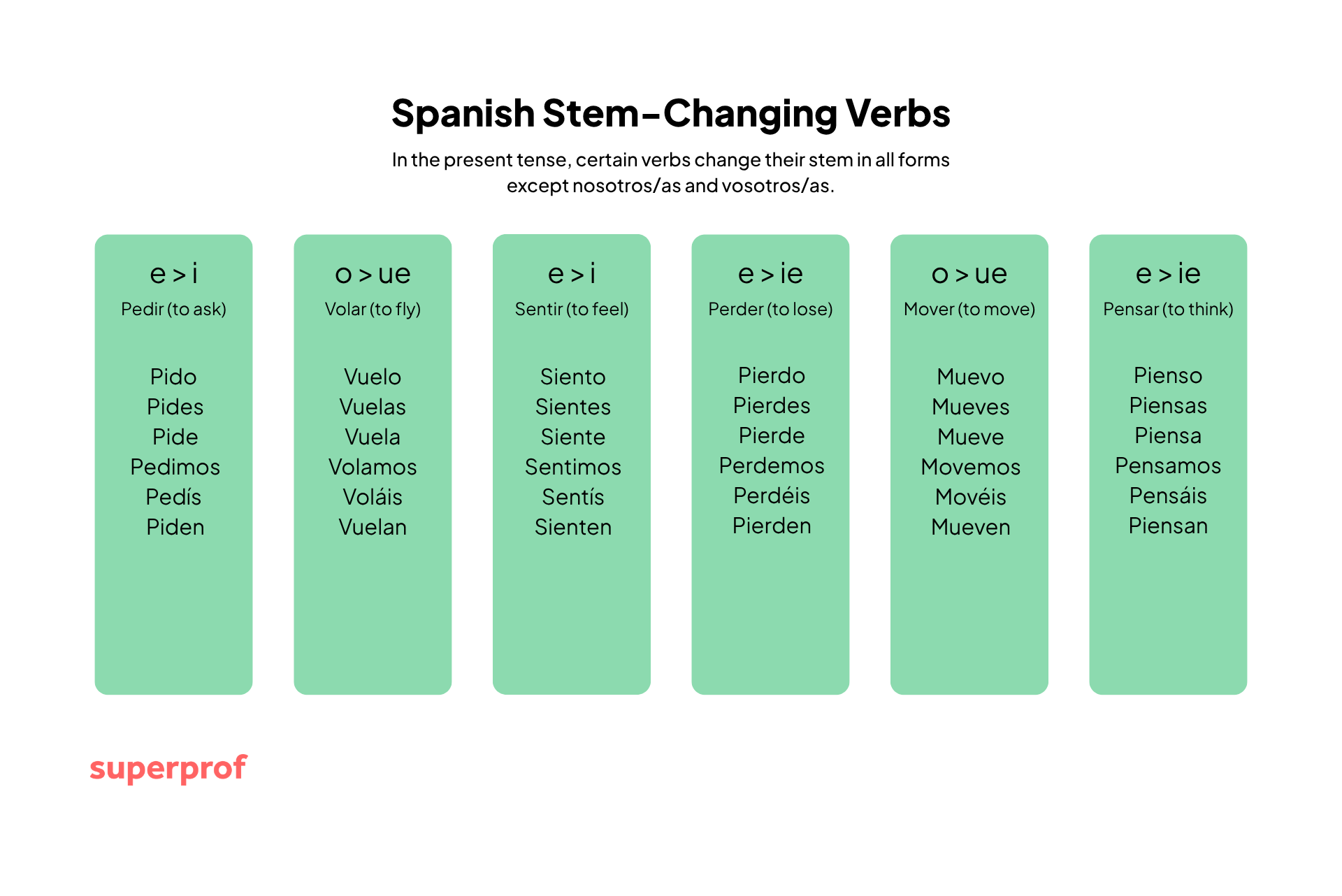
Stem-changing verbs are those in which the stem changes when conjugated; however, the verb endings usually remain regular. The stem is the part of the verb that comes before the ending. These changes occur when conjugating the verbs in the present tense and affect all forms except nosotros/as and vosotros/as.
If you are learning Spanish or reviewing for language proficiency exams, find a personalized Spanish lesson with Superprof.
Tips and Strategies for Mastering Conjugation
Learning any language can be a bit overwhelming at first, but regular practice and finding effective study methods can make the process much easier.
Practice Techniques
Practice makes perfect. Consistent practice is one of the most effective ways to master Spanish verb conjugation. Some effective study techniques include:
Language learning apps and online practice platforms can also help you review conjugation patterns interactively and track your progress over time.
Did you know that a 2022 meta-analysis reviewing 23 studies found that students who used mobile apps for language learning achieved significantly better results than those who relied solely on traditional methods? 1
Common Pitfalls to Avoid
Many Spanish learners make mistakes when conjugating verbs, especially in the early stages, which is completely understandable. However, being aware of these mistakes can help you avoid confusion.
To overcome these difficulties, we recommend focusing on one tense at a time, practicing with repetition and real-life examples, and paying attention to patterns rather than memorizing random forms.
Interactive Learning Tools
Interactive tools such as multiple-choice quizzes and sentence completion tasks are very useful for practicing verb conjugation. Combining different educational exercises will help you identify patterns and gain a better understanding of Spanish.
Conjugation Exercises
Conjugation exercises will help you put everything you've learned in theory into practice and identify which areas need more practice. Interactive quizzes will help you identify:
- Regular and irregular verbs
- Different verb tenses and moods
- Stem change patterns
Some useful exercise formats include:
- Fill-in-the-blank activities
- Multiple-choice quizzes
- Matching exercises
- Sentence completion tasks
- Timed conjugation challenges
These types of resources help improve memory retention and make you feel more confident using verbs in Spanish conversations.
Audio Pronunciations
On the other hand, it’s also important to practice pronunciation when learning Spanish verb conjugations. Using audio examples to study will help students understand:
- The pronunciation of verb endings
- The differences between similar conjugations
So, to listen to and repeat conjugated verbs aloud, you can use some helpful audio resources such as:
- Language learning apps
- Recordings of native speakers
- Podcasts and videos in Spanish
- Text-to-speech pronunciation tools
Additional Resources
Grammar guides, reading materials and online tools, as well as other alternative resources, also offer more opportunities to practice verb conjugations in Spanish anywhere, anytime.
Recommended Reading
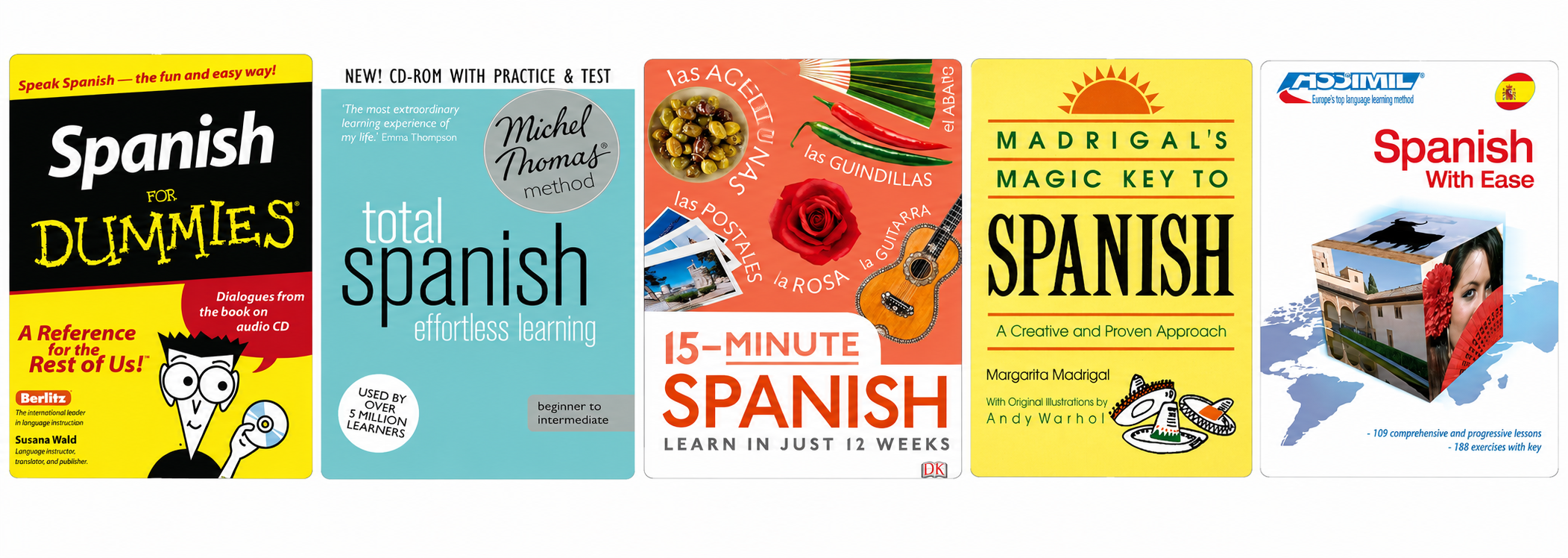
Academic books and grammar guides can help you better understand verb structures, tenses and conjugation patterns. Some recommended resources include:
- The Assimil Method
- Madrigal’s Magic Key to Spanish
- 15-Minute Spanish: Learn in Just 12 Weeks
- Michel Thomas Method – Spanish
- Spanish for Dummies!
Learn how to master Spanish conjugation.
Online Tools
Online platforms and mobile apps are excellent for practicing conjugation, listening comprehension, and vocabulary while commuting or in your free time.
Some useful tools include:
- Duolingo
- Babbel
- Memrise
- Busuu
- FluentU
- Quizlet
Many of these platforms include resources like:
- Interactive verb conjugation quizzes
- Audio pronunciation examples
- Verb reference charts
- Personalized learning exercises
- Progress tracking features
Combining grammar study, reading practice, and interactive tools can make learning Spanish verb conjugation more effective and enjoyable. Work on your accent with a private teacher and start mastering Spanish conjugation to become truly proficient! Find a Spanish online course with Superprof today!
References
- Mihaylova, M., Gorin, S., Reber, T. P., & Rothen, N. (2022). A Meta-Analysis on Mobile-Assisted Language Learning Applications: Benefits and Risks. Psychologica Belgica, 62(1), 252. https://doi.org/10.5334/pb.1146
Summarize with AI:
Did you like this article? Leave a rating!


 Loading...