


Poets are undoubtedly some of the finest wordsmiths on the planet. Poets who truly excel tend to be those who manage to capture relatable experiences eloquently in few words, with sensory appeal and challenging themes. When you think about the best poems out there, it’s likely that the likes of William Shakespeare’s Sonnet 18, Robert Frost’s The Road Not Taken, and William Wordsworth’s I Wandered Lonely as a Cloud spring to mind.
In this article, we’re going to pull back the curtain on some other famous poems that deal with the likes of love, nature, identity, loss, and personal growth. There are bound to be a few mentions that even the biggest literary enthusiast among us hasn’t encountered before. When you come across an unfamiliar poem, we absolutely recommend that you add it to your reading list!


Famous Classic English Poems
If nothing immediately springs to mind when you hear the term classic English poetry, try to remember as far back as English class at school. These poems tend to frequent the English curriculum for the role they played in shaping literature for centuries.
Sonnet 18 by William Shakespeare
Shall I compare thee to a summer’s day?
William Shakespeare, Sonnet 18
Whether it’s plays, novels, or poems, Shakespeare is impossible to avoid, as he is arguably the most influential person in literature. It’s likely that you’ve studied several of his contributions already in your education. However, if somehow Sonnet 18 escaped your radar, you should definitely give it a read. It explores beauty, love, and the passage of time through an incredibly powerful idea that poetry provides an avenue to preserve beauty beyond the limits of human life. It really hits home when you think about how we’re still appreciating his work to this day, right? He's definitely one of the most romantic poets of all time, and inspired the future generation of British poets.
The Road Not Taken by Robert Frost
Another great addition to your reading list would be Robert Frost’s The Road Not Taken. Believe us when we say that the hype is most definitely deserved with this one. Frost describes a traveler choosing between two paths in a forest.

The idea behind it is incredibly fascinating, as it surrounds how people make decisions with incomplete information and later construct stories about their choices. So immediately, you can see how it has the makings of a relatable experience that will leave you with plenty to ponder.
Paradise Lost by John Milton
Long is the way / And hard, that out of Hell leads up to light.
Paradise Lost, Book II
If you’ve yet to come across an epic poem that really grabbed you, let John Milton’s Paradise Lost serve as your introduction. It’s definitely a memorable one, seeing as it’s very distinguishable from most poems you’ll come across in your studies. How many poems have you come across that retell a biblical story? Well, that’s exactly what this epic is so famous for: telling of humanity’s fall from grace.
The Raven by Edgar Allan Poe
Edgar Allan Poe is another major name in the literary field. We definitely think you should get your hands on a famous poem of his titled The Raven. You’ll immediately be transported into the poet’s world, which conjures a grieving narrator who encounters a mysterious bird.
As you progress through the lines, it intensifies his despair over a lost loved one. It makes for an incredibly captivating reading experience, as it flows incredibly well, building an unsettling suspense. You could definitely place it up there with the best love poems, all be it a sad one.
Ozymandias by Percy Bysshe Shelley
While it’s definitely one of the more famous poems out there, Ozymandias by Percy Bysshe Shelley is perhaps the first mention that you might not be aware of if your poetry study is confined to high school English classes.

Well, you’ll be glad to hear that it’s also an incredibly accessible poem that you’re bound to enjoy. In it, Shelley describes the remains of a monumental statue in a deserted landscape. It has all the makings of an enjoyable exploration with some great storytelling and some striking imagery sprinkled in, too!
Dover Beach by Matthew Arnold
Rounding off our list of classic English inclusions, we’ve got a poem that takes an unsuspecting turn. Matthew Arnold’s Dover Beach starts out by painting a peaceful coastal scene before taking the reader on a detour, tackling uncertainty about faith, meaning, and the modern world. If it isn’t evident in your first reading, further study into the poem’s intricacies will unveil how this change is intentional. Going from natural beauty to emotional unease gives the poem its distinctive atmosphere that makes it a poem that you won’t soon forget.
Famous Short Poems
Every piece of literature has its own unique objective. However, what makes a good poem isn’t always how many techniques are on display. In fact, it’s often those that are able to say more with less that tend to be remembered most. This style of famous poem requires its own unique skillset, as a more condined mode of storytelling. Let’s look at how some short poems demonstrate how a small number of carefully chosen words can accomplish so much.
Hope is the Thing with Feathers by Emily Dickinson
Emily Dickinson is definitely a poet who deserves every drop of recognition that she gets. The hardest thing about her work is deciding on a favorite, given how extensive her library of gems is. This is really saying something, given the challenging themes that she tackles across her poems. Her poem Hope is the Thing with Feathers adopts a tone of optimism that you’ll learn to see is a contrast to some of her other poetry.
Fire and Ice by Robert Frost
It would be difficult to exclude Robert Frost from any poetry list, at least if you wanted to remain credible, that is. He's probably one of the most famous American writers of the 20th century, if not of all time. His short poem Fire and Ice is a textbook example of what we were talking about above, accomplishing more with less. In just a few lines, he discusses how the world might end through fire or ice. He uses these elements to represent destructive human emotions, making for an incredibly evocative read that you simply can’t pass up on.
Dreams by Langston Hughes
Hold fast to dreams
Langston Hughes, Dreams
One of the things about short poems is that they present no excuse for not reading them, especially if you’re selecting one from a curated list like this. Langston Hughes’s Dreams won’t require much of your time at all to read, even a few times over. The negligible time required to indulge in this one will be rewarded tenfold, as its simple imagery instills a meaningful and uplifting message that we won’t spoil for you.
Aedh Wishes for the Cloths of Heaven by W. B. Yeats
W. B. Yeats has earned a reputation for being one of the biggest names in poetry, and deservedly so! We could think of no better introduction to the poet than picking up Aedh Wishes for the Cloths of Heaven. If you were to ask anyone who’s read it what makes it so special, you can expect their answer to center on how its extravagant imagery and emotional simplicity are so well contrasted.
Nothing Gold Can Stay by Robert Frost
You know when a poet is mentioned twice on a rather short list that they’re the real deal, and this won’t be his last mention today, either! Frost’s Nothing Gold Can Stay is well deserving of its inclusion.

The short poem reflects on how beauty and innocence inevitably change, and it comes with some lovely natural imagery that reminds the reader of something that might be a little upsetting to read at first: how precious moments cannot remain untouched by time. It’ll have you reflecting on all those memories that you hold dearest.
We Real Cool by Gwendolyn Brooks
If the thought of rebellion, risk, and the consequences of choices made without considering the future speaks to you, then you’re going to love this one. Gwendolyn Brooks packs all of this into her short poem We Real Cool. She does this through an unusual rhythm and carefully placed pauses to bring a collective identity to the speaker. If you were interested in learning how poetic techniques can be employed to bring a short poem to life, then this one serves as a perfect example.
Famous Nature Poems
Another major theme in poetry is nature. These next inclusions use the likes of landscapes, animals, and changing seasons to communicate strong emotions to the reader. Let’s look at some of the most famous examples.
I Wandered Lonely as a Cloud by William Wordsworth
Regardless of your years in school, you’ll likely be familiar with William Wordsworth, a poet whose reputation exceeds poetry itself. Well, his most famous poem is actually one that tackles this very theme. In it, he describes his encounter with a field of golden daffodils, which, on the surface, creates a rather striking image in the mind of the reader, but under the hood, it describes how nature can nourish the imagination.
To Autumn by John Keats
Where are the songs of Spring? Ay, Where are they?
John Keats, To Autumn
Another textbook example of vivid imagery and metaphors would be John Keats’s To Autumn. This masterpiece celebrates the richness of the seasons. After your reading, you’ll find yourself with a newfound appreciation for the beauty of nature and the passage of time that makes each so special.
The Lake Isle of Innisfree by W. B. Yeats
Perhaps one of the more memorable poems for many, regardless of theme, is The Lake Isle of Innisfree by Yeats. This one’s particularly beautiful and is something you can actually reflect on whenever you find yourself cooped up in an office or studying for a test.
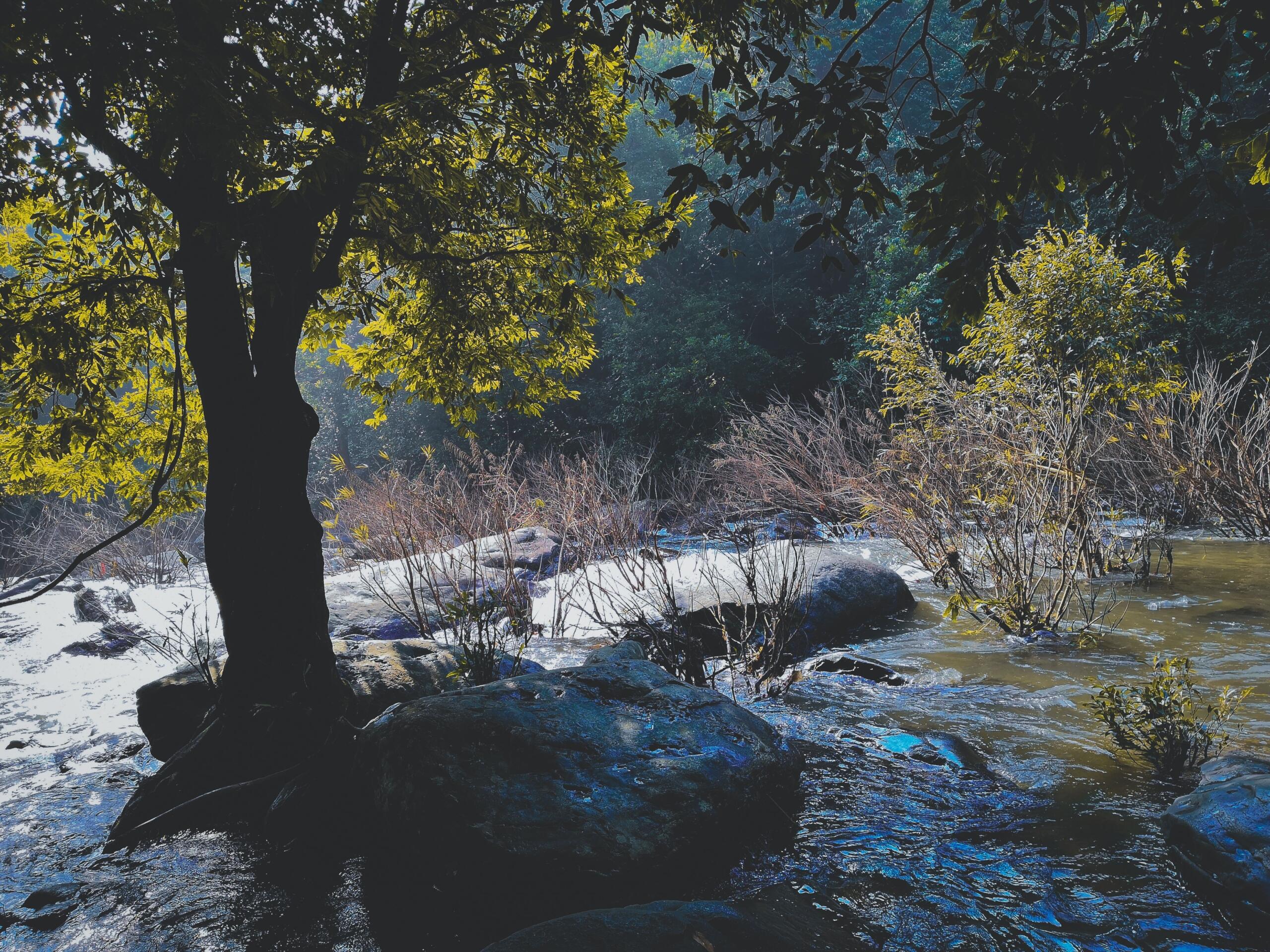
That’s because the poet finds himself in a similar environment, wishing to escape the shackles of an urban environment and have a peaceful existence surrounded by nature.
The Eagle by Alfred, Lord Tennyson
As you may have guessed from the title, The Eagle presents a striking image of… well, an eagle perched high above the sea before plunging toward its prey. It’s something that so often goes overlooked as we’re constantly distracted by the events of our own lives. However, the poet does wonders in depicting this scene, allowing us to experience nature’s beauty.
Birches by Robert Frost
One could do worse than be a swinger of birches.
Birches, Robert Frost
Here we have Frost going for his hat trick in this article, with his third poem, Birches, conjuring an image of a boy swinging from the branches of trees bent over by ice. This foreign image will have you in the same shoes as the poet, wanting to drop all the stresses of life and escape to this freeing and tranquil scene.
The Peace of Wild Things by Wendell Berry
Have you ever found yourself far out in nature, simply admiring its beauty? Well, that’s exactly what this Wendell Berry classic touches on. In it, the speaker rids themselves of all life’s worries with that temporary peace. It’s really a lovely read that we strongly suggest you add to your list!
What is your favorite theme in poetry?
Famous Modern Poems
One of the common misconceptions with poetry is that you always need to learn from poetry that was written long before any of us were born. While we can, of course, learn a great deal from the literary classics, there is an abundance of contemporary poems that you can enjoy and draw inspiration from.
Still I Rise by Maya Angelou
Let’s kick off our modern inclusions with Still I Rise, a poem that will really challenge you to think deeply about self-worth and resistance. It jumps out from other inclusions on our list thus far, and it can really help shape your outlook on resilience. Perhaps you might take something from your read and apply it in your own life.
Do Not Go Gentle into That Good Night by Dylan Thomas
This gem from Dylan Thomas also tackles a heavier theme: death. While this is something that really seems to interest poets, it remains a refreshing take, as he urges resistance against death.

We’re not alone in our admiration of this modern classic, as it’s a poem that’s celebrated by critics around the world. You can’t ask for a better recommendation than that now, can you?
The Waste Land by T. S. Eliot
The next famous poem we’ve got for you is T. S. Eliot’s The Waste Land. This modern poem reflects on society following the First World War. Despite the subject matter, it’s far from a poem that’s only to be enjoyed by the history buffs among us. Eliot makes this one an accessible read about a fractured world.
Daddy by Sylvia Plath
I have always been scared of you.
Daddy by Sylvia Plath
Sylvia Plath is a poet who needs no introduction. She’s earned herself a reputation as a poet who never hesitates to take on the heaviest of themes in her work. If you like the sound of a poem that combines the likes of family relationships, grief, and authority, then Daddy might be your favorite find from our list.
The Red Wheelbarrow by William Carlos Williams
The Red Wheelbarrow is a poem that accomplishes an entirely different goal from many of the other inclusions on our list thus far. Through simple language and carefully arranged structure, it shows how an ordinary scene can become the center of a poem. It’s always an example of a good poem when it turns the most mundane scene or object into something so captivating.
One Art by Elizabeth Bishop
Until now, there’s been no mention of a certain name that you might have expected to see right off the bat. Well, there was no better place to discuss Bishop than in the modern poem section through her critically acclaimed One Art.
We all experience loss in some shape or form in this life. So, this poem makes for a universally relatable read, driving home how even seemingly manageable losses can become deeply personal.

The Orange by Wendy Cope
Rounding off our modern pieces and the list of 25 famous poems, we’ve kept one that we’re sure you’ll enjoy. The Orange is one of those poems that’s impossible not to love. It’s incredibly uplifting, as it invites the reader to celebrate the unexpected happiness found in ordinary experiences. No matter what mood you find yourself in, we encourage you to pick up this one and watch your mood elevate!
Why These Poems Are Considered Famous
After reading any of these poems, it’ll quickly become apparent why they are held in such high regard across the world. However, prior to indulging in your exploration, it might not be as apparent. What makes a poem endure the test of time is its ability to connect individual experiences with universal emotions and questions. You’ll always find that the famous titles in poetry offer fresh perspectives on familiar experiences and the world around us.
You could choose to bring any one of these poems with you to your poetry lessons. It's a great way to immerse yourself in the world of poetic expression. These courses provide the flexibility to learn from the comfort of your home, allowing you to explore diverse poetic forms and techniques at your own pace.
Summarize with AI:
Did you like this article? Leave a rating!


 Loading...

