Definition of Asymptotes
Asymptotes are lines that the function approaches indefinitely.
There are three types of asymptotes:
1. Horizontal
2. Vertical
3. Oblique
Horizontal Asymptotes
If either of the following two conditions is satisfied:

then the line  is a horizontal asymptote for the graph of
Example: Calculate the horizontal asymptotes of the function 
We calculate the limit as  approaches
  ; to do this we divide each term of the numerator and denominator by
  :
:
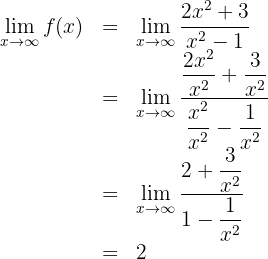
Thus, the function has a horizontal asymptote 
Vertical Asymptotes
If either of the following two conditions is satisfied:

then the line  is a vertical asymptote for the graph of
Note that  are the points that do not belong to the domain of the function (in rational functions).
Example: Calculate the vertical asymptotes of the function
The domain of the function is 
We calculate the lateral limits as approaches  :
:
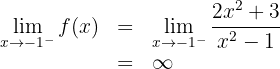
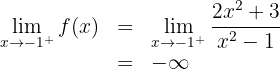
Thus, the function has a vertical asymptote 
We calculate the lateral limits as approaches  :
:
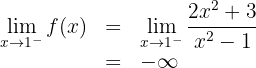
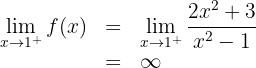
Thus, the function has another vertical asymptote 
The above can be observed from the graph of the function.

Oblique Asymptotes
We will only find oblique asymptotes when there are no horizontal asymptotes.
For there to be an oblique asymptote, it must be satisfied that the degree of the numerator is exactly one degree higher than that of the denominator; then the asymptote is given by:

where
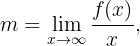

Example: Calculate the asymptotes of the function 
It is satisfied that the degree of the numerator is exactly one degree higher than that of the denominator; we only need to verify if horizontal asymptotes exist.
We calculate the limit as approaches ; to do this we divide each term of the numerator and denominator by :
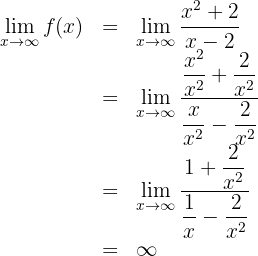
Thus, the function has no horizontal asymptotes.
To see if it has oblique asymptotes, we calculate:
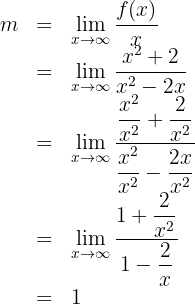
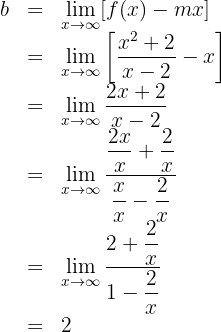
Thus, the oblique asymptote is 
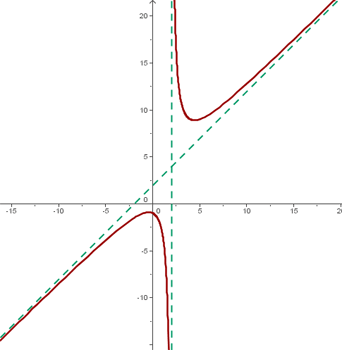
Note that the domain of the function is  and
and  is a vertical asymptote.
Summarize with AI:
Did you like this article? Rate it!

 Loading...