Before you start these conditional probability exercises and problems, take a look at our theory with the summary of probabilities.
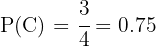
30% of students study both English and French while 60% study French. Find the probability that a student who studies French also studies English.
1 We indicate the events:
F: the student studies French
I: the student studies English
2 We know that: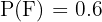

3 We calculate the probability that a student who studies French also studies English:
47% of John's friends have both a Nintendo and Xbox console, while 70% have an Xbox. Find the probability that a friend of John who has an Xbox also has a Nintendo console.
1 We indicate the events:
N: the friend has a Nintendo console
X: the friend has an Xbox console
2 We know that: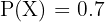

3 We calculate the probability that a friend of John who has an Xbox console also has a Nintendo console:
30% of students passed the mathematics exam and 15% passed both chemistry and mathematics. Find the probability that a student who passed mathematics also passes chemistry.
1 We indicate the events:
M: the student passed mathematics
Q: the student passed chemistry
2 We know that: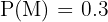

3 We calculate the probability that a student who passed mathematics also passes chemistry:
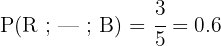
At a school, 75% of people play soccer. If 20% of people also play baseball in addition to playing soccer, what is the probability that a person at the school who plays soccer also plays baseball?
1 We indicate the events:
F: plays soccer
B: plays baseball
2 We know that:

3 We calculate the probability that a person who plays soccer also plays baseball:
A container holds 3 red balls, 2 green balls, and 1 blue ball. One ball is drawn and without returning it to the bag, a second ball is drawn. What is the probability that the second ball is red if the first is blue?
In total there are 6 balls. If the first one drawn is blue, then 5 balls remain in total, of which 3 are red. Thus the probability of drawing a red ball is:
A container holds 4 red balls, 2 green balls, and 4 blue balls. One ball is drawn and without returning it to the bag, a second ball is drawn. What is the probability that the second ball is green if the first is red?
In total there are 10 balls. If the first one drawn is red, then 9 balls remain in total, of which 2 are green. Thus the probability of drawing a green ball is:

A container holds 3 red balls, 2 green balls, and 4 blue balls. One ball is drawn and without returning it to the bag, a second ball is drawn. What is the probability that the second ball is red if the first is also red?
In total there are 9 balls. If the first one drawn is red, then 8 balls remain in total, of which 2 are red. Thus the probability of drawing a red ball is:

From a standard 52-card deck, two cards are drawn simultaneously. Calculate the probability that:
a) Both are hearts
b) At least one is a heart
c) One is a heart and the other is a spade
a) Both are hearts
We can treat this problem as if we were drawing two cards without replacement.
Let  denote the event of obtaining a heart in the
  -th draw, where
  . With this in mind and according to the definition of conditional probability:


To calculate  , we simply divide the number of favorable cases by the total number of cases. In this case, there are 13 possible hearts, which is the number of favorable cases, and a total of 52 cards, which represent the total number of cases. Therefore:
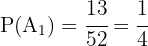
On the other hand:
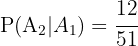
because the number of favorable cases is 12, since one heart has already been drawn, and the total number of cards is now 51.
Then:

b) At least one is a heart
We denote by the event of obtaining a heart in draw  , and by
  the event of not obtaining a heart in draw . The condition of drawing at least one heart is satisfied in any of the following cases:
a heart is obtained in both draws,
a heart is obtained in the first draw and no heart in the second, and
no heart is obtained in the first draw and a heart is obtained in the second.
Then the probability requested will be the probability of the union of the three previous events, which is equivalent to the sum of their probabilities, since they are mutually exclusive events. In mathematical terms:


From the previous part we know that 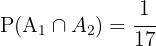
To calculate the remaining probabilities we will use conditional probability. We obtain:


The number of favorable cases in event  is 13 and in event
  is 39, since it is the number of cards that are not hearts. In both cases, since it is the first draw, the total number of cases remains 52. Therefore:
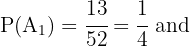
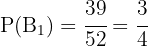
Then, the number of favorable cases in event  is 39, since it is the number of cards that are not hearts; while for
  it is 13, since no hearts have been drawn yet. In both cases, the total number of cases is 51, thinking that we have already drawn one card. Therefore:
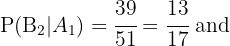
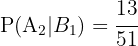
Then:


And thus:

c) One is a heart and the other is a spade
Let denote the event of obtaining a heart in draw , and  the event of obtaining a spade in draw . The condition of drawing one heart and one spade is satisfied in any of the following cases:
a heart is obtained in the first draw and a spade in the second, and
a spade is obtained in the first draw and a heart in the second.
Then the probability we seek will be the probability of the union of these two events, which is equivalent to the sum of their probabilities, since they are mutually exclusive events. In mathematical terms:


And in turn:


Since there are 13 cards of each suit in the deck, and the deck has a total of 52 cards, using the formula of number of favorable cases over total cases, it follows that:
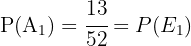
On the other hand, in the case of event  we have 13 favorable cases and a total of 51 cards (since one draw has already been made) or total cases. Note that these are the same counts for
  , therefore:

With the above, we obtain:


Finally:

Before an exam, a student has only studied 15 of the 25 topics corresponding to the subject matter. The exam is conducted by randomly bringing two topics and letting the student choose one of the two to be examined. Find the probability that the student can choose one of the studied topics in the exam.
Let  be the event "the student can choose one of the studied topics during the exam." Then:

where  denotes the complementary event of , that is, "the student cannot choose one of the studied topics during the exam."
To calculate  , note that there are 10 topics that the student has not studied, so the probability of choosing one of these as the first topic is equal to
  . We have simply applied the rule:

Similarly, the probability of choosing a second topic that the student has not studied is  , since in this case we have already chosen one unstudied topic, leaving 9 possible favorable cases and 24 total cases.
Then, the result of is obtained by multiplying the two probabilities we have found since we assume that it is equivalent to drawing without replacement two unstudied topics:
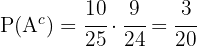
Therefore:

A class is made up of 10 boys and 10 girls; half of the girls and half of the boys have chosen French as an optional subject.
a) What is the probability that a randomly chosen person is a boy or studies French?
b) What is the probability that the person is a girl and does not study French?
a) What is the probability that a randomly chosen person is a boy or studies French?
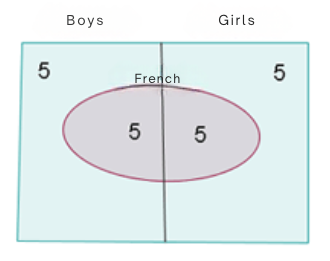
Let be the event "the randomly chosen person is a boy and has not chosen French" and  be the event "the randomly chosen person studies French." Then, if
  denotes the event "the randomly chosen person is a boy or studies French," which is the probability we wish to calculate:

The last equality is true because events and are mutually exclusive.
To calculate 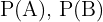 we will apply the rule:
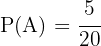
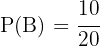
In event the number of favorable cases is 5, since this is the number of people who are boys and do not study French; while for the number of people who study French is equal to 10, which is the number of favorable cases. In both events the total number of cases is 20, which is the total number of students. With this we can conclude that:

b) What is the probability that the person is a girl and does not study French?
In the context of the previous part, we simply observe that the event "randomly choose a girl who does not study French" is equivalent to  , that is, the complementary event of .
For any event and its complement, the following equalities are valid because they are always mutually exclusive:


Then, substituting the value we found in the previous part for  :
:

In a class where everyone practices some sport, 60% of students play either soccer or basketball and 10% practice both sports. If additionally 60% do not play soccer, what will be the probability that a randomly chosen student from the class:
a) Plays only soccer
b) Plays only basketball
c) Practices only one of the sports
d) Plays neither soccer nor basketball
a) Plays only soccer
We have that 60% of students play soccer or basketball, and of that percentage, 10% practice both sports. This means that 50% of students play only one of the sports, which means that the probability of choosing a student who plays only one sport equals 0.5.
On the other hand, 60% or with probability 0.6, do not play soccer. This means that of the 50% who play only one sport, 60% play only basketball. Now, 60% of 50% is found by calculating the product 0.5 × 0.6 = 0.3.
Therefore, if  is the event "play only soccer" and "play only basketball," and "plays only one of the sports," it follows that:

b) Plays only basketball
We have that 60% of students play soccer or basketball, and of that percentage, 10% practice both sports. This means that 50% of students play only one of the sports, which means that the probability of choosing a student who plays only one sport equals 0.5.
On the other hand, 60% or with probability 0.6, do not play soccer. This means that of the 50% who play only one sport, 60% play only basketball. Now, 60% of 50% is found by calculating the product 0.5 × 0.6 = 0.3.
Therefore, if is the event "play only basketball," then 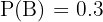 .
.
c) Practices only one of the sports
We have that 60% of students play soccer or basketball, and of that percentage, 10% practice both sports. This means that 50% of students play only one of the sports, which means that the probability of choosing a student who plays only one sport is 0.5.
d) Plays neither soccer nor basketball
Let be the event "play soccer" and be the event "play basketball." Then "play soccer or play basketball" is equivalent to the event  . Therefore, the probability of choosing someone who plays neither soccer nor basketball is equal to the probability of the complementary event of , which we do know the probability of since by hypothesis
  .
.
Then:

A workshop knows that on average the following arrive: in the morning, three automobiles with electrical problems, eight with mechanical problems, and three with body problems; and in the afternoon, two with electrical problems, three with mechanical problems, and one with body problems.
a) Make a table organizing the previous data
b) Calculate the percentage of those who attend in the afternoon
c) Calculate the percentage of those who attend for mechanical problems
d) Calculate the probability that an automobile with electrical problems attends in the morning
a) Make a table organizing the previous data
| Electrical | Mechanical | Body | Total | |
|---|---|---|---|---|
| Morning | 3 | 8 | 3 | 14 |
| Afternoon | 2 | 3 | 1 | 6 |
| Total | 5 | 11 | 4 | 20 |
b) Calculate the percentage of those who attend in the afternoon
To calculate the percentage of cars that attend in the afternoon, we simply need to find the quotient:
For this situation, the number of favorable cases is the number of cars that attend the workshop in the afternoon, that is, 6; while the total number of cases is the total of cars that are presented, that is, 20. Therefore:

Finally, to express this figure as a percentage, we simply multiply it by one hundred. Therefore, the percentage of cars attending in the afternoon is 30%.
c) Calculate the percentage of those who attend for mechanical problems
To calculate the percentage of cars that attend for mechanical problems, we simply need to find the quotient:
For this situation, the number of favorable cases is the total number of cars that attend the workshop for mechanical problems, that is, 11; while the total number of cases is the total of cars that are presented, that is, 20. Therefore:

Finally, to express this figure as a percentage, we simply multiply it by one hundred. Therefore, the percentage of cars attending for mechanical problems is 55%.
d) Calculate the probability that an automobile with electrical problems attends in the morning
To calculate the probability of cars with electrical problems attending in the morning, we simply need to find the quotient:
For this situation, the number of favorable cases is the total number of cars that attend the workshop for electrical problems during the morning shift, that is, 3; while the total number of cases is the total of cars that are presented for electrical problems, that is, 5. Therefore:

In a city, 40% of the population has brown hair, 25% has brown eyes, and 15% has both brown hair and eyes. A person is chosen at random:
a) If they have brown hair, what is the probability that they also have brown eyes?
b) If they have brown eyes, what is the probability that they do not have brown hair?
c) What is the probability that they have neither brown hair nor brown eyes?
a) If they have brown hair, what is the probability that they also have brown eyes?
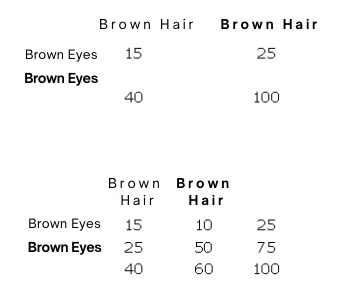
Let  denote the events "have brown eyes" and "have brown hair" respectively. Thus, the probability we are looking for is expressed as
  .
.
By the definition of conditional probability, this is:
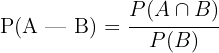
We observe that  is equivalent to "have brown eyes and brown hair," of which we know its probability since 15% meet this condition, which means
  . Following a similar reasoning, we have
 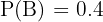 , therefore:

b) If they have brown eyes, what is the probability that they do not have brown hair?
According to the problem statement, 25% have brown eyes and also 15% have brown hair and brown eyes. From this it follows that the remaining 10% must have brown eyes but not brown hair.
Making the events "not have brown hair" and "have brown eyes" respectively, then from the previous paragraph it follows that the event (equivalent to "have brown eyes and not have brown hair") has probability 0.1. Since we also know that 25% have brown eyes, then  .
.
Then, from the definition of conditional probability:

c) What is the probability that they have neither brown hair nor brown eyes?
According to the problem statement, 25% have brown eyes and also 15% have brown hair and brown eyes. From this it follows that the remaining 10% must have brown eyes but not brown hair.
On the other hand we know that 40% of the population has brown hair, from which we can infer that the remaining 60% do not have brown hair. In addition to this, we have found that 10% do not have brown hair but do have brown eyes. Then, subtracting them from the total percentage of the population without brown hair, we obtain that 50% of the population has neither brown hair nor brown eyes. Therefore, the probability of choosing a person with neither brown hair nor brown eyes is 0.5.
In a classroom there are 100 students, of which: 40 are male, 30 wear glasses, and 15 are males and wear glasses.
a) What is the probability that a student is female and does not wear glasses?
b) If we know that the selected student does not wear glasses, what is the probability that they are male?
a) What is the probability that a student is female and does not wear glasses?
We have 100 students, of which 40 are male, which means 60 are female. Additionally, 30 students wear glasses and 15 of them are male, which indicates that the other 15 students with glasses are female. Then, we have 25 males without glasses and 45 females without glasses.
Then, we can find the probability that a student is female and does not wear glasses using the rule:
In this case the number of favorable cases is the number of females who do not wear glasses, that is, 45, while the total number of cases is the total number of students. Therefore:

b) If we know that the selected student does not wear glasses, what is the probability that they are male?
Let be the events "be male" and "not wear glasses" respectively. Thus, the probability we are looking for is given by .
We have 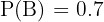 , since 70 of the hundred students do not wear glasses, that is:
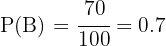
On the other hand  is equivalent to the event "be male and not wear glasses," and according to the previous exercise there are 25 students in this category, so:
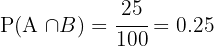
Following the definition of conditional probability, we have:

A trip to Rome is raffled off among the 120 best customers of an automobile agency. Of these, 65 are women, 80 are married, and 45 are married women. It is requested:
a) What will be the probability that the trip goes to a single man?
b) If it is known that the winner is married, what will be the probability that they are a woman?
a) What will be the probability that the trip goes to a single man?
Let us begin by noting that within the population we have 65 women and 55 men, since the sum of individuals must be 120. Continuing with the same reasoning, we know there are 80 married people and 45 of them are women, which leaves us with 35 married men and therefore 20 single men.
Therefore, the probability that the trip goes to a single man is:

where we have simply applied the rule:
and identified the favorable cases as the single men and the total cases as the total number of individuals in the raffle.
b) If it is known that the winner is married, what will be the probability that they are a woman?
In the previous exercise, we calculated the number of married women, which is 45. Knowing that there are 80 married people, the probability that the trip is for a woman, knowing that the winner is married, is:

In this case the total number of cases is the number of married individuals, since we know that the winner of the trip is a married person. While the number of favorable cases are the married women.
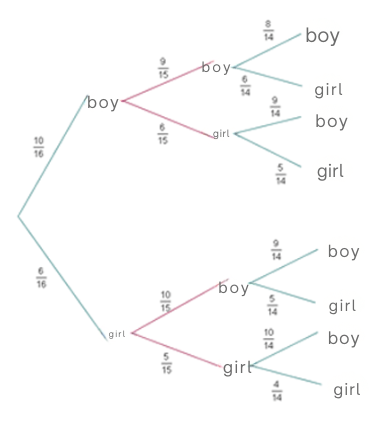
A class consists of six girls and 10 boys. If a committee of three is chosen at random, find the probability of:
a) Selecting three boys
b) Selecting exactly two boys and one girl
c) Selecting at least one boy
d) Selecting exactly two girls and one boy
a) Selecting three boys
We can treat this problem as if we were making three draws without replacement.
Let denote the event of choosing a boy in the -th draw, where  . With this in mind and according to the definition of conditional probability:

To calculate , we simply divide the number of favorable cases by the total number of cases. In this case there are 10 possible boys to choose from, that is, 10 is the number of favorable cases, and a total of 16 students, which represent the total number of cases. Therefore:
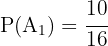
On the other hand:
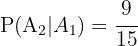
since the number of favorable cases is 9, having already chosen a boy, and the total number of students to choose from is now 15.
Then:
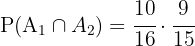
Applying this argument iteratively for the selection of the third boy we would have:

b) Selecting exactly two boys and one girl
To calculate this probability, we first need to identify the different cases in which we could select two boys and one girl. The first case is choosing 2 boys and finally a girl. The second case is choosing a girl and finally two boys. And finally, one boy, one girl, and one boy. We can calculate the probability of each case by multiplying the probability at each step.
For example, if we denote the first case as event , then:
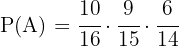
Then, denoting as  the remaining events, we have:
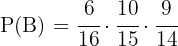
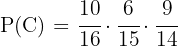
Finally, the probability we are looking for is the probability that any of these events occurs, that is  . Since these are mutually exclusive, it follows that:

Therefore:

c) Selecting at least one boy
To calculate the probability of selecting at least one boy, we will do:

We can calculate the probability of choosing three girls in exactly the same way as part a of this exercise. Therefore:

Then:

d) Selecting exactly two girls and one boy
To calculate this probability, we first need to identify the different cases in which we could select two girls and one boy. The first case is choosing 2 girls and finally a boy. The second case is choosing a boy and finally two girls. And finally, one girl, one boy, and one girl. We can calculate the probability of each case by multiplying the probability at each step.
For example, if we denote the first case as event , then:
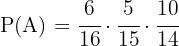
Then, denoting as the remaining events, we have:
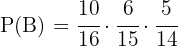
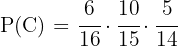
Finally, the probability we are looking for is the probability that any of these events occurs, that is . Since these are mutually exclusive, it follows that:
Therefore:

An container holds 5 red balls and 8 green balls. One ball is drawn and replaced by two of the other color. A second ball is then drawn.
a) Probability that the second ball is green
b) Probability that both balls drawn are the same color
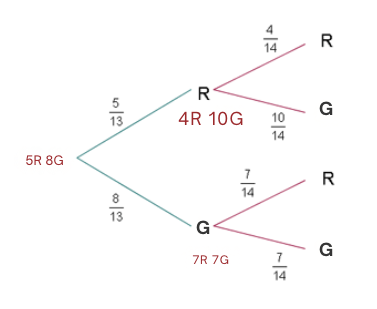
a) Probability that the second ball is green
Let  be the event "the second ball is green." There are two possibilities for this event: the first ball is red or the first ball is green. We will represent the above as
  and it is important to observe that these cases are mutually exclusive, that is, they cannot both occur at the same time. Therefore:

Following the definition of the probability of an intersection, we have:


According to the problem:


With this, we obtain:

b) Probability that both balls drawn are the same color
Let  be the event "the -th ball is green," and
  be the event "the -th ball is red." We seek
  .
.
Following the definition of the probability of an intersection, we have:


According to the problem:

With this, we obtain:


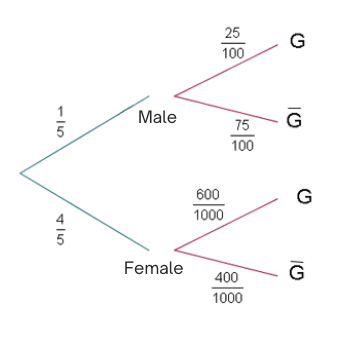
It is assumed that 25 out of every 100 men and 600 out of every 1,000 women wear glasses. If the number of women is four times greater than the number of men, find the probability of encountering:
a) A person without glasses
b) A woman with glasses
a) A person without glasses
Of the total population, we know that  corresponds to the proportion of women and
  corresponds to the proportion of men. In this way the condition "the number of women is four times greater than the number of men" is satisfied.
Then, 25 out of every 100 men wear glasses is equivalent to saying that  is the probability of encountering a man with glasses, from which it follows that 0.75 is the probability for men without glasses. Under the same reasoning,
  is the probability of encountering a woman with glasses, while 0.4 is the probability for women without glasses. In both cases, we have simply calculated the quotient of favorable cases over total cases.
Let  be the events "not wear glasses," "be male," and "be female," respectively. We are looking for
  . Since being male and being female are mutually exclusive events, it follows that:

According to the rules of conditional probability:

As we know 
And substituting these values in the previous expression, we obtain:

b) A woman with glasses
Of the total population, we know that corresponds to the proportion of women and corresponds to the proportion of men. In this way the condition "the number of women is four times greater than the number of men" is satisfied.
We observe that is the probability of encountering a woman with glasses, while 0.4 is the probability for women without glasses. In both cases, we have simply calculated the quotient of favorable cases over total cases.
Let  be the events "wear glasses" and "be female," respectively. We are looking for
  .
.
According to the rules of conditional probability:

As we know 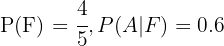
And substituting these values in the previous expression, we obtain:

In a school, students can choose to take either English or French as a foreign language. In a given course, 90% of students study English and the rest study French. 30% of those studying English are boys, and 40% of those studying French are boys. When a student is randomly chosen, what is the probability that they are a girl?
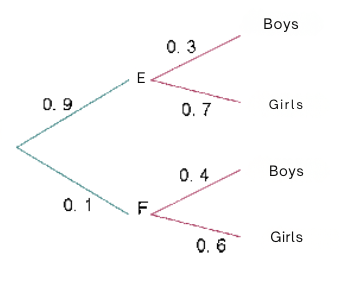
Let  be the events "study English," "study French," "be female," respectively. We then seek the probability of randomly choosing a female. However, since all people in the school study either English or French, the requested probability can be calculated through the following probabilities:

For both probabilities we can do:


In this way we can use the information provided, since:
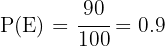
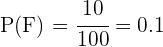
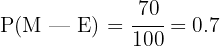
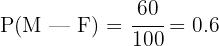
Substituting all these values we obtain the following calculation:

A box contains three coins. One coin is fair, another has two heads, and the other is biased so that the probability of getting heads is  . A coin is randomly selected and flipped. Find the probability of getting heads.
Let  be the event "select the -th coin," where
  is the fair coin,
  is the two-headed coin, and
  is the biased coin. In this context, if we call the event "flip the coin and get heads," we can calculate by making an intersection with the events , since these are mutually exclusive. That is:

By the definition of conditional probability, the following equalities are valid:



Since the choice of coin is made at random, we have  , with . Then:
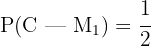
since the first coin is fair, which means it has heads and tails and can take either value with equal probability.

since this coin has two heads, so no matter how it lands, its value will be heads.
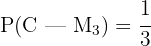
since the last coin is biased so that this is the probability of getting heads. Thus:


Summarize with AI:
Did you like this article? Rate it!

 Loading...