Two geometric figures are said to be similar if they have the same shape regardless of the size differences between them. For triangles, we have the following criteria that help us determine when they are similar:


Angle-Angle Criterion (AA)
Two triangles are similar if they have two equal angles.


Side-Side-Side Criterion (SSS)
Two triangles are similar if they have proportional sides.


Side-Angle-Side Criterion (SAS)
Two triangles are similar if they have two proportional sides and the angle between them is equal.


Similarity of Triangles


Similarity Criteria for Right Triangles
Two right triangles are similar if they have one equal acute angle.


Two right triangles are similar if they have the two legs proportional.


Two right triangles are similar if the hypotenuse and one leg are proportional.


Exercises on Triangle Similarity
Determine whether the following triangles are similar:
1


Solution:
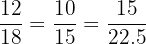

They are similar because they have their 3 sides proportional.
2


Solution:
They are similar because they have two equal angles.
3


Solution:
 and

 and
They are similar because they have two proportional sides and one equal angle.
What Is an Included Angle?
An included angle is the angle between two line segments or rays. For any triangle, its three interior angles are each included between two sides. Draw or imagine an equilateral triangle:△NAP:
To find the included angles, start with the sides:
- NA and AP include ∠A between them
- AP and PN include ∠P between them
- PN and NA include ∠N between them
Check for your understanding using a new triangle, △JET:
[insert obtuse scalene △JET with side JE = 13 meters, ET = 7 m, TJ = 9 m, ∠J ≈ 30.8°, ∠E ≈ 41.2°, ∠T ≈ 108.0°]
Is ∠E the included angle for sides JE and TJ?
No; ∠J is their included angle. ∠E is the included angle for sides JE and ET.
Geometry allows you to start with the simplest measures of the earth ("geo-metry" means "earth measure"), and build to harder concepts. Trigonometry is closely connected to geometry, so "included angle" finds a spot in both mathematical fields.
Included Angles in Geometry
Most mathematics students find geometry a bit easier to comprehend than trigonometry. So let's first look at included angles in geometry. In formal proofs, anytime you see an angle sandwiched between other elements, you are using an included angle:
- Side Angle Side congruence
- Side Angle Side Theorem of similarity
Congruence
Picture two isosceles triangles. The first isosceles triangle has legs 14 decimeters long and a base 12 decimeters. Its included angle is 67°. Look at the second drawing. It has the same measurements.
Are the two isosceles triangles congruent?
Thanks to the Side Angle Side Theorem, which states that two triangles are congruent if two of their sides, and the included angle, are congruent. You know mathematically that these two isosceles triangles are congruent.
Similarity
The same concept applies to similarity of triangles: the Side Angle Side Theorem (or postulate) of similarity tells us that two triangles are similar if two corresponding sides are proportional and their included angle is congruent. Here is a new obtuse triangle, △CAR, to compare with △JET above.
[insert obtuse scalene △CAR with side CA = 39 meters, AR = 21 m, RC = 27 m and all angles = △JET]
Notice that side AR = 21 m and RC = 27 m, while our original △JET had ET = 7 m, TJ = 9 m.
The angle between them, ∠R in △CAR and ∠T in △JET, are both ≈ 108.0°. Are these two triangles similar?
Our new △CAR has sides three times longer than △JET but the same angle between those corresponding sides. The triangles are similar, but not congruent, thanks to the Side Angle Side Postulate (or theorem) of similarity.
Included Angles in Trigonometry
Trigonometry allows you to find properties of triangles, like area, using only the relationships between sides and angles. While geometry provides a formula for area, A=21bh, trigonometry provides a different one, where A = area of the triangle, a and b are lengths of sides, and C is their included angle:
A=(21)absin(C)
Here you are multiplying the lengths of two sides times the sine of their included angle, and then taking half of that (since a triangle is half a rectangle).
Suppose you have a triangle-shaped state park famous for its herds of wild zoids roaming the wide open spaces:
[insert obtuse scalene triangle WYD with ∠Y = 105°; side WY = 25 km and side YD = 15 km]
You can see that side WY will stand in for our a, and side YD will be our b side. We need only find the sine of ∠Y, 105°, to find the area.
Plug in what you know:
A=(21)absin(C)
A=(21)25km×15km×sin(105°)
A=375km2×sin(105°)
A=375km2×0.96592582
A≈181.111km2
If 181 square kilometers seems large, remember we were drawing a state park, full of wide open spaces where you can go to trap a zoid.
Lesson Summary
After studying this lesson, you are now able to identify the included angle for any two sides of any triangle, use included angles in geometric proofs of similarity and congruence, and apply the trigonometry formula for finding the area of a triangle, A=21absin(C) where a and b are sides of the triangle and C is the included angle.
Summarize with AI:
Did you like this article? Rate it!

 Loading...