Welcome to the exciting exercises on vectors and scalar product! Vectors are fundamental tools in the field of mathematics and physics, used to represent directional quantities in the plane and in space. They are especially useful when we want to describe movements, forces, velocities, and many other physical quantities.
In these exercises, you will explore the manipulation of vectors and learn to perform key operations, such as vector addition and subtraction. You will also venture into the exciting world of the scalar product, an operation that combines the magnitudes and directions of two vectors to obtain a numerical value.
Through challenging practical problems, you will test your skills and discover how these mathematical tools are applicable in various disciplines, such as engineering, physics, computer science, computer graphics, and more. So get ready to develop your vector manipulation skills and enhance your ability to solve complex problems.
Solve the following problems:
Find the symmetric point of  with respect to
1 We calculate the symmetric point  , for which we use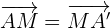

2 We equate the coordinates and solve for the variables 
For the first coordinate:

For the second coordinate:
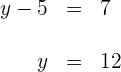
3 The symmetric point  has coordinates:

Given two vertices of a triangle  and the centroid
  , calculate the third vertex.
1 The formula for the centroid of a triangle with vertices  is
is

2 We calculate the centroid with the third vertex  by substituting in the previous formula:

3 We equate the coordinates and solve for the variables
For the first coordinate:
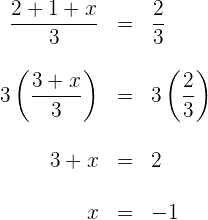
For the second coordinate:
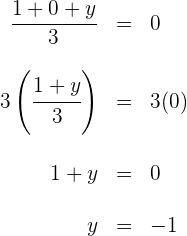
4 The third vertex is:

Given the points  and
and  find a point
  aligned with
  and
and  , such that
1 Since , we substitute the values of  and
and  and obtain:
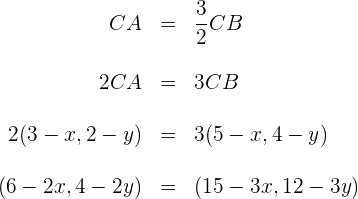
2 We equate the coordinates and solve for the variables
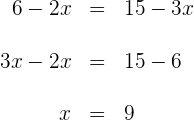
For the first coordinate:
For the second coordinate:
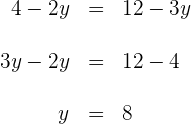
3 The point sought is 
Calculate the coordinates of  so that the quadrilateral with vertices
  and is a parallelogram.
1 To find the coordinates  , we use the fact that, since the opposite sides of the parallelogram are equal, their vectors are also equal:

2 We substitute the data and obtain:
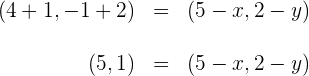
3 We equate the coordinates and solve for the variables
For the first coordinate:
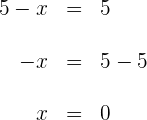
For the second coordinate:
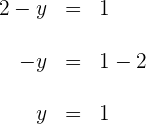
4 The vertex sought is 
If  form an orthonormal basis, calculate:
a 
b 
c 
d 
1 Since  are orthonormal, they are perpendicular to each other, so they form an angle of
  and their magnitude is 1, that is,
2 To find the requested products, we use the formula:

where  is the angle between
  and
and 
3 We find the requested products by substituting into the formula and using the appropriate value of :  if the vector is the same and if they are different.
a 
b 
c 
d 
Given the vectors  , calculate
  so that vectors
  are:
are:
a. Perpendicular.
b. Parallel.
c. Form an angle of  .
.
a. Perpendicular: Two vectors are perpendicular if their product is zero.
We perform the product and solve for the variable  :
:
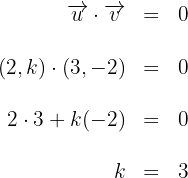
b. Parallel: Two vectors are parallel if their components are proportional, that is:

We perform the proportion equality and solve for the variable :
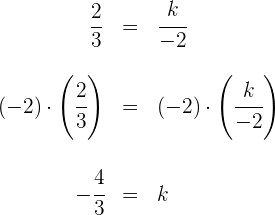
c. Form an angle of : We substitute the values into the vector product formula:
where 
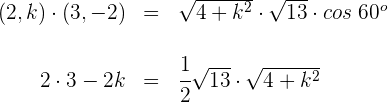
We square both sides and simplify:
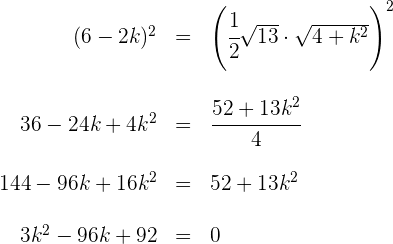
We solve using the quadratic formula:
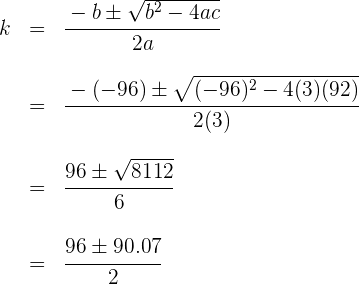
The roots of the quadratic equation are  , but only
  satisfies the original equation without squaring, so this is the value of sought.
Calculate the value of knowing that  and
and 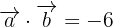
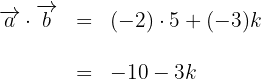
1 We calculate the vector product:
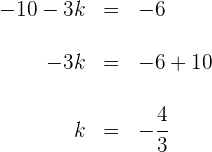
2 We equate the result to  and solve for :
Assuming that with respect to the orthonormal basis  of the plane, calculate the value so that the vectors
  and
and 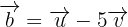 are orthogonal.
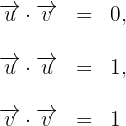
1 Since the basis is orthonormal, we have:
2 We calculate the dot product of  and
and 
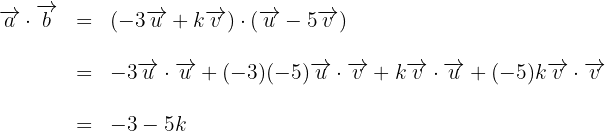
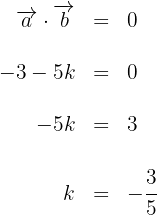
3 Two vectors are orthogonal if their dot product is zero. We substitute and solve for :
Calculate the projection of the vector 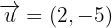 onto the vector
  .
.
1 The formula for the projection of vector onto vector is given by:
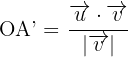
2 We calculate the product of the vectors:
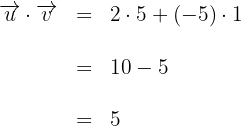
3 We calculate the magnitude of vector
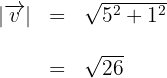
4 We substitute the data into the projection formula:
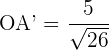
Find a unit vector  in the same direction as the vector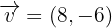
1 The formula for a unit vector is given by:

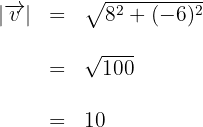
2 We calculate the magnitude of vector :
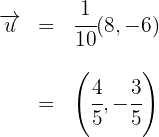
3 We substitute into the unit vector formula:
Summarize with AI:
Did you like this article? Rate it!

 Loading...