A vector is a mathematical quantity that has both magnitude (size) and direction. Unlike scalars, which are quantities that have only magnitude (such as temperature, mass, or speed), vectors represent quantities like force, velocity, or displacement that require both a numerical value and a direction to be fully described.
Vectors are commonly represented in two ways:
- Geometrically: as arrows, where the length represents the magnitude and the arrow points in the direction
- Algebraically: using components, such as
 in two dimensions, where
  and
and  are the horizontal and vertical components respectively
Now that we understand the definition of a vector, we will proceed to study some of the basic operations that can be performed between vectors.


Vector Addition
If we have two vectors  and , then the sum of
  and
and  is
is

In other words, the sum vector of and is the vector that results from adding the respective components of these vectors: the first component of is added to the first component of , and the second component of is added to the second component of .
Graphic Interpretation of Addition
Let's observe the following graph that shows the addition of vectors and :
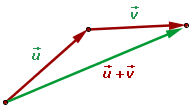
If and are two free vectors, then to add them graphically we first choose the representative of whose origin is the endpoint of . Then,  is the vector whose origin is the origin of and whose endpoint is the endpoint of .
Note that we can also choose a representative of such that its origin is the endpoint of . The sum will have the same value, but now we will obtain it by connecting the origin of with the endpoint of .
Parallelogram Rule
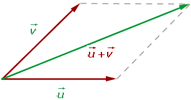
What we discussed earlier as the graphic addition of vectors is known as the parallelogram rule. In particular, if we want to add two free vectors with a common origin, then we must draw lines parallel to the vectors. In this way, a parallelogram is obtained whose diagonal (which starts at the origin of the vectors) is the sum of the vectors itself.
Observe the following figure that shows the parallelogram rule.
Vector Subtraction
The subtraction of two vectors and is simply the addition of with  (that is, the opposite of ).
Thus, if we consider the components of and , then the subtraction is given by:

Graphically, the subtraction of and is obtained the same way as addition. The only difference is that we add the opposite of . Observe the following figure that shows  and note that at the endpoint of we place the origin of
  .
.
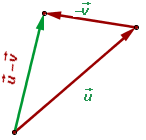
Note that graphically, the subtraction vector connects the endpoint of with the endpoint of .
Scalar Multiplication
The multiplication of a vector by a number  is written
  or
or  . The number is also known as a scalar. Furthermore, scalar multiplication is another vector that satisfies the following properties:
- has the same direction as .
- If is positive, then has the same sense as .
- If is negative, then has the opposite sense to .
- The magnitude of is

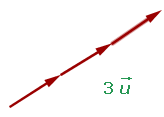
Observe the following figure that represents the multiplication of by 3.
In terms of components, if , then scalar multiplication is given by:

Example Exercises with Vectors
Consider the vectors  and
and  . Thus:
1 The sum is given by:

2 The subtraction is:

3 The opposite of is:

4 The scalar product of by 3 is given by:

Summarize with AI:
Did you like this article? Rate it!

 Loading...