Geometric progressions have various applications in daily life, such as calculating loan interest when you purchase an item or measuring population growth of a species. Superprof invites you to learn more about their properties.
A geometric progression is a sequence in which each term is obtained by multiplying the previous term by a fixed quantity r, called the common ratio.
Example:
If you have a first term a₁ = 3 and a common ratio r = 4, you can construct the following geometric progression:
3, 12, 48, 192, ...
since when you operate the first term a₁ = 3 with the common ratio r = 4, you obtain:
3
3(4)=12
12(4)=48
48(4)=192, ...
As you can see, 12 is obtained by multiplying 3 by 4, which is the ratio, and so on successively until reaching the desired term n.
On the other hand, if you know two consecutive terms aₙ and aₙ₊₁ of the geometric progression and you do not know the ratio r, you can calculate the ratio r by dividing these terms as indicated by the following equation:

Example:
You have the geometric progression: 3, 6, 12, 24, 48, ... Notice that any two consecutive terms have the ratio r = 2, since applying the equation above yields:
r=6/3=2
r=12/6=2
r=24/12=2
r=48/24=2


General Term of a Geometric Progression
The general term of a sequence is the expression aₙ that allows you to find any term as a function of its position n.
When you want to find the value of the general term aₙ, you may face two situations:
1. If you know the first term a₁ and the common ratio r:
In this case, it is possible to find any other term of the progression using the following formula:
an = a1 · rn-1
Example:
You have the following progression and are asked to calculate the value of the term in position 20:
3, 6, 12, 24, 48, ...
Identify that a₁ = 3, the ratio r = 2, and since you want to find the value of term 20, then n = 20. When you substitute these values into the formula, you obtain:
a20 = 3· 220-1 = 3· 219 = 1, 572, 864
Therefore, the value of term 20 is 1,572,864.
2. When you do not know the first term a₁ of the geometric progression, but you know any other term aₖ and the ratio r:
In this case, it is possible to calculate any term aₙ using the following equation:
an = ak · rn-k
Where k is the position number of the term you know and n is the position of the term you wish to find.
Example:
Suppose aₖ equals 24, where k = 4 and the ratio r = 2. When you substitute the values into the formula, you have:
an= a4 · 2n-4
Now, if you want to find the value of a₁, it is calculated as follows:
a1= 24· 21-4= (24)· 2-3 = (24)(1/8) =3
Now, in the case of wanting to find the value of a₁₀, it is calculated in the same way as the previous example:
a10= 24· 210-4= (24)· 26 = 1536
Remember that n is the position of the term you wish to find.
As you will realize, no matter which term aₙ you want to find, you calculate it with the appropriate formula depending on the situation. Whether knowing the first term a₁ or any other term aₖ of the geometric progression, along with the ratio r.
Interpolation of n Terms in a Geometric Progression
To interpolate geometric means or proportional means between two numbers a and b means to construct a geometric progression that has elements a and b as extremes, and a determined quantity of intermediate values. To accomplish this, it is necessary to know how many elements m you want to interpolate, and with this information calculate the appropriate ratio r. Once you have r and the value of a, you construct the geometric progression.
The formula for finding the appropriate ratio r to interpolate m geometric means between a and b is:

Example:
Interpolate 3 geometric means between a = -2 and b = -4802. First, find the appropriate ratio r.

Once you know that r = 7, you use it to construct the geometric progression taking a = -2 as the first value and multiplying by the ratio r = 7 successively, obtaining:
-2, -14, -98, -686, -4802.
Notice that 3 numbers have been interpolated between -2 and -4802, forming the progression.
Example:
Interpolate three geometric means between a = 3 and b = 48. First, find the appropriate ratio r.
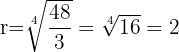
Notice that you use the ratio found to construct the geometric progression, obtaining:
3, 6, 12, 24 , 48.
In the same way as the previous example, 3 numbers have been interpolated but now between 3 and 48, forming the desired progression.
In conclusion, you can interpolate the quantity of terms m that you need or desire between a and b. It is simply a matter of calculating the appropriate ratio r using the formula.
Sum of n Consecutive Terms of a Geometric Progression
To sum n consecutive terms of a geometric progression, you first need to know the ratio r, the first term a₁, and the number of values n that you wish to sum from the sequence.
Once you know these data, you use the formula:
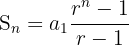
where Sₙ is the sum of n consecutive terms of a geometric progression.
Example:
Calculate the sum of the first 5 terms of the following progression: 3, 6, 12, 24, 48, ...
Calculate the ratio r by dividing two consecutive values, as seen at the beginning:
r = 6/3 = 2
Now with r = 2, n = 5, and a₁ = 3, you substitute the values into the formula, obtaining:

and with this you know the result of summing the n requested terms, giving the result:
3 + 6 + 12 + 24 + 48 = 93
Notice that an advantage of performing the sum of n terms with this procedure is that you save a lot of work, as opposed to doing the sum directly, since there is a possibility that the quantity of terms n to sum may be very large.
Sum of the Terms of an Infinite Decreasing Geometric Progression
There are occasions where you need to sum all the terms of an unlimited decreasing geometric progression. For the sum to make sense, the value of the ratio must be between -1 and 1. Otherwise, it is not possible to perform the sum, as it would not have a numerical result.
The formula that helps you find the result of summing all the terms:

with -1 < r < 1 is:

With this formula you calculate the sum of all the terms of the progression, that is:

Example:
Calculate the sum of the terms of the unlimited decreasing geometric progression formed by a₁ = 2 and r = 0.5.
Remember that you must have the value of r between -1 and 1, and in our case r = 0.5, meeting the condition, which means we can proceed with the process.
Now you construct the progression:

and so on (the ellipsis indicates that the process continues without ending).
So with this, you know the result of the sum of all the terms by substituting into the formula:
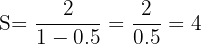
which means that:

arriving at the desired result.
Note: The sum we work with now is different from the previous one, since here we have summed an unlimited quantity of terms (previously the sum was of a finite quantity of terms), for this reason it was necessary to use the formula mentioned.
Product of Two Equidistant Terms
When you have a geometric progression where a₁ is the first term and aₙ is the last, two values are understood to be equidistant if they are at the same distance from one extreme as from the other of the progression respectively. For example:
a₂ is equidistant from aₙ₋₁
a₃ is equidistant from aₙ₋₂
a₄ is equidistant from aₙ₋₃
and so on.
A property indicates that the multiplication between two equidistant values equals the product of the extremes of the progression, that is:

Example:
If you have the following geometric progression:
5, 10, 20, 40, 80, 160
you can see that the product of the extremes:
5(160) = 800
equals the product of any pair of equidistant terms, for example:
10(80) = 800
20(40) = 800
This property has the advantage of multiplying only the extremes so that you know the result of multiplying any pair of equidistant terms, and moreover it may be needed for future results.
Product of n Consecutive Terms of a Geometric Progression
If you seek to multiply a quantity n of consecutive terms of a geometric progression, it is sufficient to know the values of the extremes a₁ and aₙ. That is, to find the product of the terms:

You use the formula:

in other words, the formula allows you to know effectively the result of the following product:

Example:
Calculate the product of the first 5 terms of the progression:
3, 6, 12, 24, 48, ...
Here we can see that a₁ = 3 and a₅ = 48 with n = 5, then the substitution is:

in other words, the result obtained is:
(3) (6) (12) (24) (48) = 248, 832
and just as with the sum of n consecutive terms, here too it is more convenient and practical to know the result of the product with the use of the formula, since you may end up with a large quantity of factors.
Summarize with AI:
Did you like this article? Rate it!

 Loading...