Directly Proportional Distribution
A grandfather distributes $450 among his three grandchildren, aged 8, 12 and 16; proportionally to their ages. How much does each one receive?
1 The proportional distribution is:
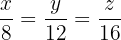
2 By the property of equal ratios:

3 Each grandchild will receive:



Three individuals form a partnership contributing $5,000, $7,500 and $9,000. After one year they have earned $6,450. What amount corresponds to each one if they make a distribution directly proportional to the capital contributed?
1 The proportional distribution is:
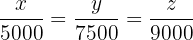
2 By the property of equal ratios:

3 Each partner will receive:



An amount of money is distributed among three people, directly proportional to 3, 5 and 7. Knowing that the second one receives $735. Find what corresponds to the first and the third.
1 The proportional distribution is:

2 The first and third person receive:


Money is distributed in proportion to 5, 10 and 13; the smallest share amounts to $2,500. How much corresponds to the other two?
1 The proportional distribution is:
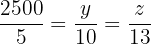
2 The second and third person receive:


Three painters painted a house in 10 hours; the first worked 2 hours, the second 3 and the third 5 hours. If they received a payment of $400, how much corresponds to each one if they split the payment in proportion to the hours worked?
1 The proportional distribution is:

2 By the property of equal ratios:

3 Each painter will receive:



Inversely Proportional Distribution
Two employees have different production capacities in a factory: one can produce 8 units per hour and the other 15 units per hour. If a $500 incentive must be divided inversely proportional to their capacity, how much corresponds to each employee?
1 We take the reciprocals:

2 We put them over a common denominator
 ,

3 We carry out a distribution directly prop. to the numerators: 15 and 8
1. The proportional distribution is:

2. By the property of equal ratios:
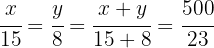
3. The shares of each worker will be:


thus, the worker who produces 8 units receives $326 and the one who produces 15 units receives $174.
Two brothers took part in a riddle contest and won $500. The first brother made 2 mistakes and the second made 5. If they decide to split the prize inversely proportional to the number of mistakes made, how much does each one get?
1 We take the reciprocals:
 ,

2 We put them over a common denominator
 ,

3 We carry out a distribution directly prop. to the numerators: 5 and 2
1. The proportional distribution is:

2. By the property of equal ratios:
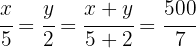
3. The shares of each brother will be:


To secure first place in the riddle contest, the two brothers decide to invite María. The three of them take part and manage to win first place, obtaining a prize of $1,000. On this occasion the first brother made 1 mistake, the second 2 and María 3. If they decide to split the prize inversely proportional to the number of mistakes made, how much does María get?
1 We take the reciprocals:

2 We put them over a common denominator

3 We carry out a distribution directly prop. to the numerators: 6, 3 and 2
1. The proportional distribution is:

2. By the property of equal ratios:

3. The shares of each brother and María will be:


María receives $181.82.
Three brothers help with the family's upkeep by contributing $5,900 annually. If their ages are 20, 24 and 32 and the contributions are inversely proportional to age, how much does each one contribute?
1 We take the reciprocals:
 ,
 ,

2 We put them over a common denominator
 ,
 ,

3 We carry out a distribution directly prop. to the numerators: 24, 20 and 15
1. The proportional distribution is:
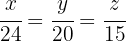
2. By the property of equal ratios:

3. The contributions of each brother will be:



The aim is to distribute $420 among three children in parts inversely proportional to their ages, which are 3, 5 and 6. How much money corresponds to each one?
1 We take the reciprocals:
 , ,

2 We put them over a common denominator
 ,
 ,

3 We carry out a distribution directly prop. to the numerators: 10, 6 and 5
1. The proportional distribution is:
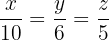
2. By the property of equal ratios:

3. Each child will receive:



Summarize with AI:
Did you like this article? Rate it!

 Loading...