Second and fourth degree inequalities are powerful mathematical tools that allow us to analyze and understand a wide variety of situations in which inequalities play a crucial role. In these exercises, we will explore the resolution of second and fourth degree inequalities, which will give us the opportunity to apply advanced mathematical concepts and develop solid analytical skills.
Get ready to immerse yourself in the world of second and fourth degree inequalities and strengthen your mathematical abilities!
Solve the Following Inequalities

1 We set the polynomial of the first member equal to zero, factor it, and obtain the roots of the second degree equation.

Setting the factors equal to zero, we obtain the roots  and

2 The roots divide the real line into three intervals: 
The endpoints are open because they do not belong to the solution, since the inequality is strictly greater than.

3 We take a representative from each interval and substitute it into the inequality:

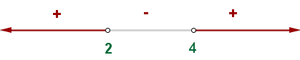
4 The solution is composed of the intervals (or the interval) that have the same sign as the polynomial.
The intervals are open because 2 and 4 are not included in the solution.
Thus, the solution is 

1 We set the polynomial of the first member equal to zero, factor it, and obtain the roots of the second degree equation.

Setting the factor equal to zero, we obtain the root 
2 Since a number raised to the square is always positive, the solution is 
 + 6x + 9 <0
1 We set the polynomial of the first member equal to zero, factor it, and obtain the roots of the second degree equation.
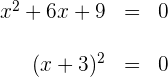
Setting the factor equal to zero, we obtain the root 
2 Since a number raised to the square is always positive, the inequality has no solution.

1 We set the polynomial of the first member equal to zero and solve the equation:

The polynomial cannot be factored by elementary methods, so we study its discriminant:
 <0
Since the discriminant is negative, it has no real roots. We evaluate the polynomial at any value, for example:


2 Since the inequality is satisfied, the solution is 
-3x +9 <0
1 We set the polynomial of the first member equal to zero and solve the equation:

The polynomial cannot be factored by elementary methods, so we study its discriminant:
 <0
Since the discriminant is negative, it has no real roots. We evaluate the polynomial at any value, for example

2 Since the inequality is not satisfied, the inequality has no solution.
 + 21x - 28 <0
1 We set the polynomial of the first member equal to zero, factor it, and obtain the roots of the second degree equation.

Setting the factors equal to zero, we obtain the roots  y

2 The roots divide the real line into three intervals: 
The roots do not belong to the solution, since the inequality is strictly less than.
3 We take a representative from each interval and substitute it into the inequality:


4 The solution is composed of the intervals (or the interval) that have the same sign as the polynomial.
The intervals are open because -4 and 1 are not included in the solution.
Thus, the solution is 
 + 4x - 7 <0
1 We set the polynomial of the first member equal to zero and solve the equation:

The polynomial cannot be factored by elementary methods, so we study its discriminant:
 <0
Since the discriminant is negative, it has no real roots. We evaluate the polynomial at any value, for example
 <0
2 Since the inequality is satisfied, the solution is
If the inequality had not been satisfied, it would have had no solution.

1 We set the polynomial of the first member equal to zero and solve the equation:

The polynomial cannot be factored by elementary methods, so we study its discriminant:
 <0
Since the discriminant is negative, it has no real roots. We evaluate the polynomial at any value, for example

2 Since the inequality is not satisfied, the inequality has no solution.

1 We set the polynomial of the first member equal to zero and solve the equation:

The polynomial cannot be factored by elementary methods, so we study its discriminant:
 <0
Since the discriminant is negative, it has no real roots. We evaluate the polynomial at any value, for example
 <0
2 Since the inequality is not satisfied, the inequality has no solution.

1 We set the polynomial of the first member equal to zero and solve the equation:

The polynomial cannot be factored by elementary methods, so we study its discriminant:
 <0
Since the discriminant is negative, it has no real roots. We evaluate the polynomial at any value, for example

2 Since the inequality is satisfied, the solution is

1 Obtain the critical values of the inequality
To do this, we set it equal to zero and factor:
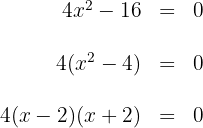
Setting the factors equal to zero, we obtain the roots  . These roots are solutions (since substituting them into the inequality satisfies the equality).
2 Represent the critical values on the number line
Since the roots are  and
 , the real line is divided into the intervals
 and

3 We take the values  and
 and evaluate them in the inequality:


4 Since the quadratic expression is positive, the solution of the inequality is the union of two intervals: 

1 Obtain the critical values of the inequality
To do this, we set it equal to zero and factor:

Setting the factor equal to zero, we obtain the root 
2 Since the binomial squared is negative and the sign is less than or equal to, the inequality has a unique solution: 

1 Obtain the critical values of the inequality
To do this, we set it equal to zero and factor:
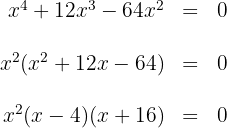
Setting the factors equal to zero, we obtain the roots  . These roots are solutions (since substituting them into the inequality satisfies the equality).
2 Represent the critical values on the number line
Since the roots are  and
 , the real line is divided into the intervals
 and
 .
3 We take the values  and
 and substitute them into the inequality:

4 Since the quadratic expression is positive, the solution is the union of the intervals  and the critical values. Thus, the solution is

 -
 +144<0
1 Obtain the critical values of the inequality
To do this, we set it equal to zero and factor:
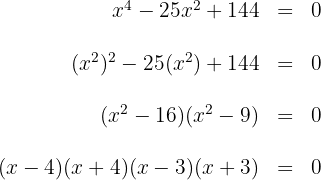
Setting the factors equal to zero, we obtain the roots  .
2 Represent the critical values on the number line
Since the roots are  , the real line is divided into the intervals
 and .
3 We take the values  and
 , and substitute them into the inequality:
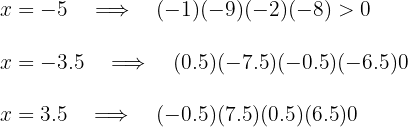

4 Since the quadratic expression is negative, the solution is the union of the intervals 

1 Obtain the critical values of the inequality
To do this, we set it equal to zero and factor:

Since the binomial  is always greater than zero for any value of
 , we only consider the linear binomials to calculate the critical values. Thus,
 are the roots we seek. These roots are solutions (since substituting them into the inequality satisfies the equality).
2 Represent the critical values on the number line
Since the roots are , the real line is divided into the intervals  , and
 .
3 We take the values  and
 , and substitute them into the inequality:


4 Since the quadratic expression is positive or zero, the solution is the union of the intervals and the critical values; that is,  .
Summarize with AI:
Did you like this article? Rate it!

 Loading...


 (include endpoints) or >, < (exclude endpoints).