


Transitive vs. intransitive verbs
A transitive verb expresses a doable action that impacts the object of a sentence. An intransitive verb needs no connection to an object. Sentences whose main verb is intransitive do not contain an object.
Transitive: Sally sent the birthday gift yesterday.
Verb: sent
Direct Object: birthday gift
Intransitive: Sally went to Jack's birthday party.
Verb: went
Object: none
How to identify transitive and intransitive verbs
Looking at the object of the sentence is the best way to identify if the verb in a sentence is transitive or intransitive. The object of a sentence is the noun or pronoun that receives the action of the verb and is either direct (recipient of the action) or indirect (a noun or noun phrase that receives the direct object).
The following guidelines explain the best ways to identify transitive and intransitive verbs using the object of a sentence:
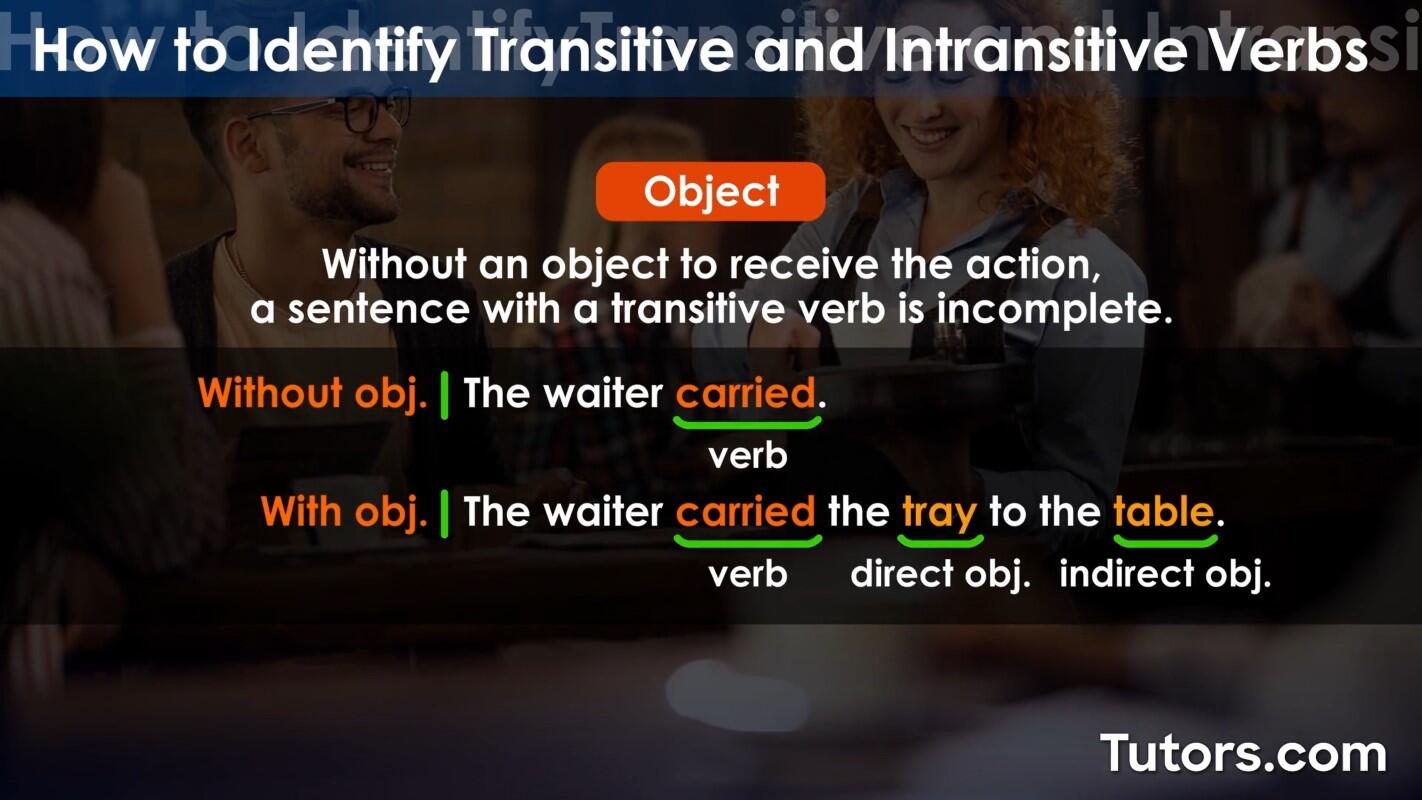
Object: When using a transitive verb, the object must receive the action. Without an object, a sentence with a transitive verb is incomplete.
Without an object: The waiter carried.
Verb: carried
With an object: The waiter carried the tray to the table.
Verb: carried
Direct object: tray
Indirect object: table
No object: When there is no direct or implied object in a sentence, the verb is intransitive.
The waiter walked all night.
Verb: walked
Transitive and intransitive: Some verbs can be both transitive and intransitive. Consider the verb "to run:"
Direct object: Susan ran the entire department.
Indirect object: Susan ran the entire department for the CEO.
No direct object: Susan ran every morning.
Transitive phrasal verbs
Phrasal verbs combine a verb with a preposition, adverb, or both to create a new verb with a meaning different from that of the original words:
| back up | let down |
| calm down | put up with |
| dive into | shut off |
| fall apart | top off |
| give up | wait on |
Phrasal verbs can also be transitive or intransitive depending upon the presence of a direct or indirect object:
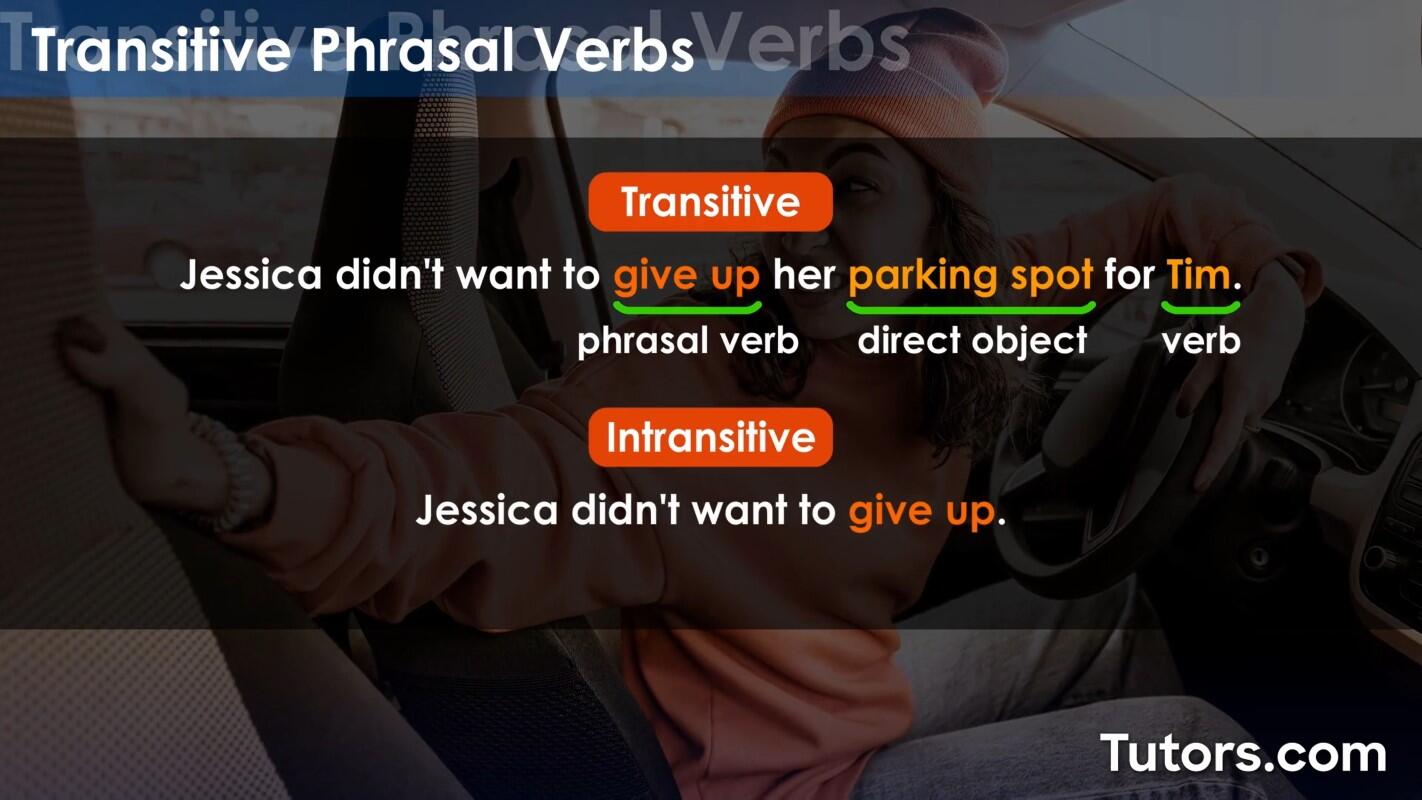
Transitive Phrasal Verb: Jessica didn't want to give up her parking spot for Tim.
Phrasal Verb: give up
Direct Object: parking spot
Indirect Object: Tim
Intransitive Phrasal Verb: Jessica didn't want to give up.
Phrasal Verb: give up
Transitive and intransitive verb examples
Some of the more common verbs that can be transitive and intransitive include the following:
| Transitive | Intransitive | Transitive and Intransitive |
|---|---|---|
| ate | agree | continue |
| bring | belong | drive |
| clean | cry | eat |
| feed | disappear | grow |
| hit | go | move |
| make | laugh | play |
| offer | live | read |
| promise | remain | return |
| send | rise | understand |
| teach | vanish | write |
The following sentences incorporate examples of transitive verbs:
Transitive (Direct Object)
John ate all of his dinner.
I have to clean my room before I leave.
Please feed the dog twice a day.
Rita offered a dozen cookies.
Don't forget to send a postcard.
Transitive (Direct and Indirect Object)
Ian brought an extra pencil for Katie.
Wendy hit the ball over to Nelly.
Did you make a reunion video for your family?
Karen offered a stick of gum to Oliver.
Mrs. Jones taught math and English to the class.
The following example sentences use intransitive verbs:
Intransitive (No Object)
I was surprised that Trent agreed with me.
Nick lives down the street.
The movie made most of us laugh out loud.
Only three participants remained.
It was like Hannah had just vanished.
The following sentences use verbs that can be either transitive or intransitive:
Transitive and Intransitive:
Drive
Joanna drove the car down the street.
Joanna drove all night.
Eat
Ryan does not like eating vegetables.
The family was eating later than usual.
Grow
They mainly grow vegetables in their garden.
It was as if the vegetables grew overnight.
Read
Have you ever read The Great Gatsby?
I don't read much.
Write
Write 5-10 lines of poetry before the end of class.
Laura could read and write at a young age.
Summarize with AI:
Did you like this article? Rate it!

 Loading...